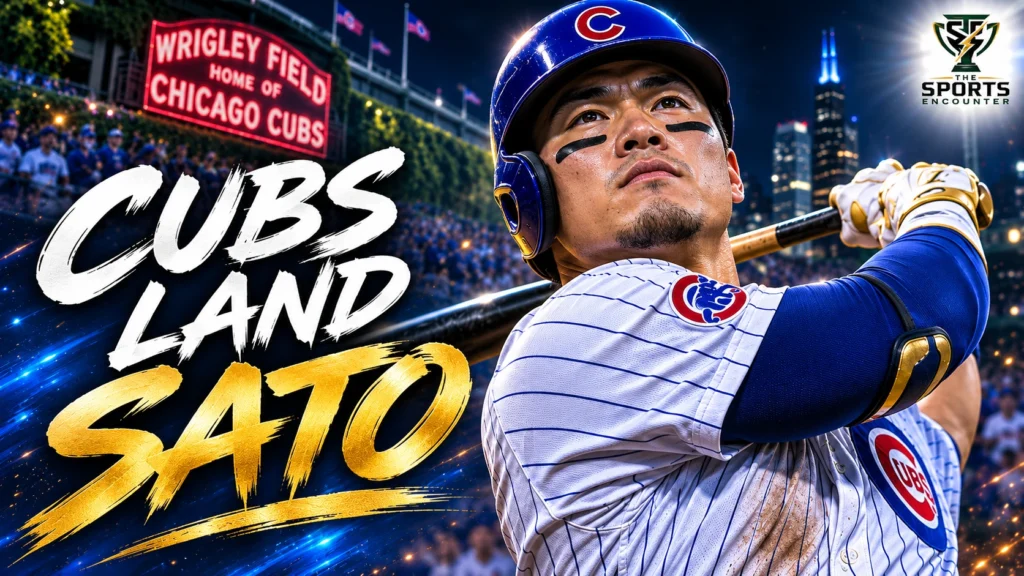
CHICAGO, United States, November 24, 2026: The Chicago Cubs have reportedly agreed to a six-year, $120 million contract with Japanese slugger Teruaki Sato, moving to secure one of Nippon Professional Baseball’s most accomplished hitters as the franchise rebuilds its outfield around National League MVP Pete Crow-Armstrong.
Sato, 27, is coming off a remarkable season with the Hanshin Tigers, winning Japan’s Central League batting Triple Crown after hitting .306 with 39 home runs and 106 RBIs. The left-handed power hitter also captured his second consecutive Central League Most Valuable Player award, establishing himself as one of the most accomplished Japanese position players to pursue a major league career.
Key Takeaways
- Sato, 27, is coming off a remarkable season with the Hanshin Tigers, winning Japan’s Central League batting Triple Crown after hitting .306 with 39 home runs and 106 RBIs.
- According to reports citing ESPN’s Jeff Passan, Chicago has reached an agreement worth an average of $20 million annually.
- His reported arrival follows another major Cubs agreement, with left-handed pitcher Trevor Rogers also set to receive $120 million over five years.
- Sato began his professional career with the Hanshin Tigers in 2021 after emerging as one of Japan’s most promising amateur power hitters.
According to reports citing ESPN’s Jeff Passan, Chicago has reached an agreement worth an average of $20 million annually. The contract was still being finalized when the agreement was reported, and the Cubs had not formally announced the completed transaction.
Story at a glance
Teruaki Sato Cubs Deal: Contract Details and Financial Implications
The reported agreement represents one of Chicago’s most significant recent investments in an international position player.
Why Chicago Is Investing $120 Million in Sato’s Power
Sato’s attraction extends beyond his recent batting average.
What Makes Sato’s Triple Crown Such an Important Achievement?
Winning a batting Triple Crown requires leading a league in three separate offensive categories: batting average, home runs and RBIs.
Why Sato’s Move Could Reshape the Cubs’ Entire Outfield
The most immediate roster consequence involves Chicago’s corner outfield positions.
Pete Crow-Armstrong and Sato Could Give Chicago a Powerful New Combination
One of the most interesting possibilities involves Sato joining a lineup already built around Crow-Armstrong.
The move comes as Chicago faces important decisions about its outfield. Seiya Suzuki and Ian Happ have reached free agency, leaving the Cubs with significant offensive production to replace and an opportunity to reorganize their lineup.
Sato has played primarily at third base during his professional career, but reports indicate that Chicago expects to use him in a corner outfield position.
His reported arrival follows another major Cubs agreement, with left-handed pitcher Trevor Rogers also set to receive $120 million over five years. Together, the two reported contracts represent $240 million in commitments as Chicago attempts to strengthen a roster that has reached the postseason in consecutive years without delivering another World Series championship.
Teruaki Sato Cubs Deal: Contract Details and Financial Implications
The reported agreement represents one of Chicago’s most significant recent investments in an international position player.
| Contract Detail | Reported Terms |
|---|---|
| Player | Teruaki Sato |
| Club | Chicago Cubs |
| Previous team | Hanshin Tigers, Nippon Professional Baseball |
| Contract length | Six years |
| Guaranteed value | $120 million, reported |
| Average annual value | $20 million |
| Age at agreement | 27 |
| Bats / Throws | Left / Right |
| Expected position | Corner outfield, subject to team confirmation |
| Transaction status | Reported agreement, pending finalization |
The reported financial commitment is substantial, but it also reflects the Cubs’ assessment that Sato can become a productive major league hitter during the remaining prime years of his career.
The six-year term would take him through his age-33 season if the agreement begins in 2027.
That provides Chicago with a potentially significant period of offensive production, although the value of the contract will depend on how successfully his abilities translate from Japanese baseball to Major League Baseball.
The official MLB.com report on the Sato agreement confirms the reported six-year, $120 million framework and details his achievements with Hanshin.
Why Chicago Is Investing $120 Million in Sato’s Power
Sato’s attraction extends beyond his recent batting average.
He has demonstrated sustained home-run production in a league where scoring conditions have generally been less favorable to hitters than those commonly associated with modern MLB offense.
During the 2025 season, Sato hit 40 home runs and drove in 102 runs while recording a .277 batting average.
He followed that performance with 39 home runs and 106 RBIs in 2026, winning the Central League Triple Crown by leading the circuit in batting average, home runs and runs batted in.
Across those two seasons, Sato produced 79 home runs and 208 RBIs.
That level of production helps explain why MLB teams viewed him as a major international free-agent target rather than simply an intriguing developmental player.
Teruaki Sato’s Last Two NPB Seasons
| Statistic | 2025 | 2026 |
|---|---|---|
| Games | 139 | 143 |
| Batting average | .277 | .306 |
| Home runs | 40 | 39 |
| RBIs | 102 | 106 |
| On-base percentage | .345 | .383 |
| Slugging percentage | .579 | .609 |
| OPS | .924 | .992 |
| Major achievement | Central League MVP | Triple Crown, Central League MVP |
Source: Published NPB season records and MLB reporting. The 2026 figures reflect the completed regular season rather than earlier in-season statistical snapshots.
His improvement in batting average and on-base percentage is particularly relevant.
Sato maintained virtually the same home-run production while reaching base more frequently and producing greater overall offensive efficiency.
That combination suggests development beyond pure power hitting.
The Cubs will nevertheless need to assess whether those improvements can be maintained against MLB pitching, where velocity, pitch movement and scouting preparation may create different challenges.
What Makes Sato’s Triple Crown Such an Important Achievement?
Winning a batting Triple Crown requires leading a league in three separate offensive categories: batting average, home runs and RBIs.
Each rewards a different aspect of production.
Batting average measures the frequency of hits relative to official at-bats. Home runs reflect power and the ability to generate immediate scoring. RBIs measure runs driven in, although that total is influenced partly by how often teammates reach base ahead of the batter.
Leading all three categories in one season is difficult because the skills do not always develop together.
A player capable of hitting 40 home runs may also strike out frequently enough to struggle in the batting-average race.
A high-average contact hitter may lack the power required to lead in home runs.
Sato’s .306 average, 39 home runs and 106 RBIs therefore demonstrate the breadth of his offensive performance.
His 2026 season also built on the previous year’s MVP-winning campaign, reinforcing that his success was not limited to one exceptional stretch.
That consistency is central to Chicago’s reported willingness to make a six-year commitment.
Why Sato’s Move Could Reshape the Cubs’ Entire Outfield
The most immediate roster consequence involves Chicago’s corner outfield positions.
Pete Crow-Armstrong remains established in center field following his remarkable 2026 season, but Suzuki and Happ reached free agency after playing important roles in the Cubs’ recent postseason appearances.
Both players represent potential losses in offensive production, defensive experience and lineup stability.
Chicago therefore entered the offseason needing to determine whether it would retain its established outfielders, promote younger players or acquire replacements.
Sato’s reported agreement provides a potentially major part of that answer.
Although he earned recognition as a third baseman in Japan, the Cubs are expected to explore using him in right field or another corner outfield position.
The Cubs’ official assessment of their corner outfield options identifies the vacancies created by Suzuki and Happ reaching free agency and outlines the available internal alternatives.
Does Sato’s Arrival Mean Seiya Suzuki Is Leaving Chicago?
The reported agreement increases Chicago’s flexibility but does not, by itself, establish where Suzuki will play next season.
Suzuki has been one of the Cubs’ most productive hitters during his five-year stay in Major League Baseball.
He recorded 113 home runs over that period and produced an adjusted OPS+ of 128, indicating offensive production 28 percent above the league average under that measure.
His contract situation became especially significant when Chicago extended him a qualifying offer worth $23.15 million.
The Sports Encounter’s analysis of the MLB qualifying-offer market examined Suzuki’s value and the financial implications of his free agency.
Sato gives Chicago another Japanese power hitter capable of filling an important lineup position.
But replacing Suzuki’s established MLB production would still involve uncertainty because Sato has yet to demonstrate that he can sustain similar results against major league pitching.
Until Chicago confirms its final roster decisions, the precise distribution of outfield responsibilities remains unresolved.
Pete Crow-Armstrong and Sato Could Give Chicago a Powerful New Combination
One of the most interesting possibilities involves Sato joining a lineup already built around Crow-Armstrong.
The young center fielder enjoyed an extraordinary 2026 campaign, becoming one of the National League’s leading players and earning MVP recognition.
His value extends across power hitting, speed and defense.
Sato would bring a different offensive profile.
As a left-handed slugger with consecutive seasons of approximately 40 home runs in Japan, he could provide an additional source of extra-base power.
The combination could give Chicago greater flexibility in constructing its batting order.
Crow-Armstrong’s athleticism and ability to influence games in several ways would complement Sato’s more established power-hitting reputation.
However, the Cubs will need to determine how effectively Sato adapts to his expected defensive position and the quality of MLB pitching.
TSE’s examination of Pete Crow-Armstrong’s MVP campaign analyzed the importance of his remarkable season and his place among the National League’s most influential players.
Adding Sato would represent an attempt to build on that foundation rather than depend entirely on the continued development of one young star.
From Hanshin Tigers Star to Wrigley Field: Sato’s Japanese Baseball Career
Sato began his professional career with the Hanshin Tigers in 2021 after emerging as one of Japan’s most promising amateur power hitters.
He made an immediate impression, hitting 24 home runs during his rookie season.
He followed with 20 home runs in 2022 and 24 in 2023, establishing himself as a regular contributor in the Central League.
His development continued despite fluctuations in batting average and strikeout production.
That progression was especially evident during the 2025 and 2026 seasons, when he combined improved contact results with elite power.
Sato also played an important role in Hanshin’s 2023 Japan Series championship, helping the Tigers win their first national title since 1985.
His career in Japan therefore includes both individual statistical achievements and experience contributing to a championship team.
The Nippon Professional Baseball Organization’s official player record documents his professional batting history, physical profile and Hanshin career statistics.
Why the Hanshin Tigers Connection Matters
Hanshin is one of Japanese baseball’s most recognizable organizations, with a passionate following and a history closely connected to the sport’s domestic development.
Playing for the Tigers brings expectations that extend beyond individual statistics.
The club’s supporters place considerable importance on postseason performance, competitive consistency and the ability to handle pressure.
Sato’s experience in that environment could prove useful when adapting to the expectations surrounding the Cubs.
Wrigley Field is one of Major League Baseball’s most recognizable venues, and Chicago’s fan base has historically placed enormous attention on the franchise’s pursuit of championships.
Success in Japan does not guarantee success in MLB, but Sato is not arriving without experience performing under scrutiny.
What Did Sato Show During the World Baseball Classic?
Sato also represented Japan during the 2026 World Baseball Classic.
He appeared in five games, batting .300 with three doubles and two RBIs.
The sample was small, with only ten official at-bats, so it would be misleading to treat those numbers as a reliable forecast of his future MLB performance.
Nevertheless, the tournament provided experience competing against international opposition in an environment different from Japan’s domestic league.
That exposure may help with the transition, particularly in adapting to varied pitching styles and the demands of international travel.
His larger NPB statistical record remains the stronger evidence of his established offensive ability.
Chicago’s Investment Extends Beyond the Reported $120 Million Salary
Sato entered the MLB market through the posting system, which allows eligible players under contract with Japanese clubs to negotiate with major league teams when their NPB organization makes them available.
The system differs from ordinary MLB free agency because the acquiring club must also compensate the Japanese organization under the applicable posting agreement.
For guaranteed major league contracts above $50 million, the standard posting-fee calculation includes:
- 20 percent of the first $25 million in guaranteed salary.
- 17.5 percent of the next $25 million.
- 15 percent of guaranteed salary above $50 million.
Applying that formula to a $120 million guarantee produces an estimated posting fee of $19.875 million.
| Financial Component | Amount |
|---|---|
| Reported player contract | $120 million |
| First $25 million posting component | $5 million |
| Second $25 million posting component | $4.375 million |
| Remaining $70 million posting component | $10.5 million |
| Estimated total posting fee | $19.875 million |
| Estimated combined commitment | $139.875 million |
These are calculations based on the reported guaranteed contract and standard posting-fee formula, not confirmed final transaction charges. Additional contractual provisions or qualifying compensation may affect the actual financial outcome.
The distinction matters because the reported $120 million salary does not necessarily represent Chicago’s total expenditure to acquire Sato.
Once the estimated posting fee is included, the combined commitment approaches $140 million.
That figure reflects how highly the organization appears to value his potential contribution.
Two $120 Million Agreements Reveal Chicago’s Offseason Priorities
Sato’s reported contract arrived shortly after Chicago reached another major agreement with Trevor Rogers.
The left-handed pitcher is reportedly receiving $120 million over five years after rebuilding his performance following an uneven period of his career.
The two agreements address different roster needs.
Rogers provides additional starting-pitching depth and a potential frontline rotation contribution.
Sato supplies left-handed power and an option to fill a corner outfield vacancy.
Combined, they represent $240 million in reported guaranteed player contracts, excluding any posting fee associated with Sato.
The spending demonstrates an aggressive attempt to strengthen the roster rather than wait for all remaining free-agent decisions to be resolved.
Chicago’s approach also reflects a wider MLB market in which teams continue committing substantial money to established and emerging talent.
TSE’s report on Dustin May’s $52.5 million agreement with the Chicago White Sox examined the rising cost of pitching and the importance of assessing a player’s future production rather than relying exclusively on past results.
The Cubs are making a similar forward-looking calculation with Sato, although the uncertainty involves adaptation from NPB to MLB rather than recovery from injuries.
Can Sato’s Japanese Home-Run Numbers Translate to MLB?
The central sporting question is whether Sato can maintain enough offensive production to justify the reported contract.
His Japanese record provides strong evidence of power, but performance across different leagues cannot be translated through a simple mathematical conversion.
Several factors will influence his adaptation.
Major League Pitching Will Present New Challenges
MLB pitchers employ a wide range of breaking balls, high-velocity fastballs and pitch sequences specifically designed to exploit a hitter’s weaknesses.
Sato will need to adjust to unfamiliar opponents and the level of scouting preparation available to major league teams.
His strikeout totals in Japan also warrant attention.
He struck out 163 times during his MVP-winning 2025 campaign.
His improved 2026 batting average suggests that he made progress in offensive efficiency, but the Cubs will still need to determine how reliably he can make contact against MLB pitching.
Wrigley Field Creates a Different Hitting Environment
Chicago’s home stadium presents distinctive conditions, particularly because wind direction can influence how fly balls travel.
Some days favor home-run hitters, while others make long fly balls less likely to clear the fence.
Sato’s power should give him opportunities to exploit favorable conditions, but his performance will also depend on producing quality contact away from Wrigley Field.
Predicting an exact MLB home-run total from his Japanese statistics would therefore be premature.
Defensive Adaptation May Influence His Playing Time
Sato has earned recognition as a third baseman, including a Gold Glove award in Japan.
Chicago’s reported expectation that he will play a corner outfield position introduces another adjustment.
Continue the MLB Story



His defensive ability at third base does not automatically establish that he will be equally effective in right or left field.
Outfield play requires different reads, positioning and throwing decisions.
The Cubs will need to evaluate those skills during spring training and determine where he best fits within the team’s roster.
How Sato Fits Into Chicago’s Recent History With Japanese Players
The Cubs already have substantial experience integrating Japanese players into their organization.
Seiya Suzuki joined Chicago in 2022 after a successful career with Hiroshima Toyo Carp.
His five-year, $85 million agreement represented a significant investment in a Japanese position player and established a useful reference point for the Cubs’ international recruitment strategy.
Unlike Sato, Suzuki arrived with a profile that combined power with an established record of offensive consistency and plate discipline.
He subsequently developed into a productive major league hitter.
Chicago has also employed prominent Japanese pitchers, including Yu Darvish and Shota Imanaga, demonstrating its willingness to recruit across different areas of the Japanese baseball system.
Those examples establish organizational experience, but they do not eliminate the uncertainty surrounding Sato.
Every player arrives with a different profile and must adapt individually.
The Cubs will need to balance their knowledge of Japanese baseball with an objective assessment of the specific challenges facing their latest reported acquisition.
Does the MLB Labor Dispute Affect the Sato Agreement?
The timing of Chicago’s spending is particularly noteworthy because Major League Baseball is approaching the expiration of its collective bargaining agreement on December 1.
Owners and the MLB Players Association remain divided over the league’s proposed salary-cap and payroll-floor arrangements.
The proposals under discussion could significantly alter future roster spending if a new agreement introduces a hard payroll ceiling.
However, those proposals have not been enacted.
It would therefore be inaccurate to assess Sato’s reported contract as though a new hard cap were already in force.
The agreement must instead be understood within the existing contractual framework and the uncertainty surrounding future labor negotiations.
The Sports Encounter’s investigation into MLB’s proposed salary cap examined the league’s plan to delay implementation until 2028, the union’s objections and the financial consequences for major-market clubs, including Chicago.
The Cubs’ latest reported investments illustrate why the outcome of those negotiations will matter.
Long-term contracts establish financial obligations extending well beyond the next season, while any new payroll restrictions could influence how teams build around those commitments.
What Must Happen Before Sato’s Cubs Agreement Becomes Official?
The reported agreement is a major development, but several details remain subject to confirmation.
Chicago must complete the transaction process, including any required medical examination, final contract documentation and administrative approval.
The Cubs must also finalize the posting arrangements with Hanshin under the applicable rules.
Until the club issues a formal announcement, the reported agreement should not be represented as an officially completed signing.
Once confirmed, attention will shift to Sato’s defensive position, the team’s remaining outfield decisions and the structure of Chicago’s lineup.
Those developments will determine whether the reported acquisition replaces one established offensive role or becomes part of a broader reorganization.
What the Teruaki Sato Agreement Means for the Cubs’ Championship Ambitions
Chicago’s decision to pursue Sato represents a substantial commitment to a player whose achievements in Japan place him among the strongest international hitters available.
His 2026 Triple Crown and consecutive MVP awards establish his reputation, while the reported six-year contract demonstrates that the Cubs are prepared to invest heavily in his ability to adapt.
But the agreement also reveals something important about the team’s broader plans.
The Cubs are not simply attempting to preserve the lineup that delivered consecutive postseason appearances.
They are pursuing a different combination of established talent, international recruitment and roster flexibility.
Sato could become a central part of that strategy, particularly if he provides a reliable left-handed power threat alongside Crow-Armstrong.
The potential benefit is substantial. So is the uncertainty.
His Japanese numbers cannot guarantee an equivalent MLB performance, and his expected move from third base to the outfield introduces another important adjustment.
Chicago’s investment in Rogers also shows that the organization is addressing its pitching needs while restructuring its offense.
The ultimate measure of success will not be the size of the contracts or the reputation of the players involved.
It will be whether the Cubs can convert those investments into a more complete roster capable of advancing deeper into October.
For now, Sato’s reported $120 million agreement gives Chicago one of the offseason’s most intriguing potential acquisitions: a two-time Japanese MVP and Triple Crown winner preparing to test his power against the best pitching in Major League Baseball.