Key Takeaways
- MLB’s November 3 proposal changes the proposed implementation date and increases the spending limits compared with the league’s earlier economic framework.
- The November offer increases both limits compared with the league’s original proposal for 2027.
- The inclusion of Milwaukee and Tampa Bay among teams facing proposed payroll increases introduces an awkward question for MLB’s competitive-balance argument.
- Under the revised proposal, the existing Competitive Balance Tax framework would remain in force for the 2027 season, using the same thresholds and tax rates as in 2026.
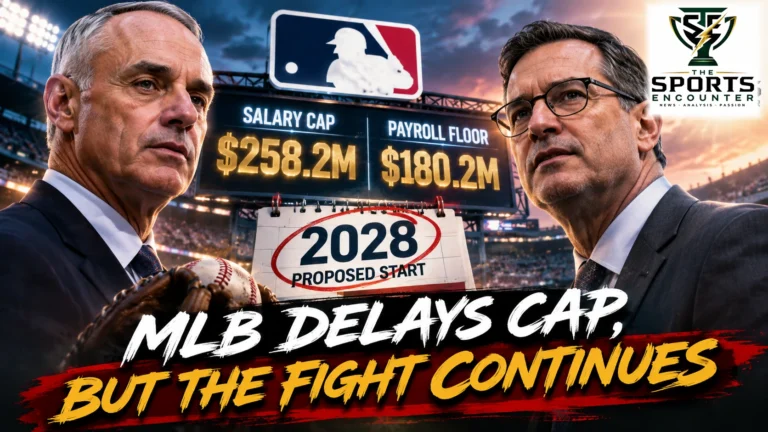
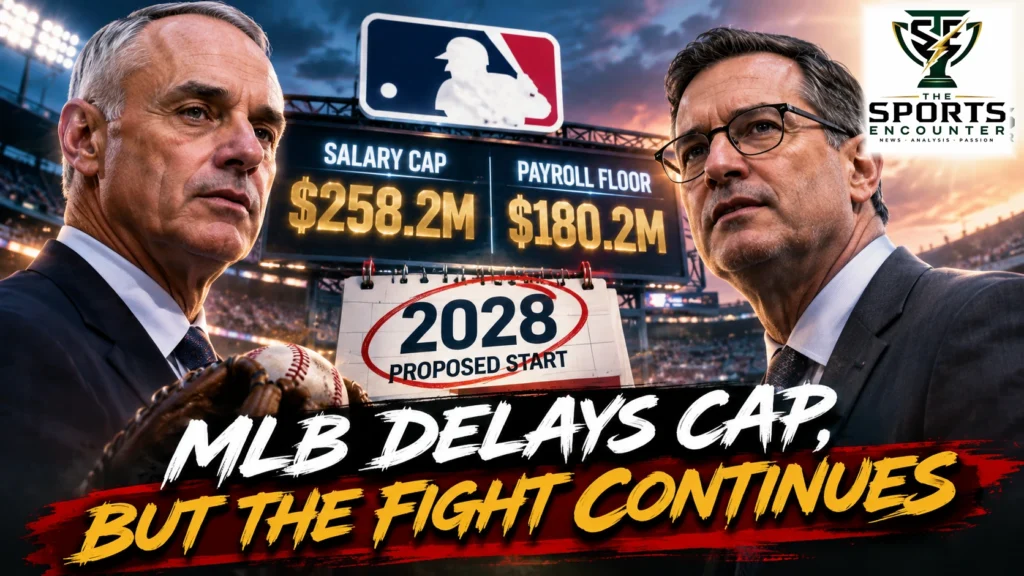
NEW YORK, United States, November 3, 2026: Major League Baseball has offered to postpone its proposed salary cap until the 2028 season, but the concession has done little to resolve the labor dispute threatening baseball’s next campaign. Under the proposal presented to the MLB Players Association on Tuesday, teams would face a $258.2 million payroll ceiling and a $180.2 million spending floor. The league estimates that 12 clubs would have to increase payrolls by a combined $636 million, while eight would need to cut spending by $528 million. With the collective bargaining agreement expiring December 1, the proposed changes leave owners and players confronting fundamental disagreements about compensation, competitive balance and who controls baseball’s growing revenues.
The postponement would allow the 2027 season to operate under the existing luxury-tax framework, giving clubs additional time to adjust their contracts before a proposed cap takes effect. MLB argues that a cap-and-floor system would distribute spending more evenly and increase aggregate player compensation. The union rejects that argument, warning that a hard ceiling could restrict free-agent earnings, weaken contract guarantees and reduce players’ bargaining power. The disagreement is especially striking after the Milwaukee Brewers defeated the Tampa Bay Rays in the 2026 World Series, a championship contested by two comparatively modest-spending organizations. That outcome has complicated a debate that neither side appears close to settling.
What Exactly Has MLB Proposed for the 2028 Season?
MLB’s November 3 proposal changes the proposed implementation date and increases the spending limits compared with the league’s earlier economic framework.
Story at a glance
What Exactly Has MLB Proposed for the 2028 Season?
MLB’s November 3 proposal changes the proposed implementation date and increases the spending limits compared with the league’s earlier economic framework.
Why Did MLB Move the Proposed Salary Cap From 2027 to 2028?
Timing has become a practical problem for the owners.
MLB Raises Its Cap and Floor Figures, but by How Much?
The November offer increases both limits compared with the league’s original proposal for 2027.
The $1.16 Billion Payroll Shake-Up: What the Headline Numbers Really Mean
The most consequential part of the revised plan concerns how much spending would have to move across baseball’s 30 franchises.
Which MLB Teams Would Have to Cut Payroll Under the Proposed Cap?
Eight clubs appear on MLB’s list of organizations that would need to reduce payroll to meet the proposed $258.2 million ceiling.
The new plan would establish a hard payroll ceiling of $258.2 million and a floor of $180.2 million beginning in 2028. The limits would be calculated using the average annual value of player contracts and related payroll costs, broadly following the accounting principles of the existing Competitive Balance Tax system.
Unlike the luxury tax, which permits teams to exceed a threshold by paying financial penalties, a hard cap would prohibit spending above its limit under the agreed rules.
The floor would establish a minimum spending obligation, although MLB has proposed transitional flexibility for the first year.
| Proposal Component | MLB’s November 3 Position |
|---|---|
| Proposed first season | 2028 |
| Hard salary cap | $258.2 million |
| Salary floor | $180.2 million |
| Difference between cap and floor | $78 million |
| Initial 2028 floor flexibility | Clubs could temporarily spend as little as 90% of the floor, subject to the proposed three-year obligation |
| 90% transitional amount | $162.18 million |
| 2027 financial framework | Existing luxury-tax and revenue-sharing arrangements retained under the proposal |
| Proposed labor agreement | Seven years, extending through 2033 |
| Union acceptance | Not obtained |
| Existing CBA expiration | December 1, 2026 |
The distinction between a proposed agreement and an enacted rule is essential. None of the new salary-cap figures is binding merely because owners have offered them during negotiations.
The MLBPA must agree to the economic structure before it can form part of a new collective bargaining agreement.
MLB’s earlier explanation of its proposed economic reforms outlines the case for a hard cap, mandatory floor and greater distribution of baseball revenues. The league’s published cap-and-floor proposal provides the original framework from which the November changes developed.
Why Did MLB Move the Proposed Salary Cap From 2027 to 2028?
Timing has become a practical problem for the owners.
The 2026-27 free-agent negotiating period has already begun. Clubs are entering that market with existing multiyear contracts, arbitration commitments and payroll obligations.
Introducing a hard cap immediately could force high-spending teams to reduce their payrolls before they have sufficient time to restructure their rosters.
Under MLB’s revised timetable, the current luxury-tax structure would continue during 2027. The cap-and-floor system would then begin in 2028, giving organizations an additional offseason to prepare.
The delay could reduce the immediate complications of signing free agents this November. However, a club considering a multiyear contract would still have to account for potential restrictions beginning in 2028.
That uncertainty limits how much relief postponement can provide.
A team might have flexibility during 2027 but face much tighter obligations the following year. Players negotiating three-, five- or seven-year contracts would likewise need to consider an economic system whose terms have not been finalized.
The proposal therefore addresses a transition problem without resolving the disagreement over whether baseball should adopt a cap at all.
MLB Raises Its Cap and Floor Figures, but by How Much?
The November offer increases both limits compared with the league’s original proposal for 2027.
The earlier framework called for a $245.3 million ceiling and a $171.2 million floor.
The revised figures are $258.2 million and $180.2 million, respectively.
| Measure | Earlier Proposal | November 3 Proposal | Change |
|---|---|---|---|
| Salary cap | $245.3M | $258.2M | +$12.9M (+5.26%) |
| Salary floor | $171.2M | $180.2M | +$9.0M (+5.26%) |
| Cap-floor difference | $74.1M | $78.0M | +$3.9M |
| Initial implementation season | 2027 | 2028 | One-year delay |
TSE calculation: The proposed cap increases by $12.9 million, calculated as $258.2 million minus $245.3 million. Dividing that increase by the earlier $245.3 million ceiling produces approximately 5.26%.
The corresponding floor increase is $9 million. Dividing $9 million by $171.2 million produces approximately 5.26%.
The nearly identical percentage increases mean the new proposal raises the limits without materially changing their proportional relationship.
The earlier figures were proposed for 2027, while the revised figures are proposed for 2028. Consequently, the comparison describes changes between negotiating offers, rather than an actual year-over-year increase in enforced payroll limits.
The $1.16 Billion Payroll Shake-Up: What the Headline Numbers Really Mean
The most consequential part of the revised plan concerns how much spending would have to move across baseball’s 30 franchises.
MLB estimates that 12 teams would collectively need to increase their payrolls by $636 million to meet the proposed floor.
Another eight clubs would collectively need to reduce spending by $528 million to comply with the ceiling.
The difference produces a proposed net payroll increase of $108 million.
But that net figure conceals the scale of the proposed redistribution.
| Payroll Adjustment | Clubs | Combined Amount | Average Per Affected Club |
|---|---|---|---|
| Required payroll increases | 12 | $636M | $53M increase |
| Required payroll reductions | 8 | $528M | $66M reduction |
| Clubs between proposed limits | 10 | No mandatory adjustment indicated by MLB’s estimate | Not applicable |
| Net change across increases and reductions | 20 affected clubs | +$108M | Not a uniform club-level change |
| Combined magnitude of payroll adjustments | 20 affected clubs | $1.164B | Not a net spending increase |
TSE statistical discovery: Adding the absolute value of the proposed increases and reductions produces $1.164 billion in combined payroll adjustments.
That figure measures the total magnitude of the changes across the two groups. It is not the amount MLB would spend in additional salaries, nor is it money literally transferred from one group of teams to another.
The estimated net increase is $108 million, calculated by subtracting $528 million in proposed reductions from $636 million in increases.
In other words, the proposed system would require changes totaling more than $1.16 billion in opposite directions to produce an overall increase of $108 million.
The calculation provides a clearer picture of how dramatically the proposal could change the distribution of payroll obligations.
These remain league estimates based on the stated proposal. Actual payrolls, contract obligations, exemptions, enforcement arrangements and negotiated transition rules could produce different outcomes.
Which MLB Teams Would Have to Cut Payroll Under the Proposed Cap?
Eight clubs appear on MLB’s list of organizations that would need to reduce payroll to meet the proposed $258.2 million ceiling.
They include several of baseball’s most commercially prominent franchises.
| Teams Facing Proposed Payroll Cuts | Teams Facing Proposed Payroll Increases |
|---|---|
| Boston Red Sox | Athletics |
| Chicago Cubs | Chicago White Sox |
| Los Angeles Dodgers | Cincinnati Reds |
| New York Mets | Cleveland Guardians |
| New York Yankees | Colorado Rockies |
| Philadelphia Phillies | Miami Marlins |
| San Diego Padres | Milwaukee Brewers |
| Toronto Blue Jays | Minnesota Twins |
| Pittsburgh Pirates | |
| St. Louis Cardinals | |
| Tampa Bay Rays | |
| Washington Nationals |
The list shows why the debate extends beyond a handful of superstar contracts.
The Dodgers, Yankees and Mets have long operated with the financial advantages associated with major markets. A hard cap could substantially change how they structure multiyear agreements, approach free agency and allocate payroll across their rosters.
The Yankees face an especially interesting situation after another season without a World Series title.
TSE’s examination of Brian Cashman’s return for a 30th season despite the Yankees’ championship drought explored how the organization must improve its roster after an offensive decline.
A future hard salary cap could narrow the financial options available to Cashman, even as the Yankees seek to remain competitive in the American League.
For the Dodgers, a cap would introduce another layer of complexity to an organization accustomed to pursuing elite talent and structuring substantial long-term contracts.
However, the proposal does not establish which players would be traded, released or offered revised agreements. Team-specific adjustment estimates have not been disclosed for every franchise.
It would therefore be premature to predict individual roster departures or assign exact cuts to particular teams.
Why Would the Brewers and Rays Have to Spend More After Reaching the World Series?
The inclusion of Milwaukee and Tampa Bay among teams facing proposed payroll increases introduces an awkward question for MLB’s competitive-balance argument.
The Brewers have just won the 2026 World Series, defeating the Rays in five games.
Both teams reached the championship series through effective roster construction, player development and strong performances from players whose contributions were not determined solely by their salaries.
Milwaukee finished the regular season with 103 victories, swept the Dodgers in the National League Championship Series and completed its championship campaign with an 11-2 postseason record.
The Sports Encounter’s report on Milwaukee’s historic World Series triumph detailed the decisive contributions of Jacob Misiorowski, Cooper Pratt and William Contreras.
The championship demonstrates that a comparatively modest-spending organization can defeat wealthier opponents and win baseball’s biggest prize.
It does not establish that payroll disparities are irrelevant.
Successful smaller-market teams may still face difficulties retaining established players, competing for expensive free agents and sustaining championship-level rosters over many seasons.
Yet the 2026 outcome challenges the assumption that higher payrolls consistently produce superior postseason results.
Tampa Bay offers another useful example. Its run to the World Series followed an American League Championship Series victory over Cleveland, including significant contributions from Freddy Peralta and Junior Caminero.
Our analysis of the Rays’ pennant-winning campaign examined how the organization assembled a contender capable of reaching the championship series.
The Brewers-Rays World Series preview also examined why the matchup challenged conventional assumptions about baseball’s spending hierarchy.
Does the Brewers’ Championship Weaken MLB’s Salary-Cap Argument?
It weakens the simplistic version of the argument that wealthy clubs inevitably dominate championship outcomes.
Milwaukee’s success provides clear evidence that effective scouting, coaching, player development and roster construction can overcome substantial financial disadvantages in a particular season.
However, competitive balance is broader than identifying one championship winner.
It also involves whether teams across different markets have sustainable opportunities to retain talent, compete for postseason places and maintain competitive rosters over time.
The Brewers’ title is an important counterexample to claims of inevitable big-market dominance, but neither side can settle the economic debate using one World Series result alone.
Why the MLB Players Association Still Rejects a Salary Cap
The players’ union has consistently opposed the introduction of a hard salary ceiling.
Its principal objection concerns the effect on individual bargaining rights and compensation.
Under baseball’s existing system, clubs can spend above the luxury-tax threshold by accepting financial penalties. That framework allows substantial spending on players, even though teams may choose to limit payroll for their own financial reasons.
A hard cap would replace that flexibility with a binding ceiling.
The MLBPA argues that such a system could restrict the earning potential of the highest-paid players while also affecting negotiations throughout the broader market.
Its concerns include contract guarantees, potential pressure on middle-tier free agents, limitations on bonuses and the risk that owners could use the ceiling to justify restrained spending.
The union also disputes the financial definitions underlying MLB’s proposed 50-50 revenue-sharing arrangement.
That disagreement matters because the value of a percentage depends on what is counted as revenue, which costs are deducted and how compensation is calculated.
The MLBPA’s official response to the league’s earlier bargaining proposals makes its opposition clear. The union argues that proposed improvements in player benefits cannot be evaluated separately from the restrictions it believes a cap would impose.
Players have also pointed to baseball’s historical labor conflicts as a warning against attempts to introduce spending limits without their agreement.
The disagreement is therefore deeper than whether the cap begins in 2027 or 2028.
Why MLB Believes a Salary Floor Could Help Smaller-Market Teams
The owners argue that the existing system allows significant differences in spending between franchises.
MLB has repeatedly highlighted the gap between the highest- and lowest-spending clubs as evidence that the financial structure requires reform.
A mandatory floor would compel organizations currently operating below the proposed $180.2 million threshold to increase payroll spending over the agreed transition period.
That could create additional demand for major league talent and potentially provide smaller-market clubs with greater capacity to retain players or participate in free agency.
But the effect would depend on the structure of the complete agreement.
Higher minimum spending does not automatically mean every player receives a larger salary.
Teams might distribute additional payroll among established veterans, arbitration-eligible players, new free agents or extensions for players already under contract.
The distribution of those gains would be influenced by negotiating leverage and roster strategy.
A salary floor also raises questions about how lower-revenue franchises would fund the mandatory spending.
MLB has proposed changes to revenue distribution, including centralizing certain media revenues from 2028.
The importance of broadcasting income is illustrated by TSE’s investigation into the record $65.82 billion global sports media-rights market.
Those worldwide figures cannot be treated as MLB revenue, but they provide context for why control of broadcasting income has become so important across professional sports.
What Would Happen to MLB’s Luxury Tax in 2027?
Under the revised proposal, the existing Competitive Balance Tax framework would remain in force for the 2027 season, using the same thresholds and tax rates as in 2026.
MLB’s current system does not prohibit a team from spending above its threshold.
Instead, teams exceeding the limit face financial penalties, with additional surcharges applying at higher payroll levels.
The base luxury-tax threshold for 2026 is $244 million.
The proposed 2028 salary cap of $258.2 million is $14.2 million higher than that 2026 base threshold, although the two figures belong to different economic systems.
The official MLB Competitive Balance Tax explainer sets out the current calculation method, tax rates and applicable thresholds.
Salary Cap vs. Luxury Tax: What Is the Difference?
| Feature | Existing Luxury-Tax System | Proposed 2028 Cap-and-Floor System |
|---|---|---|
| Upper spending limit | Teams may exceed threshold with penalties | Hard ceiling would restrict spending above cap |
| 2026 or proposed 2028 figure | $244M base threshold in 2026 | $258.2M proposed cap in 2028 |
| Minimum payroll obligation | No equivalent universal hard floor | $180.2M proposed floor, with transitional rules |
| High-spending teams | Can continue spending above threshold while paying tax | Would need to comply with agreed hard-limit rules |
| Low-spending teams | Not required to reach a universal payroll minimum | Would face mandatory minimum spending obligations |
| Player-market implications | More payroll flexibility, subject to tax deterrents | Greater formal spending constraints and minimum obligations |
| Legal status in November 2026 | Existing CBA framework | Unaccepted negotiating proposal |
The most important distinction concerns enforceability.
The luxury tax discourages spending above a threshold. A hard cap would establish a limit that clubs could not simply exceed by paying a conventional tax.
That is why the MLBPA sees the proposed structure as a substantial change to the economic rights players currently possess.
What Other Benefits Has MLB Offered Players?
The salary-cap delay is part of a wider package intended to address several issues raised during collective bargaining.
MLB has proposed increases in minimum salaries, a larger pre-arbitration bonus pool and changes to free-agency eligibility.
Among the reported elements is a $1 million minimum salary for players with at least two years of service and a $900,000 minimum for players with less service.
The proposal also includes an opportunity for certain players aged 30 or older to reach free agency after five years of service rather than six, subject to additional conditions.
MLB would increase the pre-arbitration bonus pool from $50 million in 2026 to $65 million in 2027, with further growth proposed over the agreement.
Other elements address minor league minimum salaries, roster transactions and player service-time rules.
These proposals may offer benefits to some players, particularly those earlier in their careers.
Yet the union argues that any gains must be assessed alongside restrictions on future compensation and bargaining rights.
A $1 million minimum salary can benefit a qualifying player while a hard cap simultaneously restricts the total amount teams may spend.
Those outcomes can coexist, which explains why the parties disagree over the aggregate effects.
Similar tensions between collective bargaining, employment rights and the commercial growth of sports organizations have emerged elsewhere. TSE’s coverage of the Dallas Cowboys Cheerleaders’ unionization dispute illustrates a different labor structure in which workers have sought greater influence over compensation and employment conditions.
The cases are legally distinct, but both demonstrate why headline salary improvements cannot fully resolve disagreements over collective bargaining rights.
Could the Salary-Cap Proposal Change Baseball Ticket Prices?
MLB’s proposed cap-and-floor structure does not establish how much fans will pay for tickets.
Ticket prices depend on demand, market conditions, stadium capacity, opponent appeal, scheduling, resale activity and decisions made by individual organizations.
The MLBPA has argued that salary caps do not automatically reduce prices for spectators.
The 2026 World Series offered a striking example of how local demand can influence ticket costs.
Milwaukee’s long-awaited return produced reported resale entry prices exceeding $3,100 for Game 1, while lower prices were quoted for comparable games in Tampa Bay.
TSE’s analysis of the World Series ticket-price divide examined why demand differed so sharply between the two host markets.
That comparison does not prove a salary cap would have no effect on ticket pricing. It demonstrates that payroll is only one of many economic factors affecting the commercial value of attending a sporting event.
Neither a future reduction nor an increase in ticket prices should be presented as an established consequence of a proposal that has not been adopted.
Why Baseball’s 1994 Strike Still Shapes the Salary-Cap Fight
The current negotiations carry historical weight because MLB’s last major effort to establish a salary cap preceded one of the most damaging labor conflicts in American sports.
The 1994-95 players’ strike lasted more than seven months and resulted in the cancellation of the 1994 World Series.
That episode continues to influence the relationship between owners and players.
The present collective bargaining agreement was reached in March 2022 after a 99-day lockout.
The agreement established the economic framework under which MLB has operated through the 2026 season.
Negotiators now face another December deadline, with the possibility that owners will again lock out players if no new agreement is reached.
A lockout is not automatically equivalent to canceled regular-season games.
The consequences would depend on its duration, the progress of negotiations and whether the dispute extends into spring training or the scheduled 2027 season.
Will MLB Have a Lockout on December 1, 2026?
MLB’s current collective bargaining agreement expires December 1, 2026.
Reports indicate that owners are expected to impose a lockout if the parties do not reach a new deal before expiration.
However, a lockout has not occurred merely because it is anticipated.
The remaining negotiations could produce an agreement, an extension, a work stoppage or another temporary arrangement.
The table below separates those possibilities.
| Possible Development | What It Would Mean | Status |
|---|---|---|
| New CBA reached before December 1 | Labor terms agreed before current agreement expires | Possible, not confirmed |
| Owners impose lockout after expiration | League and union enter employer-initiated work stoppage | Expected in reporting, not yet confirmed |
| Negotiations continue during lockout | Talks proceed while transactions and other activities may face restrictions | Conditional |
| Agreement reached before 2027 regular season | Season may proceed without canceled regular-season games, depending on timing | Conditional |
| Prolonged dispute extends into season | Possible schedule disruption or postponed games | Risk, not confirmed outcome |
| Owners abandon or materially revise hard-cap demand | Negotiations could shift toward alternative revenue-sharing arrangements | Possible, not announced |
The December deadline is therefore the next major event in the dispute.
The proposal’s proposed 2028 implementation date does not eliminate the possibility of a 2026 lockout because the players must still agree to the overall economic framework.
Can MLB Improve Competitive Balance Without a Hard Salary Cap?
That question may ultimately determine whether the owners and union can find a compromise.
The MLBPA has supported changes to revenue sharing, while continuing to reject a hard cap.
MLB argues that the payroll gap between teams requires stronger rules to prevent financial disparities from undermining competition.
Several alternatives could form part of negotiations, including changes to revenue redistribution, adjustments to the luxury-tax system, incentives for competitive spending and reforms to existing roster rules.
Each approach has limitations.
More revenue sharing could help smaller-market clubs, but it would require safeguards to ensure that additional money supports baseball operations rather than simply increasing owner income.
A mandatory spending floor without a corresponding cap could encourage some teams to invest more in players while retaining spending flexibility at the top of the market.
However, the owners have not agreed to that alternative as a replacement for their proposal.
Changes to luxury-tax thresholds could affect high-spending clubs without creating an absolute ceiling, but such changes might not address concerns about teams that choose to operate with low payrolls.
The negotiations will require both sides to decide which problems they most want to solve and what concessions they are prepared to make.
How Would a Salary Cap Affect Superstar Contracts and Player Earnings?
A hard cap could change the negotiating environment for baseball’s highest-paid players, particularly when multiple long-term contracts account for a large share of a team’s payroll.
Teams facing an enforced ceiling would need to consider the combined effect of existing commitments, projected arbitration salaries and future contract extensions.
That could increase competition for available payroll space.
Meanwhile, a mandatory floor could increase demand for players among clubs that currently spend less.
Whether those effects increase or reduce total player earnings would depend on the final revenue-sharing formula, negotiated limits and actual team behavior.
The distinction between individual star salaries and broader player compensation is important.
TSE’s historical analysis of how the world’s highest-paid athletes accumulated their earnings explored the different roles of contracts, prize money and commercial endorsements.
MLB’s proposed payroll rules would principally affect contractual compensation within baseball’s collective bargaining system. They should not be confused with an athlete’s entire income from sponsorships and other outside commercial arrangements.
The Business of Baseball: Why Owners Want a Different Revenue Structure
MLB’s proposal reaches beyond player salaries.
The owners have connected the cap-and-floor system to a proposed 50-50 division of league revenue and greater centralization of certain media revenues.
The practical challenge lies in defining exactly which income belongs in the calculation.
Local television rights, national media agreements, sponsorships, stadium operations and other commercial arrangements can produce different revenue opportunities across franchises.
The proposed system could substantially alter the relationship between local-market advantages and spending power.
But the union has challenged management’s definitions of revenue and expenses, leaving an important part of the financial model disputed.
Until those definitions are agreed, the projected 50-50 arrangement should be understood as a negotiating proposal rather than an independently established guarantee of equivalent financial treatment.
What the Brewers’ Championship Reveals About Baseball’s Economic Debate
Milwaukee’s title gives both sides evidence they can reasonably interpret differently.
Players can point to the Brewers’ championship as evidence that clubs with relatively modest payrolls can compete successfully without a universal hard cap.
Owners can argue that smaller-market teams still require stronger financial resources to sustain that success and retain valuable players.
Both positions deserve scrutiny.
Milwaukee’s championship was built on more than spending levels. Its player development, pitching, roster balance and timely performances carried the team through October.
Those strengths may be difficult to reproduce every year, regardless of payroll rules.
The emotional significance of Milwaukee’s victory is explored in TSE’s tribute to Bob Uecker and the generations of Brewers supporters who waited for a championship.
That perspective also explains what is ultimately at stake for supporters: competitive hope, sustained team quality and confidence that their clubs have a realistic opportunity to win.
The dispute is over which economic system offers the most defensible route toward those goals.
What Happens Next in MLB’s Salary-Cap Negotiations?
The immediate priority for owners and players is reaching an agreement before the existing CBA expires on December 1.
MLB has demonstrated some flexibility on implementation timing by moving its proposed cap to 2028.
The union has not accepted the underlying principle of a hard spending ceiling.
Further negotiations must address payroll limits, revenue definitions, compensation guarantees, free agency, bonuses and the arrangements governing smaller-market franchises.
For teams, uncertainty could influence negotiations with free agents and planning for future payroll commitments.
For players, the consequences could affect contract value, employment conditions and future bargaining rights.
For supporters, the central concern is whether the dispute threatens the 2027 baseball season.
That outcome remains unresolved.
The Sports Encounter Analysis: Delaying the Cap Does Not Resolve Baseball’s Central Disagreement
MLB’s proposal offers a practical concession on timing while maintaining the owners’ central economic objective.
The revised limits are higher, and the 2028 implementation date gives clubs more time to prepare.
But the union still opposes the principle of imposing a hard salary ceiling.
The contrast between the projected $1.164 billion in payroll adjustments and the $108 million estimated net increase illustrates why both sides view the plan differently.
Owners see a more balanced distribution of spending obligations across the league.
Players see a proposed system that could restrict compensation negotiations even while requiring some teams to spend more.
The Brewers’ championship further complicates an argument that cannot be resolved through a single spending statistic or one postseason result.
Baseball has shown that comparatively modest-spending teams can win championships. The unanswered question is whether the league’s current financial structure gives those clubs a sustainable opportunity to remain competitive over many years.
That is the issue owners and players must confront before December 1.
The salary cap may have been pushed back by a year in MLB’s latest proposal. The deadline for resolving baseball’s labor dispute has not moved.
Continue the MLB Story
 MLBMariners Hand Jason Kanzler First Managerial Job at 36, Betting on Player Development to Reverse a 14-Win Collapse
 MLBEight MLB Stars Face $185.2M Decision as World Series Hero Jake Bauers Weighs Brewers’ $23.15M Offer
 MLBPitching Problems Exposed: Rays Lose Edwin Uceta Into 2027 as Red Sox Trade Eduardo Rivera to Cardinals
Frequently Asked Questions About MLB’s Proposed 2028 Salary Cap
Has MLB Approved a Salary Cap for 2028?
No. MLB has proposed introducing a hard salary cap and payroll floor in 2028. The MLB Players Association has not accepted the proposal, and no new agreement has been finalized.
What Is the Proposed MLB Salary Cap for 2028?
MLB has proposed a $258.2 million hard payroll ceiling for the 2028 season.
What Is the Proposed MLB Minimum Payroll?
The proposed floor is $180.2 million, with transitional flexibility that could allow clubs to spend as little as 90% of that amount in 2028 under the proposed conditions.
Which Teams Would Have to Reduce Payroll?
MLB identifies the Red Sox, Cubs, Dodgers, Mets, Yankees, Phillies, Padres and Blue Jays as clubs requiring reductions under its estimate.
Which Teams Would Have to Increase Spending?
MLB identifies 12 clubs, including the Brewers, Rays, Athletics, Pirates, White Sox, Guardians and Marlins, as teams requiring payroll increases.
Why Does the MLBPA Oppose a Salary Cap?
The union argues that a hard ceiling could restrict player compensation, weaken negotiating rights and create limitations on contracts and guarantees.
What Is the Difference Between a Salary Cap and Luxury Tax?
A hard cap prohibits spending above an agreed limit. The existing luxury tax allows clubs to exceed a threshold while paying financial penalties.
Will MLB Have a Lockout in December 2026?
A lockout is expected if owners and players fail to agree on a new contract before the existing CBA expires on December 1. It has not yet occurred as of November 3.
Would a Lockout Cancel the 2027 MLB Season?
Not necessarily. A lockout could end before the regular season, although a prolonged dispute might disrupt preparations or scheduled games.
Did the Milwaukee Brewers’ 2026 Championship Change the Salary-Cap Debate?
Milwaukee’s victory demonstrated that a comparatively modest-spending team can win the World Series. It does not conclusively establish whether MLB needs a different long-term economic system.