CHICAGO, United States, November 24, 2026: The Chicago Cubs have reportedly reached a five-year, $120 million agreement with left-handed pitcher Trevor Rogers, betting that his remarkable second-half recovery with the Baltimore Orioles offers a more accurate picture of his future than the 4.03 ERA he recorded across the full season.
The agreement, first reported by MLB Network’s Jon Morosi, remains subject to a physical and official confirmation by the Cubs. Rogers, who turned 29 earlier this month, is expected to become a central figure in Chicago’s rebuilt starting rotation after five pitchers from its season-ending staff entered free agency.
Key Takeaways
- The agreement, first reported by MLB Network’s Jon Morosi, remains subject to a physical and official confirmation by the Cubs.
- The financial commitment averages $24 million annually, making it the third-largest free-agent contract awarded to a pitcher in Cubs history, behind Jon Lester’s $155 million agreement and Yu Darvish’s $126 million deal.
- The deal follows Rogers’ decision to reject Baltimore’s one-year, $23.15 million qualifying offer.
- Evaluating Rogers through his full-season ERA alone would miss the most important development in his 2026 campaign.
The financial commitment averages $24 million annually, making it the third-largest free-agent contract awarded to a pitcher in Cubs history, behind Jon Lester’s $155 million agreement and Yu Darvish’s $126 million deal.
Story at a glance
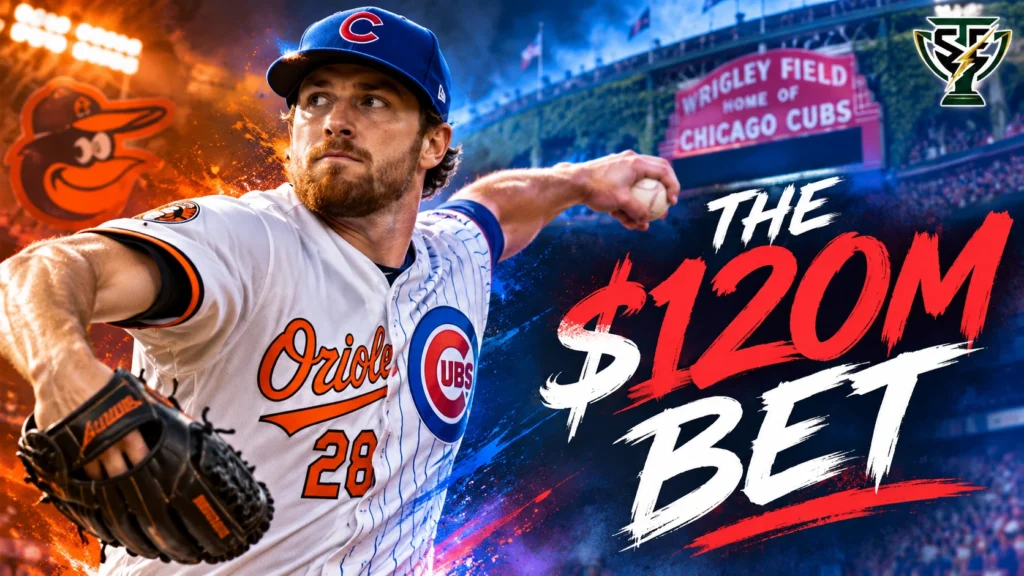
Trevor Rogers’ $120 Million Contract: What the Cubs Are Reportedly Paying
The Reuters report on the agreement confirms the reported financial terms and the uncertainty surrounding final completion.
Why Rogers’ 4.03 ERA Conceals the Pitcher Chicago Wants
Evaluating Rogers through his full-season ERA alone would miss the most important development in his 2026 campaign.
Chicago’s Rotation Crisis Makes Rogers More Than an Expensive Addition
The Cubs are entering the offseason with an unusually large number of starting-pitching decisions.
Why the Cubs’ Gold Glove Defense Could Make Rogers More Effective
One of the most interesting elements of the agreement is the relationship between Rogers’ pitching style and Chicago’s defensive strengths.
Rogers’ Injury History Is the Biggest Risk in the Five-Year Investment
The strongest argument against treating Rogers as an established frontline starter is his uneven record of availability and performance.
But the more revealing numbers are hidden within Rogers’ season. After carrying a 6.84 ERA through his first ten starts, the former Miami Marlins prospect produced a 2.90 ERA and 2.89 fielding independent pitching mark across his final 20 appearances. That sustained improvement helps explain why Chicago is willing to make such a substantial investment in a pitcher whose overall win-loss record was 10-11.
Trevor Rogers’ $120 Million Contract: What the Cubs Are Reportedly Paying
| Contract Detail | Reported Terms |
|---|---|
| Team | Chicago Cubs |
| Player | Trevor Rogers |
| Position | Left-handed starting pitcher |
| Contract length | Five years |
| Total value | $120 million |
| Average annual value | $24 million |
| Age at agreement | 29 |
| Previous team | Baltimore Orioles |
| Status | Agreement reported; physical and club confirmation pending |
The Reuters report on the agreement confirms the reported financial terms and the uncertainty surrounding final completion.
The deal follows Rogers’ decision to reject Baltimore’s one-year, $23.15 million qualifying offer. That decision exposed him to the risks of free agency but also created the opportunity to secure considerably greater long-term financial security.
Had he accepted the qualifying offer, Rogers would have received a guaranteed $23.15 million for one season. The reported Cubs agreement instead guarantees $120 million across five years, subject to the contract being finalized.
That difference explains why the qualifying-offer decision mattered. Rogers exchanged the certainty of a substantial one-year salary for the possibility of a longer commitment, and the reported agreement suggests the strategy has succeeded.
The Sports Encounter’s analysis of MLB’s $23.15 million qualifying offers previously identified Rogers among the pitchers whose decisions could reshape the free-agent market.
Why Rogers’ 4.03 ERA Conceals the Pitcher Chicago Wants
Evaluating Rogers through his full-season ERA alone would miss the most important development in his 2026 campaign.
He struggled badly during the opening two months, carrying a 6.84 ERA through his first ten starts. Illness also affected his early-season preparation and performance.
From June onward, however, his results changed substantially.
Across his final 20 starts, Rogers recorded a 2.90 ERA, struck out 119 batters and issued only 21 walks in 121 innings.
That produced a strikeout-to-walk ratio of approximately 5.67 over the period, substantially better than his full-season ratio of 4.03.
| 2026 Performance | First 10 Starts | Final 20 Starts |
|---|---|---|
| ERA | 6.84 | 2.90 |
| FIP | Not established here | 2.89 |
| Strikeouts | 38, calculated from season totals | 119 |
| Walks | 18, calculated from season totals | 21 |
| Innings pitched | 48⅔ | 121 |
| Strikeout-to-walk ratio | 2.11 | 5.67 |
The improvement was not confined to a handful of appearances. Twenty starts represent two-thirds of his season, providing a meaningful period over which to evaluate his performance.
His 2.89 FIP over that stretch also closely matched his 2.90 ERA. FIP estimates a pitcher’s performance using outcomes such as strikeouts, walks, hit batters and home runs, reducing the influence of team fielding.
The near-identical figures strengthen the case that Rogers’ improvement involved more than favorable defensive results.
They do not guarantee that he will maintain the same performance over five seasons, but they provide a stronger basis for Chicago’s investment than his overall ERA alone.
The MLB.com examination of Rogers’ reported agreement provides additional detail on his second-half performance, pitching repertoire and potential fit with the Cubs.
Chicago’s Rotation Crisis Makes Rogers More Than an Expensive Addition
The Cubs are entering the offseason with an unusually large number of starting-pitching decisions.
Matthew Boyd, Shota Imanaga, Clay Holmes, Kevin Gausman and David Peterson have reached free agency, leaving Chicago without much of the rotation that finished the previous campaign.
Meanwhile, Justin Steele, Cade Horton and Ben Brown have been recovering from injuries.
The combination of departing veterans and injured starters means Chicago cannot simply rely on internal depth to fill every vacancy.
Rogers addresses one of those openings and offers a potential frontline starter, but his arrival does not complete the reconstruction.
Why the Cubs Still Need Additional Starting Pitchers
A major league rotation ordinarily requires five starters, with additional depth necessary to cover injuries, fatigue and periods of poor performance.
Even if Rogers delivers 30 starts, Chicago must still account for the remaining rotation workload.
His 169⅔ innings in 2026 represent a useful benchmark. Repeating that total would provide substantial value, particularly if his run prevention resembles his stronger second-half performance.
However, the Cubs cannot assume that one established pitcher will resolve the uncertainty surrounding multiple rotation positions.
The front office must continue evaluating free agents, potential trades and the rehabilitation progress of pitchers already under contract.
That need distinguishes Chicago’s approach from the Minnesota Twins, who recently strengthened an existing rotation by bringing back Sonny Gray.
TSE’s analysis of Gray’s reported $55 million agreement examined how Minnesota is investing in experienced pitching from a comparatively stronger depth position.
Chicago is making its investment while attempting to replace several important members of its staff.
Why the Cubs’ Gold Glove Defense Could Make Rogers More Effective
One of the most interesting elements of the agreement is the relationship between Rogers’ pitching style and Chicago’s defensive strengths.
The Cubs won the 2026 Team Gold Glove Award, recognizing their collective fielding performance.
Center fielder Pete Crow-Armstrong also earned the National League Platinum Glove, further highlighting the team’s defensive quality.
Rogers has historically generated a substantial number of ground balls, although his ground-ball rate declined from 46.0% in 2025 to 38.3% in 2026.
His career rate stands at approximately 42.7%.
That creates a potentially useful combination. A pitcher who induces manageable contact can benefit from strong infield defense, while effective outfield positioning can help convert fly balls and line drives into outs.
Chicago’s defensive quality could therefore support Rogers’ run prevention, especially if he restores some of his previous ground-ball production.
However, the relationship should not be overstated.
A strong defense cannot prevent walks or home runs, and its contribution varies with the type and location of contact a pitcher allows.
Rogers must still command his pitches, avoid damaging contact and maintain his strikeout production.
His Pitching Arsenal Offers More Than Ground-Ball Potential
Rogers relies on a four-seam fastball that averaged approximately 93.8 mph in 2026.
His success does not depend exclusively on overpowering hitters with velocity.
His lower arm angle and deceptive delivery make his fastball difficult to track, while his changeup, sweeper, sinker and cutter provide different movement profiles.
Since the beginning of the 2025 season, opponents have batted approximately .204 against his four-seam fastball.
That figure indicates the pitch has remained effective despite velocity that is not exceptional by modern major league standards.
The Cubs will be interested in preserving that deception while helping Rogers maintain the command and pitch selection that contributed to his improved second-half results.
Rogers’ Injury History Is the Biggest Risk in the Five-Year Investment
The strongest argument against treating Rogers as an established frontline starter is his uneven record of availability and performance.
He emerged as a promising pitcher with Miami in 2021, earning an All-Star selection and finishing second in National League Rookie of the Year voting.
That season, he recorded a 2.64 ERA across 25 starts.
But recurring lower-body injuries interrupted his progress in subsequent years.
He appeared in only four major league games in 2023 and struggled after being traded from Miami to Baltimore in July 2024.
The Orioles subsequently received a much stronger return when Rogers produced a 1.81 ERA across 18 starts in 2025.
Even that outstanding campaign came after a dislocated right kneecap limited his availability.
His 2026 season provided encouragement because he completed a career-high 30 starts and 169⅔ innings.
Still, a single relatively healthy season does not eliminate the risks associated with his previous injuries.
| Season | Key Development | What It Reveals |
|---|---|---|
| 2021 | 2.64 ERA, All-Star selection, Rookie of the Year runner-up | Early frontline potential |
| 2023 | Only four major league appearances | Significant availability concerns |
| 2024 | Traded from Miami to Baltimore; struggled after the move | Performance inconsistency |
| 2025 | 1.81 ERA in 18 starts | Elite run prevention in a limited workload |
| 2026 | 4.03 ERA in 30 starts, with a 2.90 ERA over the final 20 | Improved durability and sustained second-half effectiveness |
Chicago is effectively paying for a combination of Rogers’ demonstrated upside and the belief that his improved durability can continue.
The contract’s success will depend on both assumptions.
How the $120 Million Deal Compares With Other Pitching Investments
Rogers’ reported agreement comes during an offseason in which teams are committing substantial money to starting pitching.
The New York Mets reportedly agreed to a nine-year, $450 million contract with Tarik Skubal, placing one of baseball’s most accomplished pitchers in a different financial category.
Rogers’ $24 million average annual value is considerably lower than Skubal’s $50 million figure.
That gap reflects different levels of established performance, but it also illustrates how expensive credible starting pitching has become.
Chicago’s reported investment can also be compared with the White Sox’s three-year, $52.5 million agreement with Dustin May.
TSE’s examination of the Dustin May agreement explored another Chicago club’s willingness to invest in a pitcher whose health and future performance carry uncertainty.
| Pitcher | Reported Contract | Annual Average |
|---|---|---|
| Tarik Skubal | 9 years, $450 million | $50 million |
| Trevor Rogers | 5 years, $120 million | $24 million |
| Sonny Gray | 2 years, $55 million | $27.5 million |
| Dustin May | 3 years, $52.5 million | $17.5 million |
These figures compare reported contract values rather than identical player situations. Age, contract length, health, performance history and market timing all influence the price.
For Chicago, the essential question is whether Rogers can deliver enough effective innings to justify the guaranteed commitment.
The Hidden Cost: Chicago Also Sacrifices Draft and International Spending Resources
The reported contract carries an additional cost beyond its $120 million value.
Because Rogers rejected Baltimore’s qualifying offer, the Cubs face draft-pick and international bonus-pool penalties under MLB’s compensation rules.
As a club subject to the relevant Competitive Balance Tax penalties, Chicago is expected to surrender its second- and fifth-highest selections in the next amateur draft, along with $1 million from its international signing bonus pool.
That makes the agreement a broader organizational investment.
The Cubs are committing money to an established major league pitcher while sacrificing resources that could otherwise support their longer-term player-development system.
The trade-off may be worthwhile if Rogers helps stabilize the rotation and contributes to postseason contention.
But it increases the importance of the deal delivering value over several seasons.
For comparison, TSE’s analysis of Seattle’s Maikel Garcia trade examined another example of a club surrendering valuable pitching resources to address an immediate roster weakness.
The transactions are structurally different, but both demonstrate how improving one area of a roster can create costs elsewhere.
Continue the MLB Story
MLB’s Labor Uncertainty Adds Another Layer to the Cubs’ Decision
Chicago is making a major multiyear commitment shortly before the current collective bargaining agreement expires on December 1.
Major League Baseball and the players’ union remain divided over proposed economic changes, including a possible salary cap and spending floor.
No new salary-cap system has been adopted.
However, the unresolved negotiations create uncertainty about the financial framework clubs will operate under in future seasons.
The Cubs have been identified among the higher-spending organizations that could face adjustments under certain proposed payroll limits.
That makes a five-year commitment particularly relevant to long-term roster planning.
The Sports Encounter’s investigation into MLB’s proposed salary cap and labor dispute examined the potential consequences for major-market clubs, including Chicago.
The current agreement with Rogers should not be interpreted as evidence that a particular future labor outcome is expected.
It does, however, show that Chicago is willing to commit substantial resources before the sport’s next financial framework has been settled.
What the Orioles Lose After Rogers’ Departure
Baltimore loses a pitcher who provided 169⅔ innings and 157 strikeouts during the 2026 season.
His departure removes an established left-handed starter from a rotation that must also address the future of veteran Chris Bassitt.
The Orioles will receive qualifying-offer compensation under the applicable MLB rules, but a draft selection cannot immediately replace Rogers’ major league workload.
Baltimore must therefore evaluate whether its existing pitchers can assume greater responsibilities or whether another acquisition is necessary.
Rogers’ development also provides an interesting perspective on the trade that brought him to Baltimore.
The Orioles acquired him from Miami in 2024 in a deal involving Kyle Stowers and Connor Norby.
His initial struggles made the transaction appear disappointing, but his outstanding 2025 performance and strong finish to 2026 substantially improved the value Baltimore received.
The eventual assessment of that trade will depend on the longer-term performances of the players involved.
What the Cubs Need to See From Rogers
The reported agreement will be judged through several measurable outcomes rather than the size of the contract alone.
| Performance Area | What to Monitor | Why It Matters |
|---|---|---|
| Durability | Starts and innings pitched | Determines how much rotation workload Rogers can absorb |
| Run prevention | ERA and FIP | Tests whether his second-half improvement continues |
| Command | Walk rate and strikeout-to-walk ratio | Measures whether he sustains improved control |
| Contact management | Ground-ball rate and quality of contact | Shows how effectively his approach complements Chicago’s defense |
| Pitch effectiveness | Four-seam fastball results and secondary-pitch performance | Indicates whether his deception remains effective |
| Rotation construction | Additional acquisitions and injury recoveries | Determines whether Chicago can build a complete starting staff |
Rogers does not need to reproduce his exceptional 1.81 ERA from 2025 for the agreement to provide value.
He does, however, need to offer reliable innings and strong run prevention over an extended period.
The Cubs must also complete the rest of their rotation reconstruction. A successful signing cannot compensate for multiple unresolved vacancies.
Why Chicago’s $120 Million Bet Could Reshape Its Pitching Future
Trevor Rogers arrives at an important point in his career.
He has demonstrated the ability to pitch at an elite level, recovered from serious setbacks and completed his heaviest major league workload.
His final 20 starts provide a persuasive argument that his 4.03 ERA understates his recent effectiveness.
But the Cubs are committing five years and $120 million to a pitcher whose injury history and fluctuating performance remain relevant.
The strongest case for the investment is not that Rogers will automatically become an ace. It is that his improved command, deceptive pitching arsenal and ability to generate manageable contact could make him a dependable frontline option within Chicago’s defensive system.
Whether that happens will depend on his health, consistency and the supporting rotation the Cubs assemble around him.
Chicago has reportedly secured an important piece of its pitching reconstruction. The remaining challenge is turning one expensive acquisition into a rotation capable of competing throughout the season and into October.