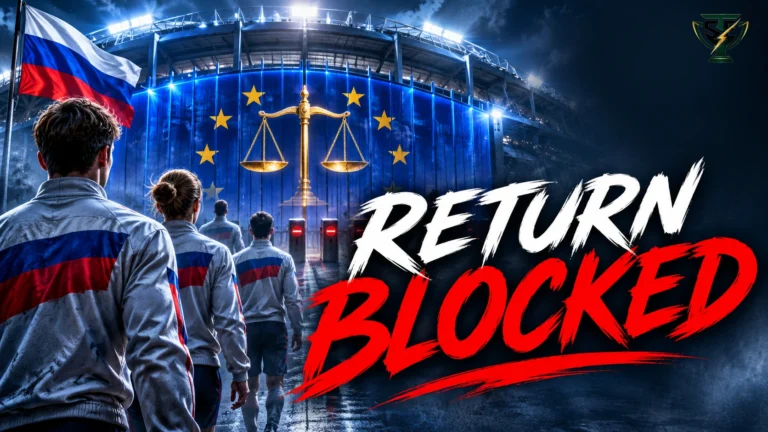
BRUSSELS, Belgium, November 23, 2026: Russia’s attempts to regain full participation in international sport face a new obstacle after the European Commission proposed restrictions on Russian teams, national symbols and sporting officials, deepening a confrontation between Olympic authorities, international federations and European governments.
The proposals emerged as Russian sports organizations pursued legal victories that could reopen competitions from which they have been excluded since Moscow’s full-scale invasion of Ukraine in February 2022. Yet the Russia Olympic return now faces a fundamental problem: a federation can declare an athlete eligible to compete without guaranteeing that the athlete can enter the country hosting the event.
Key Takeaways
- The proposals emerged as Russian sports organizations pursued legal victories that could reopen competitions from which they have been excluded since Moscow’s full-scale invasion of Ukraine in February 2022.
- European Commission President Ursula von der Leyen announced the proposed measures as part of the EU’s 22nd sanctions package against Russia.
- The sharpest illustration of the conflict emerged on October 30, when CAS upheld an appeal by the Russian Ice Hockey Federation against the International Ice Hockey Federation.
- The 2027 European Games in Turkey are particularly relevant because continental events can form part of the qualification pathways for Olympic sports.
The conflict has become particularly visible in ice hockey. The Court of Arbitration for Sport ordered the International Ice Hockey Federation to readmit Russian teams to several championships, but government entry restrictions and resistance from national federations have complicated implementation.
Story at a glance
Russia Olympic Return Meets a New European Sanctions Proposal
European Commission President Ursula von der Leyen announced the proposed measures as part of the EU’s 22nd sanctions package against Russia.
Four Separate Barriers Could Determine Which Russians Compete
Russia’s participation now depends on several overlapping decisions rather than one universal ban or reinstatement.
Ice Hockey Shows Why Winning in Court May Not Be Enough
The sharpest illustration of the conflict emerged on October 30, when CAS upheld an appeal by the Russian Ice Hockey Federation against the International Ice Hockey Federation.
CAS Has Already Reached Different Decisions in Hockey and Curling
The differences between recent arbitration rulings deserve particular attention.
Norway’s Resistance Reveals the Limits of a Federation’s Authority
Norway has become a prominent example of European resistance to Russia’s sporting reinstatement.
With qualification pathways toward the Los Angeles 2028 Olympics approaching, the dispute is shifting from whether Russian athletes should be eligible to compete to whether international sporting organizations possess the practical authority to secure their participation.
Russia Olympic Return Meets a New European Sanctions Proposal
European Commission President Ursula von der Leyen announced the proposed measures as part of the EU’s 22nd sanctions package against Russia.
The sporting provisions would restrict Russian teams and athletes competing under their national flag at events in the European Union, prohibit displays of official Russian symbols and limit financial flows from Russian sponsors to European sports and cultural organizations.
The Commission also proposed restrictions on Russian nationals holding positions in European-based sporting federations.
According to the European Commission’s official sanctions announcement, the measures are intended to prevent sporting and cultural events from being used to promote the Russian state during the continuing war in Ukraine.
The proposal marks an important escalation because the EU is seeking to influence participation through mechanisms beyond the disciplinary authority of international sporting federations.
However, the proposed restrictions have not automatically become binding law. Their final scope, adoption and enforcement depend on the applicable EU decision-making procedures.
Nor should the proposed restriction on competing under Russian national symbols be confused with a universal prohibition on every Russian passport holder participating as a neutral athlete.
Those distinctions will matter as federations, event organizers and athletes assess their options.
Why the Russia Olympic Return Cannot Be Settled by the IOC Alone
International sport operates through several layers of authority.
The International Olympic Committee sets rules and policies for the Olympic movement. International federations govern their individual sports and determine eligibility for their competitions.
The Court of Arbitration for Sport can review disputes within its jurisdiction, while national governments retain authority over immigration, visas and public security.
Each institution can therefore reach a decision that affects participation without controlling every other part of the process.
A Russian athlete might satisfy a federation’s eligibility requirements but still be unable to enter a host country. A Russian team could win an arbitration case but face practical difficulties when national federations refuse to play against it.
The resulting uncertainty has significant consequences for athletes preparing to qualify for major championships.
Four Separate Barriers Could Determine Which Russians Compete
Russia’s participation now depends on several overlapping decisions rather than one universal ban or reinstatement.
1. Recognition by the IOC
In July, the IOC provisionally lifted its suspension of the Russian Olympic Committee, reversing an important institutional restriction imposed in 2023.
That suspension had followed the Russian Olympic Committee’s decision to incorporate sporting organizations from Ukrainian territories whose inclusion the IOC considered a violation of the Olympic Charter.
The IOC’s official reinstatement announcement also withdrew its earlier recommendations concerning Russian athletes’ participation in international federation competitions.
Nevertheless, provisional recognition does not automatically establish that every Russian team can participate under its national flag at Los Angeles 2028.
Event-specific eligibility requirements, federation decisions and Olympic participation arrangements must still be satisfied.
2. Eligibility Under Individual Sports Federations
Different international federations have adopted different approaches to Russian participation.
Some have restored access under national symbols, others permit participation under neutral conditions, and several continue to maintain restrictions.
World Athletics remains among the most consequential examples of the latter approach.
Russian Athletics has challenged the continuing exclusion through CAS proceedings, a dispute examined in The Sports Encounter’s investigation into the World Athletics sanctions.
The case illustrates why the IOC’s broader policy shift cannot independently determine the eligibility of Russian track and field athletes.
3. Government Entry and Visa Decisions
Even when athletes satisfy sporting eligibility rules, governments can impose restrictions affecting entry into their territory.
Norway has introduced measures preventing Russian and Belarusian professional athletes from entering the country for sporting competition, including athletes with neutral status.
The Czech Republic has also moved to restrict Russian athletes’ entry.
Those measures are particularly relevant for sports whose international calendars depend heavily on European venues.
European visa arrangements can create additional legal and operational questions, especially when an athlete receives permission to enter one country but intends to compete in another.
4. EU Restrictions on National Symbols, Sponsorship and Governance
The latest European Commission proposals introduce a fourth dimension.
Rather than relying exclusively on individual governments or sporting federations, the EU is seeking a coordinated legal framework covering Russian national representation and certain institutional relationships.
Restrictions on sponsorship and federation governance could also affect sporting organizations beyond the immediate question of who appears on a starting list.
The extent of those effects cannot be established until the measures are finalized and their legal scope is clear.
Ice Hockey Shows Why Winning in Court May Not Be Enough
The sharpest illustration of the conflict emerged on October 30, when CAS upheld an appeal by the Russian Ice Hockey Federation against the International Ice Hockey Federation.
The tribunal ruled that the IIHF had not presented sufficient evidence to justify maintaining the contested exclusion on safety and security grounds.
Its decision required the governing body to admit Russian teams to five competitions during the 2026-27 championship cycle.
They included the men’s World Championship in Germany and several junior and women’s championships in North America and Europe.
The Sports Encounter documented the decision in its report on Russia’s landmark CAS victory over the IIHF.
Yet a legal victory has not resolved the practical problem of entering tournaments.
Canada has maintained restrictions affecting Russian participation at the World Junior Championship, while Norway has publicly opposed facing Russia at the men’s World Championship.
As TSE’s subsequent investigation into the World Juniors dispute established, the IIHF confirmed that Russia would not participate in the Canadian tournament despite the arbitration decision.
That sequence provides a concrete example of the difference between winning an eligibility dispute and actually competing.
It also exposes a difficult question for governing bodies: how should a tournament respond when its sporting regulations require participation but the host country’s entry policies prevent that participation?
CAS Has Already Reached Different Decisions in Hockey and Curling
The differences between recent arbitration rulings deserve particular attention.
CAS’s October 30 announcement did more than confirm Russia’s victory in ice hockey. It also summarized separate proceedings involving curling, luge, skiing and other sports.
In curling, the tribunal dismissed Russian appeals against restrictions affecting adult competitions.
The relevant governing body had argued that Russian participation could create operational and competition-integrity problems, including potential refusals by opponents to play, difficulties securing hosts and visa restrictions.
CAS accepted that the challenged decisions addressed the functioning of competitions rather than simply imposing disciplinary punishment.
In ice hockey, however, the tribunal found that the IIHF had failed to substantiate the security concerns supporting the restrictions challenged in that case.
The CAS media release documenting the different rulings demonstrates why the disputes cannot be reduced to one sweeping judicial position on Russia.
The cases involved different regulations, records and arguments.
Consequently, a successful appeal in one sport does not establish that every other federation must immediately readmit Russian teams.
This is one of the most important distinctions for understanding the current legal landscape.
Norway’s Resistance Reveals the Limits of a Federation’s Authority
Norway has become a prominent example of European resistance to Russia’s sporting reinstatement.
Its authorities have maintained opposition to the return of Russian and Belarusian athletes while the war continues.
Norway’s hockey federation has also opposed playing Russia at the World Championship scheduled for Germany.
The Sports Encounter examined the potential consequences in its report on Norway’s refusal and the risks facing the men’s hockey tournament.
The situation highlights a problem that cannot be resolved through eligibility rules alone.
A governing body may organize a championship under common sporting regulations, but participating countries retain their own political positions and legal obligations.
Potential boycotts raise further questions about fixture schedules, disciplinary consequences and the integrity of tournament results.
Those consequences would depend on each competition’s applicable rules and any decisions made by the governing body.
For now, the underlying conflict remains unresolved.
Neutral Athletes Have Already Demonstrated a Different Path Back
The dispute over Russian national representation should not obscure the fact that Russian athletes have already returned to several international competitions under different conditions.
Gymnastics offers an important example.
Angelina Melnikova won European all-around and vault gold in Zagreb while competing under neutral status.
Her performance demonstrated that Russian athletes could return to high-level competition without necessarily representing the Russian state through its flag and anthem.
The Sports Encounter explored those distinctions in its analysis of Melnikova’s European championship performance.
Winter sports provide another example of an evolving framework.
Following legal challenges, some Russian and Belarusian athletes have gained pathways into international skiing and snowboarding competitions under neutral eligibility criteria.
Those developments were examined in TSE’s report on the neutral-athlete framework in skiing.
These examples demonstrate that participation and national representation are separate policy questions.
Athletes may compete without their country’s symbols, but that arrangement does not eliminate every concern raised by European governments or Ukrainian sporting authorities.
The European Games Could Become an Early Test Before Los Angeles 2028
The 2027 European Games in Turkey are particularly relevant because continental events can form part of the qualification pathways for Olympic sports.
International federation calendars, qualifying events and continental championships will become increasingly important as the Los Angeles Olympics approach.
Russian athletes who regain international eligibility may therefore confront practical questions about access to European competitions before they reach the Olympic stage.
Those questions will vary by sport.
Some qualification systems depend on world rankings accumulated through multiple tournaments. Others use designated championships, direct qualification events or continental allocations.
Missing an event can consequently affect athletes in different ways depending on the applicable qualification rules.
It would be misleading to suggest that every Russian athlete must compete in Europe to qualify for Los Angeles.
Nevertheless, European restrictions could narrow available routes in sports where qualifying opportunities are concentrated on the continent.
Turkey’s role as a European Games host adds another complication because the country is not an EU member state. Proposed EU measures would not automatically apply to events in Turkey in the same manner as events within the Union.
The relevant qualification and entry arrangements will therefore require separate examination.
Ukraine’s Sporting Losses Remain Central to Europe’s Opposition
European opposition to Russia’s return is grounded in the continuing war and its consequences for Ukrainian athletes and sporting institutions.
Continue the Athletics Story



Ukrainian competitors have faced disrupted training environments, damaged infrastructure, displacement and the effects of military mobilization.
European governments supporting restrictions argue that the full restoration of Russian national teams and symbols could allow international sport to serve as a platform for state promotion while the conflict continues.
That concern carries particular significance because sporting events are highly visible expressions of national identity.
Russia and supporters of broader athlete participation emphasize a different principle: competitors should not automatically lose opportunities because of decisions taken by their government.
Those competing arguments raise legitimate questions about proportionality, collective restrictions, sporting neutrality and the protection of Ukrainian participants.
The legal distinction between government policy and individual sporting eligibility remains important.
CAS decisions can establish whether particular federation restrictions comply with the relevant sporting rules. They do not, by themselves, settle the broader political or moral debate surrounding Russia’s war in Ukraine.
Why Russia’s Return Could Remain Different Across Sports
Russia’s sporting position is unlikely to be resolved through one uniform reinstatement process.
International federations operate under different statutes and face different competitive conditions.
Ice hockey involves national teams, fixed championship venues and complex tournament structures.
Athletics includes numerous individual events, rankings and qualifying opportunities.
Gymnastics and swimming can accommodate individual neutral participation under specialized eligibility arrangements.
These structural differences influence how international bodies approach reinstatement and how practical restrictions affect competitors.
The same European policy may also have different consequences for a Russian athlete competing independently, a national team seeking entry to a championship and a federation official attempting to participate in governing-body proceedings.
That variation helps explain why the current landscape contains successful appeals, continuing exclusions and partial returns at the same time.
There is no single international decision that has reopened every competition to Russia.
What Must Change Before Russia Can Make a Full Olympic Comeback?
The next stage will depend on several observable developments.
EU sanctions: The final text and legal adoption of the proposed measures will determine which restrictions apply to Russian teams, national symbols, sponsorship and federation positions.
National entry policies: Governments will continue to determine whether particular athletes and officials satisfy their immigration and security requirements.
Outstanding CAS proceedings: Appeals involving athletics, biathlon and other sports could alter eligibility within specific federations, depending on their findings.
Federation decisions: Governing bodies must determine how to implement applicable rulings and organize competitions when national restrictions or boycott threats remain.
Olympic qualification: The precise pathways toward Los Angeles 2028 will determine which competitions matter most and whether alternatives exist for athletes unable to enter certain countries.
IOC participation rules: Any further clarification concerning Russian national representation at the Olympics will be important to distinguishing institutional recognition from actual Games eligibility.
These developments can be tracked independently. Progress in one area does not automatically resolve the others.
Russia’s Olympic Future Now Depends on More Than Sporting Eligibility
The Russia Olympic return has reached an unfamiliar stage in which international legal victories may produce fewer immediate competitive benefits than their headlines suggest.
The IOC has eased institutional restrictions, and Russian sports organizations have succeeded in several arbitration proceedings. Yet European governments and sporting authorities remain unwilling to treat Russia’s participation as a settled issue while the war continues.
The European Commission’s latest proposals could further formalize that resistance if adopted.
For Russian athletes, the distinction between permission to compete and practical access to competition is becoming increasingly consequential.
For international federations, the challenge is to reconcile eligibility decisions with government restrictions, athlete safety and the credibility of their competitions.
And for the Olympic movement, the approaching Los Angeles qualification cycle will test whether its policies can function consistently across sports whose rules and host-country conditions differ substantially.
The central uncertainty is no longer simply whether Russia will be readmitted to international competition. It is how much competitive access reinstatement can deliver when the institutions controlling sporting eligibility and the governments controlling entry remain divided.