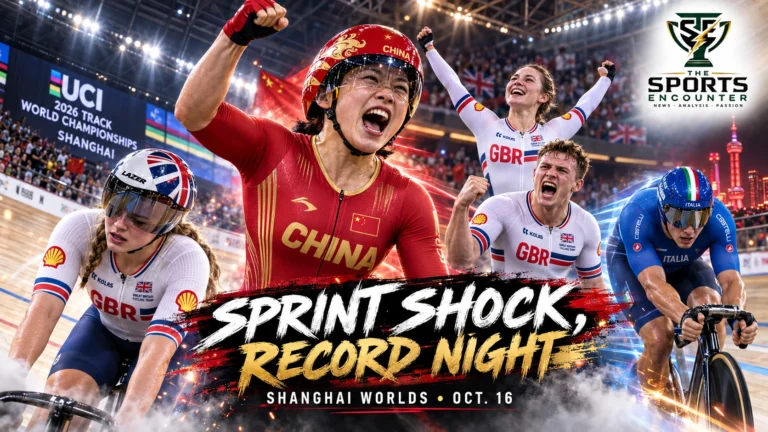
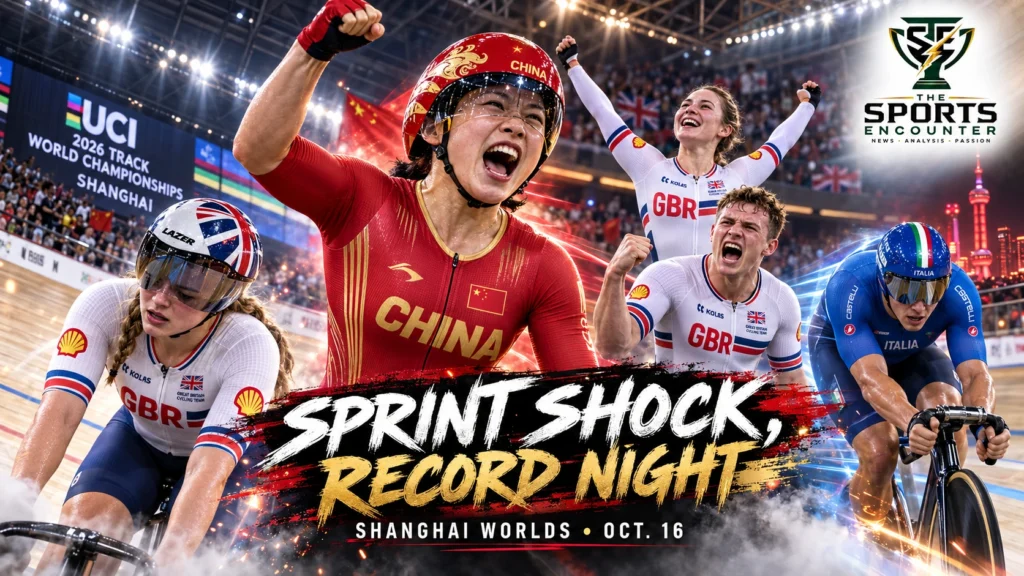
SHANGHAI, China, October 16, 2026: China’s Yuan Liying denied British sprint star Emma Finucane another world title on Friday, winning their final in straight races at the 2026 UCI Track Cycling World Championships. Great Britain responded with two gold medals through Anna Morris in the women’s omnium and Mark Stewart in the men’s points race, while Italy’s Jonathan Milan shattered his own 4,000-meter individual pursuit world record with a remarkable 3:58.850 before securing the championship title.
The five finals delivered contrasting demonstrations of world-class cycling. Yuan won through explosive speed and tactical positioning, Morris added an individual title to Thursday’s team pursuit gold, Stewart’s calculated sprinting earned his first world crown, and Milan became the first rider to complete the 4km pursuit in under three minutes and 59 seconds. Dutch specialist Jeffrey Hoogland completed the day’s champions with victory in the men’s kilometer time trial, as Great Britain strengthened its position at the top of the medal standings after three days of racing.
UCI Track World Championships 2026: October 16 Results
| Event | World Champion | Country | Defining Performance |
|---|---|---|---|
| Women’s Sprint | Yuan Liying | China | Defeated Emma Finucane 2-0 |
| Women’s Omnium | Anna Morris | Great Britain | Second gold medal of the championships |
| Men’s Points Race | Mark Stewart | Great Britain | Won the 40km race with 35 points |
| Men’s Individual Pursuit | Jonathan Milan | Italy | World record of 3:58.850 in qualifying, followed by gold |
| Men’s 1km Time Trial | Jeffrey Hoogland | Netherlands | Won the final in 58.713 seconds |
The championships are taking place at the Shanghai Velodrome from October 14 through October 18, with 22 world titles available across men’s and women’s events.
Official race times, classifications and event results are available through the 2026 UCI Track World Championships timing platform.
Story at a glance
UCI Track World Championships 2026: October 16 Results
The championships are taking place at the Shanghai Velodrome from October 14 through October 18, with 22 world titles available across men’s and women’s events.
Yuan Liying Beats Emma Finucane to Deliver China’s Sprint Breakthrough
Emma Finucane arrived in Shanghai as one of the strongest contenders for the women’s individual sprint title.
Emma Finucane Leaves the Sprint Final With Silver and Another Challenge Ahead
For Finucane, Friday brought a second disappointment against Chinese opposition in Shanghai.
Anna Morris Wins Omnium Gold to Complete a Shanghai Double
While Britain’s sprint campaign encountered another difficult moment, Anna Morris delivered a second world title in two days.
Mark Stewart Finally Claims the Points Race World Title
For Mark Stewart, Friday’s victory carried a different emotional weight.
The competition follows a busy international cycling season in which time-trial records, new champions and breakthrough performances have repeatedly reshaped expectations.
The Sports Encounter previously examined that pattern during the 2026 UCI Road World Championships in Montréal, where Remco Evenepoel claimed his fourth consecutive elite time trial title and Marlen Reusser defended the women’s crown.
Shanghai has brought the same pursuit of marginal gains into the controlled environment of the velodrome, where small differences in acceleration, positioning and pacing can decide world titles.
Yuan Liying Beats Emma Finucane to Deliver China’s Sprint Breakthrough
Emma Finucane arrived in Shanghai as one of the strongest contenders for the women’s individual sprint title.
The British rider had already won world sprint championships in 2023 and 2024 and remained among the sport’s most accomplished competitors.
China’s Yuan Liying presented a formidable obstacle.
The 21-year-old had demonstrated exceptional speed during qualification, setting the fastest time in the flying 200-meter test at 10.148 seconds.
That performance established her as a genuine contender before the elimination rounds began.
Yuan subsequently advanced through the draw and defeated Japan’s Mina Sato in the semifinals.
Finucane reached the gold-medal contest after beating British teammate Sophie Capewell.
The final therefore brought together two riders with contrasting championship histories: an established British world champion and a Chinese sprinter attempting to complete a breakthrough on home soil.
How Yuan Won the Sprint Final in Two Races
Yuan defeated Finucane 2-0, removing the need for a deciding third race.
Her first victory came by just 0.025 seconds.
That margin illustrates the precision required in elite match sprinting.
Twenty-five thousandths of a second can separate a perfectly timed acceleration from a silver-medal position.
The second race produced a more decisive difference, with Yuan finishing 0.776 seconds ahead.
She had converted her qualification speed into championship execution.
Finucane’s raw power was never in serious doubt, but Yuan’s ability to control the decisive moments gave her the title.
Japan’s Mina Sato won bronze after defeating Capewell in the third-place contest.
Why the Victory Matters for Chinese Track Cycling
China entered the championships with significant expectations in the sprint disciplines.
The women’s team sprint squad had already defeated Great Britain to win gold on the opening day.
That result was complicated by a mechanical problem involving Capewell’s saddle during the final, but China’s performance also demonstrated considerable speed and depth.
Yuan’s individual victory provided a different form of confirmation.
She progressed through a full individual competition, defeated established contenders and won the final without requiring a deciding race.
For China, winning on home soil matters, but the wider competitive implication is more important.
Yuan has now demonstrated that she can produce championship-winning performances against one of the strongest sprinting nations.
The result also creates an intriguing rivalry ahead of future World Championships and the 2028 Los Angeles Olympics.
Emma Finucane Leaves the Sprint Final With Silver and Another Challenge Ahead
For Finucane, Friday brought a second disappointment against Chinese opposition in Shanghai.
She had already been part of Britain’s women’s team sprint lineup that finished second behind China.
Now Yuan had denied her the individual sprint title.
The result should not be confused with a sudden loss of competitive ability.
Finucane reached another world championship final and remained among the fastest riders in the competition.
But the final demonstrated that elite sprinting cannot be reduced to a flying 200-meter qualification time or previous championship record.
Riders must manage the tactical demands of head-to-head racing, where acceleration timing and position can determine the result before the finish line.
Finucane still has another opportunity to compete for an individual world title in Sunday’s keirin.
What Changes Between the Sprint and Keirin?
The individual sprint requires riders to defeat one opponent through a series of head-to-head races.
The keirin involves multiple riders building speed behind a pacing motorcycle before racing for the finish.
Different positioning problems emerge because the competition involves several rivals simultaneously.
Finucane’s experience, acceleration and championship pedigree remain important assets.
However, Yuan’s victory has established another leading contender within a women’s sprint field that continues to grow more competitive.
Anna Morris Wins Omnium Gold to Complete a Shanghai Double
While Britain’s sprint campaign encountered another difficult moment, Anna Morris delivered a second world title in two days.
Morris won the women’s omnium on Friday after helping Great Britain secure the team pursuit championship on Thursday.
The individual victory was especially valuable because the omnium demands versatility across four separate races.
Competitors must manage a scratch race, tempo race, elimination race and final points race.
Success requires more than producing one outstanding burst of speed.
A rider must remain competitive across changing tactical conditions, conserve enough energy for the later races and understand how each result affects the overall classification.
Why Morris’ Omnium Victory Was a Test of Versatility
Morris began the omnium with a third-place finish in the scratch race.
She remained competitive through the subsequent disciplines before taking control of the overall title during the points race.
The result confirmed her ability to manage several different styles of racing within one championship event.
Belgium’s Lotte Kopecky, one of the most accomplished riders in women’s cycling, was among the major contenders.
Morris’ eventual gold also carried a significant personal milestone.
It was her first individual world omnium title and her sixth career world championship gold.
Two of those titles have now arrived within the same Shanghai championships.
Her success highlights the depth of Britain’s women’s endurance program.
Thursday’s Team Pursuit Victory Laid the Foundation
Morris had already contributed to Great Britain’s team pursuit success alongside Josie Knight, Millie Couzens and Erin Boothman.
The British squad defeated Italy in the gold-medal final with a time of 4:04.610.
That result represented another important achievement for a program adapting to changing personnel and the retirement of established riders.
For Morris, following team success with individual gold demonstrated exceptional recovery and competitive focus.
Riders can spend enormous physical and emotional energy during a championship team pursuit.
Returning the following day and winning a multi-discipline endurance event requires both conditioning and tactical judgment.
The performance also reflects the wider strength Britain has developed in track cycling.
TSE examined the importance of national cycling depth during our Glasgow 2026 Commonwealth Games coverage, when Australia began transferring its multi-sport dominance into the velodrome program.
Shanghai shows another side of that competitive landscape, with Britain collecting titles across team pursuit, omnium and points racing.
Mark Stewart Finally Claims the Points Race World Title
For Mark Stewart, Friday’s victory carried a different emotional weight.
The 31-year-old Scottish rider won his first elite world championship gold in the men’s points race.
The 40-kilometer contest covered 160 laps of the Shanghai velodrome and featured 16 scoring sprints.
Stewart completed the race with 35 points, finishing ahead of France’s Benjamin Thomas on 28 and Portugal’s Carlos Salgueiro on 27.
| Position | Rider | Country | Points |
|---|---|---|---|
| Gold | Mark Stewart | Great Britain | 35 |
| Silver | Benjamin Thomas | France | 28 |
| Bronze | Carlos Salgueiro | Portugal | 27 |
How Stewart Won Through Race Management
Stewart secured his championship through consistent sprint scoring rather than relying on a decisive lap gain.
He entered the closing stages in a strong position and finished second in the final sprint, collecting enough points to protect his advantage over Thomas.
The result demonstrates the tactical demands of points racing.
Competitors must constantly assess when to accelerate, when to conserve energy and whether rivals are likely to gain points in subsequent sprints.
A rider who attacks too frequently can exhaust himself before the decisive laps.
One who waits too long may discover that the gap is already impossible to close.
Stewart found the balance required to beat two experienced competitors.
Eight Years After World Bronze, Stewart Reaches the Top
Stewart had previously won world championship bronze in 2018.
He also claimed Commonwealth Games gold representing Scotland that year.
But an individual elite world title had remained beyond his reach.
His Shanghai victory ended that wait.
The achievement is particularly meaningful because it followed disappointment at the 2026 Commonwealth Games, where he finished second in the elimination race and fourth in the points race.
That history makes the victory more than another British gold medal.
Stewart returned to a familiar event, managed a highly competitive field and finally converted years of experience into a world championship title.
Similar questions about competitive depth and the ability to perform across multiple cycling disciplines emerged during TSE’s Glasgow 2026 Day 8 report, when Australia swept the men’s individual pursuit podium.
Shanghai demonstrated that Britain possesses its own world-class endurance specialists.
Jonathan Milan Breaks the Four-Minute Barrier Again, Then Wins Pursuit Gold
Friday’s most significant performance against the clock belonged to Jonathan Milan.
The Italian lowered his own men’s individual pursuit world record to 3 minutes, 58.850 seconds during qualification.
It was the first time any rider had completed the 4,000-meter pursuit in under 3:59.
Milan’s previous record stood at 3:59.153, set during the 2024 World Championships in Ballerup.
His Shanghai effort improved the benchmark by 0.303 seconds.
At that level of competition, three-tenths of a second represents an important improvement.
The record was especially notable because Shanghai’s velodrome is situated close to sea level.
High-altitude venues can provide favorable aerodynamic conditions because thinner air reduces resistance.
Milan produced the performance without that particular advantage.
Milan’s Record Was Set in Qualifying, Not the Final
The distinction is essential to understanding his achievement.
Milan clocked 3:58.850 during qualification, establishing the world record before the medal race.
He subsequently faced Denmark’s Frederik Madsen in the gold-medal final.
Milan won that contest in 4:00.769, defeating Madsen’s 4:06.038.
Those times are confirmed by the official men’s individual pursuit final results.
The world record and the championship victory therefore came from separate rides.
That makes the achievement particularly impressive.
Milan produced the fastest pursuit ever recorded, recovered sufficiently and returned to defeat another elite rider for the rainbow jersey.
Filippo Ganna Adds Bronze for Italy
Italy also earned bronze through Filippo Ganna.
The two-time individual pursuit world champion defeated Denmark’s Rasmus Pedersen in the bronze-medal race.
Ganna finished in 4:02.275, comfortably ahead of Pedersen’s 4:07.291.
The result gave Italy two places on the men’s individual pursuit podium.
It also added to the country’s endurance credentials following its silver medal in the men’s team pursuit on Thursday.
Milan’s achievement invites comparison with the outstanding performances against the clock recorded at the 2026 Road World Championships.
At Montréal, Remco Evenepoel defeated Ganna by more than 57 seconds over 39.2 kilometers.
Shanghai’s pursuit was a much shorter event, but the underlying demand was similar: produce exceptional sustained power while maintaining aerodynamic efficiency.
The two disciplines require different preparation, and the results cannot be directly compared, but both illustrate how specialization can produce extraordinary performances.
Jeffrey Hoogland Wins Kilometer Time Trial Gold in 58.713 Seconds
Jeffrey Hoogland completed Friday’s championship winners by taking the men’s one-kilometer time trial.
The Dutch rider stopped the clock at 58.713 seconds, averaging 61.315 kilometers per hour.
France’s Étienne Oliviero finished second in 59.365, while Britain’s Joseph Truman took bronze in 59.414.
| Medal | Rider | Nation | Time |
|---|---|---|---|
| Gold | Jeffrey Hoogland | Netherlands | 58.713 |
| Silver | Étienne Oliviero | France | 59.365 |
| Bronze | Joseph Truman | Great Britain | 59.414 |
The official kilometer time trial classification confirms the final times and medal positions.
Why the Kilometer Requires a Different Kind of Speed
The kilometer time trial places exceptional demands on explosive acceleration and sustained power.
Unlike a match sprint, riders do not attempt to outmaneuver an opponent directly.
Each rider competes against the clock.
That changes the tactical calculation.
Hoogland had to launch from a standing start, build speed rapidly and maintain enough power to prevent a significant loss of momentum during the closing laps.
His winning margin over Oliviero was 0.652 seconds.
Truman finished just 0.049 seconds behind the French rider, illustrating how closely contested the remaining podium positions were.
Hoogland’s success added another individual gold to the Netherlands’ campaign, which had already included victories in the men’s team sprint and keirin.
Five World Titles, Five Different Tests of Cycling Excellence
Friday’s championship results are especially revealing when the winning performances are compared.
| Champion | Discipline | Primary Winning Strength |
|---|---|---|
| Yuan Liying | Match Sprint | Acceleration and tactical positioning |
| Anna Morris | Omnium | Versatility and consistency across four races |
| Mark Stewart | Points Race | Sprint scoring and race management |
| Jonathan Milan | Individual Pursuit | Sustained power and aerodynamic efficiency |
| Jeffrey Hoogland | Kilometer Time Trial | Explosive acceleration and speed endurance |
These distinctions explain why track cycling rewards specialized training systems and diverse athlete development.
Yuan’s championship depended on defeating opponents through direct tactical encounters.
Morris needed to succeed across four different disciplines.
Stewart had to accumulate points while managing a long endurance race.
Milan and Hoogland competed against the clock, but over distances requiring substantially different power profiles.
There is no single formula for becoming a world champion on the track.
The contrast is also relevant to emerging cycling nations attempting to develop their competitive structures.
At the 2026 Asian Games, Afghanistan’s Fariba Hashimi demonstrated how access to training, international competition and development opportunities can shape an athlete’s progress.
TSE explored her achievements in our report on the Asian Games and Hashimi’s historic cycling medal.
Her story belongs to road cycling, but the wider lesson about athlete development applies across disciplines.
What Does Shanghai Reveal About the Global Cycling Medal Race?
Great Britain entered Friday already enjoying a successful championship.
Matt Bostock had won the men’s scratch race, while the women’s team pursuit squad secured gold.
Morris and Stewart added two more titles on the third day.
Continue the Cycling Story
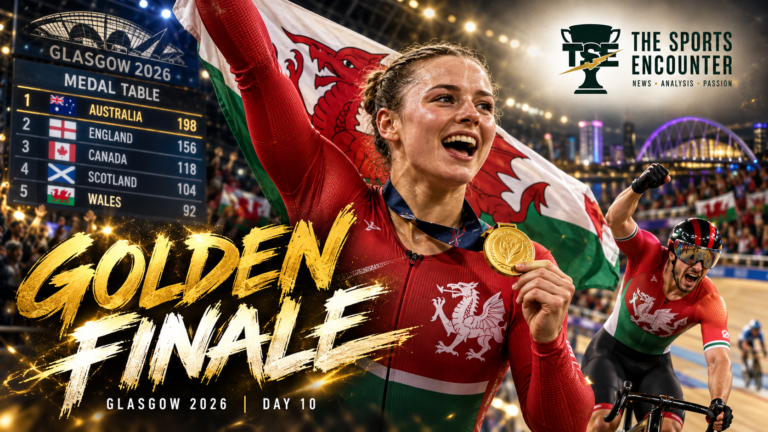 Birmingham 2026Glasgow 2026 Day 10 Wrap-Up: Finucane Makes History as Australia Top the Final Medal Table
 Asian Games 2026Asian Games 2026 End With China on Top, India’s Late Gold Rush and a New Generation of Asian Stars
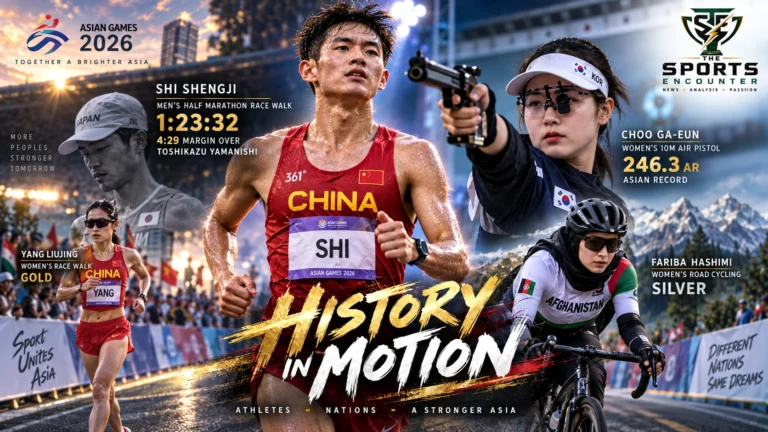 Asian Games 2026Asian Games 2026: China Sweep Historic Race-Walk Debuts, Choo Ga-eun Breaks Asian Record
Finucane and Truman also supplied silver and bronze medals.
Those results reinforced Britain’s lead in the championship medal standings after three days.
But the distribution of individual world titles also showed the strength of its major rivals.
China has demonstrated exceptional women’s sprint speed.
The Netherlands remains a major force in men’s sprint events.
Italy possesses outstanding individual pursuit specialists.
Britain’s advantage is its ability to challenge across several endurance and sprint disciplines.
That breadth matters because the championships contain 22 events rather than a small group of headline races.
The strongest national programs need several medal contenders and enough depth to withstand injuries, unexpected defeats and changes in athlete availability.
Shanghai Worlds and the Road to Los Angeles 2028
The championships are also part of a wider period of preparation for the 2028 Los Angeles Olympic Games.
Current world titles do not guarantee future Olympic selection or medals.
But performances against elite international opponents provide useful evidence about athlete development.
Yuan’s victory establishes her ability to defeat a former world champion in a high-pressure final.
Morris has demonstrated both team and individual endurance excellence.
Stewart has shown that he can convert tactical experience into an elite world title.
Milan has moved the men’s individual pursuit world record below another important time barrier.
These performances help define the competitive standards other riders and national programs must now attempt to match.
For audiences following the broader international cycling calendar, the championship forms part of a season that also included major events at the Commonwealth Games and Asian Games.
The Sports Encounter’s Aichi-Nagoya Asian Games guide explains the role of the Izu Velodrome within that competition.
The Glasgow Commonwealth Games Day 5 report provides additional context for the broader championship environment that preceded the track program.
What to Watch During the Final Two Days in Shanghai
The 2026 UCI Track Cycling World Championships continue through Sunday, October 18.
Several major events remain on the program, including the closing sprint, keirin, Madison and endurance competitions.
Can Emma Finucane Respond in the Keirin?
Finucane’s immediate opportunity is Sunday’s keirin.
Her performance will be particularly interesting after two silver medals against Chinese opposition.
She has the speed to contend, but keirin racing introduces different tactical demands and the unpredictability of multiple opponents.
Can Britain Maintain Its Advantage?
Great Britain’s gold medals in the scratch race, team pursuit, points race and omnium provide a strong foundation.
The closing events will determine whether the British team can maintain its leading position as the Netherlands, China and Italy continue competing for medals.
Will More World Records Fall?
Milan’s 3:58.850 performance has already provided the championships with a major world record.
Other events may produce exceptional times, but predictions should remain cautious until the athletes complete their remaining races.
Fans can follow the closing program through The Sports Encounter’s international sports events calendar, which includes the Shanghai championships.
2026 UCI Track World Championships: Frequently Asked Questions
Who won the women’s sprint world title in Shanghai?
China’s Yuan Liying defeated Great Britain’s Emma Finucane 2-0 in the final on October 16, 2026.
How close was the women’s sprint final?
Yuan won the opening race by 0.025 seconds and the second by 0.776 seconds.
Who won the women’s omnium world title?
Great Britain’s Anna Morris won the omnium, adding an individual gold to the team pursuit title she had secured the previous day.
Who won the men’s points race?
Mark Stewart of Great Britain won with 35 points, ahead of France’s Benjamin Thomas and Portugal’s Carlos Salgueiro.
What world record did Jonathan Milan break?
Milan set a men’s 4,000-meter individual pursuit world record of 3:58.850 during qualification in Shanghai.
Did Milan also win the individual pursuit gold medal?
Yes. He defeated Denmark’s Frederik Madsen in the final, winning in 4:00.769.
Who won the men’s kilometer time trial?
Jeffrey Hoogland of the Netherlands won in 58.713 seconds. Étienne Oliviero took silver and Joseph Truman earned bronze.
How many gold medals did Great Britain win on October 16?
Great Britain won two gold medals through Anna Morris in the women’s omnium and Mark Stewart in the men’s points race.
When do the 2026 Track World Championships end?
The championships conclude on Sunday, October 18, 2026.
Shanghai’s Winners Show Why There Is More Than One Way to Beat the Clock
Friday’s championships delivered a clear illustration of track cycling’s competitive diversity.
Yuan Liying claimed the most dramatic head-to-head victory, defeating an established sprint champion before a home audience.
Anna Morris and Mark Stewart gave Britain two more world titles through endurance, versatility and tactical judgment.
Jeffrey Hoogland demonstrated the explosive power required to win the kilometer time trial.
Jonathan Milan delivered the day’s most significant statistical achievement, lowering the individual pursuit world record to 3:58.850.
For Finucane, the defeat creates another challenge rather than ending her championship ambitions.
For Great Britain, the gold medals strengthen its pursuit of another successful world championship campaign.
And for the sport itself, Milan’s record offers a new benchmark.
Five champions emerged from Friday’s finals, each winning through a different combination of physical ability, preparation and judgment.
That variety is what makes the final two days in Shanghai worth watching.