
BEIJING, China, October 7, 2026: Coco Gauff arrived at Wednesday’s China Open Round of 16 as the highest seed still standing in a draw that had already lost Elena Rybakina and Aryna Sabalenka. A few hours later, Elise Mertens had removed her too.
Mertens defeated the No. 3 seed 6-3, 6-3 for her first victory over Gauff in six meetings, ending an unusually consistent Beijing record for the American and completing the disappearance of the tournament’s top three seeds before the quarterfinals.
Yet Wednesday was about more than another upset. Iga Swiatek produced one of her cleanest performances of the tournament against Iva Jovic, Zheng Qinwen survived yet another three-set examination in front of the home crowd, and Elina Svitolina efficiently removed Ann Li.
The result is a China Open quarterfinal field with no top-three seed, one former Beijing champion in Swiatek, China’s leading home hope still alive, two Czech players in the same section, and several contenders who entered the week well outside the obvious title conversation.
Story at a glance

China Open 2026 Round of 16 Results From October 7
The official WTA China Open scores provide the tournament’s live results and draw progression.
Why Does Gauff’s Loss Change the China Open Title Race?
Because Beijing has now lost seeds No. 1, No. 2 and No. 3 before the quarterfinal stage.
What Did Elise Mertens Do Differently Against Gauff?
Mertens did not need to overpower Gauff throughout the match. She needed to make Gauff play enough difficult service points for the American’s own instability to become expensive.
Why Was Swiatek So Comfortable Against Iva Jovic?
Swiatek’s 6-1, 6-3 victory over Jovic looked very different from the comeback she needed against Donna Vekic in the previous round.
How Did Zheng Qinwen Survive Another Three-Set Test?
Zheng’s Beijing campaign has developed a remarkably consistent rhythm: trouble arrives, the match becomes complicated, and she finds another way through.
China Open 2026 Round of 16 Results From October 7
| Winner | Opponent | Score | Key Consequence |
|---|---|---|---|
| Iga Swiatek (8) | Iva Jovic (10) | 6-1, 6-3 | Swiatek reaches her 31st WTA 1000 quarterfinal |
| Elise Mertens (13) | Coco Gauff (3) | 6-3, 6-3 | Mertens earns her first win over Gauff in six meetings |
| Zheng Qinwen (WC) | Alina Charaeva | 6-1, 2-6, 6-4 | Zheng reaches her second China Open quarterfinal |
| Elina Svitolina (6) | Ann Li (21) | 6-2, 6-3 | Svitolina advances to face Zheng |
The official WTA China Open scores provide the tournament’s live results and draw progression.
Why Does Gauff’s Loss Change the China Open Title Race?
Because Beijing has now lost seeds No. 1, No. 2 and No. 3 before the quarterfinal stage.
Rybakina’s defeat to Alina Charaeva and Sabalenka’s loss to Nikola Bartunkova had already transformed the tournament. The Sports Encounter examined how those two exits blew open the women’s draw, but Gauff was the obvious player who could benefit from that disruption.
Instead, she became the next major casualty.
Gauff had reached at least the semifinals in each of her three previous China Open appearances and won the title in 2024. She entered Wednesday with a 5-0 career record against Mertens, including a difficult comeback victory in Dubai earlier this season.
None of that history protected her once the match began.
According to the official China Open match report, Mertens generated 13 break-point opportunities while Gauff created only one. Gauff also committed eight double faults, repeatedly forcing herself to play important points under immediate scoreboard pressure.
There was one moment when the match looked capable of turning. Gauff broke at love to level the opening set at 3-3. Instead of building from it, she lost the next three games and the set.
Mertens then became harder to dislodge. She won 94 percent of her first-serve points in the second set, denying Gauff the return pressure that might have created another route back into the contest.
It was a striking reversal from Gauff’s summer, when she won Cincinnati and carried an 11-match winning streak into the latter stages of the US Open. TSE’s analysis of Gauff’s Cincinnati title run showed how effectively she had been controlling matches once her return game and movement began working together.
Beijing exposed the opposite problem. When the serve became unstable, Mertens never allowed her enough cheap points to escape the pressure.
What Did Elise Mertens Do Differently Against Gauff?
Mertens did not need to overpower Gauff throughout the match. She needed to make Gauff play enough difficult service points for the American’s own instability to become expensive.
That happened repeatedly.
The Belgian attacked second serves, earned break opportunities in bunches and remained disciplined when Gauff briefly recovered in the first set. The second-set serving numbers then changed the geometry of the contest because Gauff could no longer rely on return games to repair damage from her own delivery.
The victory also has broader significance for Mertens. It sends her into her first WTA 1000 quarterfinal in five years, where the challenge becomes considerably different.
She will face Swiatek, who owns a 2-0 career record against her.
That head-to-head gives Swiatek a historical advantage. Wednesday’s performance gives Mertens a very current reason to believe the matchup cannot be treated as a formality.
Why Was Swiatek So Comfortable Against Iva Jovic?
Swiatek’s 6-1, 6-3 victory over Jovic looked very different from the comeback she needed against Donna Vekic in the previous round.
This time she established the match on her terms almost immediately.
Swiatek won the opening five games and conceded only eight points during that initial surge. Jovic, one of the strongest young players on the tour this season, finally began finding greater depth in the second set and recovered an early break to move back into contention.
At 3-2, the match briefly looked competitive.
Swiatek won the final four games.
The underlying numbers were just as convincing. She struck 28 winners compared with Jovic’s nine and won 63 percent of the total points. The WTA’s official statistical review also records this as Swiatek’s 31st WTA 1000 quarterfinal and her 148th main-draw victory at this level, moving her level with Serena Williams on that measure.
The performance continues an interesting late-season pattern. Swiatek has endured significant setbacks in 2026, including her Wimbledon defeat to Alexandra Eala, which TSE covered when the women’s Wimbledon draw was blown open on Day 6. Yet her broader consistency has remained exceptional, including the Grand Slam progression streak TSE examined during Swiatek’s US Open run.
Against Jovic, the important sign was not simply that Swiatek won. It was how quickly she restored control after Jovic threatened to make the second set complicated.
“I’m going to push no matter what,” Swiatek said after reaching the last eight.
How Did Zheng Qinwen Survive Another Three-Set Test?
Zheng’s Beijing campaign has developed a remarkably consistent rhythm: trouble arrives, the match becomes complicated, and she finds another way through.
Her 6-1, 2-6, 6-4 victory over Charaeva took 2 hours and 11 minutes and sent her into the China Open quarterfinals for the second time in four appearances.
The opening set suggested a relatively comfortable afternoon. Zheng controlled it 6-1.
Charaeva then showed why her tournament had already become one of Beijing’s major breakthrough stories. The player who eliminated top seed Rybakina responded by taking the second set 6-2 and forcing Zheng into another deciding set.
Zheng recovered to win it 6-4.
The WTA’s official account of Zheng’s victory confirms that she has now reached consecutive quarterfinals after her US Open run.
There is another pattern worth noting. Every Zheng match in Beijing so far has reached a third set. Her meeting with Anna Kalinskaya ended when Kalinskaya retired with Zheng leading 3-0 in the decider, but the broader picture remains the same: Zheng has had no straightforward route through her home tournament.
That makes her quarterfinal particularly interesting because her next opponent has arrived there in a very different way.
Can Svitolina’s Efficiency Matter Against Zheng?
Elina Svitolina defeated Ann Li 6-2, 6-3 and avoided the kind of physical and emotional marathon that has defined Zheng’s week.
Svitolina has already demonstrated throughout 2026 that she can survive long matches when necessary. She reached the Toronto semifinals during a run TSE followed closely, first when Svitolina and Swiatek completed the Toronto semifinal lineup and then when Swiatek eventually edged her in a three-set semifinal.
Beijing now gives her a different challenge.
Zheng will have the crowd, the recent US Open momentum and the confidence created by repeatedly escaping difficult positions. Svitolina enters their quarterfinal having spent considerably less time under pressure on Wednesday.
The match therefore poses a simple but important question: does Zheng’s repeated survival make her increasingly dangerous, or does the accumulated workload begin to matter against an opponent who is comfortable extending rallies and asking for one more ball?
Continue the China Open Story
 China OpenChina Open 2026: Muchova Survives Osaka, Andreeva Cruises, While Bartunkova Continues to Break Through
 China OpenNovak Djokovic Wins Seventh China Open Title After 11 Years, Extends Hard-Court Record to 73
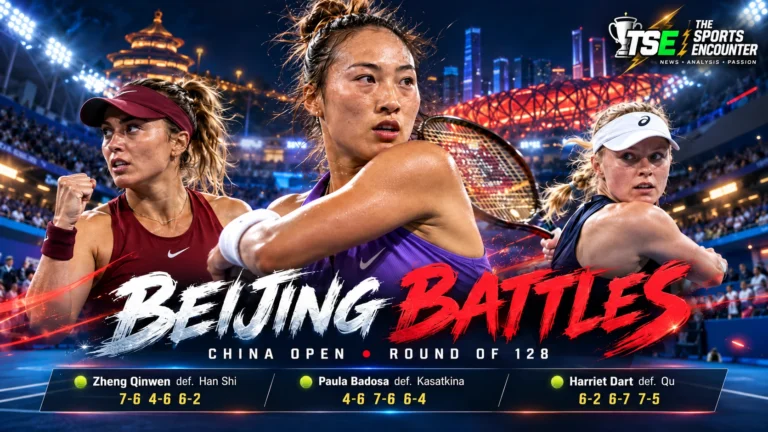 China OpenZheng Survives, Badosa Escapes, While Beijing’s Young Chinese Players Light Up China Open Round of 128
Who Is Left in the China Open 2026 Women’s Quarterfinals?
| Quarterfinal | Central Question |
|---|---|
| Mirra Andreeva (4) vs Ekaterina Alexandrova (19) | Can Andreeva finally solve an opponent who has beaten her in both previous meetings? |
| Karolina Muchova (7) vs Nikola Bartunkova (26) | Can Bartunkova extend the breakthrough run that already includes a win over Sabalenka? |
| Iga Swiatek (8) vs Elise Mertens (13) | Can Mertens reproduce the return pressure that dismantled Gauff against a cleaner Swiatek serve? |
| Zheng Qinwen (WC) vs Elina Svitolina (6) | Will Zheng’s home-court resilience overcome Svitolina’s more economical route into the last eight? |
Andreeva is now the highest seed remaining in the tournament.
Her quarterfinal with Alexandrova and the all-Czech meeting between Muchova and Bartunkova were created on Tuesday, when Muchova survived Naomi Osaka, Andreeva advanced and Bartunkova continued her breakthrough Beijing run.
Swiatek and Mertens will meet in Friday’s quarterfinal. The China Open singles quarterfinals are being played across October 8 and 9, with the semifinals on October 10 and the final on October 11, according to the official WTA tournament schedule.
What Does Gauff’s Exit Mean Beyond Beijing?
There is an immediate consequence for the Asian swing.
Following her Beijing defeat, Gauff said she would withdraw from the Wuhan Open to recover after a draining stretch. That removes the defending champion from an event that had originally been expected to contain the entire WTA Top 10.
TSE’s Wuhan Open 2026 preview was built around Gauff’s title defense and the strength of that field. Her withdrawal changes one of the tournament’s central storylines before play begins.
For Beijing, the immediate consequence is just as important.
Three days ago, Rybakina looked capable of using the China Open to reinforce her position at the top of the women’s game. Sabalenka remained the second seed. Gauff had a superb record in China and a draw that appeared increasingly favorable once the first two disappeared.
All three are now gone.
The tournament has moved into a quarterfinal stage where reputation offers very little protection.
What Should Fans Watch Next?
- Swiatek’s second serve against Mertens: Mertens created sustained return pressure against Gauff. Swiatek’s ability to prevent the same pattern may determine whether the quarterfinal remains under her control.
- Zheng’s recovery: Every one of her Beijing matches has reached a third set. Her physical response against Svitolina is now part of the matchup.
- Andreeva against Alexandrova: The highest remaining seed enters with a 0-2 record in their head-to-head, giving the quarterfinal a genuine tactical problem rather than a simple seeding advantage.
- Bartunkova’s response to another big stage: Beating Sabalenka created the breakthrough. Defeating an experienced and tactically versatile Muchova would turn it into a sustained title run.
China Open 2026 FAQs
Who beat Coco Gauff at the 2026 China Open?
Elise Mertens defeated Coco Gauff 6-3, 6-3 in the Round of 16 on October 7.
Was this Elise Mertens’ first win over Coco Gauff?
Yes. Mertens entered the match with a 0-5 career record against Gauff and earned her first victory in their sixth meeting.
Who will Iga Swiatek play in the China Open quarterfinals?
Swiatek will face Elise Mertens after beating Iva Jovic 6-1, 6-3.
Who will Zheng Qinwen play next?
Zheng will face No. 6 seed Elina Svitolina in the quarterfinals.
Who are the highest seeds eliminated from the China Open?
The top three women’s seeds are all out. No. 1 Elena Rybakina, No. 2 Aryna Sabalenka and No. 3 Coco Gauff were eliminated before the quarterfinals.
Who is the highest remaining seed at the China Open?
No. 4 seed Mirra Andreeva is the highest remaining women’s seed entering the quarterfinals.
When are the China Open 2026 women’s quarterfinals and final?
The women’s singles quarterfinals are scheduled across October 8 and 9. The semifinals take place October 10, followed by the final on October 11.