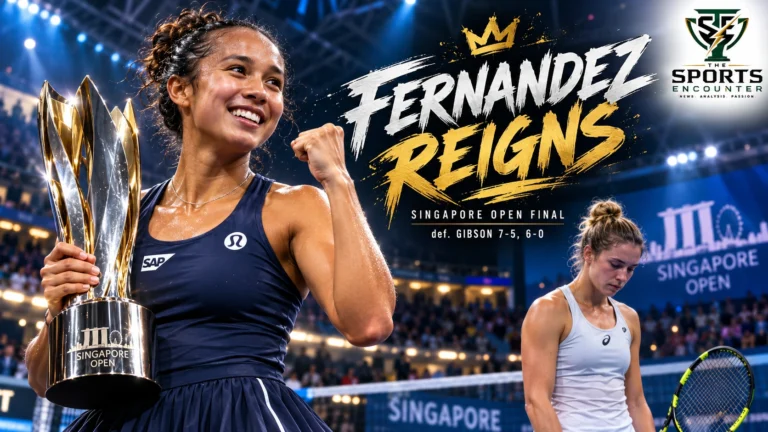
SINGAPORE, Singapore, September 27, 2026: Leylah Fernandez arrived in Singapore without a title in 2026 and left with one of the most complete tournament runs of her career.
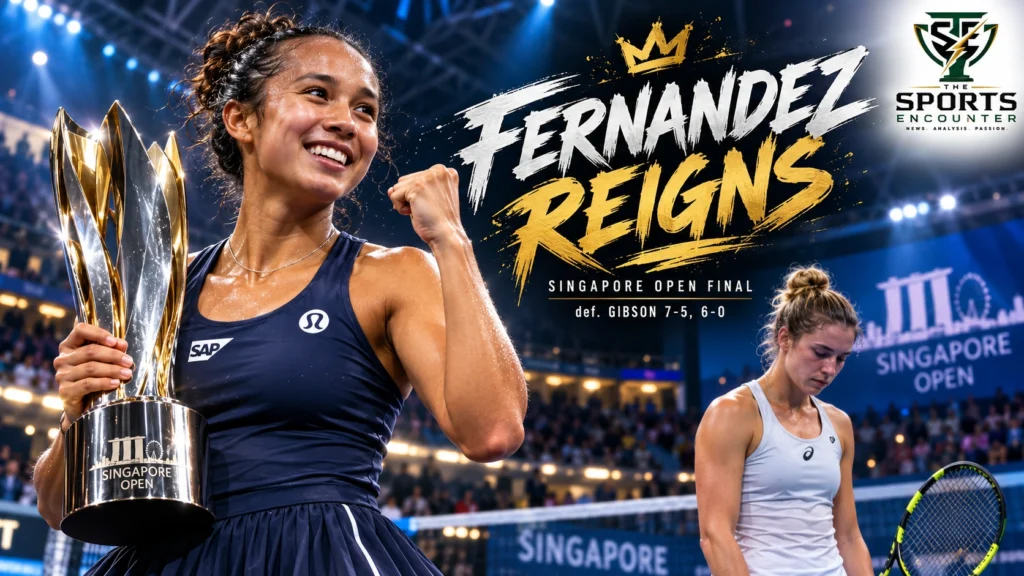
The Canadian defeated first-time WTA finalist Talia Gibson 7-5, 6-0 on Sunday to win the Singapore Tennis Open, taking the final nine games of the match and closing out the championship in one hour and 38 minutes.
It was Fernandez’s sixth career WTA singles title, her second at WTA 500 level and her first trophy of the season.
The scoreline only tells part of the story.
Story at a glance
How Did Leylah Fernandez Beat Talia Gibson in the Singapore Final?
The most important number in the final was not 7-5 or 6-0.
Why Singapore Became Fernandez’s Most Important Week of 2026
Fernandez entered Singapore ranked No. 31 and still searching for the type of deep tournament run that had been difficult to sustain this season.
Fernandez’s Route to the Singapore Open Title
The tournament had been chaotic long before Sunday’s final.
What Changed When Fernandez Won Nine Consecutive Games?
Long runs of consecutive games in tennis usually require more than one player suddenly becoming spectacular.
Talia Gibson’s Loss Should Not Overshadow Her Breakthrough
Gibson leaves Singapore without the trophy but with a completely different career position.
Fernandez’s week included a straight-sets victory over reigning Roland Garros champion and top seed Mirra Andreeva, a semifinal in which she recovered from losing the opening set 6-1 to Maja Chwalinska, and a final against an Australian whose ranking and career trajectory had changed dramatically before she even stepped onto Center Court.
The Sports Encounter had followed the draw from the opening day, when Fernandez and Gibson both opened their Singapore campaigns with victories. By Sunday evening, they were the last two players standing.
The WTA’s official final report confirms Fernandez’s sixth career title and first championship of 2026.
How Did Leylah Fernandez Beat Talia Gibson in the Singapore Final?
The most important number in the final was not 7-5 or 6-0.
It was nine.
Fernandez won the final nine games of the championship.
That means Gibson was still level with the Canadian deep in the opening set before the match changed completely. Fernandez moved from a competitive first set into total control, taking the final two games of the opener and then sweeping all six games of the second.
Once the Canadian established the momentum, Gibson could not interrupt it.
The contrast with Fernandez’s semifinal could hardly have been greater.
Against Chwalinska, Fernandez had spent the opening set searching for answers. She lost it 6-1 after the Pole won the first five games and at one stage 15 consecutive points.
Fernandez then changed the match, taking the next two sets 6-4, 6-2. TSE’s semifinal report traced how that recovery sent Fernandez into her first final of the season.
One day later, she did not need another comeback.
Why Singapore Became Fernandez’s Most Important Week of 2026
Fernandez entered Singapore ranked No. 31 and still searching for the type of deep tournament run that had been difficult to sustain this season.
Her ability to defeat elite opponents had never disappeared.
She had already produced a major result during the North American hard-court swing, beating Andreeva in Toronto. TSE’s National Bank Open analysis identified Fernandez’s victory over the French Open champion as one of the defining results of the tournament.
Singapore turned isolated evidence into a complete week.
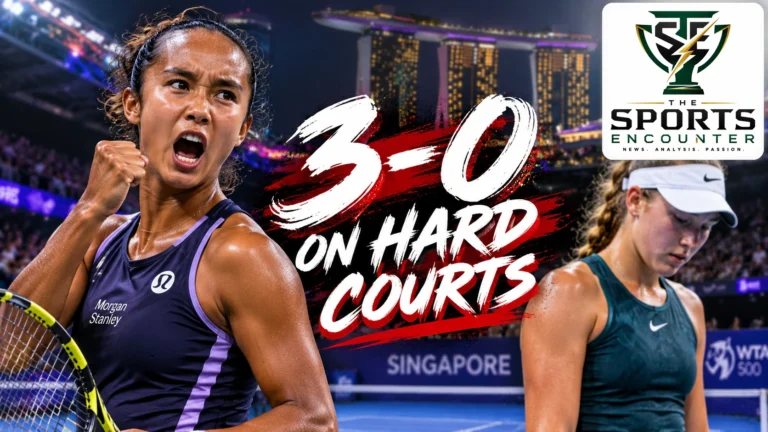
Fernandez beat Andreeva again in the quarterfinals, this time 6-2, 7-5.
The result extended her hard-court record against Andreeva to 3-0, despite the Russian arriving as world No. 5, the top seed and reigning Roland Garros champion.
TSE’s detailed Fernandez-Andreeva quarterfinal analysis showed that the decisive statistic was not how often Andreeva landed her first serve, but how little advantage that serve produced once Fernandez attacked it.
Fernandez followed that with the Chwalinska comeback and then Sunday’s final.
She dropped only one set during the entire tournament.
Fernandez’s Route to the Singapore Open Title
| Round | Opponent | Result | Why It Mattered |
|---|---|---|---|
| First Round | Kyoka Okamura | Fernandez won | Negotiated a difficult opening match and established court rhythm |
| Second Round | Alycia Parks | Fernandez won | Moved into a quarterfinal against the tournament’s top seed |
| Quarterfinal | Mirra Andreeva | 6-2, 7-5 | Beat the world No. 5 and Roland Garros champion |
| Semifinal | Maja Chwalinska | 1-6, 6-4, 6-2 | Recovered from a one-sided first set to reach her first 2026 final |
| Final | Talia Gibson | 7-5, 6-0 | Won the final nine games to claim her first title of 2026 |
The tournament had been chaotic long before Sunday’s final.
Every women’s singles quarterfinal was won by the lower-ranked player. Chwalinska removed defending champion Elise Mertens, Tatiana Prozorova beat Wang Xinyu, Fernandez eliminated Andreeva and Gibson defeated Maria Sakkari.
TSE’s full Singapore quarterfinal report described a draw that had effectively turned upside down in one afternoon.
Fernandez was the player who ultimately made the chaos work in her favor.
What Changed When Fernandez Won Nine Consecutive Games?
Long runs of consecutive games in tennis usually require more than one player suddenly becoming spectacular.
They usually reflect a shift in who controls the first meaningful ball of the rally.
Gibson had reached the final because of her aggression. She had shown throughout the week that she could take time away from opponents, particularly when attacking second serves and stepping inside the baseline.
Fernandez prevented that aggression from controlling the championship.
Once the first set reached its decisive closing phase, the Canadian became increasingly difficult to move out of position. The pressure then transferred onto Gibson’s service games.
A close opening set became a runaway second.
The WTA’s current tournament coverage describes Fernandez as riding a nine-game run to the title, the clearest indication of how dramatically the competitive balance changed late in the opening set. The official tournament page also confirms Singapore’s WTA 500 status and Fernandez’s championship run.
Talia Gibson’s Loss Should Not Overshadow Her Breakthrough
Gibson leaves Singapore without the trophy but with a completely different career position.
The 22-year-old entered the tournament ranked No. 63 and had never previously reached a WTA Tour singles semifinal, let alone a final.
She began by defeating Fiona Ferro 6-3, 6-3.
She then survived two tiebreaks against lucky loser Viktoria Morvayova before producing the defining win of her week against seventh seed and former world No. 3 Maria Sakkari.
Gibson won that quarterfinal 6-1, 4-6, 6-2.
That result completed an extraordinary Friday in which all four lower-ranked players won. TSE had already identified Gibson as one of the week’s emerging stories in its early Singapore coverage after her opening-round win over Ferro.
Her scheduled semifinal against Tatiana Prozorova never took place. Prozorova was unable to compete after suffering a concussion during doubles action, giving Gibson a walkover into the championship match.
That unusual route should not diminish the work Gibson had already done.
She had beaten three opponents, including Sakkari, before reaching the semifinal stage.
Tennis Australia projected Gibson to break into the world’s Top 40 following her run to the final.
Why Gibson’s Ranking Rise Matters More Than the Final Score
Gibson began 2026 at world No. 118.
She entered Singapore at No. 63.
Her run is now expected to take her into the Top 40.
That type of movement changes a player’s season.
Ranking position affects direct entry into larger tournaments, qualifying requirements, seeding opportunities and the number of times a player must navigate stronger opponents simply to reach the middle rounds.
Singapore therefore gave Gibson something almost as important as a trophy would have done: access.
The final showed that there is still another level to reach. Fernandez had more experience managing a championship match and, once she gained control, was far more efficient at closing the door.
Gibson now has evidence that she belongs much closer to that level than her ranking suggested at the beginning of the year.
Fernandez’s Hard-Court Identity Keeps Getting Stronger
All five of Fernandez’s titles before Singapore had come on hard courts.
Singapore makes six.
That pattern matters.
Fernandez’s movement, early ball striking and willingness to redirect pace become particularly effective on hard courts where she can use an opponent’s speed rather than manufacture all of her own.
Andreeva has experienced that problem repeatedly.
The Russian defeated Fernandez in both of their clay-court meetings, but Fernandez has now beaten her three times on hard courts.
The surface split became one of the most interesting tactical stories of their Singapore quarterfinal.
It also adds context to Fernandez’s broader season. Andreeva had established herself as one of the elite players of 2026 by winning Roland Garros. TSE’s feature on Andreeva’s French Open breakthrough examined the moment she moved from prodigy to Grand Slam champion.
Fernandez beating that player twice on hard courts in the same season is not an accident.
Singapore Also Changed the Story of Fernandez’s 2026 Season
Before Singapore, Fernandez’s year contained impressive matches but not a title.
She had beaten elite opponents and played several long three-set matches, but sustained tournament momentum had been harder to find.
At the US Open, Jessica Pegula ended her run after Fernandez won the first set. Around the same tournament, Andreeva’s season also shifted when Coco Gauff recovered to beat her in the quarterfinals, a match TSE covered in its analysis of Gauff’s comeback against the French Open champion.
Singapore was different for Fernandez because she handled every type of match the draw asked of her.
She won tight matches.
Continue the Tennis Story
 TennisSingapore Open Friday Turns Upside Down as Four Lower-Ranked Players Sweep the Quarterfinals
 TennisFernandez Turns 1-6 Shock Into Singapore Final as Gibson’s Breakthrough Week Reaches Title Match
 TennisLeylah Fernandez Beats Mirra Andreeva 6-2, 7-5, Extends 3-0 Hard-Court Edge to Reach Singapore SFs
She beat a Top 10 player.
She recovered from a disastrous opening set.
She then closed the final with nine consecutive games.
That is what separates a collection of good wins from a championship week.
What Does the Singapore Title Mean for Fernandez?
The immediate answer is straightforward.
It is title No. 6.
It is WTA 500 title No. 2.
It is her first title of 2026.
The larger answer concerns momentum.
Singapore sits at the beginning of the Asian swing, not at the end of the season. Fernandez now enters the next phase with a title rather than another collection of near misses.
She has also shown that her game can hold up through three very different high-pressure matches in succession.
Andreeva demanded tactical discipline.
Chwalinska demanded emotional recovery.
Gibson demanded that Fernandez prevent a young power player from turning a first final into a breakthrough championship.
Fernandez solved all three problems.
Singapore Open 2026 Women’s Final FAQs
Who Won the 2026 Singapore Tennis Open?
Leylah Fernandez won the women’s singles title by defeating Talia Gibson 7-5, 6-0 in the final.
How Many Games in a Row Did Fernandez Win in the Final?
Fernandez won the final nine games of the match to turn a competitive opening set into a dominant finish.
How Many Career WTA Titles Does Leylah Fernandez Have?
Singapore was Fernandez’s sixth career WTA singles title.
Was This Fernandez’s First Title of 2026?
Yes. Singapore was her first WTA title of the 2026 season.
How Many WTA 500 Titles Has Fernandez Won?
The Singapore championship was Fernandez’s second WTA 500 title.
Who Did Fernandez Beat Before Reaching the Final?
Her route included a 6-2, 7-5 quarterfinal victory over top seed Mirra Andreeva and a 1-6, 6-4, 6-2 semifinal comeback against Maja Chwalinska.
Was Singapore Talia Gibson’s First WTA Final?
Yes. The 22-year-old Australian reached her first WTA Tour-level singles final in Singapore.
Who Did Talia Gibson Beat in the Quarterfinals?
Gibson defeated seventh seed Maria Sakkari 6-1, 4-6, 6-2 to reach her first WTA semifinal.
Why Did Gibson Not Play a Semifinal?
Tatiana Prozorova was unable to play their scheduled semifinal after suffering a concussion during doubles action, so Gibson advanced to the final by walkover.
What Ranking Impact Could Singapore Have for Talia Gibson?
Tennis Australia projected Gibson to move into the world’s Top 40 after entering Singapore ranked No. 63.