


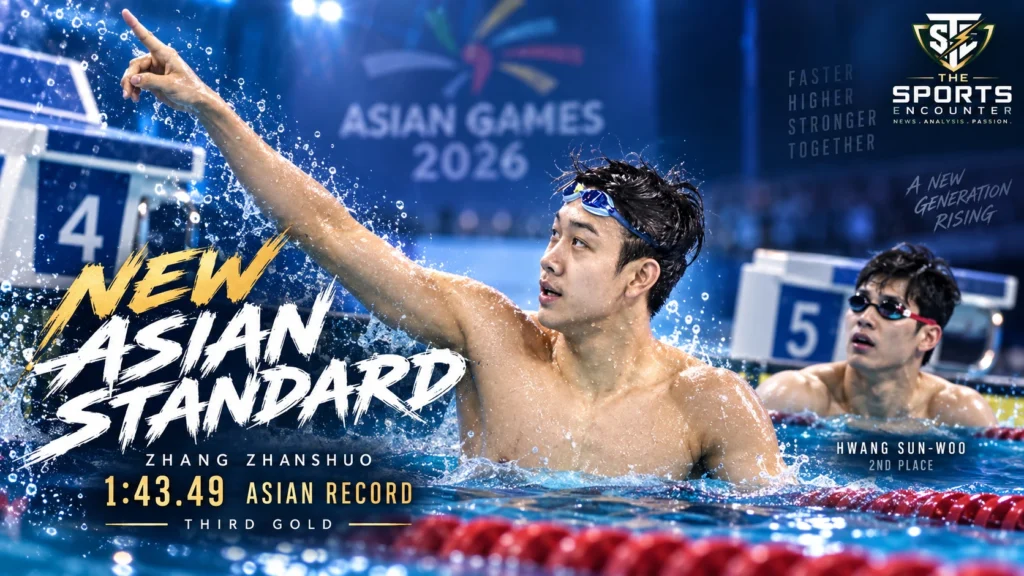
TOKYO, Japan, September 23, 2026: Hwang Sun-woo led the men’s 200m freestyle final through 150 meters. Then Zhang Zhanshuo changed the race, the Asian record and the direction of another major swimming rivalry in less than 26 seconds.
The 19-year-old Chinese swimmer closed with a devastating final length to win Asian Games gold in 1:43.49 at the Tokyo Aquatics Centre, breaking Hwang’s continental record of 1:43.92 and completing his third gold-medal performance of Aichi-Nagoya 2026.
Hwang, the defending champion and one of Asia’s most accomplished middle-distance freestylers, finished second in 1:44.62. Japan’s Tatsuya Murasa took bronze in 1:44.81.
The winning time lowered the Asian record by 0.43 seconds.
More revealingly, Zhang produced the breakthrough after spending most of the race chasing.
Hwang led at 50 meters, 100 meters and 150 meters. Zhang stayed close enough to keep the race alive and then delivered a 25.96-second final 50 meters. Hwang closed in 27.28.
That 1.32-second difference over the final length turned a title defense into silver and gave Zhang another record-breaking performance only two days after his extraordinary anchor leg carried China to an Asian record in the men’s 4x200m freestyle relay.
For continuing results, records and medal analysis, follow The Sports Encounter’s complete Asian Games 2026 coverage.
Zhang Zhanshuo vs Hwang Sun-woo: 200m Freestyle Final at a Glance
| Medal | Swimmer | Nation | Time | Key Detail |
|---|---|---|---|---|
| Gold | Zhang Zhanshuo | China | 1:43.49 | Asian record |
| Silver | Hwang Sun-woo | South Korea | 1:44.62 | Defending champion |
| Bronze | Tatsuya Murasa | Japan | 1:44.81 | Home medal |
The result was confirmed by Xinhua, while Yonhap’s race report documented Zhang’s late surge and the progression of Hwang’s lead through the first 150 meters.
Zhang Broke Hwang’s Asian Record by 0.43 Seconds
The previous continental standard had belonged to the man swimming beside him.
Hwang set the Asian record at 1:43.92 in 2025.
Zhang took it down to 1:43.49.
A difference of 0.43 seconds may sound small outside elite swimming. At this level, it is substantial.
The 200m freestyle sits in a difficult middle ground between sprinting and endurance. Swimmers must generate near-sprint speed without spending so much energy over the opening 100 meters that the final length becomes survival.
Zhang judged that balance better than anyone in the field.
The Yonhap race report shows Hwang turning first at 50 meters in 23.94, remaining ahead at 100 meters in 50.25 and still leading at 150 meters in 1:17.34.
For three quarters of the race, the defending champion was in the position he wanted.
The final quarter belonged completely to Zhang.
A 25.96 Final 50 Meters Won the Race
| Final 50m | Split |
|---|---|
| Zhang Zhanshuo | 25.96 |
| Hwang Sun-woo | 27.28 |
| Difference | 1.32 seconds |
Zhang gained 1.32 seconds on Hwang over the final 50 meters alone.
That is the race.
There was no tactical mystery once the splits were visible. Hwang built the advantage. Zhang stayed close. Then one swimmer accelerated while the other began losing efficiency.
The result resembles what Zhang did in the 4x200m freestyle relay, although the circumstances were different.
Against Japan in that relay, China entered the anchor leg 1.89 seconds behind. Zhang produced a 1:42.92 split, gained 2.77 seconds on Tomoyuki Matsushita and turned the deficit into a 0.88-second Chinese victory.
TSE’s full analysis of that relay comeback showed how unusual the closing speed was even before Wednesday’s individual final.
The 200m freestyle provided another version of the same trait.
Zhang appears increasingly dangerous when a race reaches the final length with someone still ahead of him.
Hwang Led Almost the Entire Race and Still Lost by More Than a Second
That is what makes the victory more significant than a record produced from the front.
Hwang did not swim poorly.
His 1:44.62 is an elite international time, and it put him 0.19 seconds ahead of Murasa for silver.
He simply could not match Zhang’s finish.
Hwang entered as the defending Asian Games champion after winning the event at Hangzhou in 2023 in 1:44.40. He also entered as the Asian record holder.
Wednesday removed both distinctions.
His reaction reflected how much the result mattered. Hwang told reporters afterward that he was frustrated by how his form deteriorated over the final 50 meters and said the race showed where he needs to improve before Los Angeles 2028.
That forward-looking consequence gives the result value beyond one medal.
Zhang has not merely beaten one of Asia’s established stars.
He has given Hwang a new continental standard to chase.
Three Asian Games Golds in Three Very Different Tests
Zhang’s third gold becomes more impressive when the events are separated rather than simply counted.
| Event | Result | Why It Mattered |
|---|---|---|
| 4x200m Freestyle Relay | Gold, 7:00.17 | Asian record; Zhang erased a 1.89-second deficit on anchor |
| 1,500m Freestyle | Gold, 14:42.42 | Major distance title |
| 200m Freestyle | Gold, 1:43.49 | Asian record |
Xinhua confirmed that the 200m title was Zhang’s third gold after his victories in the 1,500m freestyle and 4x200m freestyle relay. The Xinhua report carried by NAMPA also confirmed the 1:43.49 Asian record.
The range is remarkable.
The 200m requires speed.
The 1,500m demands sustained pacing, efficiency and endurance over 30 lengths of a 50-meter pool.
The relay required Zhang to chase down a rival while carrying the result of three teammates on his shoulders.
He has won all three tests.
The 1,500m Gold Showed Zhang Is Not Simply a 200m Specialist
Only one day before breaking the 200m Asian record, Zhang won the men’s 1,500m freestyle in 14:42.42.
Japan’s Kaito Tabuchi and Kazushi Imafuku followed him onto the podium.
The contrast between winning the 1,500m and then producing 1:43.49 in the 200m is one of the most interesting parts of Zhang’s Asian Games.
Elite swimmers often possess range, but championship schedules expose the physical cost of that range.
Zhang has been racing repeatedly in Tokyo.
Instead of fading as the meet has progressed, his fastest and most historically significant individual performance arrived after he had already collected two titles.
That gives his third gold a different meaning from an athlete specializing around one carefully protected event.
Zhang Was Already Moving Toward This Level Before the Asian Games
The 1:43.49 should not be treated as a performance that appeared from nowhere.
World Aquatics lists Zhang with a 1:44.53 personal best from the China Open in March 2026, already placing him among the fastest Chinese 200m freestyle swimmers in history before the Asian Games.
At China’s National Games in 2025, he won five individual titles and produced national junior records across multiple freestyle distances.
World Aquatics described him then as one of the defining young swimmers emerging from China’s next generation.
“I’m part of the new generation, but I don’t want to put too much pressure on myself,” Zhang said during that National Games breakthrough.
The World Aquatics account of that meet showed an athlete already building unusual range across the 200m, 400m and 800m freestyle distances.
Less than a year later, he owns Asia’s 200m freestyle record.
The Relay Had Already Given Us a Warning
Monday’s 4x200m freestyle final now looks even more important in hindsight.
Japan controlled most of the race.
China were 3.47 seconds behind after two legs.
Pan Zhanle reduced the deficit before Zhang entered 1.89 seconds behind.
Then Zhang swam 1:42.92 with a flying relay start.
That split could not count as an individual record because relay starts allow swimmers to anticipate the exchange rather than reacting to a starting signal.
It did reveal the speed available.
Wednesday converted that relay warning into an official individual Asian record.
The pattern also reinforces the broader picture from TSE’s September 21 Asian Games report, when China’s swimming depth began transforming its medal-table lead into something much larger.
Zhang’s Rise Is Happening Alongside China’s Teenage Swimming Explosion
Zhang is 19, which makes him young by senior international standards.
He is still not the youngest Chinese swimmer rewriting the record book this week.
Yu Zidi has become one of the defining athletes of Aichi-Nagoya at only 13.
Her 2:06.10 in the women’s 200m individual medley broke the Asian, Asian Games and world junior records, a performance examined in TSE’s full analysis of Yu’s record-breaking swim.
That time also moved Yu to No. 2 among the fastest women ever in the 200m individual medley.
The two swimmers represent different forms of the same Chinese development story.
Yu is arriving extraordinarily early.
Zhang is moving from elite prospect to continental record holder at 19.
China are not simply winning through established Olympic champions such as Pan Zhanle and Xu Jiayu.
The next generation is already taking ownership of major events.
China’s Swimming Team Has Youth and Longevity at the Same Time
Zhang’s breakthrough becomes even more striking when placed beside Xu Jiayu.
Xu is 31 and has won the men’s 50m backstroke at three consecutive Asian Games. His latest victory came in a Games-record 24.04, covered in TSE’s analysis of Xu’s remarkable three-title streak.
That gives China two very different competitive advantages.
Established champions are still getting faster.
Younger swimmers are arriving quickly enough to break continental records themselves.
The combination helps explain why China’s swimming medal production has been so difficult for the rest of Asia to contain.
The 200m Freestyle Is Becoming One of Asia’s Strongest Events
Zhang’s record also says something about the event itself.
Hwang has been a world champion and established himself as one of the finest 200m freestylers of his generation.
Murasa entered the final with international-level speed.
Pan Zhanle, although better known for the 100m freestyle, also owns world-class 200m ability.
Asian swimming has therefore reached a point where a continental final can contain several athletes capable of times that matter globally.
The women’s version has shown similar depth.
Siobhan Haughey defended her Asian Games 200m freestyle crown in 1:54.96 despite another strong Chinese field, a performance included in TSE’s analysis of one of the busiest medal sessions of the Games.
The difference on Wednesday was that the men’s final did not merely produce a champion.
It moved the continental standard.
Zhang and Hwang May Be Building Asia’s Next Major Swimming Rivalry
Hwang is 23.
Zhang is 19.
Neither swimmer is close to the end of his career.
That makes Wednesday potentially more important than a single changing of the record holder.
Hwang has the experience of world titles and major international finals.
Zhang now has the faster time.
The competitive dynamic is particularly compelling because their strengths overlap without being identical.
Hwang’s early speed allowed him to control most of Wednesday’s final.
Zhang’s endurance and finishing power changed it late.
If those patterns persist, future 200m races between them will involve more than raw speed.
Hwang may need to create enough separation before the final turn to neutralize Zhang’s finish.
Zhang may continue trusting that his range from the 1,500m downward allows him to reach the closing 50 meters with more available than his rivals.
Russel Pang Shows the Distance Revolution Is Wider Than China
Zhang’s ability to move between distances also fits a broader trend visible during these Games.
Singapore’s 16-year-old Russel Pang lowered his national 1,500m freestyle record to 15:22.16 during his Asian Games debut.
TSE’s profile of Pang’s record swim examined how younger Asian distance swimmers are being pushed by stronger regional competition and better domestic reference points.
Zhang occupies a much more advanced level of that development.
He is no longer chasing national records.
He is setting continental ones.
Why Zhang’s Third Gold May Be His Most Important
The relay gold demonstrated nerve.
The 1,500m gold demonstrated range.
The 200m gold produced history.
That is why the third title stands above the first two even though all three contribute equally to the medal table.
An Asian Games gold lasts for an edition.
An Asian record remains the measurement every swimmer on the continent has to confront until somebody goes faster.
Before Wednesday, that number was 1:43.92.
Now it is 1:43.49.
And the swimmer who owns it is still 19.
What Zhang Zhanshuo’s Week Says About Los Angeles 2028
Aichi-Nagoya 2026 was always going to function partly as a bridge toward the next Olympics, one of the themes identified in TSE’s complete Asian Games preview.
Zhang has made that connection impossible to ignore.
He already owns World Championship relay medals.
He has now won Asian Games titles from 200 meters to 1,500 meters.
He has produced an Asian record individually and helped produce another in a relay.
Los Angeles remains almost two years away.
Nothing about an Olympic medal should be treated as inevitable.
What can be said now is that Zhang’s development has moved beyond prospect status.
A swimmer with a 1:43.49 200m freestyle and enough endurance to win a continental 1,500m title is already relevant to global championship racing.
Zhang Is No Longer Just Part of China’s Future
At 19, Zhang fits easily into discussions about China’s next generation.
That description is beginning to become inadequate.
Future stars are athletes expected to win later.
Zhang is winning now.
He erased a 1.89-second relay deficit against Japan.
He won the 1,500m freestyle.
He chased down the defending 200m champion over the final 50 meters.
He broke an Asian record held by one of the continent’s established world champions.
Three gold medals provide the headline count.
The way he won them explains why the number matters.
Frequently Asked Questions
Who won the men’s 200m freestyle at the 2026 Asian Games?
China’s Zhang Zhanshuo won gold in an Asian-record time of 1:43.49.
What Asian record did Zhang Zhanshuo break?
Zhang broke Hwang Sun-woo’s men’s 200m freestyle Asian record of 1:43.92, lowering it by 0.43 seconds to 1:43.49.
Who won silver in the men’s 200m freestyle?
South Korea’s Hwang Sun-woo took silver in 1:44.62.
Who won bronze?
Japan’s Tatsuya Murasa finished third in 1:44.81.
How old is Zhang Zhanshuo?
Zhang is 19 years old.
How many gold medals has Zhang won at the 2026 Asian Games?
Zhang has won three gold medals: the men’s 200m freestyle, 1,500m freestyle and 4x200m freestyle relay.
What did Zhang swim in the 1,500m freestyle?
Zhang won the Asian Games 1,500m freestyle title in 14:42.42.
What did Zhang swim on the 4x200m freestyle relay?
Zhang produced a 1:42.92 anchor split as China overturned a 1.89-second deficit to Japan and won in an Asian-record 7:00.17.
How fast was Zhang’s final 50 meters against Hwang?
Zhang closed the 200m freestyle final in 25.96 seconds. Hwang covered the final 50 meters in 27.28.
Did Hwang Sun-woo lead the race?
Yes. Hwang led at the 50m, 100m and 150m marks before Zhang overtook him during the final length.
Was Hwang Sun-woo the defending Asian Games champion?
Yes. Hwang won the men’s 200m freestyle at the Hangzhou Asian Games in 2023.
Why is Zhang Zhanshuo’s 1:43.49 significant?
It is the fastest recognized long-course men’s 200m freestyle time ever recorded by an Asian swimmer and makes Zhang the current continental record holder.