


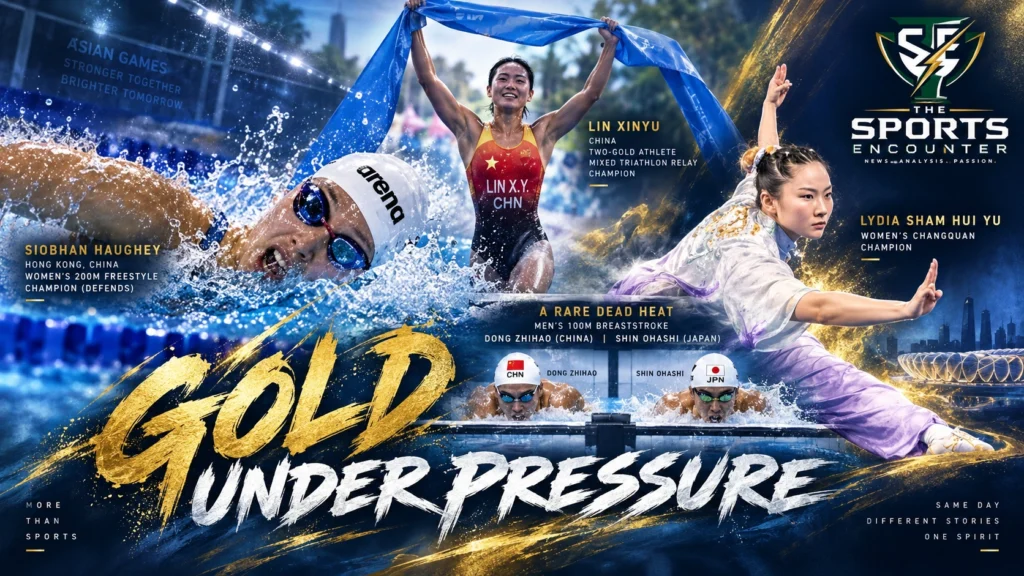
NAGOYA, Japan, September 21, 2026: Siobhan Haughey successfully defended one of Asian swimming’s most competitive titles, China and Japan produced a rare dead heat for gold in the men’s 100m breaststroke, Lin Xinyu collected her second triathlon gold in 24 hours, and Lydia Sham Hui Yu survived one of the closest judged finals of the Asian Games.
Haughey controlled the women’s 200m freestyle final in Tokyo and won in 1:54.96, comfortably ahead of China’s Li Jiaping and Liu Yaxin. Minutes later, Dong Zhihao and 17-year-old Shin Ohashi touched together in 58.64 in the men’s 100m breaststroke, leaving defending champion Qin Haiyang with bronze.
Several hours earlier in Gamagori, Lin helped China break Japan’s long hold on the mixed triathlon relay only a day after winning the women’s individual title. In Nagoya, Sham scored 9.713 in women’s Changquan and beat Macao, China’s Sou Cho Man by only 0.003 points.
The results added a different layer to an Asian Games already producing world, continental and Games records. TSE’s first full medal-day analysis documented China’s opening surge, Yu Zidi’s first record swim, Haughey’s relay silver and Lin’s individual triathlon breakthrough.
Four Asian Games Gold Stories at a Glance
| Event | Champion | Result | Why It Mattered |
|---|---|---|---|
| Women’s 200m Freestyle | Siobhan Haughey, Hong Kong, China | 1:54.96 | Successfully defended 2023 title |
| Men’s 100m Breaststroke | Dong Zhihao, China / Shin Ohashi, Japan | 58.64 | Exact dead heat produced shared gold |
| Mixed Triathlon Relay | China | 1:25:54 | Lin Xinyu’s second gold in 24 hours |
| Women’s Wushu Changquan | Lydia Sham Hui Yu, Hong Kong, China | 9.713 | Gold decided by 0.003 points |
The four results also underline the range of competition inside a Games containing 43 sports and 469 medal events, outlined in The Sports Encounter’s Aichi-Nagoya 2026 preview.
How Siobhan Haughey Defended the Asian Games 200m Freestyle Title
Haughey spent the morning doing exactly enough.
She qualified second fastest in 1:58.60, only 0.10 seconds behind China’s Li Jiaping. The four-time Olympic medalist said after the heat that the objective had simply been to reach the final and return later ready to swim much faster.
Her assessment was accurate.
Haughey attacked from the opening length in the final and never surrendered control. She led by 0.84 seconds after the first 50 meters and continued creating separation as the race developed.
Her winning time of 1:54.96 was more than four seconds faster than her morning swim.
Li took silver in 1:56.58, with Liu Yaxin completing China’s double podium in 1:57.53.
| Medal | Swimmer | Nation | Time |
|---|---|---|---|
| Gold | Siobhan Haughey | Hong Kong, China | 1:54.96 |
| Silver | Li Jiaping | China | 1:56.58 |
| Bronze | Liu Yaxin | China | 1:57.53 |
Why Haughey’s Title Defense Carries More Weight Than the Time
Haughey went faster when she won this event at Hangzhou in 2023.
Her 1:54.12 there remains the Asian Games record, while her 1:53.92 from the Tokyo Olympics remains the Asian long-course record. Her World Aquatics profile reflects a career that has included Olympic, world championship and Asian Games medals across multiple freestyle distances.
Monday’s significance came from defending the title against a Chinese program producing younger contenders in almost every swimming discipline.
Li was fastest in the heats. Liu has previously swum 1:54.96 at national level. Both entered with the speed to pressure Haughey.
The final never developed that way.
At 28, Haughey used championship experience more effectively than she needed to use raw speed. Her first 50 meters immediately forced the Chinese swimmers to chase, and the lead became more difficult to close every time the race moved through another turn.
The performance belongs to the same wider theme TSE has followed throughout 2026: established swimmers continuing to win while younger generations move closer. Katie Ledecky’s 16-year unbeaten 1500m freestyle run represented an extreme version of that championship longevity.
Haughey and Lydia Sham Give Hong Kong, China a Two-Gold Surge
Haughey’s title followed another major Hong Kong, China victory earlier in the day.
Sham won women’s Changquan in Nagoya with 9.713.
Combined with Haughey’s swimming success, the two results gave Hong Kong, China gold medals in entirely different sporting environments on the same day.
That breadth is one of the most valuable aspects of a multi-sport campaign. Swimming depends on measurable time. Wushu Changquan is judged through technical execution, difficulty, balance, speed, power and presentation.
Both demanded almost no margin for error on Monday.
How Close Was Lydia Sham’s Wushu Gold Medal?
Extremely close.
Sham scored 9.713.
Sou Cho Man of Macao, China finished on 9.710.
Indonesia’s Widodo Eugenia Diva took bronze with 9.706, while Iran’s Zahra Kiani missed the podium on 9.703.
| Position | Athlete | Nation | Score |
|---|---|---|---|
| 1 | Lydia Sham Hui Yu | Hong Kong, China | 9.713 |
| 2 | Sou Cho Man | Macao, China | 9.710 |
| 3 | Widodo Eugenia Diva | Indonesia | 9.706 |
| 4 | Zahra Kiani | Iran | 9.703 |
Only 0.010 points separated first from fourth.
The gold-silver difference was 0.003.
The Olympic Council of Asia’s official report described the event as a razor-thin final and confirmed all four scores.
Why Changquan Can Produce Margins This Small
Changquan translates as “long fist” and rewards explosive movement, flexibility, speed and technical precision through an extended routine.
The scoring system leaves very little room between elite athletes who all execute difficult routines successfully.
Sham therefore did not need an obvious collapse from a rival to win.
She needed marginally better execution across the full performance.
That is what makes 9.713 significant. A difference that looks almost meaningless on paper decided an Asian Games gold medal.
TSE’s Opening Ceremony analysis highlighted how traditional Asian disciplines remain central to the Games even as newer sports such as MMA and teqball expand the program. Sham’s victory is exactly the kind of result that gives those longstanding disciplines continued relevance.
Why Dong Zhihao and Shin Ohashi Both Won 100m Breaststroke Gold
The men’s 100m breaststroke produced an even tighter outcome.
There was no measurable difference at all.
Dong and Ohashi both touched in 58.64.
Swimming finals are timed to one hundredth of a second. When two swimmers record exactly the same official time in a medal final, both receive the same placing.
Dong and Ohashi therefore shared gold.
There was no silver medalist.
Qin took bronze in 59.01 because his was the third-fastest official result.
| Medal | Swimmer | Nation | Time |
|---|---|---|---|
| Gold | Dong Zhihao | China | 58.64 |
| Gold | Shin Ohashi | Japan | 58.64 |
| Bronze | Qin Haiyang | China | 59.01 |
The Dead Heat Also Revealed a Generational Shift
The names on the podium make the result more interesting.
Dong is 21 and entered the Games with a 58.57 personal best from China’s national championships.
Ohashi is only 17. He had already swum 58.54 at the 2026 Pan Pacific Championships, a world junior and Japanese record listed on his World Aquatics results profile.
Qin remains China’s established breaststroke star and the Asian record holder over 100 meters, but this final belonged to two younger swimmers.
The outcome fits the generational turnover visible throughout international swimming. During Glasgow 2026, established champions and emerging swimmers repeatedly shared podiums, a pattern examined in TSE’s final Commonwealth swimming report.
Lin Xinyu Wins Two Asian Games Gold Medals in 24 Hours
Lin’s second title required a completely different physical demand.
She had already won the women’s individual triathlon in 57:37 on September 20, leading a Chinese one-two with Huang Anqi.
Less than 24 hours later, Lin returned as the opening athlete in China’s mixed relay team alongside Li Mingxu, Huang and Zhang Xirui.
China won in 1:25:54.
Japan finished second and Hong Kong, China took bronze.
Lin’s second gold turned her into one of the first multiple champions of Aichi-Nagoya 2026.
Her individual victory had already been part of TSE’s opening medal-day coverage. The relay revealed that her value extended beyond simply being China’s fastest woman.
Lin Created the Gap China Needed on the First Leg
The relay consists of four athletes, with each completing a 300-meter swim, 6.6-kilometer bike leg and 2-kilometer run before handing over to the next teammate.
Lin volunteered to start.
She exited the water first, widened the lead on the bike and then produced a sharp run that allowed China to complete the opening exchange 39 seconds ahead of the chasing group.
Japan later reduced that margin and briefly moved ahead during the third leg.
Huang’s run restored China’s advantage before Zhang delivered the fastest anchor leg of the competition.
The official World Triathlon race analysis confirms that Japan briefly took control before China regained the lead and pulled clear.
China’s Relay Gold Ended Japan’s Asian Games Triathlon Grip
The wider historical significance belongs to the national program.
Japan had dominated Asian Games triathlon for years.
Lin’s individual victory already broke Japan’s women’s winning sequence stretching back to Guangzhou 2010. The mixed relay then confirmed that China’s progress was not limited to one outstanding athlete.
World Triathlon described the result as a historic breakthrough produced after several years of development.
Lin’s two gold medals sit at the center of that shift, but Huang also collected individual silver before joining the relay-winning quartet.
Zhang had taken individual men’s silver behind Japan’s Takumi Hojo before anchoring the relay gold.
China therefore converted individual depth into a team title one day later.
What Connects Haughey, the Dead Heat, Lin and Sham?
The four stories look very different on the surface.
One was a controlled swimming title defense.
Another could not separate two swimmers even to one hundredth of a second.
A third required four athletes to combine three disciplines in sequence.
The fourth was decided by judges separating four wushu athletes across only 0.010 points.
The common element was pressure.
Haughey had to defend a title while China placed two swimmers on the podium behind her. Dong and Ohashi had one race with no second chance and produced identical times. Lin returned less than 24 hours after winning individually and immediately accepted responsibility for China’s opening relay leg. Sham competed in a field where one small technical deduction could move an athlete from gold to outside the medals.
Those are the stories that give a multi-sport Games depth beyond the medal table.
TSE’s opening competition report showed the breadth of the program before medals began arriving, while the Upcoming Sports Encounters calendar tracks the Games through their October 4 conclusion.
Why the Pool Is Producing So Many Different Championship Stories
Swimming has already delivered several of Aichi-Nagoya’s strongest individual narratives.
Yu Zidi has rewritten records at 13.
Xu Jiayu has extended a title streak deep into his career.
Kim Young-beom broke the same Games record twice in one day.
China’s men lowered the Asian 4x200m freestyle relay record.
Haughey’s victory adds something different: a champion winning without needing a record.
Major meets are often remembered through the clock, but titles can carry significance even when the time remains outside an athlete’s best.
TSE saw the same principle at the European Championships when Ellen Walshe won the 400m individual medley through a perfectly timed late comeback and when Sara Curtis produced an entirely different kind of pressure by breaking a world record before her final.
Haughey’s task was simpler to describe and difficult to execute.
Arrive as champion. Lead from the opening length. Leave as champion again.
Frequently Asked Questions
Who won the women’s 200m freestyle at the 2026 Asian Games?
Hong Kong, China’s Siobhan Haughey won gold in 1:54.96, successfully defending the title she first won at Hangzhou 2023.
Who finished behind Siobhan Haughey?
China’s Li Jiaping won silver in 1:56.58 and Liu Yaxin took bronze in 1:57.53.
Did Haughey break the Asian Games record?
No. Her winning time was 1:54.96. Haughey already owns the Asian Games record of 1:54.12 from Hangzhou 2023.
Who won the men’s 100m breaststroke?
China’s Dong Zhihao and Japan’s Shin Ohashi shared gold after both finished in exactly 58.64 seconds.
Why was there no silver medal in the men’s 100m breaststroke?
Dong and Ohashi shared first place. Qin Haiyang produced the third-fastest time at 59.01 and therefore received bronze.
How many Asian Games gold medals has Lin Xinyu won in 2026?
Lin has won two. She won the women’s individual triathlon and then helped China win the mixed team relay less than 24 hours later.
Who raced for China in the mixed triathlon relay?
China’s winning quartet consisted of Lin Xinyu, Li Mingxu, Huang Anqi and Zhang Xirui.
What was China’s mixed triathlon relay winning time?
China won in 1 hour, 25 minutes and 54 seconds.
Who won women’s Changquan in wushu?
Hong Kong, China’s Lydia Sham Hui Yu won gold with 9.713.
How close was the women’s Changquan final?
Only 0.003 points separated Sham from silver medalist Sou Cho Man, while the top four athletes were separated by just 0.010 points.