


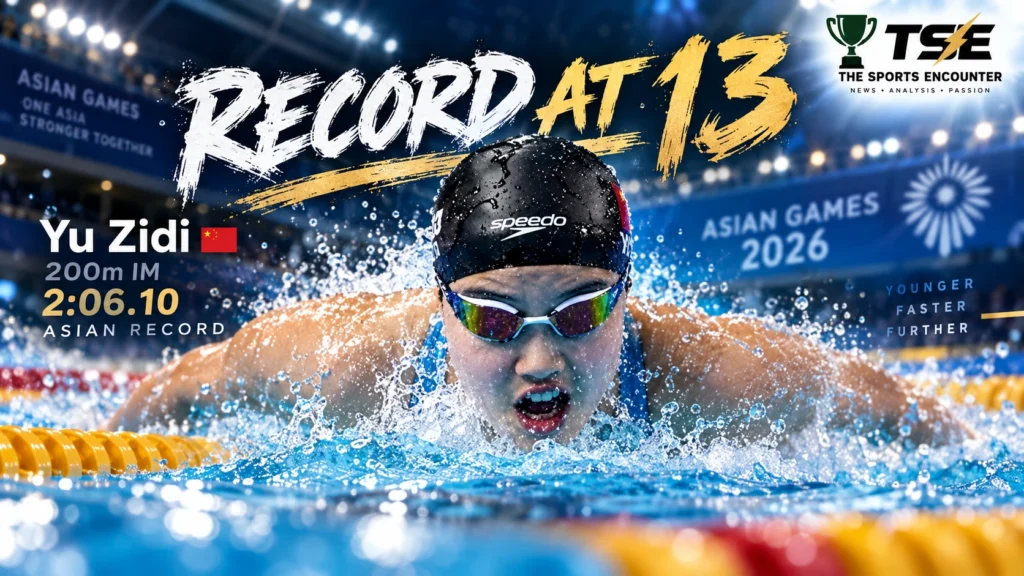
TOKYO, Japan, September 21, 2026: Yu Zidi has turned her Asian Games debut into one of the defining stories of Aichi-Nagoya 2026. The 13-year-old Chinese swimmer won the women’s 200m individual medley in 2:06.10 at the Tokyo Aquatics Centre, breaking the Asian record, Asian Games record and world junior record while claiming her second individual gold medal in two days.
Yu finished 1.89 seconds ahead of compatriot Yu Yiting, the defending champion and previous Asian record holder, while Japan’s Mio Narita secured bronze. The performance came only 24 hours after Yu won the 200m butterfly in a Games-record 2:05.08.
Two races have now produced two gold medals and two record-breaking swims.
The scale of the 200m individual medley performance goes far beyond Asia. Only Canada’s Summer McIntosh, whose 2:05.70 world record has stood since June 2025, has ever completed the event faster.
Yu arrived in Japan already carrying enormous attention after becoming the youngest swimming medalist in World Championships history at age 12. Her first Asian Games gold was documented in The Sports Encounter’s first medal-day report. One day later, the conversation around her has changed again.
Yu Zidi’s 2:06.10: What Records Did She Break?
| Record | Previous Mark | New Mark |
|---|---|---|
| Asian Record | 2:06.82, Yu Yiting | 2:06.10, Yu Zidi |
| Asian Games Record | 2:07.75, Yu Yiting | 2:06.10, Yu Zidi |
| World Junior Record | 2:06.56, Summer McIntosh | 2:06.10, Yu Zidi |
| World Record | 2:05.70, Summer McIntosh | |
The previous Asian record belonged to Yu Yiting, who swam 2:06.82 at the Chinese National Championships in June. World Aquatics lists that performance among Yu Yiting’s career results.
Yu Zidi removed 0.72 seconds from that continental standard.
She also lowered the Asian Games record of 2:07.75 set by Yu Yiting at Hangzhou in 2023 and improved the world junior benchmark previously held by McIntosh.
The remaining target is only 0.40 seconds away.
How Close Is Yu Zidi to Summer McIntosh’s World Record?
Very close.
McIntosh established the women’s 200m individual medley world record at 2:05.70 during the 2025 Canadian Swimming Trials, breaking Katinka Hosszu’s decade-old 2:06.12 mark.
World Aquatics recorded McIntosh’s breakthrough as one of the defining swims of her extraordinary 2025 season.
Yu’s 2:06.10 places her only four-tenths behind.
That gap is remarkable because Yu does not turn 14 until October.
At this level, four-tenths across 200 meters can be found or lost through turns, underwater phases, stroke transitions and the final meters of freestyle. Yu has years of physical development and technical refinement ahead of her, yet she is already operating inside the narrow space below one of swimming’s strongest world records.
Why the 200m Individual Medley Shows More Than Pure Speed
The 200m individual medley requires 50 meters each of butterfly, backstroke, breaststroke and freestyle.
It rewards versatility rather than mastery of a single stroke.
A swimmer can gain time in one section and lose it immediately in the next. The transitions between strokes also matter because every turn changes the body position, rhythm and technical demands of the race.
Yu’s ability to produce 2:06.10 therefore reveals something broader about her development.
She had already shown world-class butterfly speed by winning the 200m fly. The individual medley requires her to combine that strength with competitive backstroke and breaststroke legs before still having enough speed available for the final freestyle length.
TSE has followed similar all-stroke demands in major international competition, including Ellen Walshe’s European 400m individual medley victory, where managing four different disciplines across one race became the deciding factor.
Yu Yiting Led the Heats, Then Yu Zidi Changed the Race at Night
The final result was not obvious from the morning session.
Yu Yiting qualified fastest for the final, finishing more than half a second ahead of Yu Zidi. The Olympic Council of Asia’s heats report identified Yu Yiting as the quickest qualifier.
That made the final a genuine intra-China contest rather than a race in which the younger swimmer simply arrived as an overwhelming favorite.
Yu Yiting had strong reasons for confidence.
She entered as defending Asian Games champion, held the continental record and had beaten McIntosh by 0.02 seconds at the Pan Pacific Championships only weeks earlier.
Yu Zidi then produced 2:06.10 when the medals were decided.
The 1.89-second winning margin is substantial for an event where elite swimmers are often separated by tenths.
Two Gold Medals in Two Days Have Changed Yu Zidi’s Asian Games
Yu’s first final came in the 200m butterfly.
She won in 2:05.08, lowering Zhang Yufei’s Asian Games record and finishing more than three seconds ahead of Chinese teammate Chang Mohan.
Her reaction afterward attracted almost as much attention as the swim. She described the performance as only “so-so” and immediately identified technical details she still wanted to improve.
That race formed part of a dominant Chinese opening swimming session covered in TSE’s analysis of China’s first-day surge.
China won six of seven swimming gold medals that night.
Yu’s second victory has separated her individual story from the larger Chinese medal machine. The national team is producing champions throughout the pool, but no other swimmer at these Games has combined her age, record progression and proximity to a senior world record.
From Three Fourth Places to Major Championship Gold
Yu’s rise becomes easier to understand by returning to Singapore in 2025.
She was 12 years old at the World Aquatics Championships.
She finished fourth in the 200m individual medley.
She finished fourth in the 200m butterfly.
She finished fourth in the 400m individual medley.
The margins were painfully small.
Yu finally became the youngest swimming medalist in World Championships history through China’s bronze in the women’s 4x200m freestyle relay.
Those near misses created an unusual baseline for a swimmer who was still years younger than most elite juniors.
She returned to Chinese competition later in 2025 and lowered the Asian record in the 200m IM to 2:07.41. Yu Yiting subsequently pushed the continental mark down to 2:06.82 in June 2026.
Yu Zidi has now taken it back at 2:06.10.
World Aquatics documented her earlier record progression in its review of China’s record-breaking National Games.
Why the McIntosh Comparison Is Becoming Unavoidable
Swimming careers should not be reduced to age comparisons, especially when one athlete is still 13.
The times themselves are beginning to place Yu inside territory dominated by McIntosh.
McIntosh holds the 200m IM world record at 2:05.70.
She also owns the 200m butterfly world record at 2:01.65 and is the leading global standard across several of the events Yu swims.
Yu has already demonstrated enough range to make those events overlap meaningfully.
Her 200m butterfly gold in Tokyo followed a 2:05.71 swim earlier this year in which she defeated American Olympic medalist Regan Smith.
Her 200m IM has now reached 2:06.10.
She also owns a 4:30.79 personal best in the 400m individual medley.
The comparison does not require predicting what Yu will become. Her current times already place her alongside the fastest senior swimmers in the world.
TSE recently examined the endurance end of that global standard through Katie Ledecky’s 16-year unbeaten 1500m freestyle run. Yu represents a very different stage of an elite career, with the ceiling still being established rather than defended.
China’s Swimming Generation Is Getting Younger Without Losing Its Veterans
Yu is emerging inside a Chinese team that already contains established champions.
Pan Zhanle arrived in Japan as the men’s 100m freestyle world-record holder.
Xu Jiayu remains one of Asia’s finest backstrokers.
Li Bingjie continues to win major distance titles.
Yu Yiting is only 20 herself and remains an Asian record-level individual medley swimmer.
The Asian Games therefore offer China something more valuable than a simple medal count. The country is integrating a new generation while several members of its established core remain capable of winning major titles.
This is part of the broader Chinese advantage identified in TSE’s Asian Games 2026 preview, which examined how the defending continental powerhouse entered Japan after winning 201 gold medals at Hangzhou.
Why Yu’s Age Makes the Development Question Important
Yu will turn 14 next month.
She is already competing in senior international finals, traveling through major championships and producing times that belong near the top of the all-time rankings.
That makes development management as important as the medals.
Elite swimming careers can stretch for well over a decade, but the path is rarely linear. Training load, technical changes, physical growth and the pressure attached to early success all influence what happens next.
The history of swimming contains many prodigious teenagers. The athletes who build long careers usually do so by continuing to evolve rather than trying to reproduce the same performance year after year.
TSE’s broader championship coverage has repeatedly shown how different stages of a swimming career can intersect. At the 2026 European Aquatics Championships, emerging record breakers shared the same sessions with established Olympic and world champions trying to extend their own careers.
Yu is currently at the earliest end of that spectrum.
What Does Yu Zidi Swim Next at the Asian Games?
Yu entered the Games in three individual events.
Two are complete.
| Event | Result | Record |
|---|---|---|
| 200m Butterfly | Gold, 2:05.08 | Asian Games record |
| 200m Individual Medley | Gold, 2:06.10 | Asian, Asian Games and world junior records |
| 400m Individual Medley | Still to come | Personal best: 4:30.79 |
The 400m IM presents a different challenge because endurance becomes a much larger part of the equation.
Yu has already shown that she can manage the longer medley distance. Her 4:30.79 personal best from the Chinese National Championships earlier this year placed her among the fastest swimmers in the world in 2026.
Another strong performance would give her an opportunity to complete a remarkable three-event Asian Games program.
How Does Yu Zidi’s Rise Fit the Wider Asian Games Story?
The Aichi-Nagoya Games opened with more than 11,000 athletes, 43 sports and 469 medal events, a scale examined in TSE’s Opening Ceremony report.
That size means individual stories can disappear quickly as one medal session replaces another.
Yu has already prevented that from happening.
Her two record-breaking victories have become one of the clearest individual narratives of the first 48 hours of medal competition.
The Games had begun producing history even before swimming started, including new champions and unfamiliar sports covered in TSE’s opening competition report.
The pool has now supplied an athlete whose significance reaches well beyond one continental championship.
What Makes 2:06.10 So Significant?
Swimming records can sometimes look abstract without a comparison point.
Yu’s time needs only one.
Summer McIntosh: 2:05.70.
Yu Zidi: 2:06.10.
Everyone else in history has been slower.
The Asian Games have given Yu two gold medals.
The clock has given the swimming world a much larger story.
For readers following record progression across international swimming, TSE has tracked similar breakthrough performances through the record-filled Glasgow 2026 swimming program and major individual medley races such as Walshe’s European title in Paris.
Frequently Asked Questions
What time did Yu Zidi swim in the Asian Games 200m individual medley?
Yu Zidi won the women’s 200m individual medley in 2:06.10.
What records did Yu Zidi break with 2:06.10?
She broke the Asian record, Asian Games record and world junior record in the women’s 200m individual medley.
Who held the previous Asian 200m IM record?
China’s Yu Yiting held the previous Asian record at 2:06.82, set at the Chinese National Championships in June 2026.
Who holds the women’s 200m individual medley world record?
Canada’s Summer McIntosh holds the world record at 2:05.70.
How close is Yu Zidi to the world record?
Yu’s 2:06.10 is 0.40 seconds slower than McIntosh’s world record.
How many Asian Games gold medals has Yu Zidi won?
Yu has won two individual gold medals through her first two Asian Games finals, taking the 200m butterfly and 200m individual medley titles.
What record did Yu Zidi set in the 200m butterfly?
She won in 2:05.08, breaking the Asian Games record previously held by Zhang Yufei.
How old is Yu Zidi?
Yu is 13 years old and turns 14 in October 2026.
Who finished second in the Asian Games 200m IM?
Yu Yiting won silver, finishing 1.89 seconds behind Yu Zidi. Japan’s Mio Narita took bronze.
What event does Yu Zidi swim next?
Her remaining individual event at the Asian Games is the women’s 400m individual medley.