


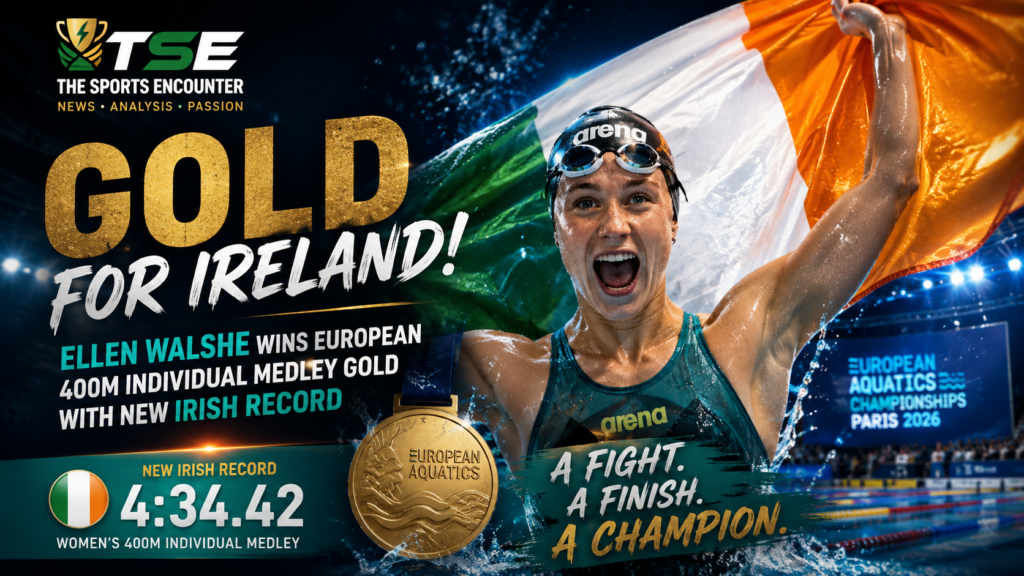
Ellen Walshe produced one of Ireland’s standout swims of the 2026 European Aquatics Championships, storming through the final 50 meters to win the women’s 400m individual medley in an Irish-record 4:34.42 at the Paris Aquatic Centre.
The 24-year-old Templeogue swimmer did not dominate from the opening length. She had to build her way into the race, chase down Great Britain’s 16-year-old Amalie Smith and then summon the fastest finish when the European title was on the line.
Walshe touched first in 4:34.42, lowering her own Irish long-course record of 4:35.32. Smith took silver in 4:35.12, just 0.70 seconds behind, while Poland’s Justina Kozan claimed bronze in a national-record 4:36.47.
For Walshe, the victory carried more than medal-table value. The 400m individual medley had become one of the events testing her confidence as much as her endurance, making the way she won in Paris particularly significant.
“I was delighted to see my hand on the wall first,” Walshe said after the race. “I just fought so hard at the end.”
For more results, records and athlete stories from the pool, follow The Sports Encounter’s international swimming coverage.
Ellen Walshe 400m IM Final: Key Results
| Position | Swimmer | Nation | Time | Margin |
|---|---|---|---|---|
| 1 | Ellen Walshe | Ireland | 4:34.42 | Irish record |
| 2 | Amalie Smith | Great Britain | 4:35.12 | +0.70 |
| 3 | Justina Kozan | Poland | 4:36.47 | +2.05 |
| 4 | Vivien Jackl | Hungary | 4:37.30 | +2.88 |
| 5 | Alba Vázquez Ruiz | Spain | 4:38.21 | +3.79 |
The official race result was confirmed by Omega Timing, the championship timing provider.
Walshe Had to Chase the Race
The final tells a much better story when viewed through the splits.
Walshe was fifth after the opening 50 meters in 29.44 and slipped to sixth after the butterfly leg, reaching 100 meters in 1:03.05.
That placed her behind several rivals early.
She began climbing during the backstroke.
At 150 meters, Walshe had moved into fourth. By the halfway point she was third in 2:14.26.
Then came the breaststroke, often the section where a 400m individual medley changes shape.
Walshe moved into second after 250 meters and stayed there through 300.
Smith remained in front.
At 300 meters, the British teenager led in 3:30.38. Walshe followed in 3:31.93, leaving the Irish swimmer 1.55 seconds behind with 100 meters of freestyle remaining.
The European title was still Smith’s to lose.
The Final 50 Meters Won the Gold
The gap had almost disappeared by the final turn.
At 350 meters, Smith still led in 4:03.36.
Walshe touched in 4:03.62.
Only 0.26 seconds separated them.
Then Walshe found another gear.
She covered the final 50 meters in 30.80 seconds.
Smith closed in 31.76.
That means Walshe gained almost a full second on her British rival over the final length, turning a narrow deficit into a 0.70-second European championship victory.
It was exactly the kind of finish the 400m IM demands after seven lengths of changing technique, breathing patterns and muscle groups.
Walshe did not simply survive the freestyle.
She attacked it.
Amalie Smith Was Inches From Another Major Breakthrough
The runner-up deserves considerable credit.
Smith arrived in Paris as one of the most exciting teenagers in international swimming and came within one length of becoming European champion at 16.
The Sports Encounter recently profiled Amalie Smith after her Commonwealth Games breakthrough, where she won 400m IM silver in Glasgow in 4:33.70.
That Glasgow performance demonstrated that Smith had already moved beyond junior-level promise.
Paris reinforced it.
She took control during the breaststroke section and led through 250, 300 and 350 meters before Walshe finally caught her.
Smith’s 4:35.12 was slower than her Commonwealth personal best, but the medal adds another senior international podium to a résumé that already includes European junior titles and world junior medals.
The next chapter of this rivalry could become particularly interesting because both swimmers appear capable of moving the event forward in Europe.
Walshe Breaks Her Own Irish Record
The winning time matters beyond the medal.
Walshe entered the final as the Irish record holder after clocking 4:35.32 at the 2025 World Championships, according to Swim Ireland.
Her Paris swim improved that mark by 0.90 seconds.
That may sound like a small number.
At elite level, finding almost a second in an event where an athlete is already competing near international medal standard represents meaningful progress.
It also gives Walshe another national record in a career that has increasingly been defined by versatility.
She has competed internationally across butterfly, backstroke and both individual medley distances, making her one of the most technically rounded swimmers in Irish high-performance swimming.
Why the 400m Individual Medley Is Such a Severe Test
The 400m IM exposes almost everything about a swimmer.
The race begins with 100 meters butterfly, followed by 100 meters backstroke, 100 meters breaststroke and 100 meters freestyle.
Each section asks something different.
Butterfly can burn too much energy if the opening is forced. Backstroke demands rhythm and body position. Breaststroke can completely reorder the field because stroke efficiency varies dramatically among medley specialists. Freestyle then becomes a test of technique under extreme fatigue.
The strongest 400m IM swimmers rarely win with only one great stroke.
They manage weakness, maximize strength and understand when to spend energy.
That is what made Walshe’s race impressive.
She remained patient while sitting outside the top three early, moved steadily through the backstroke and breaststroke, then committed fully once the freestyle opened the race.
The same event produced one of the defining swimming stories of the Commonwealth Games when Jenna Forrester won for Australia, a result covered in The Sports Encounter’s Glasgow 2026 Day 4 report.
A Gold Medal With a Mental Backstory
The emotional significance of Walshe’s victory is easy to underestimate if the result is viewed only as a championship time.
Before Paris, Walshe had spoken openly about the psychological challenge attached to the 400m IM.
A disappointing seventh-place result in the event at the European Short Course Championships had stayed with her despite other successes.
Wow 😭 😭😭
— Her Sport (@HerSportDotIE) August 12, 2026
What have I just seen!! Incredible. Wow. What a performance. What a swim! Ellen Walshe the 400M IM EUROPEAN CHAMPION!
A NEW IRISH RECORD TOO!! 4:34.42.
What an evening this is turning out to be! 🇮🇪 pic.twitter.com/hhSD1PLgPk
She described the process of getting her training performances to appear consistently in competition as a major mental challenge.
That gives the Paris final a different meaning.
Walshe entered the closing 100 meters behind.
She could see Smith ahead.
She had already spent more than three and a half minutes moving through three different strokes at championship intensity.
Then she had to make a decision.
Chase.
Her final 50 suggests she never hesitated.
Brian Sweeney’s Preparation Pays Off
Walshe has credited coach Brian Sweeney as an important influence throughout her preparation.
The work has included maintaining a demanding multi-event program rather than narrowing Walshe into a single specialty.
That versatility requires careful management.
A swimmer training seriously across medley, butterfly and backstroke needs enough technical volume in several strokes while still building the aerobic base required for a 400m race.
The Paris result offers tangible evidence that the approach is working.
Walshe did not win because one section of the medley carried her through everything else.
She remained competitive across all four.
Ireland’s Strong Night Gets Better With Mona McSharry Silver
Walshe’s gold was part of a significant session for Irish swimming.
Mona McSharry collected silver in the women’s 100m breaststroke, touching in 1:05.41 behind Great Britain’s Angharad Evans, who won in a championship-record 1:04.87. Italy’s Benedetta Pilato took bronze in 1:05.89. European Aquatics confirmed the podium results.
McSharry’s medal added another major championship result to a career that already includes Olympic bronze from Paris 2024.
Evans had entered these championships carrying considerable momentum after completing a Commonwealth breaststroke double in Glasgow. The Sports Encounter documented that rise in its feature on Angharad Evans’ second Commonwealth gold.
The fact that Walshe and McSharry reached the podium during the same evening gives Ireland something bigger than two individual medals.
It demonstrates depth.
Swim Ireland sent a squad to Paris containing established Olympic performers and younger swimmers with international ambitions. The national body described the European Championships as one of the key meets on the international calendar, with more than 1,000 athletes competing across five aquatics disciplines.
Pool competition runs through August 16 at the Paris Aquatic Centre.
Paris Is Producing a Remarkable Swimming Championship
Walshe’s gold came during an extraordinary evening of racing.
Italy’s Sara Curtis broke the women’s 50m backstroke world record in the semifinals, swimming 26.63 seconds.
The Sports Encounter’s full report on Curtis’ 26.63 world record examines how the 19-year-old moved from Italian record holder to the fastest woman ever in the event within a matter of months.
Elsewhere, Germany’s Johannes Liebmann won a high-quality men’s 800m freestyle final in a European-record 7:37.59.
Olympic champion Daniel Wiffen narrowly missed another medal for Ireland, finishing fourth in 7:43.30.
Sweden’s Sarah Sjöström also returned to the top of the European podium by winning the women’s 50m butterfly.
That depth of performance makes Walshe’s gold even more valuable.
Paris is producing world records, championship records and elite fields.
Ireland now owns one of the titles.
Walshe’s Final 100 Compared With Smith
| Split | Ellen Walshe | Amalie Smith | Race Position |
|---|---|---|---|
| 300m | 3:31.93 | 3:30.38 | Smith leads by 1.55 |
| 350m | 4:03.62 | 4:03.36 | Smith leads by 0.26 |
| Final 50 | 30.80 | 31.76 | Walshe gains 0.96 |
| Finish | 4:34.42 | 4:35.12 | Walshe wins by 0.70 |
Those numbers explain the race better than any general description.
Walshe cut 1.29 seconds from Smith’s lead between 300 and 350 meters, then gained another 0.96 over the final length.
The European title was won during the closing minute.
What the Result Means for Irish Swimming
Ireland’s swimming ambitions have changed considerably over the past several Olympic cycles.
International finals are no longer treated as the ceiling.
Wiffen has become an Olympic champion. McSharry owns an Olympic medal. Walshe has reached major finals and collected significant short-course international honors.
Paris adds another senior continental title to that progression.
The wider pattern matters because successful national programs usually grow when several athletes create expectations for one another.
One swimmer reaching a final proves it is possible.
Several swimmers winning international medals create a culture where finals and podiums begin to feel normal.
That was visible throughout Glasgow 2026 as leading swimming nations accumulated medals through depth rather than dependence on one star. The Sports Encounter’s Day 5 Commonwealth Games analysis examined how swimmers such as Jenna Forrester, Lani Pallister, Kylie Masse and Lewis Clareburt maintained success across demanding programs.
Ireland operates on a smaller scale, but the underlying principle is similar.
Walshe and McSharry sharing the podium spotlight on the same evening is valuable evidence of a national program capable of producing multiple championship threats.
TSE Verdict: Walshe Won This Gold the Hard Way
Ellen Walshe’s European title should be remembered for the way it unfolded.
She was sixth after 100 meters.
She was still outside the lead at halfway.
She trailed Smith by more than a second with 100 meters remaining.
Even at the final turn, she was behind.
Then came 30.80 seconds of freestyle.
That final length delivered a European title, an Irish record and one of the strongest championship finishes of Walshe’s career.
The result also provided an answer to the mental questions she had carried into Paris.
Training speed matters.
National records matter.
Previous medals matter.
Championship swimming eventually asks a simpler question: what can an athlete produce when another swimmer is ahead and the wall is approaching?
Walshe produced enough.
By 0.70 seconds.
And Ireland has another European champion.
Frequently Asked Questions
Who won the women’s 400m individual medley at the 2026 European Aquatics Championships?
Ireland’s Ellen Walshe won gold in Paris with an Irish-record time of 4:34.42.
What record did Ellen Walshe break?
Walshe broke her own Irish long-course record in the women’s 400m individual medley. Her previous best was 4:35.32.
Who finished second behind Ellen Walshe?
Great Britain’s Amalie Smith won silver in 4:35.12, finishing 0.70 seconds behind Walshe.
Who won bronze in the women’s 400m IM?
Poland’s Justina Kozan finished third in 4:36.47, setting a Polish national record.
Did Ellen Walshe lead the whole race?
No. Official timing shows Walshe was sixth after 100 meters and second heading into the final 50. She overtook Amalie Smith during the closing length.
How fast was Walshe’s final 50 meters?
Walshe completed the final 50 meters in 30.80 seconds compared with Smith’s 31.76, allowing her to turn a 0.26-second deficit into a 0.70-second victory.
Did Ireland win another swimming medal on the same night?
Yes. Mona McSharry won silver in the women’s 100m breaststroke in 1:05.41 behind Great Britain’s Angharad Evans.
Where are the 2026 European Aquatics Championships being held?
The championships are being held in Paris, France, with pool swimming taking place at the Paris Aquatic Centre from August 10 to 16.
Where can I follow more swimming stories?
Visit The Sports Encounter’s Swimming hub for race reports, records, athlete features and championship analysis.