


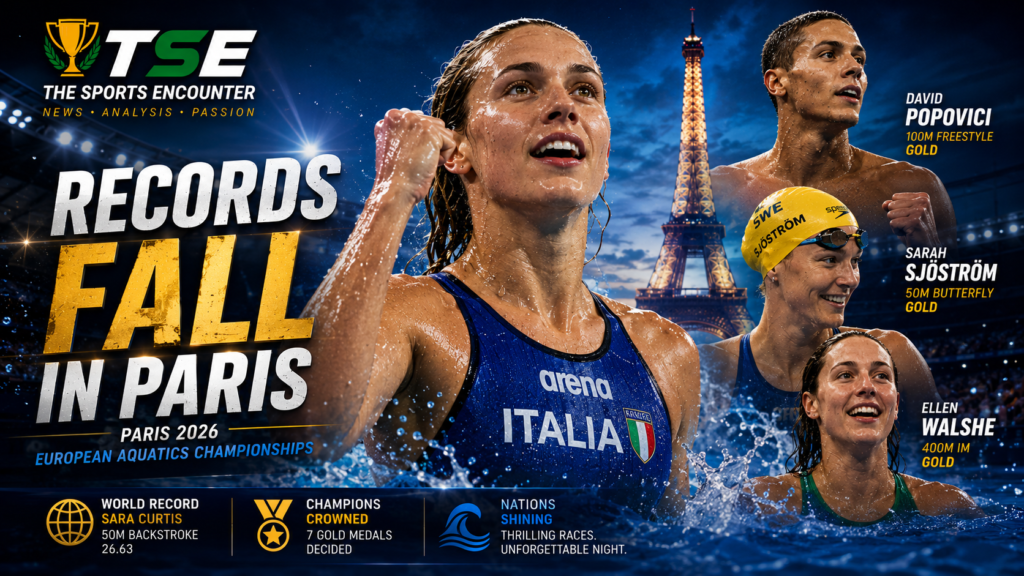
Paris produced the kind of swimming session that refuses to settle around one headline. Sara Curtis broke the women’s 50m backstroke world record before even reaching the final, David Popovici survived a spectacular 100m freestyle challenge, Sarah Sjöström returned to the top of a European podium after becoming a mother, Johannes Liebmann lowered his own European record, and Ellen Walshe delivered Ireland a dramatic 400m individual medley gold.
Day 3 of swimming at the 2026 European Aquatics Championships turned the Olympic Aquatic Centre into a record-breaking stage on Wednesday, August 12.
Seven titles were decided.
Some champions controlled their races. Others had to find something in the final meters.
The most extraordinary performance did not even come in a final.
Italy’s 19-year-old Sara Curtis blasted 26.63 seconds in the women’s 50m backstroke semifinals, breaking the world record before returning later in the evening to help Italy win silver in the women’s 4x100m freestyle relay.
Romania’s Popovici needed almost every centimeter of the pool to secure his third consecutive European 100m freestyle crown. Sweden’s Sjöström added another chapter to one of European swimming’s greatest careers. Germany’s Liebmann moved the continental 800m freestyle standard forward again.
Hungary’s Hubert Kós added European gold to his global backstroke credentials, Britain’s Angharad Evans produced another championship record in the women’s 100m breaststroke, and Walshe gave Ireland one of its biggest moments of Paris 2026.
The Netherlands then closed the evening with a championship record in the women’s 4x100m freestyle relay.
Paris 2026 Swimming Day 3 Gold Medalists
| Event | Champion | Nation | Winning Time | Significance |
|---|---|---|---|---|
| Men’s 200m Backstroke | Hubert Kós | Hungary | 1:53.08 | First European title in the event |
| Women’s 50m Butterfly | Sarah Sjöström | Sweden | 25.05 | 18th European gold |
| Men’s 100m Freestyle | David Popovici | Romania | 46.56 CR | Third consecutive European title |
| Women’s 100m Breaststroke | Angharad Evans | Great Britain | 1:04.87 CR | Third championship record across the rounds |
| Women’s 400m Individual Medley | Ellen Walshe | Ireland | 4:34.32 | Late surge earns European gold |
| Men’s 800m Freestyle | Johannes Liebmann | Germany | 7:37.59 ER | European record |
| Women’s 4x100m Freestyle | Netherlands | Netherlands | 3:31.89 CR | Championship record |
Official schedules and complete results are available through European Aquatics.
Sara Curtis Produces the Performance of the Night Before the Finals Are Over
Sara Curtis arrived in Paris as one of Italy’s most exciting young swimmers.
By Wednesday night, she was a world-record holder.
Curtis entered the women’s 50m backstroke semifinals having already established a European record of 27.07 earlier this summer.
She took the event somewhere entirely different in Paris.
The Italian touched in 26.63 seconds.
That erased the previous world record of 26.68 set by Australia’s Kaylee McKeown.
The performance becomes even more striking when placed in context.
Curtis is only 19.
She broke the world record in a semifinal.
The European title itself is still to be decided.
That leaves Thursday’s final with a rare dynamic: Curtis enters as the fastest woman in history rather than simply the fastest qualifier at these championships.
Her night was still not finished.
Curtis later produced a 52.29 relay leg as Italy challenged for the women’s 4x100m freestyle title.
The Netherlands ultimately denied them gold, but Curtis had already transformed the evening.
Popovici Finds the Final Strokes He Needs
David Popovici’s third consecutive European 100m freestyle title looked anything but inevitable with only a few meters remaining.
Egor Kornev attacked the first length aggressively and turned in 22.06, giving him a 0.30-second advantage over the Romanian.
Popovici had work to do.
He gradually reduced the gap through the second 50 meters, but Kornev remained in front deep into the finish.
Then came the decisive strokes.
Popovici touched first in 46.56 seconds.
Kornev finished only 0.18 behind in 46.74.
Hungary’s Kristóf Milák took bronze in 46.87.
| Position | Swimmer | Nation | Time |
|---|---|---|---|
| 1 | David Popovici | Romania | 46.56 CR |
| 2 | Egor Kornev | NAB | 46.74 |
| 3 | Kristóf Milák | Hungary | 46.87 |
Popovici also lowered the championship record he had established in the semifinals by another 0.16 seconds.
The result gives him three straight European titles in the event.
What made this one memorable was the pressure.
Popovici could see the race disappearing.
His response came when the margin for correction had almost vanished.
Sjöström Returns and Immediately Starts Winning Again
Sarah Sjöström’s 50m butterfly victory carried a different kind of significance.
The Swedish great had been absent from championship racing for 20 months.
She became a mother during that period before returning to competition in April.
Paris was therefore testing more than speed.
It was testing whether one of the defining swimmers of her generation could return to a major championship and immediately compete for titles again.
The answer arrived in 25.05 seconds.
Sjöström had already qualified fastest through the heats and semifinals. She improved again in the final, holding off Belgium’s Roos Vanotterdijk.
| Position | Swimmer | Nation | Time |
|---|---|---|---|
| 1 | Sarah Sjöström | Sweden | 25.05 |
| 2 | Roos Vanotterdijk | Belgium | 25.12 |
| 3 | Sara Junevik | Sweden | 25.51 |
The victory brought Sjöström’s collection to 18 European gold medals.
Her comeback therefore moved almost immediately from a story about returning to competition into another story about winning.
Liebmann Breaks His Own European Record
Johannes Liebmann is also 19.
His breakthrough came across 800 meters rather than 50.
The German produced 7:37.59 to win a high-quality men’s 800m freestyle final and lower his own European record.
Germany made the result even stronger when Sven Schwarz took silver in 7:41.16.
Hungary’s Zalan Sarkany completed the podium in 7:41.75.
| Position | Swimmer | Nation | Time |
|---|---|---|---|
| 1 | Johannes Liebmann | Germany | 7:37.59 ER |
| 2 | Sven Schwarz | Germany | 7:41.16 |
| 3 | Zalan Sarkany | Hungary | 7:41.75 |
| 4 | Daniel Wiffen | Ireland | 7:43.30 |
Daniel Wiffen finished fourth in 7:43.30.
For Ireland, that was one of the evening’s few frustrations, especially given Wiffen’s Olympic pedigree.
For Germany, it was an emphatic demonstration of distance depth.
Liebmann had already broken Schwarz’s European record earlier in 2026.
Paris showed he was capable of moving his own standard again under championship pressure.
Ellen Walshe Refuses to Let Amalie Smith Get Away
Ireland’s biggest celebration came in the women’s 400m individual medley.
For much of the decisive closing phase, Great Britain’s 16-year-old Amalie Smith appeared capable of completing a remarkable senior European breakthrough.
Ellen Walshe kept coming.
The Irish swimmer attacked the final freestyle leg and finally moved past Smith inside the last 25 meters.
Walshe touched in 4:34.32.
Smith followed for silver, while Poland’s Justina Kozan claimed bronze in 4:36.47.
The result completed an excellent evening for Ireland after Mona McSharry had already won silver in the women’s 100m breaststroke.
Walshe’s race also demonstrated why the individual medley can produce some of swimming’s best finishes.
A lead built through butterfly, backstroke or breaststroke can disappear quickly when two athletes reach freestyle with very different amounts of energy remaining.
Walshe judged that final transition better.
She still needed the finish of her life to turn it into gold.
Angharad Evans Keeps Getting Faster
Angharad Evans did something unusual during the women’s 100m breaststroke competition.
She kept rewriting the championship record.
Her final performance of 1:04.87 represented the third consecutive championship record of her Paris campaign.
Italy’s Benedetta Pilato reached the turn 0.30 seconds ahead.
Evans remained patient.
Her final 25 meters changed the race completely.
The British swimmer surged clear and secured European gold after winning two Commonwealth titles for Scotland earlier this summer.
Mona McSharry gave Ireland another medal by finishing second in 1:05.41.
Pilato held on for bronze in 1:05.89.
| Position | Swimmer | Nation | Time |
|---|---|---|---|
| 1 | Angharad Evans | Great Britain | 1:04.87 CR |
| 2 | Mona McSharry | Ireland | 1:05.41 |
| 3 | Benedetta Pilato | Italy | 1:05.89 |
Defending champion Eneli Jefimova finished fourth in 1:05.94.
Evans’ progression through the rounds made the result particularly convincing.
She did not simply arrive at one exceptional swim.
She became faster as the championship demanded more.
Hubert Kós Turns Semifinal Speed Into 200m Backstroke Gold
Hubert Kós had already delivered a warning before the men’s 200m backstroke final.
The Hungarian qualified in 1:52.30, setting European and championship records in the semifinal.
That performance put Aaron Peirsol’s long-standing 1:51.92 world record within the wider conversation entering the final.
Kós did not reproduce his semifinal time when the medals were decided.
He did not need to.
The world and Olympic champion controlled the final sufficiently to win in 1:53.08.
Defending European champion Apostolos Siskos took silver in 1:53.81, with Italy’s Thomas Ceccon third in 1:53.96.
| Position | Swimmer | Nation | Time |
|---|---|---|---|
| 1 | Hubert Kós | Hungary | 1:53.08 |
| 2 | Apostolos Siskos | Greece | 1:53.81 |
| 3 | Thomas Ceccon | Italy | 1:53.96 |
It was Kós’ first European title in the 200m backstroke.
The larger point is what happened across the two rounds.
He demonstrated world-record-level ambition in the semifinal and enough control to finish the job in the final.
Netherlands Ends the Night With Another Championship Record
The final title of Day 3 went to the Netherlands.
Italy made the women’s 4x100m freestyle relay competitive, with Curtis contributing her 52.29 split after the emotional high of her world record.
Marrit Steenbergen settled the race.
The Dutch world champion produced a 51.34 anchor leg to carry the Netherlands home in 3:31.89.
That established another championship record.
Italy finished second in 3:33.19, while NAB took bronze in 3:33.69.
| Position | Nation | Time |
|---|---|---|
| 1 | Netherlands | 3:31.89 CR |
| 2 | Italy | 3:33.19 |
| 3 | NAB | 3:33.69 |
Steenbergen’s anchor was another reminder that relay races are often decided by which team can keep its strongest swimmer within striking distance for the final exchange.
The Netherlands did exactly that.
Ireland Leaves Day 3 With Gold, Silver and a Painful Fourth
Few nations experienced as many different emotions Wednesday as Ireland.
Walshe won the 400m individual medley.
McSharry collected silver in the 100m breaststroke.
Wiffen finished fourth in the 800m freestyle.
Those results represent three very different championship experiences.
Walshe produced the late attack required to become European champion.
McSharry added another major international medal to her résumé.
Wiffen found himself on the wrong side of one of swimming’s most unforgiving positions, close enough to the podium to see exactly what was missing.
Collectively, however, Ireland showed significant depth across medley, breaststroke and distance freestyle.
Day 3 Belonged to Different Generations
Perhaps the most interesting feature of Wednesday was the age range of the athletes shaping it.
Curtis is 19.
Liebmann is 19.
Amalie Smith is 16 and came within the closing meters of a European title.
At the other end of the spectrum, Sjöström is 32 and returned from becoming a mother to win another major championship gold.
That creates a compelling picture of European swimming in 2026.
The next generation is already breaking world and continental records.
Some of the defining champions of the previous generation remain fast enough to beat them.
Three Different Records Fell in One Evening
The times also explain why Day 3 deserves more than a standard results recap.
Curtis produced a world record.
Liebmann produced a European record.
Popovici and the Netherlands lowered championship records in their finals.
Evans completed a remarkable sequence of championship records across the women’s 100m breaststroke rounds.
Kós had already broken the European 200m backstroke record in qualifying for his final.
Paris is therefore producing fast swimming across very different disciplines.
There is sprint speed.
There is distance speed.
There is backstroke speed.
The depth of those records matters more than one isolated spectacular swim.
Noe Ponti Responds After His 50m Butterfly Frustration
Wednesday also created important stories for Thursday.
Switzerland’s Noe Ponti had endured a frustrating men’s 50m butterfly final when his goggles became dislodged.
His response in the 100m butterfly semifinals was emphatic.
Ponti qualified fastest in 50.21.
Kristóf Milák followed at 50.50, with France’s Maxime Grousset at 50.78.
That gives Thursday a high-quality final involving three swimmers capable of changing the race in very different ways.
Ponti now has an immediate opportunity to turn one championship disappointment into a title challenge.
Filip Nowacki Leads the 200m Breaststroke Finalists
Great Britain’s Filip Nowacki provided another glimpse of Europe’s younger generation.
The 18-year-old world junior champion qualified fastest for the men’s 200m breaststroke final in 2:08.60.
Austria’s Luka Mladenovic followed in 2:08.85.
The final therefore gives Nowacki an opportunity to translate junior success onto the senior European stage.
After Evans’ victory in the women’s 100m breaststroke, British breaststroke enters Thursday with considerable momentum.
What to Watch on Paris 2026 Swimming Day 4
Thursday’s schedule continues immediately with another strong medal program.
The men’s 100m butterfly final brings Ponti, Milák and Grousset together.
Curtis returns for the women’s 50m backstroke final as the new world-record holder.
The men’s 200m breaststroke final gives Nowacki his first major senior title opportunity.
The women’s 200m freestyle final will add another major test of European middle-distance depth.
The men’s 4x100m freestyle relay closes the evening.
Morning competition also begins new paths toward medals in the men’s 200m freestyle, women’s 100m butterfly, men’s 50m backstroke, women’s 200m breaststroke and women’s 1500m freestyle.
That makes Curtis particularly fascinating.
Breaking the world record created history Wednesday.
Thursday asks her to reset emotionally and win the actual European title.
TSE Verdict: Paris Produced Its First Truly Extraordinary Swimming Night
The opening days established the championship.
Wednesday accelerated it.
A 19-year-old broke a world record.
Another 19-year-old broke a European record.
Popovici needed a furious finish to preserve his European 100m freestyle reign.
Sjöström returned from motherhood and a 20-month championship absence with another gold medal.
Walshe chased down a 16-year-old rising star in the final 25 meters.
Evans kept rewriting the championship record every time the pressure increased.
Kós backed up a European-record semifinal with gold.
Steenbergen closed the evening with a relay anchor worthy of a championship record.
That variety made Day 3 special.
Paris did not give the evening to one swimmer, one nation or one generation.
Established champions survived.
Young swimmers arrived.
Records disappeared.
Several Thursday finals became considerably more interesting because of what happened Wednesday.
And Sara Curtis still has to swim the final of the event in which she has already become the fastest woman in history.
That may be the best measure of how quickly Paris 2026 has come alive.
Frequently Asked Questions
Who broke the world record at Paris 2026 on August 12?
Italy’s Sara Curtis broke the women’s 50m backstroke world record with 26.63 seconds in the semifinals.
Who won the men’s 100m freestyle?
David Popovici won in a championship-record 46.56, narrowly beating Egor Kornev’s 46.74.
How many consecutive European 100m freestyle titles has Popovici won?
Popovici has now won three consecutive European titles in the men’s 100m freestyle.
Who won the women’s 50m butterfly?
Sarah Sjöström won in 25.05 seconds, earning her 18th European gold medal.
Who won the women’s 400m individual medley?
Ireland’s Ellen Walshe won in 4:34.32 after passing Great Britain’s Amalie Smith during the closing stages.
Who won the women’s 100m breaststroke?
Great Britain’s Angharad Evans won in a championship-record 1:04.87, with Ireland’s Mona McSharry taking silver.
Who broke the men’s 800m freestyle European record?
Germany’s Johannes Liebmann lowered his own European record to 7:37.59 while winning gold.
Where did Daniel Wiffen finish?
The Irish Olympic champion finished fourth in the men’s 800m freestyle in 7:43.30.
Who won the men’s 200m backstroke?
Hungary’s Hubert Kós won in 1:53.08 after setting a European record of 1:52.30 in the semifinals.
Who won the women’s 4x100m freestyle relay?
The Netherlands won in a championship-record 3:31.89, ahead of Italy and NAB.
When does swimming at Paris 2026 finish?
The pool swimming program continues through Sunday, August 16.