


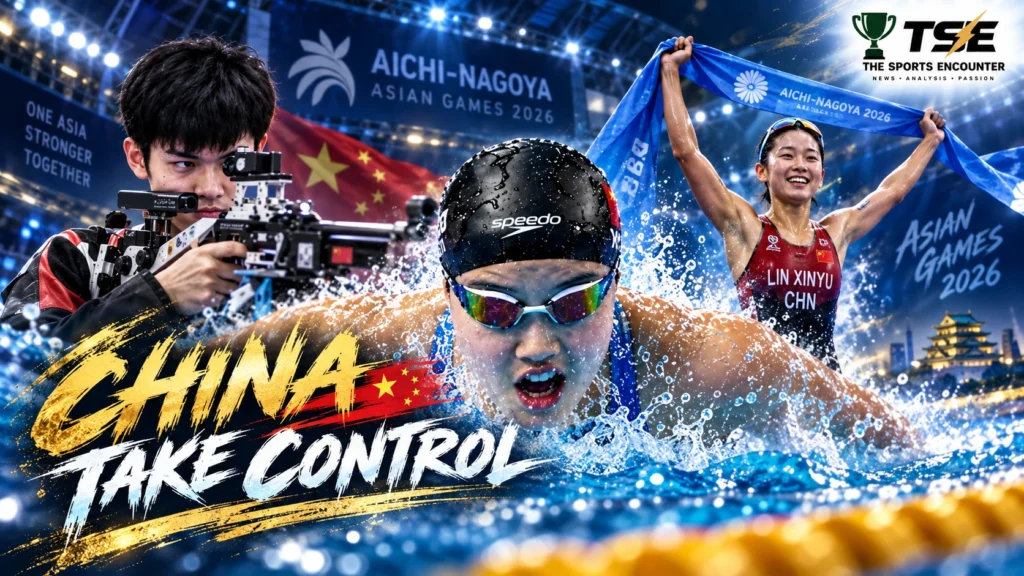
NAGOYA, Japan, September 21, 2026: China transformed an early Asian Games advantage into a substantial medal-table cushion on Monday, but the story of September 21 stretched far beyond raw numbers. A 13-year-old swimmer moved within four-tenths of a world record, an Olympic shooting champion rewrote Asian standards, a Chinese gymnast defeated two Japanese global champions on their home floor, and several medal contests were settled by margins measured in hundredths or thousandths.
By the end of competition, China led the Aichi-Nagoya 2026 medal standings with 23 gold, 10 silver and five bronze medals for 38 overall. Host Japan followed with eight gold and 32 total medals, while South Korea held third with five gold and 23 medals.
The scale of China’s lead matters, but the more revealing development was where those medals came from. Swimming, shooting, gymnastics, wushu and triathlon all contributed major results on the same day. That breadth is beginning to separate China from the chasing nations much earlier than many rivals would have wanted.
For full tournament coverage, schedules, analysis and developing medal stories, follow The Sports Encounter’s Asian Games 2026 hub.
Asian Games 2026 September 21: Key Results at a Glance
| Event | Winner / Result | Why It Mattered |
|---|---|---|
| Women’s 200m Individual Medley | Yu Zidi, China – 2:06.10 | Asian record, Asian Games record and world junior record |
| Men’s 10m Air Rifle Team | China – 1,899.0 | World record |
| Men’s 10m Air Rifle Individual | Sheng Lihao, China – 254.2 | Asian and Asian Games record |
| Men’s Artistic Gymnastics All-Around | Zhang Boheng, China – 85.065 | Defended title against Shinnosuke Oka and Daiki Hashimoto |
| Men’s 50m Freestyle | Kim Young-beom, South Korea – 21.66 | Broke Asian Games record for second time that day |
| Men’s 50m Backstroke | Xu Jiayu, China – 24.04 | Third straight Asian Games title and Games record |
| Women’s 200m Freestyle | Siobhan Haughey, Hong Kong, China – 1:54.96 | Successfully defended title |
| Men’s 100m Breaststroke | Dong Zhihao / Shin Ohashi – 58.64 | China and Japan shared gold after exact dead heat |
| Men’s 4x200m Freestyle Relay | China – 7:00.17 | Asian record after late comeback against Japan |
| Mixed Triathlon Relay | China – 1:25:54 | Lin Xinyu collected second gold in 24 hours |
| Women’s Wushu Changquan | Lydia Sham Hui Yu, Hong Kong, China – 9.713 | Gold decided by 0.003 points |
China’s Medal Lead Is Becoming a Story About Depth
China had already established control after the first full medal day of Aichi-Nagoya 2026, when Yu Zidi, Pan Zhanle, Xu Jiayu and the Chinese shooting team helped deliver an early rush of gold medals.
September 21 made the advantage more difficult to dismiss as an opening-day surge.
China finished Monday with 23 gold medals. Eleven had come from swimming alone, but the overall lead was being reinforced elsewhere. Shooting supplied three golds across the opening two medal days. Wushu and triathlon had each produced two. Artistic gymnastics then added another major championship victory through Zhang Boheng.
The official Aichi-Nagoya 2026 Games platform is tracking a program that will eventually distribute hundreds of titles across dozens of disciplines. Early domination guarantees nothing across such a broad schedule, particularly before athletics and several other medal-heavy sports fully develop.
China have nevertheless established the most valuable advantage available at this stage: they are winning in sports that reward very different types of athletes and national systems.
Yu Zidi Turns a Teenage Breakthrough Into a Global Swimming Story
Yu Zidi entered these Games as one of the most closely watched young swimmers in the world. Two finals have already moved the discussion beyond potential.
The 13-year-old won the women’s 200m individual medley in 2:06.10 on Monday, breaking the Asian record, Asian Games record and world junior record. Her performance left her only 0.40 seconds behind Summer McIntosh’s world record of 2:05.70.
That followed Yu’s 2:05.08 Asian Games record in the 200m butterfly one day earlier.
TSE’s detailed analysis of Yu Zidi’s extraordinary 2:06.10 individual medley shows why the time matters beyond another continental title. She removed 0.72 seconds from the Asian record and finished 1.89 seconds ahead of defending champion Yu Yiting.
The individual medley also asks more of Yu than her butterfly title did. Four strokes expose technical weaknesses that can be hidden in a specialist event. Producing one of the fastest 200m IM performances ever recorded suggests her development is already unusually broad.
China now have a teenager capable of winning continental titles while approaching global senior records. That may prove more significant than the two medals themselves.
Sheng Lihao Turns China’s Shooting Strength Into a World Record
The shooting range delivered China’s clearest example of institutional depth.
Sheng Lihao, Ma Sihan and Zhang Changhong combined for 1,899.0 in the men’s 10m air rifle team competition, improving the previous world record of 1,898.4. India took silver with 1,890.1, while South Korea finished third on 1,884.2.
Sheng then entered the individual final and won gold with 254.2, improving his own Asian and Asian Games final record.
The full TSE breakdown of China’s air rifle world record and Sheng Lihao’s individual title also reveals how close India came to disrupting the expected order.
Rudrankksh Patil led early in the individual final. Himanshu Dhillon climbed alongside him, briefly leaving India with the top two positions before Sheng worked his way forward.
Dhillon eventually secured silver with 252.4 and Rudrankksh took bronze with 230.9.
China therefore produced a world record and two gold medals from the discipline, while India emerged with team silver and two individual podium places.
India’s Shooting Depth Keeps the Medal Count Moving
India ended September 21 with six medals: four silver and two bronze. Five of those six came from shooting.
The absence of a gold medal will attract attention, but the more useful early measure is conversion. Indian shooters have repeatedly reached finals and converted those positions into podium finishes.
Monday’s men’s air rifle competition was especially strong. Three athletes produced enough depth for team silver, while two qualified for the individual final and both won medals.
That pattern matters across a long multi-sport Games. Medal tables can change quickly when a national program repeatedly places several athletes inside finals rather than relying on one favorite.
India also collected its first Asian Games medal in mixed martial arts through Suchika Tariyal. Her women’s traditional 60kg semifinal finished level before Singapore’s Tiffany Teo advanced under a weight-based tiebreak because she had weighed 700 grams less.
The unusual ending and the rules behind it are examined in TSE’s report on Suchika Tariyal’s historic MMA bronze.
The Pool Produced More Than China’s Medal Rush
China won five of Monday’s seven swimming events, yet several of the session’s strongest stories came from athletes representing other delegations.
South Korea’s Kim Young-beom broke the men’s 50m freestyle Asian Games record twice in a matter of hours. He first clocked 21.71 in the heats, then returned for the final and lowered it again to 21.66.
Kim’s progression, including how close he came to the 21.64 Asian record, is detailed in TSE’s 50m freestyle analysis.
Hong Kong, China’s Siobhan Haughey produced a different kind of championship performance. She defended the women’s 200m freestyle crown in 1:54.96, finishing comfortably ahead of China’s Li Jiaping and Liu Yaxin.
Haughey did not need a record. She controlled the final from the opening length and turned an event containing two dangerous Chinese challengers into one of Monday’s clearest victories.
Dong Zhihao and Shin Ohashi Could Not Be Separated
The men’s 100m breaststroke supplied perhaps the cleanest illustration of how small the margins became.
China’s Dong Zhihao and Japan’s 17-year-old Shin Ohashi both touched in exactly 58.64. Both received gold, with no silver medal awarded. China’s Qin Haiyang finished third in 59.01.
That race, Haughey’s successful defense, Lin Xinyu’s triathlon double and Lydia Sham’s wushu title are covered together in TSE’s September 21 multi-sport analysis.
Xu Jiayu Extends a Title Streak That Began Eight Years Ago
China’s swimming strength also includes experience.
Xu Jiayu won the men’s 50m backstroke in an Asian Games record 24.04, completing a third consecutive title in the event after victories at Jakarta 2018 and Hangzhou 2023.
His winning times across those Games have moved from 24.75 to 24.38 and now 24.04.
That progression is important because Xu is 31. He is not simply surviving through reputation or past achievements. His fastest Asian Games performance has arrived at his latest appearance.
The broader context behind the streak is explored in TSE’s analysis of Xu Jiayu’s third straight 50m backstroke title.
China Chase Down Japan to Break the Asian 4x200m Relay Record
The men’s 4x200m freestyle relay produced one of the day’s most revealing races.
Japan built the early advantage and still led China by 1.89 seconds when the anchor swimmers entered the water.
Zhang Zhanshuo then delivered a 1:42.92 final leg.
China overturned the deficit and won in 7:00.17, lowering its own Asian record. Japan finished second in 7:01.05 and defending champion South Korea took bronze in 7:06.76.
The race showed why relay strength is such a useful measure of national depth. A team can survive an early deficit when several world-class swimmers remain available later in the order.
TSE’s full breakdown of China’s 4x200m comeback explains how Pan Zhanle began reducing Japan’s lead before Zhang transformed the final leg.
Zhang Boheng Beats Oka and Hashimoto on Japanese Ground
One of China’s most important gold medals did not come from the pool or shooting range.
Zhang Boheng successfully defended the men’s artistic gymnastics all-around title with 85.065 points at Nagoya City General Gymnasium.
Japan’s Olympic all-around champion Shinnosuke Oka finished second with 84.698, while three-time world champion Daiki Hashimoto took bronze on 83.865.
The quality of the field gives Zhang’s victory unusual weight.
He had finished behind Oka at the Paris 2024 Olympics and behind Hashimoto at the 2025 world championships. Monday gave him a chance to meet both in Japan.
Zhang moved into the lead during the fifth rotation after scoring 14.700 on parallel bars, the highest apparatus score among the three leading contenders. He then completed a controlled horizontal bar routine to protect the advantage.
The Olympic Council of Asia’s official gymnastics report confirmed that the victory gave China its 12th men’s all-around gold in the 14 Asian Games editions in which the event has been contested.
Lin Xinyu Turns Individual Speed Into a Team Gold
China’s mixed triathlon relay victory added a second gold medal to Lin Xinyu’s Games in less than 24 hours.
Lin, Li Mingxu, Huang Anqi and Zhang Xirui won in 1:25:54, finishing 51 seconds ahead of Japan. Hong Kong, China took bronze.
Lin had already won the women’s individual triathlon on September 20. She then volunteered to take the opening relay leg and built a 39-second advantage before handing over.
Japan briefly moved ahead later in the race, but Huang restored China’s lead before Zhang expanded it on the anchor leg.
The official OCA triathlon report details how China converted its individual strength into a team victory.
Lydia Sham Wins a Wushu Final Separated by Thousandths
Not every important result came from China.
Hong Kong, China’s Lydia Sham Hui Yu won women’s Changquan with 9.713 points, just 0.003 ahead of Macao, China’s Sou Cho Man.
Indonesia’s Widodo Eugenia Diva took bronze with 9.706, while Iran’s Zahra Kiani finished fourth on 9.703.
Only 0.010 points separated first from fourth.
China did collect another wushu title through Liu Dewen, who won the men’s Taijiquan and Taijijian all-around competition with 19.560. Chinese Taipei’s Sun Chia-hung earned silver with 19.453 and South Korea’s An Hyeon-gi took bronze with 19.429.
India Dominate Team Events While the Koreas Draw in Football
Several important preliminary-round stories developed away from the medal events.
India’s women’s hockey team followed its 19-0 opening victory over Uzbekistan by beating Indonesia 17-1. Deepika Sehrawat, Rutuja Pisal and Navneet Kaur each scored hat-tricks, taking India to 36 goals from two Pool B matches.
India’s men’s kabaddi team also opened its title defense with a 49-24 victory over Japan.
Both Indian table tennis teams recorded 3-0 victories over Pakistan. The women topped their group and progressed, while the men’s team moved into the knockout phase after responding to an earlier defeat against Iran.
Women’s football delivered another notable result as North Korea and South Korea drew 1-1 in their final Group F match. Both entered the game already assured of progressing. North Korea finished top of the section on goal difference, with South Korea second.
Asian Games 2026 Medal Table After September 21
| Rank | Nation | Gold | Silver | Bronze | Total |
|---|---|---|---|---|---|
| 1 | China | 23 | 10 | 5 | 38 |
| 2 | Japan | 8 | 12 | 12 | 32 |
| 3 | South Korea | 5 | 3 | 15 | 23 |
| 4 | Kazakhstan | 4 | 1 | 3 | 8 |
| 5 | Thailand | 3 | 1 | 0 | 4 |
| 6 | Hong Kong, China | 2 | 3 | 3 | 8 |
| 12 | India | 0 | 4 | 2 | 6 |
What September 21 Changed at the Asian Games
The headline number is China’s 23 gold medals, but the medal count alone does not explain why the gap has opened so quickly.
Yu Zidi represents extraordinary youth. Xu Jiayu represents longevity. Sheng Lihao represents an established Olympic champion still pushing record standards. Zhang Boheng defeated two of the finest gymnasts in the world in their home country. Lin Xinyu showed that China’s individual triathlon progress can translate into a relay title.
Those are different athlete profiles emerging from different performance systems.
Japan remain close enough in overall medals to keep the host nation’s campaign visible, while South Korea’s swimming speed and broader podium presence have produced 23 medals. Hong Kong, China enjoyed an especially efficient day through Haughey and Sham. India, meanwhile, are accumulating podiums without yet finding the gold that would move them sharply upward in the standings.
The structure of the medal race will change as more sports enter their decisive phases. China have already created enough separation, however, that the chasing nations need more than isolated champions. They need medals across disciplines.
That was the central lesson of September 21.
The Sports Encounter’s complete Aichi-Nagoya 2026 preview identified national depth as one of the major themes before the Games. Two full medal days later, that theme is becoming visible on the scoreboard.
Frequently Asked Questions
Who leads the Asian Games 2026 medal table after September 21?
China lead with 23 gold, 10 silver and five bronze medals for 38 overall.
How many medals does Japan have?
Japan finished September 21 with eight gold, 12 silver and 12 bronze medals, giving the host nation 32 overall.
What record did Yu Zidi break?
Yu Zidi won the women’s 200m individual medley in 2:06.10, breaking the Asian record, Asian Games record and world junior record.
Did China break a world record in shooting?
Yes. Sheng Lihao, Ma Sihan and Zhang Changhong scored 1,899.0 in the men’s 10m air rifle team event, breaking the previous world record of 1,898.4.
Who won the men’s gymnastics all-around title?
China’s Zhang Boheng successfully defended his title with 85.065 points, beating Japan’s Shinnosuke Oka and Daiki Hashimoto.
How many medals does India have?
India ended September 21 with six medals: four silver and two bronze. Five came from shooting and one from mixed martial arts.
Who won the men’s 50m freestyle?
South Korea’s Kim Young-beom won in an Asian Games record 21.66 after also breaking the record with 21.71 during the heats.
Who won the women’s 200m freestyle?
Hong Kong, China’s Siobhan Haughey successfully defended her Asian Games title in 1:54.96.
Why were two gold medals awarded in the men’s 100m breaststroke?
China’s Dong Zhihao and Japan’s Shin Ohashi both finished in exactly 58.64 seconds. The dead heat meant both received gold, with no silver medal awarded.