


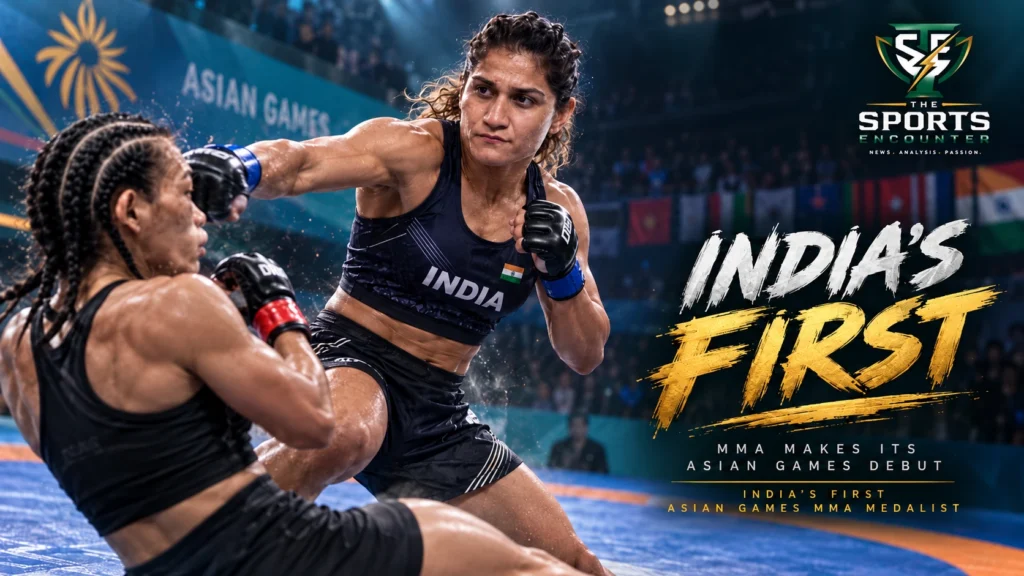
NAGOYA, Japan, September 21, 2026: Suchika Tariyal has become India’s first Asian Games medalist in mixed martial arts, but the 36-year-old’s historic bronze arrived through a semifinal that may ultimately say as much about MMA’s difficult transition into major multi-sport competition as it does about one athlete’s breakthrough.
Tariyal’s women’s traditional 60kg semifinal against Singapore veteran Tiffany Teo, whose full name is Teo Hui Hoon, remained unresolved even after regulation, overtime and an Indian appeal. The reviewed result was eventually deemed level, triggering a competition tiebreak procedure.
Teo advanced because she had weighed approximately 58.5kg at the official weigh-in, around 700 grams lighter than Tariyal’s 59.2kg.
Both fighters were comfortably inside the 60kg limit. Tariyal was not overweight. The difference mattered only because the preceding judging and disciplinary criteria could not separate them.
That left Teo heading to Tuesday’s gold-medal bout against Uzbekistan’s Khilola Sobirova and Tariyal with bronze, India’s first MMA medal at the first Asian Games ever to stage the sport.
The result carries significance far beyond India’s medal tally. TSE identified MMA’s Asian Games debut as one of Aichi-Nagoya’s most consequential experiments before the competition began. Its opening medal rounds have now shown both the opportunity and the complications involved in converting a professional combat sport into a standardized national-team event.
Suchika Tariyal’s Historic Asian Games MMA Run
| Stage | Opponent | Outcome | Significance |
|---|---|---|---|
| Quarterfinal | Altanchimeg Baigalmaa, Mongolia | Tariyal won 2-0 | Guaranteed India’s first Asian Games MMA medal |
| Semifinal | Tiffany Teo, Singapore | Draw after review; Teo advanced on weight tiebreak | Tariyal received bronze |
| Final | Tiffany Teo vs Khilola Sobirova | September 22 | First women’s traditional 60kg Asian Games champion to be crowned |
Tariyal had already made Indian sporting history before the controversy developed.
Her 2-0 quarterfinal victory against Mongolia’s Altanchimeg Baigalmaa guaranteed a medal because both losing semifinalists receive bronze.
The achievement gives India a place in MMA’s first Asian Games medal table only months after the sport was confirmed as one of the major additions to the Aichi-Nagoya program.
The broader Games began with more than 11,000 athletes and a changing definition of what belongs inside continental multi-sport competition, something TSE explored in our Asian Games Opening Ceremony analysis.
Why Did Suchika Tariyal Lose a Semifinal That Was Ruled a Draw?
The unusual ending is the central question surrounding the fight.
Teo initially emerged as the winner after a tightly contested bout that extended into an additional one-minute period.
India challenged the decision.
Following a review, the contest was reassessed as a draw.
That did not create another round.
The Asian MMA competition rules contain a sequence of tiebreak criteria. Reporting from the venue indicates that warnings are considered first, followed by other officiating criteria. When those still fail to separate the athletes, the official pre-competition weight becomes decisive.
Teo had weighed roughly 700 grams less.
| Fighter | Approximate Official Weight | Weight Class |
|---|---|---|
| Suchika Tariyal | 59.2kg | Traditional -60kg |
| Tiffany Teo | 58.5kg | Traditional -60kg |
| Difference | 0.7kg | Teo lighter |
Tariyal therefore met the weight requirement without difficulty. The rule did not punish her for missing weight.
It used relative body weight as a final separator between two eligible fighters whom the preceding criteria could not distinguish.
Why the 700-Gram Rule Has Become Controversial
The criticism centers on whether morning body weight should decide advancement after the actual fighting has failed to produce a winner.
Tariyal publicly disagreed with the outcome and argued that weighing slightly lighter should not override what happened during the bout when both athletes had legally made the same division.
The rule does, however, provide tournament organizers with a defined endpoint.
Multi-sport events operate on fixed schedules. Finals, broadcast slots, athlete recovery windows and venue sessions make indefinite rematches or repeated overtime difficult.
The issue for MMA is whether weight is the best final criterion.
That question deserves attention because Aichi-Nagoya is effectively establishing the first generation of Asian Games precedents for the sport.
Tiffany Teo Is Now One Win From the First Asian Games MMA Gold
Teo’s place in the story goes beyond the controversial semifinal.
The 36-year-old former ONE Championship title challenger reached the medal rounds by defeating Iran’s Arezou Salimighalehtaki in the quarterfinals.
That victory had already guaranteed Singapore its first Asian Games MMA medal.
She then survived Tariyal’s challenge and will face Uzbekistan’s Khilola Sobirova in Tuesday’s women’s traditional 60kg final.
Singapore’s official Team SG coverage confirms the final matchup after Sobirova defeated Cambodia’s Cheng Dalin in the opposite semifinal.
Teo therefore has an opportunity to become one of MMA’s first Asian Games champions only days after the sport began writing a completely blank continental record book.
What Is Traditional MMA at the Asian Games?
The Asian Games does not simply reproduce a UFC fight inside a national-team uniform.
The official Aichi-Nagoya MMA guide separates competition into two formats: traditional and modern.
Traditional MMA uses a gi, allowing athletes to grip the uniform during throws and submission sequences. Competitors also use protective equipment.
Modern MMA uses fight shorts and rash guards while retaining striking, grappling, throwing and submission techniques.
The Asian Games program contains six medal events:
- Men’s Modern -60kg
- Men’s Modern -71kg
- Men’s Traditional -65kg
- Men’s Traditional -77kg
- Women’s Modern -54kg
- Women’s Traditional -60kg
The Olympic Council of Asia confirmed MMA’s inclusion in May 2025, creating the first Asian Games medal program for the sport.
Why Asian Games MMA Looks Different From the UFC
The differences are deliberate.
Asian Games MMA is built around athlete safety and a format suitable for a multi-sport competition rather than the professional entertainment model familiar to UFC audiences.
The fights take place on an open mat rather than inside a cage.
Elbow strikes are prohibited under the competition format being used in Nagoya, and knees to grounded opponents are also restricted. Athletes wear protective equipment, including shin protection.
Traditional competitors wear gis.
Those changes reduce some of the damage-oriented elements associated with professional MMA and place greater emphasis on technical striking, takedowns, positional grappling and submissions.
TSE explored the opposite end of the sport only one day earlier when UFC 331 produced title fights, knockouts and high-level professional MMA in Los Angeles.
The contrast is useful.
UFC competition is designed around professional rankings, contracts, purses and championship belts. Asian Games MMA is structured around national teams, medals, weight classes and a rule set adapted for a continental multi-sport environment.
Why MMA Reaching the Asian Games Is Bigger Than One Bronze Medal
MMA has spent decades building global audiences without achieving the institutional status enjoyed by boxing, judo, wrestling or taekwondo.
The Asian Games changes part of that equation.
For the first time, athletes can represent national Olympic committees in MMA at Asia’s largest multi-sport event.
The OCA initially approved six medal categories, four for men and two for women. The qualification pathway ran through Asian Mixed Martial Arts Association competitions, including continental championships that also served as official Asian Games qualifiers.
The OCA’s report from the Asian MMA qualifiers described the process as part of a push toward a standardized competitive pathway and greater recognition inside the Olympic Movement.
Nearly 200 athletes from 19 countries and regions participated in the January qualifying championship alone.
India sent 14.
Tariyal is now the first of them to convert that pathway into an Asian Games medal.
Does MMA Have a Real Path Toward the Olympic Games?
The Asian Games is an important step, but Olympic inclusion is not automatic.
MMA is not currently an Olympic sport, and no confirmed Olympic debut has been awarded.
The sport still faces structural questions that disciplines such as judo and wrestling resolved decades ago: a universally accepted international governance model, standardized rules, athlete-safety protocols, anti-doping structures and a competition format that fits the Olympic program.
The Asian Mixed Martial Arts Association has openly described participation in major continental events as part of a wider effort to establish MMA inside the Olympic Movement.
Aichi-Nagoya therefore functions as something close to a live institutional test.
Can MMA deliver understandable rules?
Can athletes compete safely across several rounds in a short tournament?
Can officials produce decisions that athletes, national federations and audiences regard as credible?
Can the sport maintain its identity after removing some techniques associated with professional MMA?
Tariyal’s 700-gram tiebreak shows why those questions are already more than theoretical.
The Weight Controversy Could Help MMA Refine Its Multi-Sport Rules
New sports rarely enter major Games with every competitive issue already solved.
Teqball is also making its Asian Games debut in Japan. TSE’s opening competition report examined how its first medal tournament immediately began establishing precedents that future editions will inherit.
MMA is doing the same under much greater scrutiny because combat-sport judging is inherently more subjective.
A result decided by knockout or submission is easy to understand.
A close judges’ decision is less straightforward.
A draw that eventually comes down to 700 grams of legal weight is more complicated still.
That does not invalidate the competition. It gives the sport a rule question worth examining before future Asian Games editions.
Whether organizers retain the same tiebreak procedure will become part of MMA’s institutional development.
Suchika Tariyal’s Medal Adds Another Chapter to a Long Combat-Sports Career
Tariyal arrived at MMA through several disciplines rather than following a single-sport pathway.
She has represented India in judo and kurash and has also competed internationally in jiu-jitsu.
At Hangzhou 2023, she competed in kurash.
Three years later, she has become India’s first Asian Games MMA medalist.
That background fits traditional MMA particularly well because its gi-based format rewards athletes comfortable with grips, throws and submission transitions.
Her route also illustrates why Asia may be particularly fertile territory for national-team MMA. Countries across the continent already possess deep systems in judo, wrestling, sambo, wushu, jiu-jitsu, kurash, karate and taekwondo.
MMA gives athletes from those systems another competitive destination.
Asian Games MMA and UFC Represent Two Different Futures for the Sport
The timing of MMA’s debut is especially interesting for TSE because the Asian Games has arrived during a busy period at the professional level.
Our UFC 331 preview examined how elite professional fighters move through rankings, title challenges and commercial fight cards.
The UFC 331 results then showed the sport at its professional extreme, including Arman Tsarukyan’s knockout and Joshua Van’s five-round championship defense.
Asian Games MMA creates a parallel structure.
Athletes compete for flags rather than promotions. Bronze can matter nationally even without a professional championship attached. Qualification flows through continental federation events rather than matchmaking.
Those models can coexist.
The important question is whether the multi-sport version can establish enough credibility to become permanent.
What Happens Next in Asian Games MMA?
The MMA finals are scheduled for Tuesday, September 22 at the Nagoya City Inae Sports Center.
The official Aichi-Nagoya venue schedule lists all six championship bouts in the afternoon session.
Teo will meet Sobirova for the women’s traditional 60kg title.
The remaining modern and traditional divisions will also crown MMA’s first generation of Asian Games champions.
TSE’s Upcoming Sports Encounters calendar continues tracking the Asian Games through October 4, while our first medal-day analysis shows how quickly new medal stories are reshaping the tournament.
Tariyal will not fight for gold.
Her bronze has already secured something permanent.
Every Indian MMA athlete who follows her at a future Asian Games will be trying to become the country’s second medalist.
She will remain the first.
Frequently Asked Questions
Who won India’s first Asian Games medal in MMA?
Suchika Tariyal became India’s first Asian Games MMA medalist by winning bronze in the women’s traditional 60kg category at Aichi-Nagoya 2026.
Why did Suchika Tariyal win bronze rather than reach the final?
Her semifinal against Singapore’s Tiffany Teo was ruled level after review. The competition’s tiebreak procedure eventually moved to official body weight, with Teo advancing because she had weighed approximately 700 grams less.
Was Suchika Tariyal overweight?
No. Tariyal weighed approximately 59.2kg in a 60kg category and legally made weight. Teo was simply lighter at approximately 58.5kg.
Who is Tiffany Teo?
Tiffany Teo, also known as Teo Hui Hoon, is a veteran Singaporean MMA fighter and former ONE Championship title challenger who has reached the Asian Games women’s traditional 60kg final.
Who will Tiffany Teo fight in the Asian Games final?
Teo will face Uzbekistan’s Khilola Sobirova on September 22.
Is MMA new to the Asian Games?
Yes. Aichi-Nagoya 2026 is the first Asian Games to include mixed martial arts as a medal discipline.
How many MMA gold medals are available at the Asian Games?
There are six MMA medal events: four for men and two for women.
What is traditional MMA?
Traditional MMA uses gis and allows athletes to incorporate striking, grappling, throwing and submission techniques, including grips on the uniform.
Why does Asian Games MMA look different from UFC fighting?
The Asian Games uses a modified competition format with protective equipment and additional safety restrictions. Elbows and knees to grounded opponents are among the techniques restricted in the Games format.
Will MMA become an Olympic sport?
No Olympic debut has been confirmed. Asian Games inclusion strengthens MMA’s multi-sport credentials, but governance, standardized rules, safety and formal recognition remain important hurdles before Olympic inclusion could be considered.