


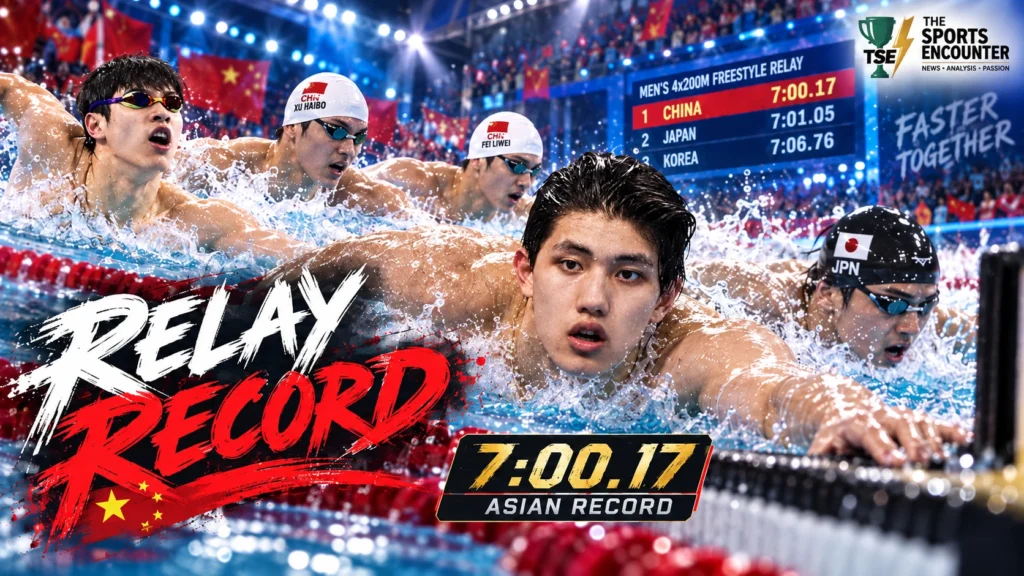
TOKYO, Japan, September 21, 2026: China overturned a 1.89-second deficit on the final leg of the men’s 4x200m freestyle relay to beat Japan in 7:00.17, breaking its own Asian record and reclaiming the Asian Games title for the first time in 16 years.
Xu Haibo, Fei Liwei, Pan Zhanle and Zhang Zhanshuo combined for a race that changed dramatically over the final 400 meters. Japan had controlled most of the final at the Tokyo Aquatics Centre and still led by 1.89 seconds when Zhang entered the water.
The Chinese anchor swam 1:42.92.
Japan’s Tomoyuki Matsushita answered with 1:45.69, but the gap disappeared. China touched 0.88 seconds ahead in 7:00.17, with Japan taking silver in 7:01.05 and defending champion South Korea finishing third in 7:06.76.
The performance added another record-level result to a Chinese swimming campaign already being shaped by Yu Zidi, Pan Zhanle and China’s first-day dominance in the pool. It also showed why China entered Aichi-Nagoya as the overwhelming favorite to top the overall medal table, a theme explored in The Sports Encounter’s complete Asian Games 2026 preview.
China vs Japan: How the 4x200m Relay Changed
| China Swimmer | Split | Japan Swimmer | Split |
|---|---|---|---|
| Xu Haibo | 1:46.27 | Tatsuya Murasa | 1:44.70 |
| Fei Liwei | 1:46.74 | Katsuhiro Matsumoto | 1:44.84 |
| Pan Zhanle | 1:44.24 | Kazusa Kuroda | 1:45.82 |
| Zhang Zhanshuo | 1:42.92 | Tomoyuki Matsushita | 1:45.69 |
| Total | 7:00.17 AR | Total | 7:01.05 |
Japan’s opening pair established the race.
Murasa gained 1.57 seconds on Xu. Matsumoto then extended Japan’s advantage further against Fei.
After two legs, China were 3.47 seconds behind.
That should have placed Japan in control of a 4x200m relay. At this level, three and a half seconds is a large gap to recover over only 400 meters.
Pan began changing the equation.
His 1:44.24 third leg was 1.58 seconds faster than Kuroda’s 1:45.82, cutting the Japanese advantage from 3.47 seconds to 1.89.
Zhang then had 200 meters to finish the job.
How Zhang Zhanshuo Erased a 1.89-Second Deficit
Zhang’s anchor was the decisive performance of the race.
He entered almost two seconds behind Matsushita and finished 0.88 seconds ahead.
The mathematics are straightforward.
Zhang gained 2.77 seconds on Japan’s anchor in a single 200-meter leg.
His 1:42.92 was comfortably China’s fastest split and came after three swimmers had already pushed the race close to record pace.
The shift was large enough to turn Japan’s long-held advantage into one of the most dramatic swimming finishes of the opening Asian Games sessions.
Zhang is already an established international relay swimmer. His World Aquatics profile records world championship medals across China’s 4x100m and 4x200m freestyle teams, including gold at Doha 2024 and silver in Singapore in 2025.
Tokyo gave him a different assignment.
He was no longer protecting a medal position or chasing a small gap. He had to erase almost two seconds against a Japanese team swimming in front of a home crowd.
He did it.
Pan Zhanle Made the Comeback Possible Before the Anchor
Zhang supplied the finish, but Pan prevented the race from becoming unreachable.
China were 3.47 seconds behind after Fei completed the second leg.
Pan’s 1:44.24 cut 1.58 seconds from the deficit.
That changed the anchor leg from a remote chase into a race Zhang could realistically attack.
Pan had already won the men’s 100m freestyle on the opening swimming night in 47.61. TSE covered that title as part of China’s six-gold opening session.
The 4x200m relay required something different from the Olympic 100m freestyle world-record holder.
He had to sustain speed for twice his primary race distance while managing the pressure created by a large team deficit.
His World Aquatics results profile also confirms Pan was part of the Chinese quartet that set the previous Asian 4x200m relay record in 2025.
He has now helped lower the continental standard twice in a little over a year.
China Broke Its Own Asian Record, Not South Korea’s 2023 Mark
The record progression deserves precise context.
South Korea’s 7:01.73 at the Hangzhou Asian Games in 2023 was the Asian record at the time. The Korean team of Yang Jae-hoon, Kim Woo-min, Lee Ho-joon and Hwang Sun-woo won gold that night ahead of China.
The Olympic Council of Asia’s Hangzhou report documented Korea’s 7:01.73 continental record.
China subsequently lowered that standard to 7:00.91 at the 2025 World Aquatics Championships in Singapore.
Ji Xinjie, Pan Zhanle, Wang Shun and Zhang Zhanshuo set that mark while taking world championship silver behind Great Britain. World Aquatics recorded the 7:00.91 as the Asian record.
Monday’s 7:00.17 therefore improved China’s own continental mark by 0.74 seconds.
It also replaced South Korea’s 7:01.73 as the Asian Games record.
Men’s 4x200m Freestyle Relay Medal Results
| Medal | Nation | Time | Key Context |
|---|---|---|---|
| Gold | China | 7:00.17 | Asian and Asian Games record |
| Silver | Japan | 7:01.05 | Led until final leg |
| Bronze | South Korea | 7:06.76 | Defending Asian Games champions |
Japan Were Faster Than the Old Asian Games Record and Still Lost
Japan’s 7:01.05 deserves context of its own.
That time was 0.68 seconds faster than South Korea’s 2023 Asian Games record.
In another era, it would have been a continental benchmark.
Instead, Japan finished second because China had pushed Asian relay swimming below 7:01 twice within 14 months.
Murasa and Matsumoto were particularly strong at the front of the Japanese relay.
Murasa opened in 1:44.70, one of the strongest flat-start performances of the race. Matsumoto followed with 1:44.84.
Those two legs created the 3.47-second advantage that China spent the rest of the race trying to recover.
Japan also arrived with strong relay form from the 2026 Pan Pacific Championships, where swimmers including Murasa, Matsumoto and Kuroda had been part of another medal-winning 4x200m program.
Monday’s performance shows that Japan’s freestyle depth is improving even though the final result was silver.
South Korea Could Not Recreate Its Hangzhou Relay
South Korea came to Tokyo as defending Asian Games champions.
Three members of the 2023 gold-medal team returned for the final: Kim Woo-min, Lee Ho-joon and Hwang Sun-woo.
Kim Jun-woo completed the quartet.
They finished in 7:06.76.
That was 5.71 seconds behind Japan and 6.59 behind China.
South Korea’s relay remained strong enough for bronze, but the continental standard has moved sharply since Hangzhou.
The 7:01.73 that won the 2023 title would have been enough only for silver against Monday’s times.
China’s development since then has been particularly significant because it has come through several different combinations rather than one fixed quartet.
China Changed Half the Quartet From Its 2025 Asian Record
The 2025 record-breaking relay contained Ji Xinjie, Pan Zhanle, Wang Shun and Zhang Zhanshuo.
Only Pan and Zhang returned for Monday’s final.
Xu and Fei replaced Ji and Wang.
China still went faster.
That says more about the program than a single championship result.
Relay strength depends on the fourth-best available swimmer as much as the biggest star. A national team can possess an Olympic champion and still struggle if the remaining legs create gaps that cannot be repaired.
China now has several 200m freestyle options capable of contributing at international level.
The coaching staff also used that depth during the morning heats, when Xu raced alongside Zhao Jiayue, Wang Haoyu and veteran Wang Shun. Pan, Fei and Zhang therefore reached the final with fresher legs.
That kind of roster management becomes important during a championship where swimmers may contest several individual and relay events across a congested schedule.
Why Relay Depth Is Becoming One of China’s Biggest Swimming Advantages
China’s opening Asian Games sessions have already shown strength far beyond one swimmer.
Yu Zidi has emerged as one of the event’s defining stars through record-breaking performances in the 200m butterfly and individual medley.
Pan retained his 100m freestyle title.
Xu Jiayu has continued China’s backstroke tradition.
Li Bingjie remains a major distance force.
The relay record adds another dimension.
Individual titles demonstrate elite talent. Relays test whether a national program can supply several athletes capable of holding world-class pace consecutively.
TSE has seen the same principle shape other major swimming championships. Australia’s enormous swimming advantage at Glasgow was built partly through relay depth, a theme examined in our Glasgow 2026 Day 6 analysis.
The United States produced similar evidence when its mixed medley team broke a world record at the Pan Pacific Championships, covered in TSE’s Pan Pacs report.
China’s 4x200m win belongs in that conversation.
Why the 7-Minute Barrier Is Now the Next Target
China’s 7:00.17 leaves the Asian record only 0.18 seconds from 6:59.99.
That gives the quartet an obvious numerical target.
The world record remains much faster at 6:58.55, set by the United States at the 2009 World Championships in Rome.
Breaking seven minutes would therefore carry symbolic importance without automatically producing a world record.
China already moved from 7:00.91 to 7:00.17 in just over a year.
Further improvement could come from several places: a faster opening leg, reducing the large deficit created over the first 400 meters, cleaner exchanges or replicating Zhang’s anchor speed while getting more from the middle legs.
Monday’s race was extraordinary partly because China reached 7:00.17 despite spending much of it behind.
China’s Record Adds to an Extraordinary Asian Games Swimming Start
The relay arrived only one day after China won six of seven swimming gold medals on the opening medal night.
That first session included Games records from Yu Zidi, Xu Jiayu and Tang Qianting, while Pan defended his 100m freestyle crown.
TSE’s complete opening swimming report documented the scale of that start.
The competition is part of a Games involving more than 11,000 athletes across 43 sports, outlined in TSE’s Opening Ceremony coverage.
Competition had already begun before the formal ceremony, with the first major results tracked in our Asian Games opening-day report.
Swimming has quickly become one of the clearest sources of Chinese separation on the medal table.
How Does China’s Relay Record Compare With Other 2026 Swimming Breakthroughs?
The international swimming calendar has been moving rapidly throughout 2026.
Sara Curtis lowered the women’s 50m backstroke world record twice during the European Championships, performances covered in TSE’s Paris swimming analysis.
Ellen Walshe produced an Irish record to win the European 400m individual medley title, detailed in our feature on her Paris breakthrough.
China’s relay performance now adds an Asian record to that broader year of technical progression.
The important part is how it happened.
China did not lead from the front and slowly extend an advantage.
The quartet had to solve a race that looked increasingly Japanese through the opening 400 meters.
Pan made the comeback plausible.
Zhang completed it.
Frequently Asked Questions
Who won the men’s 4x200m freestyle relay at the 2026 Asian Games?
China won gold in an Asian record 7:00.17.
Who swam for China in the final?
Xu Haibo, Fei Liwei, Pan Zhanle and Zhang Zhanshuo formed China’s gold-medal quartet.
What was China’s previous Asian record?
China held the previous record at 7:00.91, set at the 2025 World Aquatics Championships in Singapore.
Was South Korea’s 7:01.73 still the Asian record before this race?
No. South Korea’s 7:01.73 was the Asian record when it was set at Hangzhou 2023, but China lowered it to 7:00.91 in 2025. The 7:01.73 remained the Asian Games record until China swam 7:00.17.
How far behind Japan were China before the anchor leg?
China trailed Japan by 1.89 seconds after the first three swimmers.
What split did Zhang Zhanshuo swim?
Zhang produced a 1:42.92 anchor split.
How much time did Zhang gain on Japan’s anchor?
He gained 2.77 seconds on Tomoyuki Matsushita, turning a 1.89-second deficit into a 0.88-second victory.
What time did Japan swim?
Japan took silver in 7:01.05.
Who won bronze?
Defending champion South Korea finished third in 7:06.76.
When did China last win the Asian Games men’s 4x200m relay?
China’s previous gold in the event came at Guangzhou 2010, making the Tokyo victory its first in 16 years.