


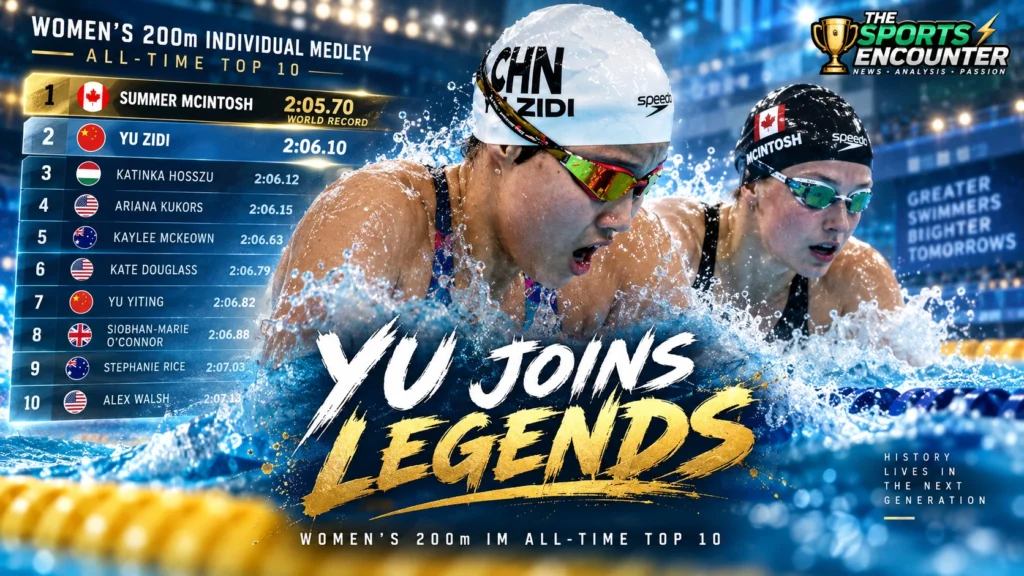
TOKYO, Japan, September 22, 2026: Swimming’s women’s 200-meter individual medley has spent almost two decades being pulled forward by athletes from different eras, different nations and very different stages of their careers. A new name has now climbed almost to the top.
China’s Yu Zidi swam 2:06.10 at the Aichi-Nagoya 2026 Asian Games on September 21, becoming the second-fastest woman in history behind Canada’s Summer McIntosh.
Yu is 13.
That single fact makes the updated all-time list remarkable, but it does not tell the whole story.
The 10 fastest performers in long-course women’s 200m individual medley history now span performances from Rome in 2009 to Tokyo in 2026. They include Olympic champions, world champions, former world-record holders, a current world-record holder, an Olympic silver medalist who came within three-tenths of gold, and a Chinese teenager who is now only 0.40 seconds away from the fastest swim ever recorded.
For more record analysis and international results, follow The Sports Encounter’s swimming coverage and our continuing Asian Games 2026 coverage.
Women’s 200m Individual Medley: The 10 Fastest Performers Ever
| Rank | Swimmer | Nation | Best Time | Year | Gap to World Record |
|---|---|---|---|---|---|
| 1 | Summer McIntosh | Canada | 2:05.70 | 2025 | World Record |
| 2 | Yu Zidi | China | 2:06.10 | 2026 | +0.40 |
| 3 | Katinka Hosszu | Hungary | 2:06.12 | 2015 | +0.42 |
| 4 | Ariana Kukors | United States | 2:06.15 | 2009 | +0.45 |
| 5 | Kaylee McKeown | Australia | 2:06.63 | 2024 | +0.93 |
| 6 | Kate Douglass | United States | 2:06.79 | 2024 | +1.09 |
| 7 | Yu Yiting | China | 2:06.82 | 2026 | +1.12 |
| 8 | Siobhan-Marie O’Connor | Great Britain | 2:06.88 | 2016 | +1.18 |
| 9 | Stephanie Rice | Australia | 2:07.03 | 2009 | +1.33 |
| 10 | Alex Walsh | United States | 2:07.13 | 2022 | +1.43 |
This is a ranking of performers rather than individual performances. Each swimmer appears once with her fastest recognized long-course 200m IM time.
That distinction matters because McIntosh, Hosszu and several others have produced multiple historically fast swims.
1. Summer McIntosh, Canada: 2:05.70
Summer McIntosh occupies a different statistical territory from everyone else.
The Canadian established the current world record of 2:05.70 at the Canadian Swimming Trials on June 9, 2025, at Saanich Commonwealth Place in British Columbia.
She was 18.
The time destroyed one of the most resilient marks in women’s medley swimming.
Katinka Hosszu’s 2:06.12 had survived since the 2015 World Championships. McIntosh lowered it by 0.42 seconds, a substantial move at a level where world records are normally attacked in hundredths.
The official World Aquatics account of McIntosh’s world record placed the swim inside an extraordinary meet in which the Canadian was rewriting multiple global standards.
Her 200m IM performance also explains why she is particularly dangerous in medley events.
McIntosh is not attempting to survive a weak stroke.
Her butterfly is world-record caliber. Her freestyle is world-class. Her backstroke is strong enough to prevent specialists from building decisive gaps, and her breaststroke has developed sufficiently to stop rivals exploiting what was once considered the obvious place to attack her.
That balance is the essence of the 200 IM.
McIntosh subsequently won the Olympic 200m individual medley title at Paris 2024 before setting the world record the following season, and her career has increasingly become a study in range rather than specialization.
The comparison with Yu Zidi is therefore becoming fascinating because both swimmers possess similarly broad event programs despite being at very different stages of physical development.
2. Yu Zidi, China: 2:06.10
Yu Zidi’s position on this list changed the meaning of the ranking overnight.
At 13 years old, she won the Asian Games 200m individual medley in 2:06.10 at the Tokyo Aquatics Centre on September 21.
The swim produced four important numbers at once:
- Asian Games gold;
- Asian record;
- Asian Games record;
- world junior record.
Most importantly for the historical list, it made Yu the second-fastest female performer ever.
Only McIntosh has gone faster.
Yu is now 0.40 seconds from the world record and, remarkably, 0.02 seconds faster than Hosszu’s former global standard.
The Sports Encounter’s full analysis of Yu Zidi’s 2:06.10 breakthrough details how much ground the teenager covered with one race.
She removed 0.72 seconds from the Asian record held by Yu Yiting and lowered the world junior standard previously associated with McIntosh.
Yu also finished 1.89 seconds ahead of Yu Yiting, the defending Asian Games champion and the swimmer who had qualified fastest for the final.
What makes the result especially important is its relationship with Yu’s other events.
She had already won the Asian Games 200m butterfly one day earlier in 2:05.08, breaking the Games record.
Earlier in 2026 she produced 2:05.71 in the same event and owns a 4:30.79 best in the 400m IM.
Her Asian Games performances form part of a wider Chinese surge documented in TSE’s September 21 Asian Games report.
At 13, the central question is not where Yu eventually ranks historically.
Her existing times already belong to history.
3. Katinka Hosszu, Hungary: 2:06.12
For almost 10 years, 2:06.12 was the number every elite 200m IM swimmer chased.
Katinka Hosszu set it while winning the 2015 World Championships in Kazan.
The Hungarian entered the final as one of the dominant medley swimmers of her generation and left with a world record that survived until McIntosh finally broke it in June 2025.
Hosszu lowered Ariana Kukors’ previous record of 2:06.15 by only 0.03 seconds.
The margin was tiny.
The significance was enormous.
World Aquatics’ report from Kazan recorded Hosszu finishing more than two seconds ahead of silver medalist Kanako Watanabe.
Her position remains extraordinary because the sport has moved considerably since 2015.
Training methods have evolved. Underwater technique has progressed. Turns have become faster. Data analysis has become deeper.
Hosszu’s 2:06.12 remains third all time.
She reinforced its legitimacy at the Rio Olympics one year later by winning gold in 2:06.58, then an Olympic record.
Hosszu’s wider résumé makes the performance even more understandable. She built her career around racing across multiple strokes and distances, earning the “Iron Lady” nickname through a competition schedule that would have overwhelmed most elite swimmers.
The individual medley rewarded exactly that versatility.
4. Ariana Kukors, United States: 2:06.15
Ariana Kukors’ 2:06.15 has survived longer inside the all-time top four than any other performance on this list.
She produced it at the 2009 World Championships in Rome, winning the world title at age 20 and setting a world record.
The result was extraordinary for another reason.
Only a year earlier, Kukors had missed qualification for the Beijing Olympics in the event by eight hundredths of a second.
She returned in Rome and became the fastest woman in history.
World Aquatics still lists the 2:06.15 as Kukors’ official long-course personal best.
The performance needs one piece of historical context.
Rome 2009 occurred during swimming’s high-tech full-body suit era. Numerous world records were broken during that period before the sport moved away from the polyurethane suits from 2010 onward.
That does not invalidate Kukors’ swim. It places it in its competitive environment.
The remarkable part is what happened afterward.
Hosszu needed six years to beat the mark and did so by only 0.03 seconds.
Even in 2026, only McIntosh, Yu Zidi and Hosszu have ever officially swum faster.
5. Kaylee McKeown, Australia: 2:06.63
Kaylee McKeown is better known as one of the greatest backstrokers of her generation.
Her place at No. 5 on the 200m IM list demonstrates how much more complete her skill set became.
McKeown swam 2:06.63 at the Australian Olympic Trials on June 10, 2024.
The performance broke her own Australian record and moved beneath Siobhan-Marie O’Connor’s 2:06.88 Commonwealth standard.
She was already the world-record holder in the 200m backstroke and had previously held global records across all three backstroke distances.
The medley presented a very different problem.
Elite backstroke alone could not produce 2:06.63.
McKeown needed enough butterfly speed to remain connected, a competitive breaststroke split and sufficient freestyle strength after using her strongest leg in the second 50 meters.
That is why the time belongs among the most impressive examples of cross-stroke versatility on the list.
McKeown later collected Olympic bronze in the 200m IM at Paris 2024 after already defending her 100m and 200m backstroke Olympic titles.
Her career demonstrates how an athlete can remain dominant in a specialty while developing enough breadth to become historically fast in the medley.
6. Kate Douglass, United States: 2:06.79
Kate Douglass reached 2:06.79 at the 2024 U.S. Olympic Trials in Indianapolis.
The performance established U.S. Open and national-meet records and moved Douglass into territory that, at the time, only a handful of women had reached.
It did not become the American record because Kukors’ 2:06.15 remained faster.
That detail illustrates the extraordinary depth of United States medley history.
Douglass’ place here also makes sense when viewed through the rest of her career.
She is one of modern swimming’s most versatile elite athletes, capable of world-class performances in individual medley, breaststroke, butterfly and freestyle.
At Paris 2024 she followed her Trials performance with Olympic silver in the 200m IM, finishing behind McIntosh.
Her career subsequently expanded even further through major breaststroke titles and relay performances.
Douglass also anchored the United States to a mixed 4x100m medley world record at the 2026 Pan Pacific Championships, a performance covered in TSE’s Pan Pacific swimming analysis.
Her 2:06.79 remains the clearest long-course numerical expression of that versatility in the 200 IM.
7. Yu Yiting, China: 2:06.82
Yu Yiting briefly owned one of the most important records in Asian swimming.
At the Chinese National Championships on June 17, 2026, she completed the women’s 200m individual medley in 2:06.82.
The time established an Asian record.
It also made Yu one of the fastest swimmers in the history of the event.
Her achievement becomes more interesting because of what happened three months later.
The swimmer who took the record from her was her 13-year-old Chinese teammate.
Yu Zidi’s 2:06.10 at the Asian Games lowered Yu Yiting’s mark by 0.72 seconds.
That should not reduce the significance of 2:06.82.
Yu Yiting had already won the Asian Games 200m IM title at Hangzhou in 2023, where she swam 2:07.75. By June 2026 she had moved almost a full second beyond that performance.
She then arrived in Tokyo as the defending Asian Games champion and qualified fastest for the final.
Yu Zidi ultimately took the title, but the presence of two Chinese swimmers inside the all-time top seven provides a wider clue about China’s development in women’s medley swimming.
That generational depth is part of the broader Chinese swimming picture examined throughout TSE’s Aichi-Nagoya 2026 coverage.
8. Siobhan-Marie O’Connor, Great Britain: 2:06.88
Siobhan-Marie O’Connor’s fastest 200m IM came on the biggest stage available.
She swam 2:06.88 in the final of the Rio 2016 Olympic Games.
It was a British national record and earned Olympic silver.
More importantly, it put genuine pressure on Hosszu.
The Hungarian won in 2:06.58.
O’Connor finished only 0.30 seconds behind.
That margin explains why her performance deserves more attention than its current No. 8 ranking might suggest.
This was not a time produced at a domestic trials meet with qualification already secured.
It arrived in an Olympic final against the reigning world-record holder.
O’Connor’s butterfly put her immediately into the race, and her ability to remain competitive across backstroke and breaststroke prevented Hosszu from creating a decisive separation before the freestyle.
She could not quite overturn the Hungarian, but 2:06.88 became one of the defining British women’s swimming performances of the Rio Games.
The result also shows how severe the all-time list has become.
A time that was only three-tenths away from Olympic gold now sits eighth.
9. Stephanie Rice, Australia: 2:07.03
Stephanie Rice belongs to the generation immediately before Hosszu and helped redefine what elite women’s medley swimming looked like during the late 2000s.
Her 2:07.03 came in the 2009 World Championships final in Rome.
Rice finished second behind Kukors, who set the world record at 2:06.15.
The Australian’s time established national and Oceania records and remains one of the fastest performances in the event more than 17 years later.
Rice had entered Rome as the reigning Olympic champion.
At Beijing 2008 she won three Olympic gold medals:
- 200m individual medley;
- 400m individual medley;
- 4x200m freestyle relay.
Her 400m IM victory in Beijing also produced a world record of 4:29.45.
Those results illustrate why she was so well equipped for the shorter medley.
Rice had the endurance to sustain all four strokes, the butterfly and freestyle speed to race aggressively and enough technical consistency to avoid a major weakness through the middle of the event.
Like Kukors, her 2:07.03 was produced during the 2009 technical-suit era.
Its continued presence in the top 10 is nevertheless striking.
Swimming has moved through several generations of champions since Rome.
Rice remains ninth.
10. Alex Walsh, United States: 2:07.13
Alex Walsh earned her place on this list while becoming world champion.
She swam 2:07.13 at the 2022 World Championships in Budapest at age 20.
The performance upgraded the Olympic silver medal she had won in Tokyo into her first individual world title.
It also made Walsh the first American women’s 200m IM world champion since Kukors in 2009.
At the time, 2:07.13 moved her to fifth on the all-time performers list.
Four years of rapid progress elsewhere have pushed that same time to No. 10.
That movement is perhaps the best illustration of how quickly this event has accelerated.
Walsh’s Olympic story also contains an unusual statistical detail.
At Paris 2024 she appeared to have swum even faster while touching third in the final, but she was subsequently disqualified for an illegal backstroke-to-breaststroke turn.
The result therefore cannot replace 2:07.13 as her recognized personal best.
McIntosh won the race and Douglass took silver, while McKeown was promoted to bronze.
Walsh’s official best consequently remains the world-title performance from Budapest.
What Makes the Women’s 200m IM So Difficult?
The event lasts only four lengths of a long-course pool.
Each one asks for a different stroke.
| Distance | Stroke | Main Challenge |
|---|---|---|
| First 50m | Butterfly | Build speed without spending too much energy |
| Second 50m | Backstroke | Maintain speed through a major technical transition |
| Third 50m | Breaststroke | Often creates the largest separation between elite swimmers |
| Final 50m | Freestyle | Finish at sprint speed after three different strokes |
A specialist can dominate one section and still lose the race somewhere else.
That is why medley performances are particularly revealing.
TSE recently explored the longer version of the challenge through Ellen Walshe’s European 400m IM title, where the order changed dramatically during the final freestyle leg.
The 200m version compresses those decisions into half the distance.
There is less time to recover from a poor turn, weak breaststroke length or slow transition.
How the Event Has Changed Since 2009
The ranking creates a fascinating historical line.
Kukors and Rice entered the list together in Rome in 2009.
Hosszu displaced Kukors as world-record holder in 2015.
O’Connor pushed the event again at Rio 2016.
Walsh joined the elite group in 2022.
McKeown and Douglass both broke into the 2:06 range in 2024.
McIntosh then took the world record below 2:06 for the first time in 2025.
Yu Yiting lowered the Asian record in June 2026.
Three months later, Yu Zidi moved all the way to No. 2.
That progression mirrors a wider acceleration taking place across women’s swimming.
Sara Curtis recently rewrote the women’s 50m backstroke world record twice within roughly 24 hours, a breakthrough documented in TSE’s analysis of Curtis’ 26.56 world record.
The wider Paris championships produced another wave of record performances, covered in our Paris 2026 Day 4 report.
Swimming records rarely move in isolation.
Training advances, underwater work, race analysis, strength development and greater depth across nations continue pushing multiple events forward simultaneously.
Why Yu Zidi’s Arrival Changes This List More Than One Ranking Position
The top of the list previously represented established senior champions.
McIntosh was already an Olympic champion before producing 2:05.70.
Hosszu was an established world champion when she set 2:06.12.
Kukors became world champion with her record.
McKeown and Douglass were seasoned international swimmers when they entered the 2:06 range.
Yu Zidi has arrived there at 13.
That creates an unusual development question.
Physical growth can change stroke mechanics.
Training loads increase.
Different events begin competing for priority.
International schedules become more demanding.
Progress at 13 does not guarantee linear improvement through 16, 18 or 22.
The clock nevertheless establishes the current reality.
Yu is already faster than the former world records of Hosszu and Kukors.
Only McIntosh remains ahead.
Women’s swimming currently contains extraordinary generational overlap. At the endurance end, Katie Ledecky is still extending a 1,500m unbeaten run that began when she was 13. At the opposite end of the developmental curve, Yu is rewriting medley records before turning 14.
The Most Remarkable Number May Be 2:06
Nine of these 10 swimmers are separated by only 1.43 seconds.
The historical cutoff has become brutally narrow.
Rice’s 2:07.03 would have looked almost unimaginable during earlier generations.
It is now ninth.
Walsh won a world championship in 2:07.13 only four years ago.
That time now barely keeps her inside the top 10.
At the top, McIntosh remains the only woman below 2:06.
Yu Zidi is four-tenths away.
Hosszu and Kukors remain within another five hundredths behind her despite setting their bests 11 and 17 years ago respectively.
That combination of old standards and emerging teenage speed is what makes the current list so compelling.
The 200m individual medley is not simply getting faster.
Several eras of women’s swimming are now compressed into little more than one second.
Frequently Asked Questions
Who holds the women’s 200m individual medley world record?
Canada’s Summer McIntosh holds the long-course world record at 2:05.70, set at the 2025 Canadian Swimming Trials.
Who is the second-fastest woman ever in the 200m IM?
China’s Yu Zidi is second all time after swimming 2:06.10 at the 2026 Asian Games.
How old was Yu Zidi when she swam 2:06.10?
Yu was 13 years old.
What records did Yu Zidi break?
Her 2:06.10 broke the Asian record, Asian Games record and world junior record.
How long did Katinka Hosszu hold the world record?
Hosszu’s 2:06.12 stood from August 2015 until Summer McIntosh lowered it to 2:05.70 in June 2025, nearly 10 years later.
Why is Ariana Kukors’ 2009 time still important?
Kukors’ 2:06.15 was a world record when she won the 2009 World Championship and remains the fourth-fastest performer mark in history.
Which countries have the most swimmers in the all-time top 10?
The United States has three swimmers in the current top 10: Ariana Kukors, Kate Douglass and Alex Walsh. China and Australia each have two.
What is the difference between a top-performers list and a top-performances list?
A performers list counts each swimmer only once using her career-best time. A performances list can contain multiple swims by the same athlete.
How far is Yu Zidi from Summer McIntosh’s world record?
Yu’s 2:06.10 is 0.40 seconds slower than McIntosh’s 2:05.70 world record.