


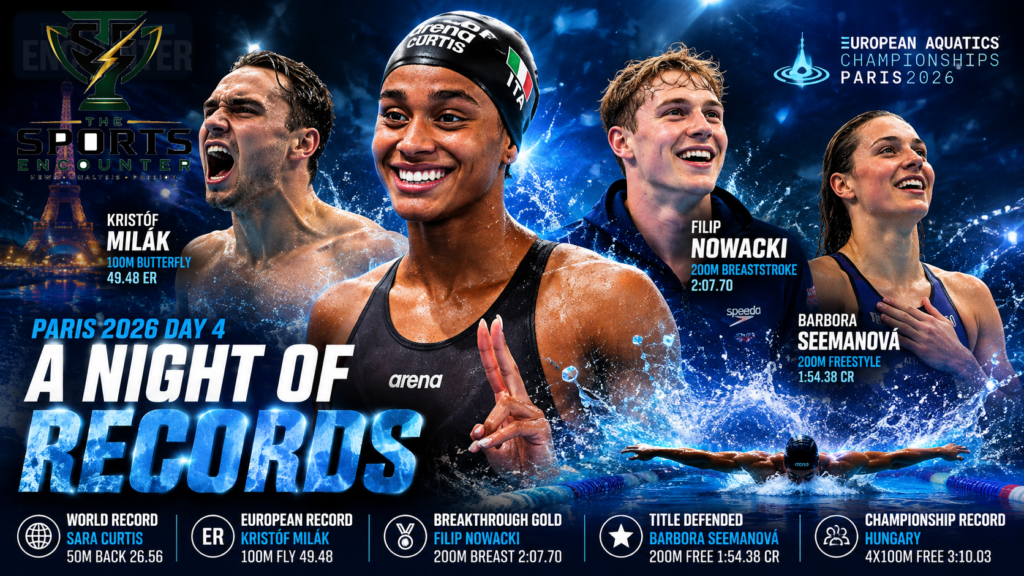
Sara Curtis had already become the fastest woman in history over 50 meters backstroke.
Twenty-four hours later, she became faster.
The 19-year-old Italian lowered her own world record to 26.56 seconds while winning European gold on Thursday, turning a remarkable semifinal breakthrough into something even more difficult: confirmation.
She was not alone in rewriting the limits of the pool.
Kristóf Milák produced a European-record 49.48 to win the men’s 100m butterfly, came within 0.03 seconds of Caeleb Dressel’s world record, and then returned later in the session to deliver a blistering 46.29 relay split as Hungary stole the men’s 4x100m freestyle title by nine hundredths of a second.
Great Britain’s Filip Nowacki completed another stage of his extraordinary rise by chasing down Caspar Corbeau for his first senior international title. Barbora Seemanová survived a furious final length against Marrit Steenbergen to defend her women’s 200m freestyle crown in championship-record time.
Five swimming titles were awarded at the Olympic Aquatic Centre on Day 4 of the 2026 European Aquatics Championships.
The numbers were exceptional. The way the races developed made the night better.
Paris 2026 Swimming Day 4: Gold Medalists at a Glance
| Event | Champion | Nation | Winning Time | Significance |
|---|---|---|---|---|
| Women’s 50m Backstroke | Sara Curtis | Italy | 26.56 | World Record |
| Men’s 100m Butterfly | Kristóf Milák | Hungary | 49.48 | European Record |
| Men’s 200m Breaststroke | Filip Nowacki | Great Britain | 2:07.70 | First senior international title |
| Women’s 200m Freestyle | Barbora Seemanová | Czechia | 1:54.38 | Championship Record |
| Men’s 4x100m Freestyle Relay | Hungary | Hungary | 3:10.03 | Championship Record |
Official championship results and schedules are available through European Aquatics.
Sara Curtis Did the Harder Thing: She Came Back and Did It Again
Breaking a world record in a semifinal creates a strange championship problem.
The athlete has already accomplished something statistically greater than winning the title, but the medal still has to be earned the following night.
That was the challenge facing Sara Curtis.
Italian teenager Sara Curtis has become a swimming sensation after setting two world records in as many days.
— RTÉ Sport (@RTEsport) August 13, 2026
She spoke to RTÉ Sport after the latest of those, a swim that also brought her gold in the 50m backstroke final at the European Aquatics Championships in Paris. pic.twitter.com/GY3EFrhMHw
On Wednesday, the Italian teenager had stunned Paris with 26.63 seconds in the women’s 50m backstroke semifinals, erasing the previous global mark and becoming one of the defining athletes of these championships before the final had even been swum.
The Sports Encounter examined the scale of that breakthrough in our report on Curtis’ first 50m backstroke world record.
Thursday required a reset.
Curtis said she had spent much of the previous evening replaying the race, reading messages and absorbing the reaction before reminding herself that the championship job remained unfinished.
Then she produced an even faster swim.
| Position | Swimmer | Nation | Time |
|---|---|---|---|
| 1 | Sara Curtis | Italy | 26.56 WR |
| 2 | Mary-Ambre Moluh | France | 27.06 |
| 3 | Lauren Cox | Great Britain | 27.15 |
| 4 | Marrit Steenbergen | Netherlands | 27.16 |
Curtis lowered her own one-day-old world record by another 0.07 seconds.
That progression deserves context.
She entered 2026 with the profile of a rising sprint talent. By June she had become the European-record holder at 27.07. On Wednesday she moved to 26.63. On Thursday she reached 26.56.
At the elite end of a 50-meter race, where athletes have almost no time to correct a poor start, weak underwater phase or mistimed finish, that is a remarkable sequence of gains.
Moluh’s silver was also impressive. Her 27.06 was itself faster than the European record Curtis held before this week.
That alone tells us how far the event moved in Paris.
Curtis is no longer a prospect
The word “potential” no longer describes what Curtis is doing.
She owns the world record.
She owns the European title.
She has now broken the global mark twice in roughly 24 hours.
What remains interesting is that she is still only 19 and remains valuable across sprint freestyle and relay events as well as backstroke.
Paris has not simply produced a championship for Curtis.
It has changed her international status.
Kristóf Milák Went Within 0.03 of the World Record
The men’s 100m butterfly final arrived with three legitimate title threats.
Noè Ponti had qualified fastest after responding to the frustration of his 50m butterfly final. Maxime Grousset had a home crowd behind him and entered as the reigning world champion. Milák carried the Olympic pedigree and the unsettling feeling that he was getting faster as the championship progressed.
The Hungarian settled the argument in 49.48.
| Position | Swimmer | Nation | Time |
|---|---|---|---|
| 1 | Kristóf Milák | Hungary | 49.48 ER |
| 2 | Maxime Grousset | France | 49.70 |
| 3 | Noè Ponti | Switzerland | 49.93 |
Milák’s 49.48 broke Grousset’s previous European record of 49.68 and moved the Hungarian to within three hundredths of Dressel’s 49.45 world record from the Tokyo Olympics.
Three hundredths in a 100m butterfly race is almost nothing.
It also means the oldest question around Milák has returned in force: what are his limits when he is healthy, motivated and racing consistently?
His career has never lacked talent. The interruptions, uncertainty and periods away from competition have made his trajectory harder to read.
Paris is providing a much clearer picture.
He took substantial chunks from his personal bests earlier in the meet and said he felt he was moving in the right direction. The 49.48 confirmed it.
Grousset’s silver deserves more respect than the color suggests
Grousset’s preparation had been compromised by a foot fracture earlier in the summer, limiting the work he could do with his kick.
He still produced 49.70 in a European final.
Only Milák’s continental record kept him from winning.
The French crowd understood the quality of the swim and gave Grousset a warm reception after the finish.
Ponti’s bronze completed a world-class podium at 49.93.
All three men broke 50 seconds.
Milák Wasn’t Finished: 46.29 Turned the Relay Upside Down
Milák’s individual gold would have been enough for most athletes to call the evening complete.
Hungary needed him again.
The decision for Milák to swim the men’s 4x100m freestyle relay was reportedly made only during the day. His teammates learned after their afternoon rest that their Olympic champion would anchor.
It changed the race.
Hubert Kós opened in 48.18.
Szebasztián Szabó followed with 48.29.
Nándor Németh produced an excellent 47.27 third leg.
Then Milák entered the water.
His split: 46.29.
Hungary touched in a championship-record 3:10.03, only 0.09 seconds ahead of Neutral Athletes B.
| Position | Team | Time |
|---|---|---|
| 1 | Hungary | 3:10.03 CR |
| 2 | Neutral Athletes B | 3:10.12 |
| 3 | Croatia | 3:11.08 |
| 4 | Spain | 3:11.91 NR |
The 46.29 needs one important explanation.
It is faster than Pan Zhanle’s official individual 100m freestyle world record split of 46.40, but Milák’s swim cannot count as an individual world record because relay swimmers after the first leg use a flying start.
They can begin moving before the incoming teammate touches the wall, provided they do not leave the block too early.
That advantage makes relay splits fundamentally different from flat-start individual times.
Still, 46.29 is extraordinary.
It came after Milák had already swum the second-fastest 100m butterfly in history earlier in the session.
That combination made him the most influential male swimmer of Day 4.
Filip Nowacki’s Summer Has Crossed Into Senior European Territory
Filip Nowacki’s rise has been happening quickly enough that every major meet seems to require his résumé to be rewritten.
World junior champion.
British senior champion.
Commonwealth champion for Jersey.
Now European senior champion for Great Britain.
The 18-year-old won the men’s 200m breaststroke in 2:07.70 after catching Olympic medalist and short-course world-record holder Caspar Corbeau during the final 25 meters.
| Position | Swimmer | Nation | Time |
|---|---|---|---|
| 1 | Filip Nowacki | Great Britain | 2:07.70 |
| 2 | Caspar Corbeau | Netherlands | 2:07.78 |
| 3 | Luka Mladenovic | Austria | 2:08.91 |
The eight-hundredths margin captures the pressure of the finish better than any adjective.
Corbeau had positioned himself to win.
Nowacki trusted the closing speed that has become one of his strongest weapons and found enough water over the final length to change the result.
We explored the teenager’s full trajectory in The Sports Encounter’s feature on Nowacki’s European breakthrough.
The important development is repetition.
Young athletes produce surprising championship performances every year. The challenge comes when the sport begins expecting them.
Nowacki keeps winning after expectations rise.
His Paris title followed the historic Commonwealth gold that gave Jersey its first swimming title at the Games and its first Commonwealth gold in any sport since 1990.
Senior European gold is another step entirely.
British breaststroke suddenly has another dimension
Great Britain entered Paris with Angharad Evans already carrying enormous momentum after her Commonwealth success.
Evans then won the European women’s 100m breaststroke title on Day 3 in championship-record time.
The Sports Encounter has followed that progression since her Glasgow breaststroke double.
Nowacki’s victory one night later gives British breaststroke a remarkably young championship core heading toward the Los Angeles 2028 cycle.
Barbora Seemanová Survives Steenbergen’s Final-Length Assault
The women’s 200m freestyle produced the night’s best conventional championship duel.
Barbora Seemanová, Marrit Steenbergen and Freya Colbert turned for the final 50 meters almost together.
Then Seemanová and Steenbergen separated from the rest.
Stroke for stroke, neither could shake the other.
The defending champion reached the wall first.
| Position | Swimmer | Nation | Time |
|---|---|---|---|
| 1 | Barbora Seemanová | Czechia | 1:54.38 CR |
| 2 | Marrit Steenbergen | Netherlands | 1:54.65 |
| 3 | Freya Colbert | Great Britain | 1:55.81 |
Seemanová’s 1:54.38 established a championship record and successfully defended the European title.
Steenbergen’s silver took her Paris medal collection to two golds and two silvers at this stage of the meet.
That matters because Steenbergen has been asked to carry a substantial individual and relay workload.
She still found 1:54.65 in a final where Seemanová needed a championship record to beat her.
Colbert’s bronze added another British medal to a meet increasingly defined by depth across strokes and distances.
Day 4 Was About Athletes Backing Up What They Had Already Shown
The deeper theme of Thursday was confirmation.
Curtis had broken the world record Wednesday. She returned and broke it again in the final.
Milák had looked increasingly dangerous across the early rounds. He converted that progression into a European record and then delivered the decisive relay anchor.
Nowacki had built a historic summer through junior, British and Commonwealth success. He proved that form could survive contact with one of the deepest senior breaststroke fields in Europe.
Seemanová arrived as defending champion. She needed to go faster than any woman had previously gone at these championships to stay champion.
That is what made Day 4 different from a conventional collection of fast times.
The best swimmers were being asked to repeat excellence after everybody else knew exactly what was coming.
Roos Vanotterdijk Sets Up Another Major Final
Thursday’s semifinals also created a potential Friday headline.
Belgium’s Roos Vanotterdijk clocked 55.89 in the women’s 100m butterfly, equaling the championship record.
The 21-year-old has developed into one of Europe’s most versatile swimmers, and 55.89 puts her squarely in title territory.
The final will test whether she can convert semifinal speed the way Curtis did one night earlier.
That is becoming one of the defining questions of Paris 2026.
Records in preliminary rounds create headlines.
Championships are settled the next evening.
David Popovici Leads a Dangerous Men’s 200m Freestyle Final
David Popovici’s championship moved immediately from one challenge to another.
Less than 24 hours after winning his third consecutive European 100m freestyle title in a championship-record 46.56, the Romanian qualified fastest for the men’s 200m freestyle final.
Popovici posted 1:44.56.
Germany’s Lukas Märtens followed at 1:44.79, with Great Britain’s James Guy third at 1:45.12.
| Qualifier | Nation | Semifinal Time |
|---|---|---|
| David Popovici | Romania | 1:44.56 |
| Lukas Märtens | Germany | 1:44.79 |
| James Guy | Great Britain | 1:45.12 |
Popovici’s 100m victory was one of the defining races in The Sports Encounter’s Paris 2026 Day 3 report.
The 200m final presents a different tactical problem.
Märtens brings world-class endurance and championship control. Guy owns years of experience across major finals. Popovici has the speed to change the race rapidly but must distribute it over twice the distance.
Friday’s final should be one of the strongest races remaining on the program.
Angharad Evans Is Back in Another Breaststroke Final
Great Britain’s Angharad Evans has barely had time to absorb her European 100m title.
She is already positioned for another medal.
Neutral Athlete B Evgeniia Chikunova qualified fastest for the women’s 200m breaststroke final in 2:20.71.
Evans followed in 2:20.96.
That creates a fascinating contrast.
Evans has built her 2026 around championship momentum, beginning with a dominant Commonwealth campaign before breaking the championship record repeatedly in the European 100m rounds.
Chikunova brings enormous pure 200m pedigree.
The final gives Evans a chance to convert a remarkable summer into another continental medal.
Men’s 50m Backstroke Produces More Record Pressure
Pavel Samusenko led the men’s 50m backstroke semifinal qualifiers in 24.03, with Kliment Kolesnikov next at 24.14.
Spain’s Iván Martínez Sota added one of the session’s quieter but highly significant achievements by lowering the Spanish national record to 24.40 and reaching the final.
Spain’s men later reinforced that progress by setting a national record of 3:11.91 in the 4x100m freestyle relay, missing the podium but finishing fourth in one of the fastest European relay finals in recent years.
Paris 2026 Is Becoming a Championship of Records
The Sports Encounter’s Day 3 wrap-up documented the moment the championship accelerated.
Curtis broke the world record.
Johannes Liebmann set a European record in the men’s 800m freestyle.
Popovici broke the championship record in the 100m freestyle.
Angharad Evans lowered the championship mark in the 100m breaststroke.
The Netherlands set another championship record in the women’s 4x100m freestyle relay.
Day 4 did not slow down.
Curtis produced another world record.
Milák broke the European 100m butterfly record.
Seemanová broke the championship record.
Hungary broke the men’s 4x100m freestyle championship record.
Vanotterdijk equaled a championship record before her final.
The pattern is becoming difficult to dismiss.
Paris 2026 is not merely producing close races. It is repeatedly forcing athletes beyond the established standards of the competition.
The Generational Mix Is Making the Championship Better
What makes the meet particularly compelling is that the records are not coming from one age group or one type of athlete.
Curtis is 19.
Nowacki is 18.
Milák is an established Olympic champion entering another phase of his career.
Seemanová is defending a title rather than discovering one.
Earlier in the week, Sarah Sjöström returned from motherhood to win another European crown at 32.
Ellen Walshe produced one of Ireland’s best races of the meet by chasing down 16-year-old Amalie Smith in the women’s 400m individual medley, a race we examined in detail in our Walshe gold-medal analysis.
This is not a championship being handed from one generation to another in a clean exchange.
Different generations are meeting in the same finals and forcing each other faster.
TSE Analysis: Curtis and Milák Won the Same Night in Completely Different Ways
The two headline swimmers of Thursday tell very different stories.
Curtis is arriving.
Milák is reasserting himself.
She entered Paris with a European record and considerable promise. Within two nights, she has broken the world record twice and won her first senior European long-course title.
Milák already owned Olympic gold, world titles and one of the fastest butterfly résumés ever assembled. His question was not whether he possessed enough talent. It was whether he could return to the level that once made every butterfly race feel capable of producing history.
His 49.48 answered much of that question.
The relay made the statement louder.
Nowacki’s story sits between them.
His talent was already established, but Paris was his first opportunity to convert that into a senior European individual title.
He did it against an Olympic medalist by eight hundredths.
Seemanová supplied another form of pressure altogether. Defending champions are measured differently because winning again requires opponents to know exactly who must be beaten.
She still found the wall first.
That variety made Day 4 one of the strongest nights of Paris 2026.
What to Watch on Paris 2026 Day 5
Friday inherits several major races created by Thursday’s semifinals.
- Men’s 200m freestyle final: David Popovici against Lukas Märtens, James Guy and a deep European field.
- Women’s 100m butterfly final: Roos Vanotterdijk enters after equaling the championship record at 55.89.
- Women’s 200m breaststroke final: Evgeniia Chikunova and Angharad Evans lead the qualifiers.
- Men’s 50m backstroke final: Samusenko and Kolesnikov start fastest, with Spanish record-holder Iván Martínez Sota also through.
- Women’s 1500m freestyle: another major endurance title enters the program.
For the broader context, results, records and athlete stories throughout the week, follow The Sports Encounter’s European Aquatics Championships 2026 hub and our wider swimming coverage.
Frequently Asked Questions
Who broke the world record on Paris 2026 Day 4?
Italy’s Sara Curtis broke her own women’s 50m backstroke world record, winning the European title in 26.56 seconds. She had set the previous record of 26.63 in the semifinals one day earlier.
How many world records has Sara Curtis broken in Paris?
Curtis has broken the women’s 50m backstroke world record twice during these championships, first with 26.63 in the semifinal and then with 26.56 in the final.
Who won the men’s 100m butterfly?
Hungary’s Kristóf Milák won in a European-record 49.48 seconds, finishing ahead of Maxime Grousset and Noè Ponti.
How close was Kristóf Milák to the world record?
Milák’s 49.48 was only 0.03 seconds slower than Caeleb Dressel’s world record of 49.45.
Did Milák also win a relay gold?
Yes. Milák anchored Hungary to victory in the men’s 4x100m freestyle relay. Hungary won in a championship-record 3:10.03.
Was Milák’s 46.29 relay split a world record?
No. Relay swimmers after the lead-off leg use flying starts, so Milák’s 46.29 cannot be recognized as an individual 100m freestyle world record. It was nevertheless an exceptional relay split.
Who won the men’s 200m breaststroke?
Great Britain’s Filip Nowacki won his first senior international title in 2:07.70, beating Caspar Corbeau by 0.08 seconds.
Who won the women’s 200m freestyle?
Czechia’s Barbora Seemanová successfully defended her European title in a championship-record 1:54.38.
Who finished second behind Seemanová?
Marrit Steenbergen of the Netherlands took silver in 1:54.65, while Great Britain’s Freya Colbert won bronze in 1:55.81.
Who qualified fastest for the men’s 200m freestyle final?
Romania’s David Popovici qualified fastest in 1:44.56, ahead of Lukas Märtens at 1:44.79 and James Guy at 1:45.12.
Who qualified fastest for the women’s 200m breaststroke final?
Evgeniia Chikunova led the semifinals in 2:20.71, narrowly ahead of Great Britain’s Angharad Evans in 2:20.96.
What record did Roos Vanotterdijk equal?
The Belgian equaled the European Championships record in the women’s 100m butterfly with a semifinal time of 55.89 seconds.
Paris Has Stopped Waiting for Its Defining Swimmers
Four days into the swimming program, the championship’s personalities are becoming clear.
Curtis has transformed from rising talent into world-record holder and European champion.
Milák looks capable of threatening the fastest butterfly standards ever recorded again.
Nowacki is carrying junior dominance into senior racing faster than most athletes manage.
Seemanová remains difficult to dislodge when European gold is on the line.
Popovici is already a champion in Paris and is moving toward another final.
Records keep falling because the athletes are giving each other very little room to protect them.
Thursday provided two global-level performances, a teenage breakthrough, a championship-record title defense and a relay decided by nine hundredths of a second.
Paris 2026 still has three swimming days remaining.
The standard has already become exceptionally high.