


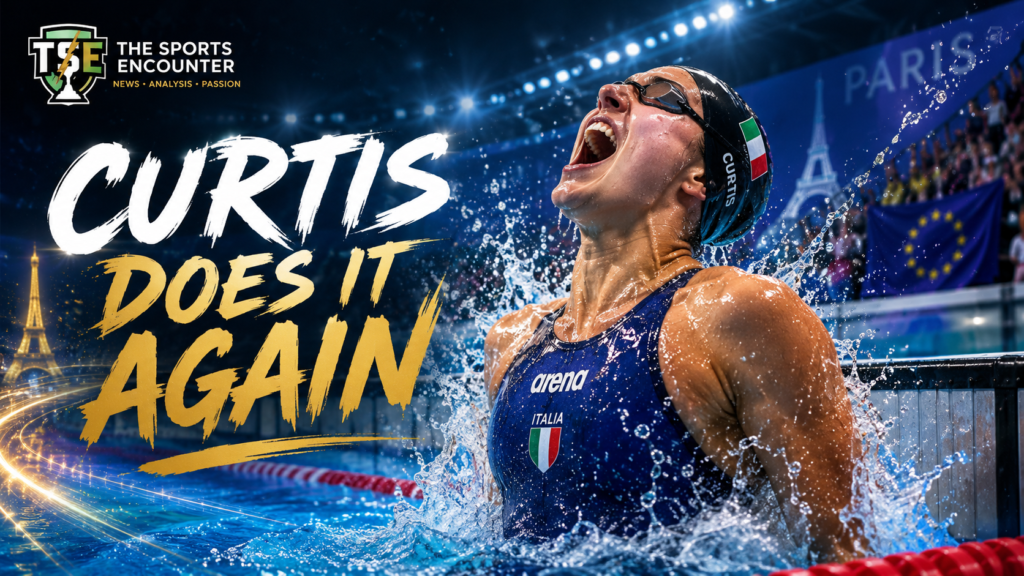
Sara Curtis did not spend long admiring her first world record.
Less than 24 hours after becoming the fastest woman in history over 50 meters backstroke, the 19-year-old Italian returned to the pool in Paris and did it again.
Curtis won the women’s 50m backstroke final at the 2026 European Aquatics Championships in 26.56 seconds, lowering the 26.63 world record she had set in Wednesday’s semifinals and completing an extraordinary two-day assault on one of swimming’s fastest events.
Her first record had already erased the 26.86 mark held by Australian great Kaylee McKeown since 2023. Curtis has now taken a total of 0.30 seconds off that standard across two swims in roughly 24 hours.
The Sports Encounter had already documented how Curtis smashed the 50m backstroke world record with 26.63 in the semifinals. At the time, the obvious question was whether she could reset emotionally and win the European title.
She answered that question by swimming even faster.
Sara Curtis 26.56 World Record: Key Facts
| Detail | Information |
|---|---|
| Swimmer | Sara Curtis |
| Country | Italy |
| Age | 19 |
| Event | Women’s 50m backstroke |
| New world record | 26.56 seconds |
| Previous world record | 26.63 seconds |
| Previous holder | Sara Curtis |
| Old McKeown record | 26.86 seconds |
| Total improvement in two days | 0.30 seconds |
| Competition | 2026 European Aquatics Championships |
| Location | Paris, France |
| Result | European champion |
From 26.63 to 26.56 in One Night
The most remarkable part of Curtis’ performance is not simply that she broke the world record twice.
It is how quickly she moved the event forward.
McKeown’s 26.86 had stood since October 2023. Curtis first cut 0.23 seconds from it in the semifinals, an enormous margin in a 50-meter sprint where races are usually separated by hundredths.
Then she found another seven hundredths in the final.
That progression now looks like this:
| Date | Meet | Time | Achievement |
|---|---|---|---|
| April 2026 | Italian Championships | 27.33 | Italian record |
| June 2026 | Sette Colli Trophy | 27.23 | Italian record |
| June 2026 | Sette Colli Trophy | 27.07 | European record |
| August 12, 2026 | European Championships semifinal | 26.63 | World record |
| August 13, 2026 | European Championships final | 26.56 | World record and European gold |
In four months, Curtis has moved from 27.33 to 26.56.
That is a reduction of 0.77 seconds at the highest level of sprint swimming.
This Time, the World Record Came With Gold
Wednesday’s semifinal created history without deciding the championship.
Thursday’s final carried a different pressure.
Curtis was no longer simply one of the favorites. She entered the race as the world-record holder, the swimmer every finalist knew they had to beat, and the athlete expected to convert the fastest time in history into a European title.
She handled all of it.
Curtis touched first in 26.56, with France’s Mary-Ambre Moluh taking silver half a second behind and Britain’s Lauren Cox claiming bronze. The victory gave Curtis her third medal of the championships after bronze in the 100m freestyle and silver in the women’s 4x100m freestyle relay.
The Semifinal Record Was Not the Peak
The Sports Encounter’s Paris 2026 Day 3 swimming wrap described Curtis’ 26.63 semifinal as the performance that changed the entire night.
At that point, she had already produced the first world record of the championships.
The final has now changed the context again.
The semifinal was not a one-off perfect race. It was evidence that Curtis had moved into a new performance range.
That distinction matters.
World records sometimes arrive through a rare combination of perfect start, underwater phase, stroke rate and finish. Curtis has now shown she can operate around that level repeatedly, under greater pressure, one day later.
Kaylee McKeown’s 26.86 Suddenly Looks a Long Way Away
Before Paris, McKeown’s world record was one of the major benchmarks in women’s backstroke.
The Australian set 26.86 in Budapest in October 2023. At the time, McKeown simultaneously held the world records in the 50m, 100m and 200m backstroke, a remarkable achievement in an era of specialist swimming.
World Aquatics still listed 26.86 as the women’s 50m backstroke world record in its 2025 overview of Olympic-program sprint events.
Curtis has now moved the standard to 26.56.
Thirty hundredths of a second may not sound enormous outside swimming.
Over one length of the pool, it is enormous.
At 19, Curtis Has Rewritten Her Career in Four Months
The speed of Curtis’ rise makes the story bigger than one championship.
She entered 2026 as one of Italy’s brightest young swimmers.
By April, she was lowering national records.
By June, she owned the European record.
By August 12, she was the fastest woman ever in the event.
By August 13, she had broken her own world record and become European champion.
Her official World Aquatics athlete profile lists Curtis as an Italian international born in August 2006, placing the scale of this breakthrough into even sharper perspective.
Paris 2026 Is Becoming a Championship of Records
Curtis’ second world record also strengthens the wider story developing at these European Championships.
Paris has already produced championship records, national records, European records and remarkable comeback performances.
The previous evening featured David Popovici winning the men’s 100m freestyle, Sarah Sjöström returning to European gold, Johannes Liebmann lowering the European 800m freestyle record and Ellen Walshe winning the women’s 400m individual medley.
Readers can follow the wider meet through The Sports Encounter’s European Aquatics Championships 2026 coverage.
TSE also covered Ellen Walshe’s European 400m IM gold and Irish record, another example of the quality Paris has already produced.
A New Standard With LA28 Ahead
The timing of Curtis’ rise carries another layer of significance.
The women’s 50m backstroke is set to join the Olympic swimming program at Los Angeles 2028 as part of the expansion of the 50-meter stroke events.
That means the world record Curtis now owns could become increasingly important as swimmers begin targeting the first Olympic medals in the event.
World Aquatics confirmed the addition of the 50m backstroke, breaststroke and butterfly events to the LA28 Olympic swimming program in 2025.
Curtis is only 19.
Los Angeles is still two years away.
Her development curve suggests the 26.56 may not be the final destination.
What Makes a 26.56 So Difficult?
The 50m backstroke leaves almost no room for correction.
The race is one length.
A slightly mistimed start, poor underwater transition, inefficient breakout or weak finish can decide the result before a swimmer has time to recover.
That makes Curtis’ two world records particularly revealing.
She did not simply swim fast once.
She reproduced the essential pieces of a world-record performance under championship pressure and then improved them.
That is the difference between producing a historic swim and establishing a new level.
Sara Curtis Has Changed the Question
Twenty-four hours ago, the question was whether Curtis could become European champion after breaking the world record in a semifinal.
She has answered that.
The next question is much bigger.
How fast can Sara Curtis ultimately go?
Her progression has accelerated from Italian record to European record to two world records in the space of a single season.
At 19, she now owns European gold and the fastest 50m backstroke swim ever recorded.
The first 26.63 announced her arrival.
The 26.56 confirmed that it was no accident.
For more record-breaking performances and athlete stories, follow The Sports Encounter’s Paris 2026 coverage and our latest sports news and analysis.
Frequently Asked Questions
What is Sara Curtis’ new 50m backstroke world record?
Sara Curtis set the women’s 50m backstroke world record at 26.56 seconds in the final of the 2026 European Aquatics Championships in Paris.
How many world records did Sara Curtis break in 24 hours?
Curtis broke the women’s 50m backstroke world record twice in roughly 24 hours. She swam 26.63 in the semifinals on August 12 before lowering her own record to 26.56 in the final on August 13.
Whose world record did Sara Curtis originally break?
Curtis originally broke Kaylee McKeown’s 26.86 world record, which the Australian had set in Budapest in October 2023.
How much faster is Curtis than McKeown’s previous record?
Curtis’ 26.56 is 0.30 seconds faster than McKeown’s previous world record of 26.86.
Did Sara Curtis win the European title?
Yes. Curtis won the women’s 50m backstroke European title while setting her second world record.
How old is Sara Curtis?
Curtis is 19 years old.
Who finished behind Sara Curtis in the final?
France’s Mary-Ambre Moluh won silver, while Britain’s Lauren Cox took bronze.
Will the 50m backstroke be an Olympic event at LA28?
Yes. The women’s and men’s 50m backstroke events have been added to the swimming program for the Los Angeles 2028 Olympic Games.