


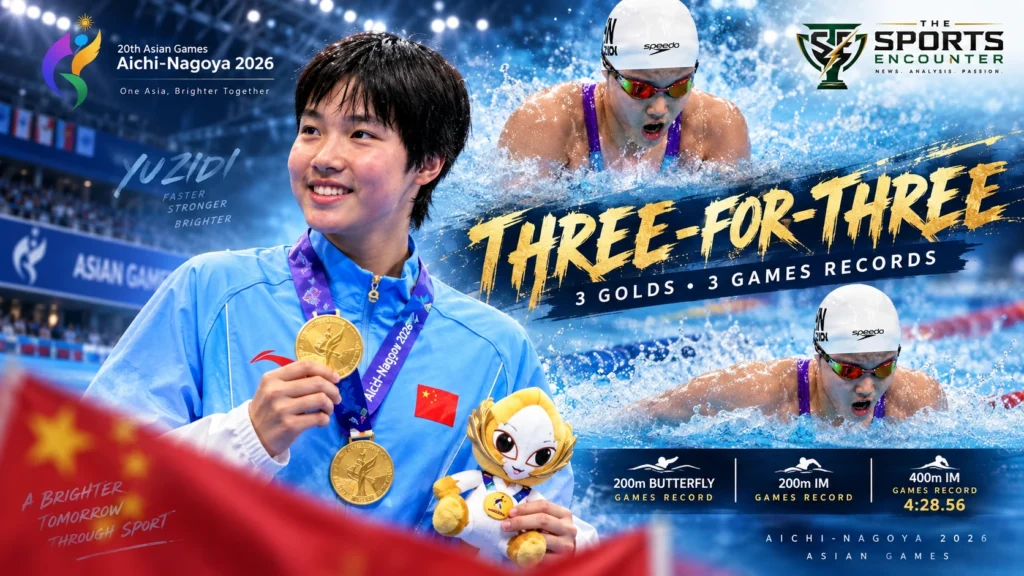
TOKYO, Japan, September 23, 2026: Three individual races. Three gold medals. Three Asian Games records.
Yu Zidi has completed one of the defining individual performances of Aichi-Nagoya 2026, winning the women’s 400m individual medley in 4:28.56 at the Tokyo Aquatics Centre to finish a clean sweep of every individual event she entered.
The 13-year-old Chinese swimmer led from the opening butterfly leg and finished 3.95 seconds ahead of teammate Ke Wenxi, who took silver in 4:32.51. Japan’s Mio Narita claimed bronze in 4:33.45.
The winning time cut 4.41 seconds from the previous Asian Games record of 4:32.97 set by China’s Ye Shiwen at Incheon 2014.
That alone would have made Wednesday memorable.
Placed beside what Yu had already done earlier in the meet, it becomes something much larger.
She won the 200m butterfly in a Games-record 2:05.08. She then won the 200m individual medley in 2:06.10, breaking the Asian, Asian Games and world junior records. The 400m IM completed the sequence.
Yu has entered three individual events at her first Asian Games and left all three as champion and Games record holder.
For continuing results, medal stories and record performances from Japan, follow The Sports Encounter’s complete Asian Games 2026 coverage.
Yu Zidi’s Asian Games Gold-Medal Hat-Trick
| Event | Winning Time | Record |
|---|---|---|
| 200m Butterfly | 2:05.08 | Asian Games record |
| 200m Individual Medley | 2:06.10 | Asian, Asian Games and world junior record |
| 400m Individual Medley | 4:28.56 | Asian Games record |
The numbers explain why Yu’s Asian Games debut has moved beyond the usual discussion about teenage potential.
This is no longer a projection about what she might become.
She is already winning major continental finals against senior international fields and producing times that sit near the highest levels of world swimming.
Yu Zidi Broke a 12-Year-Old Games Record by 4.41 Seconds
The 400m individual medley record Yu attacked on Wednesday had survived three previous Asian Games.
Ye Shiwen established the mark at 4:32.97 in Incheon in 2014.
Yu did not narrowly improve it.
She swam 4:28.56.
The difference was 4.41 seconds.
In an event where athletes must combine butterfly, backstroke, breaststroke and freestyle over eight demanding lengths, that is a substantial reduction.
The official Olympics.com Asian Games swimming results track Yu’s third individual victory alongside a growing list of records from the Tokyo Aquatics Centre.
Her time also placed her only 0.13 seconds outside Ye’s long-course Asian record of 4:28.43 from the London 2012 Olympics.
That detail may be even more revealing than the Games record.
Yu is 13.
She is already operating within fractions of a second of a mark produced during one of the most famous medley performances in Olympic history.
The 400m IM May Be the Best Proof Yet of Yu’s Range
The 200m butterfly showed endurance and technical control in one demanding stroke.
The 200m individual medley showed transition speed and versatility across all four strokes.
The 400m individual medley demands both.
There is more time for weaknesses to appear. Breaststroke efficiency becomes more important. Poor turns cost more. A swimmer who attacks too aggressively through the opening butterfly and backstroke legs can pay for it badly during the final 200 meters.
Yu never gave the race that shape.
She led after the butterfly and continued creating separation.
Her opening 100 meters came in 1:00.11. She reached halfway after the backstroke in 2:07.68 and completed the breaststroke section in 3:26.02 before closing the final 100 meters freestyle.
Ke Wenxi remained the nearest challenger, but the race never developed into a late battle for gold.
Yu had already created too much distance.
Yu Finished Almost Four Seconds Ahead of Another Elite Chinese Teenager
| Medal | Swimmer | Nation | Time | Gap |
|---|---|---|---|---|
| Gold | Yu Zidi | China | 4:28.56 | Leader |
| Silver | Ke Wenxi | China | 4:32.51 | +3.95 |
| Bronze | Mio Narita | Japan | 4:33.45 | +4.89 |
The margin also says something about Chinese swimming depth.
Ke Wenxi is not an athlete making up the numbers. She is another elite young medley swimmer emerging from the Chinese system.
Yu still finished almost four seconds ahead.
The pattern has appeared throughout these Games. Chinese swimmers are frequently racing teammates who would be medal contenders for almost any other delegation.
TSE’s September 21 Asian Games analysis showed how that depth has allowed China to accumulate medals across swimming, shooting, gymnastics and other sports rather than relying on a handful of superstars.
Yu is increasingly becoming the most visible face of that depth.
The Sweep Began With a 200m Butterfly Statement
Yu arrived at the Asian Games carrying enormous curiosity after her breakthrough at the 2025 World Championships and subsequent performances in China.
Her first final answered most of the immediate questions.
She won the women’s 200m butterfly in 2:05.08, lowering Zhang Yufei’s previous Asian Games record of 2:05.57.
Yu finished 3.36 seconds ahead of Chinese teammate Chang Mohan.
It was not simply her first Asian Games title.
It was her first senior individual gold at a major international championship.
TSE placed that performance at the center of its first full Asian Games medal-day report, when China won six of the opening seven swimming finals.
At the time, the important question was whether Yu could reproduce that level across her other events.
She answered it the next day.
The 200m IM Changed the Scale of the Story
The 200m individual medley turned an outstanding Games debut into a global swimming story.
Yu won in 2:06.10.
That performance broke three records at once: Asian, Asian Games and world junior.
It also left her only 0.40 seconds outside Summer McIntosh’s world record of 2:05.70.
TSE’s full analysis of Yu’s 200m IM masterpiece examined how extraordinary that time was for a swimmer still several weeks away from her 14th birthday.
We also placed the performance within the historical event rankings in our women’s 200m individual medley all-time Top 10.
The 2:06.10 moved Yu to No. 2 all time, behind only McIntosh.
Wednesday’s 400m IM victory does not carry the same global ranking impact.
It may tell us more about her overall championship range.
Three Events Required Three Different Solutions
One reason the hat-trick deserves more weight than three medals placed side by side is that the events are not interchangeable.
The 200m butterfly rewards athletes who can maintain stroke length and timing as fatigue builds.
The 200m IM rewards quick adaptation. Four strokes are compressed into a short race, making transitions and turns disproportionately important.
The 400m IM becomes a test of pacing, technical depth and physical endurance.
Yu won all three.
She also broke the Asian Games record in all three.
That combination separates the week from a swimmer simply finding one event in which she is much better than everyone else.
Yu has shown that opponents cannot isolate one obvious specialty and wait for the program to move away from it.
A 13-Year-Old Is Already Racing Against Swimming History
Age inevitably dominates discussion around Yu because the numbers remain extraordinary.
She was born on October 16, 2012.
At 12, she became the youngest medalist in World Aquatics Championships history when she earned relay bronze for China in Singapore in 2025.
She also finished fourth in three individual races there: the 200m individual medley, 200m butterfly and 400m individual medley.
All three are the same events she has now won at the Asian Games.
That progression is worth emphasizing.
A year ago, Yu was close enough to major championship medals to make the swimming world notice.
In Japan, she has converted all three events into gold.
World Aquatics documented Yu’s development after the 2025 Chinese National Games, where she spoke about improving her breaststroke and learning from the experience of racing at the Singapore World Championships.
Her approach was strikingly simple.
“I just go all out and give everything I have in the pool,” Yu said.
Less than a year later, the results are beginning to show how quickly that learning process has accelerated.
The Summer McIntosh Comparison Is Becoming Harder to Avoid
There is a temptation to turn every extraordinary young swimmer into “the next” established superstar.
That would undersell both Yu and McIntosh.
The more useful comparison is competitive.
McIntosh currently owns the world records in both individual medley events. Yu’s Asian Games performances have moved her close enough to those standards that a future rivalry is no longer purely hypothetical.
The Olympics.com analysis of Yu’s 200m IM performance highlighted how close she has already moved to McIntosh’s global benchmark.
The 400m comparison remains different.
McIntosh’s world record is 4:23.65, still nearly five seconds faster than Yu’s 4:28.56.
That is significant distance at this level.
It is also worth remembering that Yu has only just turned her first Asian Games into a three-gold campaign.
The question is not whether she has already caught McIntosh.
She has not.
The question is how much more she can improve before Los Angeles 2028.
Zhang Yufei’s Reaction Captures the Change Around Yu
The expectations around Yu have shifted quickly enough that senior Chinese stars are now discussing progress rather than surprise.
After Wednesday’s race, Olympic and world champion Zhang Yufei told Reuters that Yu appears to reach another level every time she competes.
“Every competition she reaches a higher level. Now everyone wonders what’s next?” Zhang said.
That is probably the most useful question surrounding Yu now.
Her age makes prediction dangerous because adolescent athletes do not always develop linearly. Bodies change. Training demands change. Expectations increase. International opposition adjusts.
Nothing about Los Angeles 2028 should be treated as guaranteed.
What can be measured is what she is doing now.
Three Asian Games individual finals have produced three titles and three Games records.
Yu’s Rise Is Happening Inside a Record-Heavy Chinese Swimming Campaign
Yu has not been producing these performances in isolation.
China’s pool team has repeatedly broken Games and continental records in Tokyo.
Xu Jiayu continued his extraordinary backstroke longevity by taking a third consecutive 50m title in 24.04, covered in TSE’s analysis of Xu’s Games-record victory.
China’s men also produced one of the most dramatic swimming races of the Games when Zhang Zhanshuo erased Japan’s anchor-leg advantage in the 4x200m freestyle relay. The quartet won in an Asian-record 7:00.17, a race broken down in TSE’s full relay analysis.
Hong Kong, China’s Siobhan Haughey has provided an important counterpoint by defending her 200m freestyle title against younger Chinese challengers, one of several stories examined in TSE’s September 21 multi-sport report.
The pool is therefore producing two stories simultaneously.
China are dominating through depth.
Yu is separating herself even within that dominant program.
How Extraordinary Is 4:28.56 at 13?
The simplest answer is that very few women of any age have ever swum faster.
Yu’s previous personal best was 4:30.79.
She lowered it by more than two seconds in an Asian Games final.
The 4:28.56 also moved her into the group of women who have broken 4:29 in the long-course 400m individual medley.
Summer McIntosh remains the global standard with her 4:23.65 world record.
Katinka Hosszu, Kaylee McKeown and Ye Shiwen are among the small group of athletes who have historically occupied this territory.
Yu is now there too.
Her race was also only 0.13 seconds slower than Ye’s 4:28.43 Asian record from London 2012.
The irony is difficult to miss.
Ye produced that Olympic performance three months before Yu was born.
Fourteen years later, a swimmer from the next Chinese generation has reached almost exactly the same numerical level.
Yu Zidi’s Asian Games Individual Checklist Is Complete
- ✓ 200m Butterfly: Gold, 2:05.08, Asian Games record
- ✓ 200m Individual Medley: Gold, 2:06.10, Asian record, world junior record and Asian Games record
- ✓ 400m Individual Medley: Gold, 4:28.56, Asian Games record
That is the entire individual program Yu brought to Tokyo.
There is no fourth individual race left in which she must defend the sweep.
She has completed it.
Why the Hat-Trick Matters Beyond the Medal Table
China entered Aichi-Nagoya as the overwhelming favorite to lead the medal standings.
Yu winning three gold medals therefore does not transform the overall team picture in the way one gold can transform the Games for a smaller delegation.
Her significance lies somewhere else.
Asian sport is looking toward Los Angeles 2028, a theme established in TSE’s complete Aichi-Nagoya 2026 preview.
Many of the athletes succeeding in Japan will arrive in Los Angeles as established senior competitors.
Yu will still be only 15.
That creates an unusual timeline.
She is already producing championship times that would make her relevant at the Olympic level, yet she remains younger than many swimmers entering international junior programs.
The next two years will therefore require something more complicated than simply swimming faster.
China must manage expectations, competition load and development around an athlete who has become internationally recognizable before reaching 14.
Yu Is Already One of the Defining Athletes of Aichi-Nagoya 2026
Multi-sport Games produce many ways to define greatness.
Some athletes win through longevity.
Some break one historic record.
Some deliver a national first.
Yu’s case is built on repetition.
She raced three different individual events.
She won all three.
Every winning performance broke the Asian Games record.
The second also broke the Asian and world junior records.
The third came within 0.13 seconds of another Asian record that has stood since the London Olympics.
That is enough to move the conversation beyond whether the 13-year-old can handle senior international competition.
She already has.
Now swimming waits to see where the ceiling actually is.
Frequently Asked Questions
How many gold medals has Yu Zidi won at the 2026 Asian Games?
Yu Zidi has won three individual gold medals, taking the 200m butterfly, 200m individual medley and 400m individual medley titles.
Did Yu Zidi break a record in all three events?
Yes. Yu set an Asian Games record in all three individual events she won.
What time did Yu Zidi swim in the 400m individual medley?
Yu won the women’s 400m individual medley in 4:28.56.
How much did Yu Zidi break the Asian Games 400m IM record by?
Yu lowered the previous Games record by 4.41 seconds. Ye Shiwen had held the record at 4:32.97 since the 2014 Asian Games in Incheon.
Who finished second behind Yu Zidi in the 400m IM?
China’s Ke Wenxi won silver in 4:32.51, finishing 3.95 seconds behind Yu.
Who won bronze in the women’s 400m individual medley?
Japan’s Mio Narita took bronze in 4:33.45.
What was Yu Zidi’s 200m butterfly time?
Yu won the 200m butterfly in an Asian Games record 2:05.08.
What records did Yu Zidi break in the 200m individual medley?
Her 2:06.10 broke the Asian record, world junior record and Asian Games record.
How old is Yu Zidi?
Yu is 13 years old. She was born on October 16, 2012.
What is the women’s 400m individual medley world record?
Canada’s Summer McIntosh holds the long-course world record at 4:23.65.
How close was Yu Zidi to the Asian 400m IM record?
Yu’s 4:28.56 was only 0.13 seconds slower than Ye Shiwen’s Asian record of 4:28.43 from the London 2012 Olympics.
Could Yu Zidi compete at the Los Angeles 2028 Olympics?
Yu is emerging as a major Chinese prospect for Los Angeles 2028. She will still be only 15 during the Olympic year, but her current international times already place her among the world’s leading swimmers in several events.