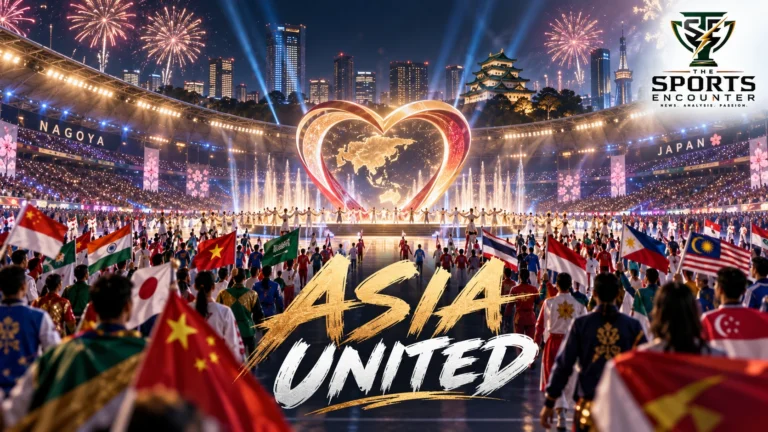
NAGOYA, Japan, September 19, 2026: The 20th Asian Games officially opened in Japan on Saturday night with a heart-shaped stage, the Japanese royal family in attendance and more athletes than competed at the Paris 2024 Olympics.
Yet the most revealing detail about Aichi-Nagoya 2026 is that the ceremony did not really start the Games.
Competition had already been running for nine days.
Men’s basketball began on September 10. Football and other team competitions followed before the flame reached the main stadium. By the time Emperor Naruhito formally declared the Games open at Nagoya City Mizuho Park Athletic Stadium, athletes had already played group matches, reached knockout rounds and begun shaping medal campaigns.
Story at a glance
A Heart Became the Center of the Asian Games
The opening ceremony was built around a simple visual idea.
Emperor Naruhito Formally Opens the Games
Emperor Naruhito and Empress Masako headed the royal presence at the ceremony as Japan welcomed Asia’s sporting delegations back for its first Asian Games since Hiroshima 1994.
The Games Are Bigger Than Paris 2024 in Athlete Numbers
This is the statistic most likely to surprise casual viewers.
Why Had the Asian Games Already Started Before the Opening Ceremony?
The calendar explains it.
New Sports Show Where the Asian Games Is Heading
Aichi-Nagoya is also using its scale to experiment.
That tells us something important about the scale of this Asian Games.
More than 11,000 athletes from 45 National Olympic Committees are expected across 43 sports and 469 medal events, with the historic OCA Refugee Team also participating. The Paris 2024 Olympics featured 10,813 athletes according to International Olympic Committee post-Games figures.
The comparison does not make the Asian Games larger than the Olympics in every sense. It does show how enormous Asia’s continental event has become.
The Sports Encounter examined that scale before opening night in our complete Aichi-Nagoya 2026 preview, covering the 43-sport program, 469 medal events, leading nations, new disciplines and the logistical challenge facing Japan.
The Olympic Council of Asia’s official Aichi-Nagoya 2026 event center confirms the September 19 to October 4 Games window and participation of 45 National Olympic Committees.
Asian Games 2026 Opening Ceremony: Key Facts
| Detail | Information |
|---|---|
| Edition | 20th Asian Games |
| Host | Aichi-Nagoya, Japan |
| Opening Ceremony | September 19, 2026 |
| Closing Ceremony | October 4, 2026 |
| Opening Venue | Nagoya City Mizuho Park Athletic Stadium |
| Ceremony Theme | Harmonic Heart Beat |
| Games Slogan | Imagine One Asia |
| Participating NOCs | 45 |
| Athletes | More than 11,000 |
| Sports | 43 |
| Disciplines | 71 |
| Medal Events | 469 |
| Host Nation Athletes | 932 announced by Team Japan |
| OCA Refugee Team | 2 taekwondo athletes |
A Heart Became the Center of the Asian Games
The opening ceremony was built around a simple visual idea.
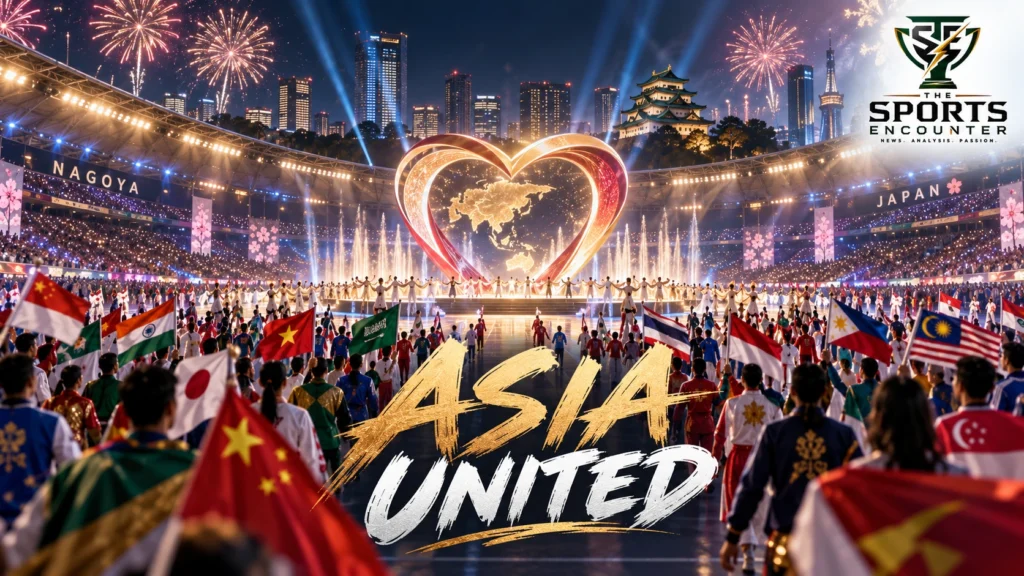
A large heart-shaped stage occupied the infield at Mizuho Park Athletic Stadium, translating the “Harmonic Heart Beat” concept into something the stadium audience could see immediately.
The theme grew from the wider Aichi-Nagoya slogan, “Imagine One Asia.”
Organizers described the concept as Asian athletes coming together through their shared heartbeat, with music, performance, light and movement used to connect the delegations arriving from across the continent.
Nagoya-born filmmaker Yukihiko Tsutsumi served as chief creative director. The OCA had explained before the Games that the concept was designed around athletes being “united in heart,” while the closing ceremony will use the theme “One Asia.”
The ceremony concept and Tsutsumi’s role were outlined in the OCA’s official ceremony planning update.
Emperor Naruhito Formally Opens the Games
Emperor Naruhito and Empress Masako headed the royal presence at the ceremony as Japan welcomed Asia’s sporting delegations back for its first Asian Games since Hiroshima 1994.
Olympic Council of Asia President Sheikh Joaan bin Hamad Al Thani addressed the stadium before the Emperor formally opened the Games.
International Olympic Committee President Kirsty Coventry was also among the senior international sports officials present.
The sequence gave Aichi-Nagoya the formal protocol expected of one of the world’s largest multi-sport events, but the athletes remained the central visual feature.
Afghanistan began the traditional parade, while host Japan entered at the end to the strongest response from the home crowd.
The Games Are Bigger Than Paris 2024 in Athlete Numbers
This is the statistic most likely to surprise casual viewers.
The Paris 2024 Olympic Games ultimately recorded 10,813 competing athletes.
Aichi-Nagoya is bringing together more than 11,000.
The comparison requires context. The Olympics bring together far more countries and carry a different global commercial, competitive and broadcasting footprint. The Asian Games draw from one continent.
Asia’s population and sporting diversity make that one continent unusually large.
Forty-five National Olympic Committees are represented. The program stretches from globally familiar Olympic sports such as athletics, swimming, football, basketball, gymnastics and judo to events whose strongest traditions are concentrated in Asia.
Kabaddi is here.
Sepaktakraw is here.
Kurash is here.
Wushu, soft tennis and esports sit alongside sports recognizable from almost every Olympic program.
The result is a sporting event whose breadth is difficult to appreciate from one opening ceremony.
Why Had the Asian Games Already Started Before the Opening Ceremony?
The calendar explains it.
Trying to fit every group stage, knockout round and medal event between September 19 and October 4 would be impossible.
Men’s basketball therefore began on September 10.
Football also started well before Saturday’s ceremony, while other competitions moved into action during the pre-opening period.
That meant some athletes arrived at the parade already carrying tournament results rather than simply anticipation.
The Sports Encounter’s Upcoming Sports Encounters calendar is tracking Aichi-Nagoya throughout its September 19 to October 4 official Games window alongside the other major championships currently taking place around the world.
This scheduling model makes the ceremony a formal transition rather than the literal first moment of competition.
New Sports Show Where the Asian Games Is Heading
Aichi-Nagoya is also using its scale to experiment.
Mixed martial arts makes its Asian Games debut.
Padel and teqball have joined the medal program.
Esports remains part of the Games after becoming a full medal sport at Hangzhou.
Each addition broadens the definition of what belongs inside a continental multi-sport event.
MMA is particularly significant because Asia already contains major professional fight markets, promotions and martial arts cultures. The Asian Games version moves those skills into national-team competition with medals attached.
The Sports Encounter recently examined MMA’s expansion into the Games while previewing UFC 331 and the changing international landscape for combat sports.
Teqball offers another kind of experiment. The curved-table sport is making its Asian Games debut, while padel arrives at a time when the racket sport continues expanding rapidly across Asia and the Middle East.
The OCA Refugee Team Adds a New Chapter
Aichi-Nagoya also includes the first OCA Refugee Team to compete at an Asian Games.
The team contains two Syrian taekwondo athletes living in the Azraq refugee camp in Jordan: Mahmoud Al Jasem Al Mohammad Al Hussein and Talah Al Hassan Al Hinide.
They compete under the Asian Refugee Team designation during competition, while the OCA Refugee Team name is used for protocol events.
Their delegation was positioned immediately before host Japan in the opening parade order.
For a Games built publicly around the idea of connection across Asia, their presence gives that language a practical sporting expression.
Japan Is Hosting the Asian Games for the Third Time
Japan’s Asian Games history began with Tokyo 1958.
Hiroshima followed in 1994.
Aichi-Nagoya arrives 32 years later and only five years after Japan hosted the postponed Tokyo 2020 Olympics.
The timing matters because the country has approached this event differently.
Aichi-Nagoya has reused and renovated venues rather than attempting to replicate the huge infrastructure model often associated with modern mega-events.
Mizuho Park Athletic Stadium itself was redeveloped and now serves three roles: opening ceremony venue, closing ceremony venue and athletics stadium.
That model will be tested throughout the next two weeks.
Opening ceremonies can present sustainability beautifully. Competition days reveal whether the transport, accommodation, security and venue network actually works.
There Is No Conventional Asian Games Village
One of the most unusual choices at Aichi-Nagoya is the absence of a single purpose-built athletes’ village.
Delegations are instead spread among hotels, temporary accommodation and a cruise ship docked at Nagoya Port.
The approach reduces the risk of constructing expensive housing that becomes difficult to use once the Games leave.
It also creates operational problems that a centralized village naturally avoids.
Athletes are spread across more locations. Transport becomes more complicated. Accommodation standards become harder to keep uniform. Security and meal logistics require coordination across a much wider footprint.
Questions around that system had already emerged during the build-up, making the opening ceremony the first major opportunity for the organizers to shift attention toward competition.
The real judgment of the model will come after October 4, when Japan can compare lower infrastructure exposure against the athlete experience it actually delivered.
Japan’s 932 Athletes Carry Home Expectations
The Japanese Olympic Committee announced 932 athletes in a total delegation of 1,430 members.
That gives the host nation enormous representation across the program.
Japan finished second on the gold-medal table at Hangzhou with 52 titles, behind China’s extraordinary 201.
Home conditions give Japanese athletes familiarity with venues, climate, travel and crowd support, but the size of China’s recent dominance makes the broader medal contest formidable.
Olympic wrestling champion Akari Fujinami is among the most recognizable home stars, while Japan will also expect significant returns across judo, gymnastics, swimming, wrestling, baseball and other established strengths.
For readers following the track and field program, The Sports Encounter’s Athletics Hub will follow the major performances once competition begins at Mizuho Park Athletic Stadium.
India Arrive With a Different Kind of Pressure
India’s 107 medals at Hangzhou changed expectations around its Asian Games program.
The question in Japan is whether that century of medals represented a one-off peak or a new competitive baseline.
Neeraj Chopra remains one of the biggest individual names in the entire Games as he chases a third consecutive Asian Games javelin title.
His path looks less predictable than it once did.
Sri Lanka’s Rumesh Tharanga Pathirage defeated Chopra with a Commonwealth Games-record 89.75-meter throw in Glasgow this summer, a major upset covered in The Sports Encounter’s Glasgow 2026 Day 8 report.
That recent result gives the Asian Games javelin competition a genuine rivalry rather than a ceremonial title defense.
North Korea Returns With a Smaller but Ambitious Team
North Korea is another delegation carrying an unusual storyline.
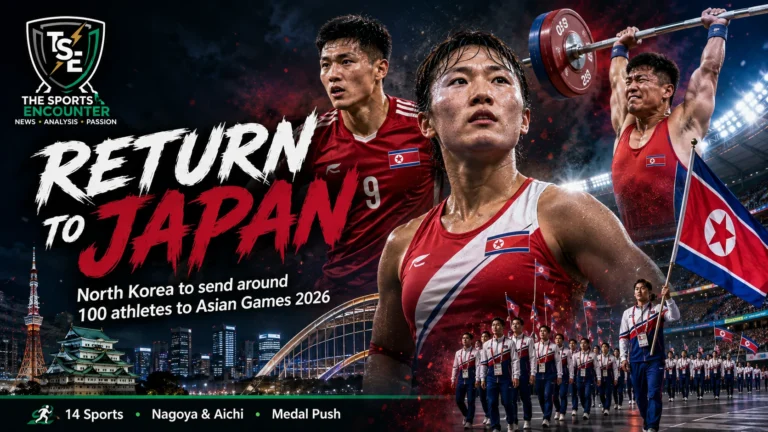
The DPRK is sending around 100 athletes across 14 sports, substantially fewer than the 185 athletes it sent to Hangzhou.
Its stated goal remains improving on the 39 medals won at the previous Games.
The Sports Encounter’s full North Korea Asian Games analysis examined where those medals could come from, with weightlifting, football, combat sports and several individual disciplines carrying much of the opportunity.
For a compact delegation, medal efficiency will be watched as closely as the overall total.
Cricket Carries Olympic Importance Beyond the Asian Games
Cricket’s presence has significance far beyond one continental medal table.
Men’s and women’s T20 tournaments are part of the Aichi-Nagoya program as the sport prepares to return to the Olympic Games at Los Angeles 2028.
Asian teams therefore receive another opportunity to operate inside a multi-sport environment before cricket’s Olympic return.
Pakistan’s young men’s group includes Maaz Sadaqat, whose recent rise from domestic cricket through the PSL and CPL has been examined in The Sports Encounter’s profile of one of Pakistan’s emerging T20 hitters.
India enter as defending champions, while Pakistan, Sri Lanka, Bangladesh and Afghanistan ensure the men’s tournament contains several teams capable of creating a high-profile knockout match.
The women’s competition carries similar relevance ahead of Los Angeles.
Full tournament coverage will continue through The Sports Encounter’s Cricket Hub.
Hockey Arrives Only Weeks After a World Cup
Few sports have been asked to reset as quickly as field hockey.
The men’s and women’s World Cups concluded only weeks before the Asian Games, sending several Asian national teams from a global championship almost directly into another major tournament.
India, Pakistan, Japan, China, Korea and Malaysia all carry substantial continental histories.
Our FIH Hockey World Cup 2026 curtain-raiser tracked many of the same teams before their global campaigns in Belgium and the Netherlands.
Aichi-Nagoya now tests how quickly those squads can recover physically and tactically.
The Asian Games Is Also a Window Into the Future of Multi-Sport Events
For all the ceremony’s visual language about unity, one of the most interesting questions around Aichi-Nagoya is practical.
Can a huge multi-sport event keep expanding without continuously expanding its permanent infrastructure?
Japan is attempting a model built around existing venues, renovated facilities, dispersed accommodation and an event footprint that stretches beyond one city.
Continue the Athletics Story


At the same time, the sports program keeps growing.
Traditional Olympic disciplines share the schedule with esports, MMA, teqball, padel, kabaddi, kurash and sepaktakraw.
Those two trends pull in opposite directions.
The event is becoming competitively broader while organizers are trying to make hosting more restrained.
If the model works, future multi-sport hosts will take notice.
The Torch Journey Connected Aichi Before the Stadium Took Over
The flame reached the opening ceremony after a relay that began at Nagoya Castle on August 22.
One thousand torchbearers carried it through all 40 municipalities of Aichi Prefecture and the 16 wards of Nagoya City before the final celebrations in central Nagoya.
The OCA’s official torch relay report details the route and the final stages before the flame reached Mizuho Park Athletic Stadium.
That regional reach fits the wider Games structure.
Aichi-Nagoya is the principal host, but competition is distributed much more widely across Japan.
What Happens After the Opening Ceremony?
The ceremonial part is finished.
Now the medal volume accelerates.
Across 43 sports and 469 medal events, the next 15 days will produce stories at completely different scales.
China will measure success through another continental title and hundreds of medals.
Japan will measure itself against the largest home team it has assembled for an Asian Games.
India wants to prove that 100-plus medals can become sustainable.
Some delegations will leave Japan transformed by one bronze.
New sports will crown the first champions in Asian Games history.
Young athletes will use the event to move toward Los Angeles 2028.
Established stars will try to protect titles earned three years ago in Hangzhou.
Saturday night’s heart-shaped stage provided the image organizers wanted for opening night.
The next two weeks determine whether “Imagine One Asia” becomes remembered primarily as a ceremony theme or as the frame around one of the most consequential Asian Games yet.
Asian Games 2026 Opening Ceremony FAQs
When did the Asian Games 2026 officially open?
The 20th Asian Games officially opened on September 19, 2026 in Nagoya, Japan.
Where was the Asian Games opening ceremony held?
The ceremony took place at Nagoya City Mizuho Park Athletic Stadium, also known as Paloma Mizuho Stadium.
Who officially opened the Asian Games 2026?
Japan’s Emperor Naruhito formally declared the Games open.
What was the theme of the opening ceremony?
The ceremony was built around the theme “Harmonic Heart Beat,” reflecting the idea of athletes from across Asia connecting through sport.
What is the official slogan of Aichi-Nagoya 2026?
The official slogan is “Imagine One Asia.”
How many athletes are competing at the Asian Games 2026?
More than 11,000 athletes are expected across the Games.
Are there more athletes at the Asian Games than Paris 2024?
Yes in athlete numbers. Aichi-Nagoya has more than 11,000 expected athletes, while IOC post-Games figures list 10,813 athletes at the Paris 2024 Olympics.
How many sports are at the 2026 Asian Games?
The program contains 43 sports and 71 disciplines.
How many medal events are at Aichi-Nagoya 2026?
There are 469 medal events.
Why did some Asian Games events begin before the opening ceremony?
Team sports with lengthy group and knockout stages need more competition days than can fit between the opening and closing ceremonies. Men’s basketball began on September 10.
Which sports are new at the Asian Games 2026?
Mixed martial arts makes its Asian Games debut, while padel and teqball have also joined the program.
Is cricket part of the Asian Games 2026?
Yes. Men’s and women’s T20 cricket are included, providing Asian teams with valuable multi-sport experience before cricket returns to the Olympics at Los Angeles 2028.
When do the Asian Games 2026 end?
The closing ceremony is scheduled for October 4, 2026 in Nagoya.