


A robot has apparently crossed one of sport’s most recognizable boundaries.
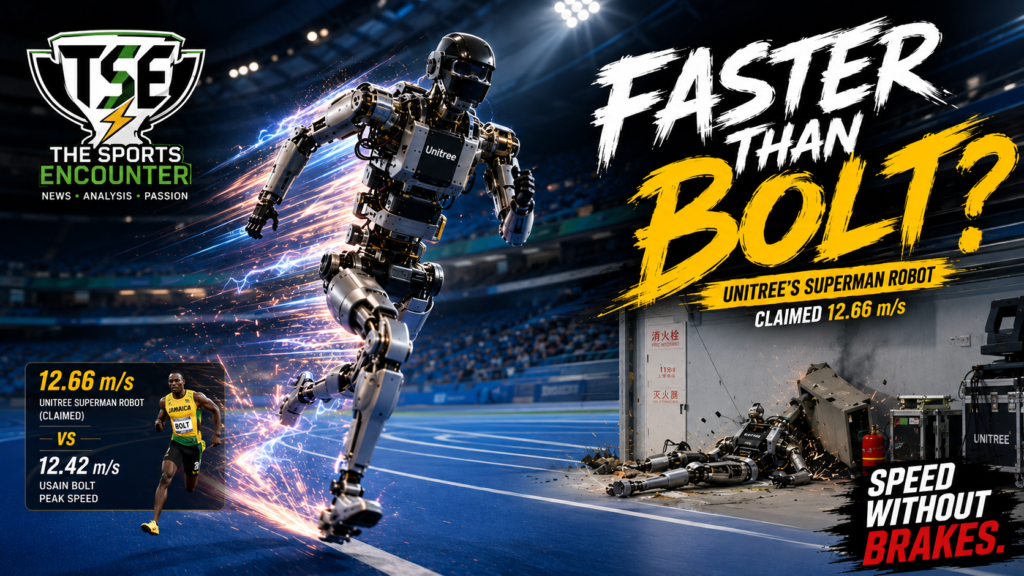
Chinese robotics company Unitree says its new humanoid, nicknamed “Superman,” has reached a top speed of 12.66 meters per second.
That works out to roughly 45.6 kilometers per hour, or 28.3 mph.
The number immediately attracted attention because Usain Bolt reached approximately 12.42 m/s during the fastest section of his 9.58-second 100-meter world record in Berlin in 2009.
On raw peak speed, Unitree’s number is higher.
There is an important catch.
Unitree’s 12.66 m/s figure comes from the company. It has not been established through an independently certified 100-meter race under the conditions that govern athletics records.
Bolt’s 9.58 came from a World Championship final, against seven elite sprinters, from blocks, under official timing, wind measurement and international competition rules.
That difference is bigger than 0.24 meters per second.
It is the difference between demonstrating speed and proving sporting performance.
Unitree Superman vs Usain Bolt at a Glance
| Category | Unitree “Superman” | Usain Bolt |
|---|---|---|
| Peak speed | 12.66 m/s claimed by Unitree | Approximately 12.42 m/s during Berlin 2009 |
| Equivalent speed | 45.6 km/h / 28.3 mph | About 44.7 km/h / 27.8 mph |
| 100m performance | No independently certified 100m record announced | 9.58 seconds, world record |
| Standing jump | 2 meters claimed | Not directly comparable |
| Leg length | 0.85 meters | Human biomechanics |
| Performance status | Company demonstration | Official World Athletics competition |
| Development context | Built in just over three months | Elite human sprint career |
What Unitree Actually Claims Its Superman Robot Can Do
Unitree unveiled the new high-speed humanoid on August 17, 2026, only days before the company was scheduled to begin trading on Shanghai’s STAR Market.
According to Reuters’ report on the launch, Unitree says Superman can reach 12.66 m/s and perform a standing jump of two meters.
The company says the robot has legs measuring just 0.85 meters and was developed in a little more than three months.
Unitree described the prototype as a work in progress, meaning the numbers being circulated this week may not represent its eventual performance ceiling.
The company’s own promotional language goes much further. In its official Superman preview, Unitree presented the machine as “breaking the limits of humanity.”
That is excellent marketing.
Sport requires a more careful comparison.
Did the Unitree Robot Really Outrun Usain Bolt?
If the question is limited to the reported peak-speed numbers, yes.
12.66 m/s is faster than 12.42 m/s.
That does not mean a robot has officially broken Usain Bolt’s 100-meter world record.
The distinction matters.
Bolt’s official record measures an entire race, beginning from a stationary start.
He had to react to a starting gun, accelerate from blocks, reach maximum velocity, maintain as much of that speed as possible and cross the finish after exactly 100 meters.
The stopwatch recorded 9.58 seconds.
World Athletics still lists 9.58 as the men’s 100-meter world record.
The Sports Encounter recently revisited the extraordinary sequence that produced that mark in our feature on Bolt’s 9.69 Olympic world record in Beijing and the 9.58 that followed exactly one year later.
A robot hitting a higher maximum velocity during a test is technically fascinating.
China’s new robot just broke Usain Bolt’s 100-meter world record
— Chay Bowes (@BowesChay) August 18, 2026
Great momentum, but still working on the brakes pic.twitter.com/RYCm4IvphR
It is not the same sporting achievement.
What Would 12.66 m/s Mean Over 100 Meters?
This is where the number becomes irresistible.
If something could travel at a constant 12.66 m/s for the entire 100 meters, simple arithmetic produces a time of approximately 7.90 seconds.
That is 1.68 seconds quicker than Bolt’s world record.
It is also a misleading way to predict an actual race.
Nothing starts a 100-meter sprint already moving at peak velocity.
Acceleration matters enormously.
Bolt’s average speed across his entire 9.58-second race was approximately 10.44 m/s, substantially below his peak speed because he had to accelerate from zero.
A legitimate robot-versus-human comparison would therefore require much more than knowing each competitor’s maximum velocity.
We would need to know how quickly Superman accelerates, how well it holds top speed, how it responds to a starting signal and whether it can stop safely after the finish.
Only then does the question become genuinely sporting.
The Most Interesting Problem May Be Braking, Not Acceleration
Humans rarely think of stopping as one of the defining skills of sprinting.
Robotics engineers have to.
A humanoid moving at more than 45 km/h carries considerable momentum. Every increase in speed raises the challenge of keeping the machine balanced while controlling deceleration, direction and foot placement.
That is why the viral reaction to Superman has included almost as much discussion about control as raw speed.
Separate footage circulating online appears to show a high-speed Unitree humanoid failing to slow cleanly and colliding with equipment at the end of a run.
That footage should not be treated as proof that the officially claimed 12.66 m/s test ended in the same way unless Unitree confirms the connection.
The broader point remains valuable.
Speed without control is incomplete athletic performance.
A Formula 1 car is impressive because it accelerates, corners and brakes.
A sprinter needs balance through acceleration, maximum velocity and deceleration.
A humanoid robot trying to become genuinely athletic faces the same basic demand.
Going fast is only one part of moving well.
Why the Two-Meter Jump Needs Even More Context
Unitree’s other headline number may sound even more outrageous.
The company says Superman can perform a standing jump of two meters.
It also claims that performance exceeds human standing-jump records.
The achievement is impressive if independently reproduced, particularly given the robot’s 0.85-meter leg length.
Comparing the number directly with athletics high jump would be misleading.
World-class high jumpers use a running approach, curved acceleration, takeoff technique and body rotation to clear a horizontal bar.
A standing robotic jump measures something different.
The Sports Encounter has covered conventional athletics records extensively, including Goodness Nwachukwu’s world-record discus performance at Glasgow 2026 and Karsten Warholm’s continued dominance in the 400m hurdles.
Those records mean something because athletes perform under standardized rules.
Robotic athletics would eventually need its own equivalent.
Bolt Still Owns the Question Humans Actually Care About
Sport has always been fascinated by machines.
Cars travel faster than runners.
Motorcycles accelerate faster than cyclists.
Mechanical devices can launch objects farther than any human thrower.
None of those facts made human athletics obsolete.
The reason is simple.
Sport measures what the human body can accomplish within agreed rules.
Bolt’s importance was never based solely on the physical fact that his body once moved at approximately 12.42 m/s.
He did it while racing Tyson Gay, Asafa Powell and the world’s finest sprinters in a World Championship final.
He had nerves.
He could false start.
He could tighten under pressure.
His muscles could fatigue.
Every physical limitation belonged to the athlete rather than a design team.
That human vulnerability is part of what made 9.58 extraordinary.
It is also why Bolt remains such a powerful benchmark whenever The Sports Encounter examines the greatest athletes across different sports.
Unitree Is Building Something Different
None of this diminishes Superman’s importance.
The robot may represent something more interesting than a threat to an athletics record.
It offers a glimpse of machines developing increasingly human-like athletic capabilities.
Unitree founder Wang Xingxing has already spoken openly about the direction of travel. In an interview published by TIME earlier this year, he said: “Robots will soon outperform humans.”
At the level of isolated physical tasks, that process may already be underway.
A robot can be designed with motors, actuators, joints, materials and control systems optimized specifically around movement.
Unlike human evolution, engineering can iterate deliberately.
A weak ankle can be redesigned.
A motor can become more powerful.
Software can adjust balance thousands of times.
That creates an entirely different performance curve from human athletics.
Three Months May Be the Most Important Number in This Story
12.66 m/s attracts headlines.
The development timeline may tell us more about where robotics is heading.
Reuters reports that Unitree developed Superman in just over three months.
That means the company went from concept development to a humanoid it says can surpass elite human peak sprint velocity in roughly one sporting season.
Unitree itself says there remains significant room for further improvement.
That is where the story becomes difficult to dismiss as a novelty.
Today’s viral demonstration becomes much more important if the same engineering system can produce faster, more stable and more autonomous machines every few months.
The Timing Is No Accident
Superman arrived immediately before a major financial moment for Unitree.
The Hangzhou-based company is scheduled to begin trading on Shanghai’s STAR Market on August 19 after raising approximately 6.1 billion yuan, or $905 million, through its IPO.
Reuters reported that retail demand exceeded the available allocation by more than 8,000 times.
That makes the Superman demonstration useful technology marketing as well as a robotics milestone.
Investors are being shown a physical expression of the company’s promise.
Speed is easy to understand.
Jumping is visual.
A humanoid running faster than the number associated with Usain Bolt creates a headline that industrial automation cannot.
That does not invalidate the technology.
It means viewers should understand the context in which the demonstration arrived.
China Is Turning Robot Performance Into Spectator Entertainment
This is where the story comes back to sport.
China’s humanoid robotics boom is increasingly being displayed through activities that audiences already understand.
Robots have run races, completed endurance events, boxed, performed martial arts and executed acrobatic movements.
Reuters reported this week that China’s robotics industry is now facing the harder commercial test of turning spectacular demonstrations into reliable real-world productivity.
That distinction sounds familiar to sport.
Combine standardized rules, competing manufacturers, timing systems, repeatable events and audiences, and robotic performance begins moving toward competition rather than demonstration.
The question is whether anyone ultimately wants to watch.
Could Robot Racing Become a Real Sport?
It is less ridiculous than it sounds.
Motorsport already provides the obvious precedent.
Formula 1 fans care about drivers, but they also care deeply about engineering.
Constructors compete over aerodynamics, engines, software, tire management and design.
The machine is part of the athlete.
Robot sport could invert that relationship.
Imagine a 100-meter humanoid championship where manufacturers must meet standardized height, weight, power and autonomy limits.
No remote steering.
No external stabilization.
Identical track dimensions.
Automatic starting signals.
Electronic timing.
Safety requirements governing braking distance.
Suddenly, the competition becomes measurable.
Who accelerates fastest?
Which machine maintains balance?
Who handles a curve?
Which engineering team can produce speed without destroying reliability?
That begins to look less like a laboratory demonstration and more like motorsport on legs.
Human Athletes Would Still Have Nothing to Fear
Robotic competition would not need to replace human sport.
It would make more sense as a separate category.
Nobody stopped caring about the Tour de France when motorcycles became faster than bicycles.
Formula 1 did not make Olympic sprinting irrelevant.
A machine clearing three meters in the future would not erase the achievement of a human high jumper clearing a bar using muscle, coordination and technique.
The limits are different.
That is why The Sports Encounter’s feature on the most respected athletes in sporting history included Bolt for something a machine cannot reproduce simply by posting a faster number: sustained human excellence under competitive pressure.
TSE Analysis: The Day a Robot Beats 9.58 Will Still Need an Asterisk
Eventually, a humanoid robot may run 100 meters in less than 9.58 seconds.
It may happen sooner than many people expect.
If it does, the headline will inevitably say a robot has beaten Usain Bolt.
Technically, the clock may support that language.
Sporting history should keep the categories separate.
Bolt’s record answers one question:
How fast has a human being officially run 100 meters under World Athletics competition rules?
A robotic record would answer another:
How fast can engineers make a humanoid machine cover the same distance?
Both questions are fascinating.
They do not need to compete for legitimacy.
The Crash May Actually Tell Us More Than the Speed
The viral fascination with robots inevitably favors success.
A clean jump looks futuristic.
A sprint above 45 km/h creates headlines.
The awkward moments may be more informative.
Every loss of balance, missed stop or imperfect landing exposes the engineering problems that remain between a spectacular demonstration and dependable athletic movement.
Humans perform something extraordinary every time they sprint without consciously calculating the hundreds of muscular adjustments required to stay upright.
Robots have to reproduce that process through hardware and software.
The fact that engineers are now discussing braking problems at speeds associated with Usain Bolt shows how far the field has already moved.
Frequently Asked Questions
How fast is Unitree’s Superman robot?
Unitree claims its Superman humanoid has reached a top speed of 12.66 meters per second, equivalent to approximately 45.6 km/h or 28.3 mph.
Is Unitree’s robot faster than Usain Bolt?
According to the claimed peak-speed figures, yes. Unitree reports 12.66 m/s, while Bolt reached approximately 12.42 m/s during his 9.58-second 100m world record. The robot’s figure has not been independently established as an official 100-meter sporting record.
What is Usain Bolt’s 100m world record?
Bolt ran 9.58 seconds at the 2009 World Athletics Championships in Berlin. The record still stands in 2026.
Could the Unitree robot run 100m in 7.9 seconds?
Only theoretically if it could travel at 12.66 m/s for the entire distance. A real 100-meter race begins from rest, so acceleration would make the actual time slower.
How high can the Superman robot jump?
Unitree says the robot can perform a two-meter standing jump. The claim should not be directly compared with conventional athletics high jump because the disciplines use different techniques and measurement conditions.
How long did Unitree take to develop Superman?
The company says the robot was developed in just over three months and still has room for further improvement.
Who makes the Superman robot?
Superman was developed by Unitree, a Hangzhou-based Chinese robotics company known for humanoid and quadruped robots.
Is Unitree going public?
Yes. Unitree is scheduled to begin trading on Shanghai’s STAR Market on August 19, 2026 after raising about 6.1 billion yuan, approximately $905 million, through its IPO.
Could robot racing become a sport?
Potentially. Standardized robot competitions involving sprinting, jumping, obstacle courses or other measurable disciplines could develop into an engineering-driven form of sport, similar in principle to the way motorsport combines competition with machine development.
The Robot May Be Faster. Bolt’s Record Still Means Something Different.
Unitree has created exactly the comparison it wanted.
12.66 versus 12.42.
Robot versus human.
Superman versus Bolt.
The numbers make the story irresistible.
The deeper story begins once we stop treating them as identical measurements.
A robot reaching a higher peak velocity shows how quickly humanoid engineering is advancing.
A human running 9.58 seconds over 100 meters shows what one athlete achieved under the pressure and limitations of international competition.
One does not diminish the other.
For now, Unitree may have built a machine that can momentarily move faster than the fastest human sprinting benchmark.
Usain Bolt still owns the world’s fastest officially recorded human 100 meters.
The next question is no longer whether robots can enter the conversation.
It is what happens when they finally get their own starting line.