


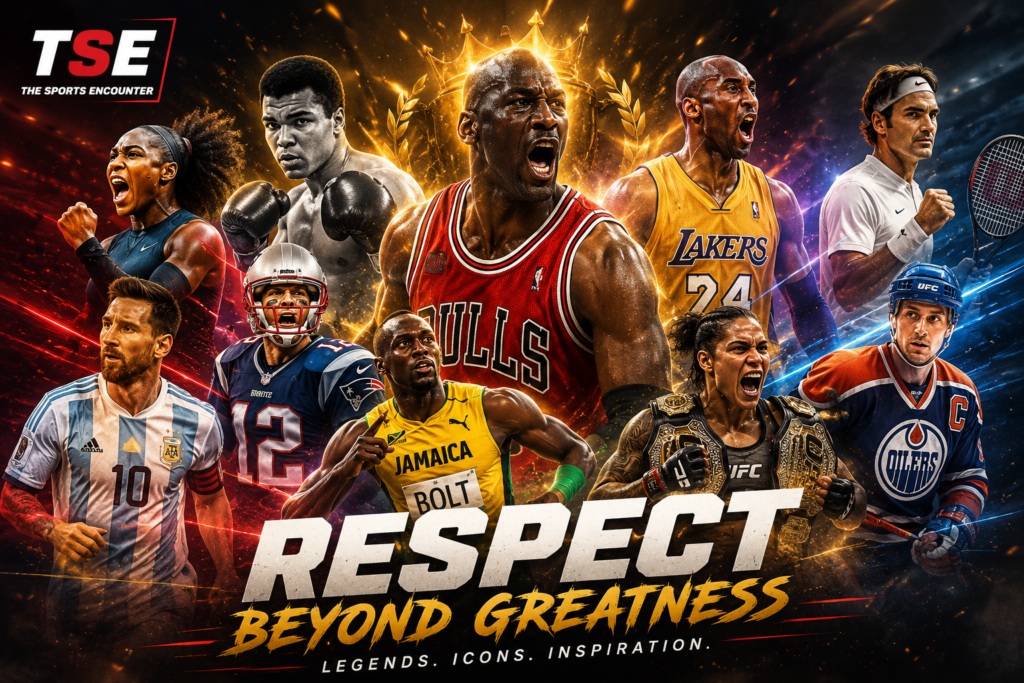
Athletic greatness can be counted. Championships, records, medals, goals, knockouts, and individual awards give us a measurable way to compare careers.
Respect works differently.
Fans may admire one athlete for domination, another for courage, and someone else for changing how an entire sport is understood. A player can own every major record and still divide public opinion. Another may finish with fewer trophies but earn lasting affection because of humility, resilience, social impact, or the way that person treated competitors.
That distinction sits at the heart of a widely shared ranking of the 15 most respected athletes of all time. The list, originally published by GiveMeSport and later turned into an infographic by RankingRoyals, places Michael Jordan first, followed by Muhammad Ali, Roger Federer, Lionel Messi, Tom Brady, Pelé, Wayne Gretzky, and Babe Ruth. Serena Williams, Kobe Bryant, Georges St-Pierre, Tony Hawk, Usain Bolt, Amanda Nunes, and Jerry Rice complete the top 15.
The Ranking at a Glance
| Rank | Athlete | Sport | Core source of respect |
|---|---|---|---|
| 1 | Michael Jordan | Basketball | Competitive dominance and global influence |
| 2 | Muhammad Ali | Boxing | Courage, conviction, charisma, and social impact |
| 3 | Roger Federer | Tennis | Excellence, elegance, longevity, and sportsmanship |
| 4 | Lionel Messi | Soccer | Genius, humility, patience, and perseverance |
| 5 | Tom Brady | American football | Longevity, preparation, and championship success |
| 6 | Pelé | Soccer | Global football legacy and cultural influence |
| 7 | Wayne Gretzky | Ice hockey | Unmatched production and generosity as a teammate |
| 8 | Babe Ruth | Baseball | Transformative historical influence |
| 9 | Serena Williams | Tennis | Dominance, resilience, and barrier-breaking impact |
| 10 | Kobe Bryant | Basketball | Work ethic, competitive intensity, and inspiration |
| 11 | Georges St-Pierre | MMA | Discipline, professionalism, and technical mastery |
| 12 | Tony Hawk | Skateboarding | Innovation and mainstreaming a subculture |
| 13 | Usain Bolt | Sprinting | Historic speed, charisma, and pressure performance |
| 14 | Amanda Nunes | MMA | Two-division dominance and trailblazing achievement |
| 15 | Jerry Rice | American football | Consistency, preparation, and enduring excellence |
What Does “Most Respected” Actually Mean?
There is no universal respect index in sports. No single formula can fairly compare a boxer who sacrificed years of his prime over a political position with a hockey player who rewrote his league’s record book, a skateboarder who helped legitimize an outsider culture, or a tennis player who broke racial and gender barriers.
Even advanced approaches to ranking athletes struggle with the problem. Research based on historical rankings and performance data has shown that some comparisons remain too close to call because different methods prioritize dominance, longevity, peak performance, or cultural significance.
Respect usually grows from five broad qualities: achievement, dominance, conduct, influence, and the human story behind the career. No athlete scores equally across every category.
Michael Jordan: The Standard for Competitive Greatness
Michael Jordan remains the athlete against whom sporting dominance is frequently measured. His place in basketball history also anchors The Sports Encounter’s wider NBA coverage.
He led the Chicago Bulls to six NBA championships and won the NBA Finals MVP award in all six title runs. The NBA’s official Michael Jordan legends profile documents a career that also included five regular-season MVP awards and six Finals MVP honors. Those championships arrived in two separate three-peats, from 1991 through 1993 and again from 1996 through 1998.
Jordan’s respect did not come from winning alone. Fans saw someone who appeared to demand perfection from every possession. His ability to turn pressure into performance created an image of competitive certainty. The larger the moment, the more likely he seemed to take control.
His influence then moved beyond the court. Jordan helped transform basketball into a global entertainment product. His shoes, advertising campaigns, silhouette, and championship performances reached audiences with little previous connection to the NBA.
His leadership style could be severe, and admiration for him has never required pretending otherwise. Jordan sits first because he changed the public idea of what a superstar athlete could become: champion, performer, global brand, and competitive archetype at the same time.
Muhammad Ali: Respect Built Through Courage
Muhammad Ali’s place near the top cannot be explained by boxing records alone.
He was an Olympic champion, heavyweight champion, extraordinary talker, and one of the most recognizable people of the 20th century. Yet the source of his enduring respect lies in the moments when athletic success was not the safest priority.
Ali refused induction into the United States military during the Vietnam War, citing his religious beliefs and opposition to the conflict. The decision cost him his boxing license and removed him from competition during years that should have formed the physical peak of his career.
He returned to boxing and participated in some of the sport’s defining fights. His victories made him a champion. His voice made him historic.
Ali challenged the expectation that athletes should remain politically quiet. He spoke about race, religion, identity, war, and dignity at a time when doing so carried serious consequences. Jordan may represent competitive greatness more clearly. Ali represents moral courage more powerfully.
Roger Federer: Excellence Without Visible Cruelty
Roger Federer’s appeal came from the illusion that elite sport could look effortless.
His movement was smooth, his shot-making appeared natural, and his emotional control made tennis at its highest level seem almost graceful. He won 20 Grand Slam singles titles and spent years at the center of one of the strongest eras men’s tennis has seen.
Novak Djokovic eventually surpassed several of Federer’s most important statistical records, while Rafael Nadal built an extraordinary legacy of his own. Federer still retained an unusual level of admiration across national and fan boundaries.
His public conduct played a major role. He frequently praised opponents, represented the sport with consistency, and built rivalries without needing to turn every contest into personal hostility.
Federer became respected because he offered a rare combination: dominance without constant aggression, confidence without theatrical arrogance, and fame without losing the appearance of dignity.
Lionel Messi: Genius, Patience, and the Weight of a Nation
Lionel Messi spent much of his career carrying an impossible demand. His wider cross-sport case is examined in our evidence-led analysis of whether Messi is the greatest athlete ever.
At club level, he won almost everything available. His dribbling, passing, scoring, vision, and ability to control matches made him one of soccer’s most complete attacking players.
For years, however, his standing in Argentina remained tied to one question: Could he win a major senior international tournament?
He kept returning after painful defeats. Argentina eventually won the Copa América, and Messi later led his country to the FIFA World Cup. That journey changed the emotional structure of his legacy.
Fans respect Messi not only because he is brilliant. His long-running rivalry with Cristiano Ronaldo is explored further in The Sports Encounter’s Messi vs. Ronaldo GOAT debate. They also remember the pressure he absorbed, the finals he lost, and his decision to keep confronting the same challenge. His story shows that respect often grows during failure before victory confirms it.
Tom Brady: The Discipline Behind Longevity
Tom Brady’s career challenged nearly every assumption about decline in American football.
He entered the NFL without the physical profile expected of a future superstar and was selected with the 199th pick of the 2000 draft. He eventually became the most successful quarterback of the Super Bowl era.
Brady earned respect by making exceptional performance look repeatable. He adapted to tactical changes, different teammates, new opponents, and the physical demands of his position.
His career also changed how athletes thought about preparation. Nutrition, recovery, film study, body maintenance, and routine became central to the Brady story.
Many athletes reach an elite level. Very few reorganize their lives around staying there for more than two decades.
Pelé: The Player Who Made Soccer Feel Global
Pelé occupies a unique place in soccer history because his legacy is inseparable from the sport’s global expansion. The lasting financial and emotional value of his career is also reflected in our report on the record sale of Pelé’s 1958 World Cup final shirt.
He remains the only male player to win three FIFA World Cups, a distinction highlighted in FIFA’s official tribute to Pelé’s World Cup legacy. His talent, movement, scoring, and charisma helped Brazil become the international symbol of expressive, attacking football.
Pelé’s respect extends beyond statistics because he represented possibility. For millions of young players, especially across the developing world, he showed that football could carry someone from modest beginnings to global recognition.
He played before every match, touch, and statistic could be digitally archived. Some of his greatness therefore survives through testimony, limited footage, memory, and cultural inheritance.
Later global soccer icons inherited a world he helped create. More historical football analysis appears in The Sports Encounter’s soccer section.
Wayne Gretzky: Dominance Through Intelligence and Generosity
Wayne Gretzky’s career numbers still look almost unnatural. His standing among hockey’s immortals can be compared with The Sports Encounter’s ranking of the 10 greatest NHL players ever.
He retired with 2,857 NHL points, including 1,963 assists. The NHL’s official retrospective on Gretzky’s records and playmaking shows how his goal-scoring milestones were matched by extraordinary assist production. His offensive production remains overwhelming because his assist total alone exceeds the career point total of almost every other player in league history.
The deeper source of his respect is how he dominated. Gretzky was never primarily celebrated as the strongest or most physically intimidating player. He controlled matches through anticipation, spatial intelligence, passing, timing, and an almost abnormal understanding of where play would develop.
His assist record also reveals something important. Gretzky’s greatness was frequently expressed through creating opportunities for teammates.
Individual domination and collective generosity rarely combine so clearly. Readers can find more league history and analysis in The Sports Encounter’s NHL hub.
Babe Ruth: The Athlete Who Changed the Shape of a Sport
Babe Ruth belongs to a different sporting universe.
He played before integration in Major League Baseball, modern conditioning, international talent pipelines, advanced analytics, and year-round media coverage. Any direct comparison with modern athletes must account for that context.
His influence remains difficult to overstate. Ruth transformed baseball’s offensive imagination. His home-run hitting helped move the sport away from the dead-ball era and toward power, spectacle, and individual stardom.
Respect for Ruth is rooted in historical importance more than modern standards of preparation or conduct. Certain athletes become part of the architecture of their sports.
Baseball after Babe Ruth looked different from baseball before him.
Serena Williams: Dominance Under a Different Level of Scrutiny
Serena Williams earned respect under conditions that were never equal. Her continuing influence on tennis is also explored in our feature on Serena Williams’ 2026 return and Wimbledon reunion.
She won 23 Grand Slam singles titles in the Open Era and remained a major champion across multiple generations of opponents. Her power, movement, serving, competitiveness, and ability to recover from setbacks created one of tennis’s defining careers.
Her impact went beyond winning. Williams faced racialized and gendered scrutiny that often focused on her body, clothes, emotions, confidence, and behavior in ways male stars rarely experienced.
Respect for Serena therefore comes from both achievement and resistance. She changed how women’s tennis looked, how it was marketed, and who could imagine belonging at its center.
Few athletes have had to prove their greatness so repeatedly.
Kobe Bryant: The Power and Complexity of a Competitive Legacy
Kobe Bryant built one of sport’s most influential identities around work.
“Mamba Mentality” became shorthand for preparation, sacrifice, repetition, confidence, and the willingness to continue through discomfort. Athletes in many sports adopted the phrase because it described a mindset rather than a basketball technique.
Bryant spent 20 seasons with the Los Angeles Lakers, won five NBA championships, earned the 2008 league MVP award, and won Finals MVP in 2009 and 2010.
Any honest discussion also needs to recognize complexity, including the 2003 sexual assault accusation and the enduring debate around that part of his life. Respect should never require erasing difficult facts.
His place reflects the reach of his competitive philosophy, his basketball accomplishments, and his influence on younger athletes. His legacy remains admired, emotional, and debated.
Georges St-Pierre: The Champion Who Treated Fighting Like a Discipline
Mixed martial arts often markets conflict through insults, hostility, and spectacle. Georges St-Pierre built a different model.
The Canadian champion became respected for technical completeness, preparation, humility, and controlled professionalism. He treated MMA as a disciplined competitive craft rather than a permanent personal feud.
St-Pierre could wrestle, strike, defend, adapt, and build detailed plans for different opponents. His ability to neutralize elite fighters made him one of the sport’s most strategically sophisticated champions.
He also stepped away while still capable of competing, speaking openly about the mental pressure and physical demands surrounding championship life.
He proved that a fighter could be dominant without becoming consumed by the performance of hatred.
Tony Hawk: The Man Who Helped a Subculture Become a Global Sport
Tony Hawk’s place may surprise readers who judge greatness mainly through traditional championships.
His importance lies in cultural transformation. Skateboarding spent years being treated as rebellious recreation rather than serious athletic competition.
Hawk’s innovation, visibility, video games, public performances, and long-term advocacy helped move the sport into the mainstream.
His successful completion of the 900 at the 1999 X Games became one of skateboarding’s defining moments. It represented technical progress, persistence, and a willingness to keep attempting something that had not been completed in competition.
His respect comes from building space for an entire sport, not simply winning within an existing structure.
Usain Bolt: The Rare Superstar Who Made Pressure Look Enjoyable
Usain Bolt did not merely win races. He turned the most basic athletic question, who is the fastest, into global theater.
Bolt won eight Olympic gold medals and dominated the 100 meters and 200 meters across three Olympic Games. His official World Athletics profile records his standing as the world-record holder in both sprint events. Those marks established him as the fastest man in recorded competition history.
Sprinting leaves almost no room for correction. A poor start, technical error, moment of tension, or minor physical problem can decide years of work in under 10 seconds. Bolt repeatedly delivered under that pressure.
He also changed the emotional atmosphere around sprinting. He smiled, gestured to the crowd, danced, and performed his famous lightning pose.
Many athletes succeed under pressure. Bolt made the pressure look like part of the celebration.
Amanda Nunes: The Champion Who Cleared Out Divisions
Amanda Nunes built one of the strongest competitive records in women’s mixed martial arts.
She became a champion in two UFC weight divisions and defeated a remarkable group of elite opponents, including Ronda Rousey, Cris Cyborg, Holly Holm, Miesha Tate, and Valentina Shevchenko.
Her importance reaches beyond the belts. Nunes established a standard based on power, versatility, patience, and tactical maturity.
She also became an important representative for LGBTQ+ athletes and Brazilian sports, building a public life around competition, marriage, motherhood, and personal stability.
Her respect comes from the scale of the opposition she defeated and the understated way she carried historic success.
Jerry Rice: Greatness Built Through Repetition
Jerry Rice may be the purest example of respect earned through professional discipline.
The former San Francisco 49ers wide receiver built a career around route precision, conditioning, preparation, reliable hands, and an almost obsessive commitment to training.
Rice did not depend on one physical advantage. His greatness came from combining athletic ability with repeatable detail.
That distinction matters in American football, where short careers, injuries, tactical changes, and dependence on teammates make sustained production difficult.
He became respected because younger players could study his career and understand that excellence was not mysterious. It was built through thousands of routes, conditioning sessions, film reviews, and technical corrections.
Who Is Missing From the Ranking?
The biggest weakness in the list is not the athletes included. It is the narrowness of the sporting world represented.
Eight of the 15 athletes are American. North American sports receive heavy representation through basketball, American football, baseball, hockey, skateboarding, and MMA. That does not invalidate the selections, but it reveals the cultural lens behind the ranking.
- Sachin Tendulkar and Don Bradman from cricket
- Michael Phelps, the most decorated Olympian in history
- Jackie Robinson and Jesse Owens for their historic social significance
- Bill Russell for championships and civil rights leadership
- Rafael Nadal and Novak Djokovic from tennis
- Marta and Mia Hamm from women’s soccer
- Lewis Hamilton from Formula 1
- Jahangir Khan from squash
- Eliud Kipchoge and Haile Gebrselassie from distance running
The omission of Jackie Robinson is particularly important in a list about respect. Babe Ruth had greater influence on baseball’s early commercial spectacle, but Robinson carried the burden of breaking Major League Baseball’s modern color barrier.
Greatness and Respect Are Not the Same Contest
A statistical ranking might produce a different order. Djokovic could replace Federer based on record accumulation. Michael Phelps would almost certainly appear. Bradman’s dominance would demand attention. Gretzky might move higher because his production separates him dramatically from most hockey players.
A cultural-impact ranking would also look different. Ali might finish first. Pelé, Jackie Robinson, Billie Jean King, Serena Williams, Jesse Owens, and Tony Hawk would gain ground. Athletes who changed access, identity, politics, or the commercial structure of their sports would matter more than athletes who simply won more often.
A sportsmanship ranking might favor Federer, Nadal, Gretzky, St-Pierre, Tim Duncan, or other figures whose public reputations centered on humility and professional conduct.
This is why respect cannot be reduced to a medal table. It develops through the relationship between an athlete and an audience. Fans decide what a career means after combining achievement with memory, identity, emotion, and social context.
Final Verdict: Muhammad Ali May Have the Strongest Case
Michael Jordan is a defensible No. 1. His competitive record, global influence, cultural reach, and continuing relevance make him one of the most powerful figures sport has produced.
Yet Muhammad Ali may have the strongest claim to being the most respected athlete rather than the greatest athlete.
Jordan risked defeat. Ali risked his career, reputation, income, and freedom.
His boxing brilliance gave him a platform, but his willingness to take a position when that platform could be taken away made him larger than sport. Time transformed a polarizing figure into a global symbol of courage, identity, and conviction.
The ranking succeeds because it encourages a discussion with no final answer. Its weakness is that it presents a culturally narrow editorial judgment as though worldwide respect can be neatly measured.
The most useful conclusion is not that Jordan, Ali, or Federer definitively owns the top position. It is that the athletes we respect most usually leave us with something greater than a record.
They change how people understand courage, excellence, discipline, creativity, identity, or possibility.
Trophies explain why they became famous. What they represented explains why they are remembered.