


August 16 has an unusual place in sprinting history.
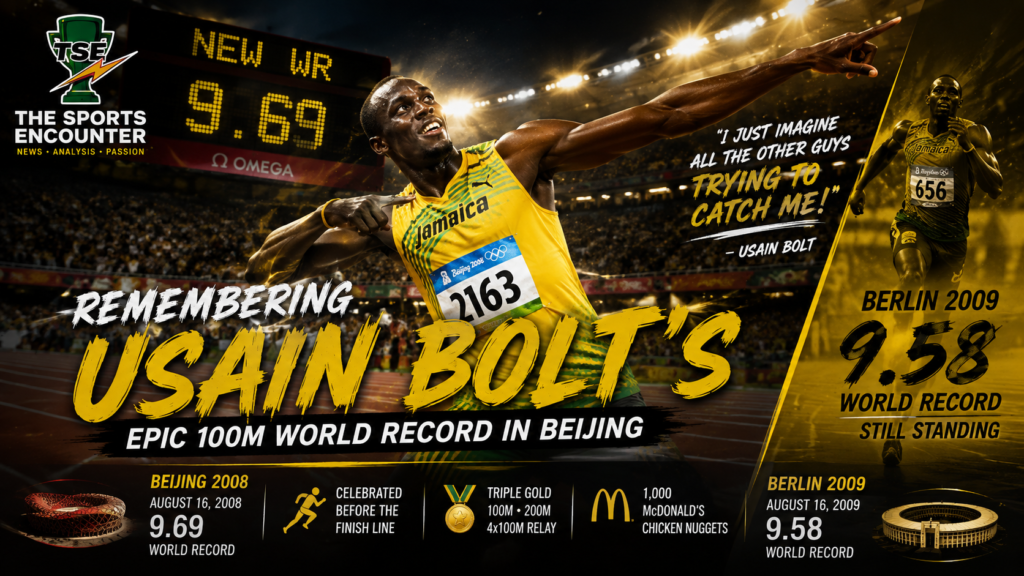
On that date in 2008, Usain Bolt crossed the Olympic 100-meter finish line in Beijing in 9.69 seconds. He had already begun celebrating, spreading his arms and turning his attention away from the simple task of running through the line.
Exactly 365 days later, Bolt lined up for another 100-meter final in Berlin.
This time he kept going.
The clock stopped at 9.58.
Eighteen years after Beijing and 17 years after Berlin, those two August 16 races still tell perhaps the clearest story of Bolt’s athletic greatness. The first showed the world a sprinter who appeared capable of going considerably faster than his own world record. The second showed just how much faster.
His 9.58 remains the men’s 100-meter world record in 2026.
The Sports Encounter recently revisited Bolt’s place among the greatest athletes ever in our cross-sport analysis of Lionel Messi and history’s strongest GOAT candidates. Few athletes in that conversation possess a claim as brutally simple as Bolt’s.
One hundred meters. One clock. Nobody has ever covered the distance faster.
Usain Bolt’s Beijing 2008 100m World Record at a Glance
| Race | Beijing 2008 Olympic men’s 100m final |
| Date | August 16, 2008 |
| Venue | National Stadium, Beijing |
| Winner | Usain Bolt, Jamaica |
| Winning time | 9.69 seconds, world record |
| Wind | 0.0 m/s |
| Silver | Richard Thompson, Trinidad and Tobago, 9.89 |
| Bronze | Walter Dix, United States, 9.91 |
| Bolt’s previous world record | 9.72 seconds |
| Berlin 2009 world record | 9.58 seconds |
| Current status | 9.58 remains the men’s 100m world record in 2026 |
Bolt Arrived in Beijing Already the Fastest Man Alive
Beijing did not introduce Bolt to elite sprinting.
It introduced the wider sporting world to the scale of what he was becoming.
Only a few months earlier, on May 31, 2008, Bolt had run 9.72 seconds in New York to break the 100m world record previously held by fellow Jamaican Asafa Powell.
18 years ago today, Usain Bolt jogged almost to an Olympic record, then cruised to a new world record two hours later pic.twitter.com/F9xWE10gZp
— Darknight 🇳🇬 (@MOON_WALKER6) August 16, 2026
That achievement was remarkable partly because Bolt’s early international reputation had been built primarily over 200 meters. At 6-foot-5, he did not resemble the conventional compact 100m sprinter, and questions remained about whether his height and comparatively long acceleration phase would work against the world’s best starters.
Beijing erased those doubts.
The Olympic 100m was expected to produce a confrontation involving Bolt, Powell and reigning world champion Tyson Gay.
Gay never reached the final.
Powell did, but he was unable to stay with Bolt once the Jamaican’s stride opened up through the middle of the race.
Even Bolt’s 9.85 Semifinal Looked Frighteningly Easy
The warning arrived before the final.
Bolt won his semifinal in 9.85 seconds.
The time itself was elite. The manner of it drew more attention.
He did not appear to be extending himself through the entire race. Bolt had already shown during the earlier rounds that qualification mattered more than chasing the clock, yet he continued producing times that other finalists would have considered major performances.
Powell won the other semifinal in 9.91. Richard Thompson ran 9.93. Churandy Martina followed in 9.94.
Bolt had run 9.85 while leaving the impression that another level remained unused.
Hours later, the world found out.
The Beijing Final Lasted 9.69 Seconds but Changed Sprinting for Years
The gun fired at 10:30 p.m. local time.
Bolt’s reaction time was 0.165 seconds, slower than several of the men around him. Thompson and Walter Dix both reacted in 0.133.
That difference quickly stopped mattering.
Once Bolt reached his upright running position, his combination of stride length, frequency and acceleration began separating him from the field.
By the latter part of the race, the Olympic final had stopped looking like a contest for gold.
Thompson was running brilliantly. He would finish in a personal-best 9.89.
Dix ran 9.91 for bronze.
Martina produced a national record of 9.93.
Powell finished fifth in 9.95.
Bolt was somewhere else.
With victory secure before the finish, he turned his head, opened his arms and began celebrating. The images became almost as famous as the time itself.
Then the scoreboard displayed:
9.69 WR.
He had lowered his own world record by three hundredths of a second while appearing to sacrifice time during the closing meters.
The Question Immediately Became: How Fast Could Bolt Have Run?
The celebration created one of athletics’ great hypothetical questions.
What would the clock have shown if Bolt had sprinted through the finish?
Researchers soon attempted to answer it rather than relying entirely on visual impressions.
A group of physicists analyzed video of the Beijing race and modeled Bolt’s position and acceleration during the closing portion of the 100 meters.
Their conservative scenario estimated approximately 9.61 seconds, with a reported uncertainty of 0.04 seconds, if Bolt had finished while following the late-race acceleration pattern of runner-up Richard Thompson.
A more aggressive model, based on Bolt maintaining a stronger acceleration profile, produced an estimate of approximately 9.55 seconds, again with a reported uncertainty of 0.04.
Those figures were theoretical estimates, not alternative official results. Bolt’s Olympic record will always be 9.69.
Yet the research captured what millions of people had sensed while watching the race.
The extraordinary part of Beijing was not simply that Bolt broke the world record.
He made a world record look unfinished.
Beijing Became a Three-Gold, Three-World-Record Olympics
The 100m was only the beginning of Bolt’s Beijing campaign.
Four days later, he attacked the 200 meters.
Bolt ran 19.30 seconds, breaking Michael Johnson’s 19.32 world record from the 1996 Atlanta Olympics.
That performance carried a different quality from the 100m.
There was no early celebration creating speculation about what might have happened. Bolt drove through the race and removed one of track and field’s most respected records.
Jamaica then won the men’s 4x100m relay in a world-record time during the Games, completing what was initially a three-gold, three-world-record Olympic campaign for Bolt. The relay result was later affected by a teammate’s doping case, but Bolt’s individual 100m and 200m victories remain among the defining performances of Beijing 2008.
Those races also accelerated Jamaica’s already formidable sprinting identity. The country’s relationship with speed remains visible nearly two decades later. At the 2026 Commonwealth Games, Jamaican athletes again featured prominently as athletics took center stage, a development covered in The Sports Encounter’s Glasgow 2026 Day 4 report.
Then There Were the Chicken Nuggets
Few Olympic legends contain a dietary subplot quite like Bolt’s Beijing story.
Bolt later described in his autobiography how uncertainty about unfamiliar food in China pushed him toward something he knew: McDonald’s chicken nuggets.
His account suggested that he consumed roughly 1,000 nuggets during his stay in Beijing, sometimes eating large quantities across several meals in a day.
It sounds almost incompatible with elite Olympic preparation.
That is part of why the story survived.
The fastest man at the Games was setting world records while living on a diet no high-performance nutritionist would design for an Olympic sprinter.
It should not be mistaken for an explanation of Bolt’s success or a diet worth copying. It belongs instead to the mythology of Beijing: the unfamiliar 21-year-old superstar who seemed to approach the biggest sporting stage with a looseness that everyone else struggled to understand.
Exactly One Year Later, Bolt Returned to the 100m Starting Line
August 16, 2009.
Berlin.
Another major championship final.
Another world record.
The symmetry remains extraordinary.
Exactly one year after Bolt ran 9.69 in Beijing, he faced Tyson Gay and the world’s leading sprinters in the 100m final at the World Athletics Championships.
Gay was much better prepared than he had been in Beijing.
He ran 9.71 seconds in the final, an American record and a performance that would have beaten every Olympic champion who came before Bolt.
It was nowhere near enough.
Bolt ran 9.58.
9.58 Changed the Scale of the Conversation
World records in the men’s 100m are normally measured through tiny improvements.
Bolt removed 0.11 seconds from his 9.69 record in one race.
World Athletics described it at the time as the largest reduction ever made to the men’s 100m world record.
Gay’s 9.71 showed the quality of the race. Asafa Powell took bronze in 9.84.
Bolt had not merely defeated a weak field by an exaggerated margin. He had run away from one of the fastest performances ever produced by another man.
Biomechanical analysis of the Berlin final showed Bolt already leading after 20 meters despite starts traditionally being regarded as one of the areas where his height could cost him time.
His peak speed approached 47 kilometers per hour.
There was no need to wonder what might have happened had he continued racing properly through the finish.
Berlin supplied the number.
9.58 seconds.
August 16 Produced Two World Records That Tell One Story
| Race | Beijing 2008 | Berlin 2009 |
|---|---|---|
| Date | August 16, 2008 | August 16, 2009 |
| Competition | Olympic Games | World Championships |
| Bolt’s time | 9.69 WR | 9.58 WR |
| Wind | 0.0 m/s | +0.9 m/s |
| Runner-up | Richard Thompson, 9.89 | Tyson Gay, 9.71 |
| Winning margin | 0.20 seconds | 0.13 seconds |
| Legacy | Olympic title and world record despite early celebration | World record that still stands in 2026 |
Viewed separately, Beijing and Berlin are two extraordinary races.
Viewed together, they explain Bolt more completely.
Beijing created possibility. Berlin established the limit everyone else has been chasing ever since.
Why 9.58 Still Feels So Far Away in 2026
Seventeen years is an extraordinary lifespan for a record in the sport’s most visible race.
Generations of elite sprinters have arrived since Berlin. Training methods have evolved. Track technology has improved. Shoe design has changed. Sports science has become more sophisticated.
The record remains 9.58.
That longevity matters when Bolt enters cross-sport greatness debates.
The Sports Encounter’s analysis of Lionel Messi’s case as the greatest athlete ever included Bolt because sprinting provides something team sports cannot: unusually clean measurement.
A footballer’s greatness depends partly on teammates, tactical systems, opponents, eras and subjective judgments about influence.
The 100m gives us a starting gun, a finish line and a clock.
Bolt’s best number remains the best number.
Modern Sprinters Keep Showing How Extraordinary Bolt’s Standard Was
The performances of today’s fastest athletes add useful perspective.
At the 2026 Commonwealth Games in Glasgow, Cameroon’s Emmanuel Eseme ran a Games-record 9.83 seconds in difficult wet conditions to win the men’s 100m.
It was an exceptional sprint and one of the performances of the Games, as The Sports Encounter detailed in our Glasgow 2026 Day 5 wrap-up.
Yet 9.83 is still a quarter of a second slower than Bolt’s 9.58.
In a race decided over 100 meters, 0.25 seconds is enormous.
That comparison should not diminish modern sprinters. It demonstrates the standard Bolt left behind.
The closer elite athletes move toward 10 seconds, the more expensive every hundredth becomes.
Bolt somehow found eleven of them between Beijing and Berlin.
Bolt Made Supremacy Look Casual, but the Numbers Were Ruthless
Memory can soften athletic greatness into personality.
With Bolt, that is particularly easy.
People remember the smile. The Lightning Bolt pose. The cameras. The dancing. The jokes. The celebrations before races and sometimes before finish lines.
Behind that personality sat extraordinary competitive numbers.
His 100m world record is 9.58.
His 200m world record is 19.19.
Both remain untouched in 2026.
He won the Olympic 100m and 200m double at three consecutive Games: Beijing 2008, London 2012 and Rio 2016.
That distinction separates the showman from the sporting achievement.
Bolt could make sprinting look playful because he was repeatedly producing performances that left almost no room for argument.
The Beijing Celebration Became Part of the Record’s Meaning
Normally, easing before a finish line would be remembered as a technical mistake.
Bolt turned it into sporting folklore.
Had he run 9.69 with perfect form through the line, Beijing would still rank among the great Olympic sprints.
The celebration added a question that lasted exactly one year.
How much faster was he?
The scientific estimates suggested Beijing itself might have contained something around the low 9.6s or perhaps even the mid-9.5s under particular modeling assumptions.
Berlin then produced 9.58 under official competition conditions.
The hypothetical became reality.
That is why the two August 16 races belong together.
TSE Verdict: Beijing Was the Warning, Berlin Was the Answer
Eighteen years later, it is tempting to remember Beijing primarily through the celebration.
The deeper significance sits in what happened around it.
Bolt entered the Olympic final as the world-record holder. He reacted slower than several rivals. He accelerated past an elite field. He opened a huge gap. He began celebrating before the finish and still stopped the clock at 9.69.
Richard Thompson ran 9.89 and lost by two tenths of a second.
The race made the world’s fastest men look as though they were competing in a different event.
Then Bolt returned on August 16, 2009 and ran 9.58.
No man has gone faster.
Beijing gave sprinting one of its greatest unanswered questions.
Berlin answered it with a number the sport is still trying to reach.
That is why August 16 will always belong, at least partly, to Usain Bolt.
Frequently Asked Questions
What time did Usain Bolt run in the Beijing 2008 Olympic 100m final?
Usain Bolt won the Beijing 2008 Olympic men’s 100m final in a world-record 9.69 seconds on August 16, 2008.
Did Usain Bolt slow down before the finish in Beijing?
Yes. Bolt visibly began celebrating before reaching the finish line, turning his attention toward the field and crowd while spreading his arms. His early celebration led to extensive debate about how much faster he could have run.
How fast could Bolt theoretically have run in Beijing?
A subsequent biomechanical study estimated approximately 9.61 seconds under a conservative model and around 9.55 seconds under a more aggressive assumption, with reported uncertainty of 0.04 seconds. These were theoretical estimates rather than official times.
Who finished second behind Bolt at Beijing 2008?
Richard Thompson of Trinidad and Tobago won the silver medal in a personal-best 9.89 seconds. American Walter Dix took bronze in 9.91.
When did Usain Bolt run 9.58 seconds?
Bolt set the 9.58 men’s 100m world record at the World Athletics Championships in Berlin on August 16, 2009, exactly one year after his Beijing 9.69 world record.
Does Usain Bolt still hold the 100m world record in 2026?
Yes. Bolt’s 9.58 from Berlin remains the men’s 100m world record in 2026.
What is Usain Bolt’s 200m world record?
Bolt holds the men’s 200m world record at 19.19 seconds, set at the 2009 World Championships in Berlin.
How many Olympic sprint doubles did Usain Bolt win?
Bolt won the individual 100m and 200m titles at three consecutive Olympic Games: Beijing 2008, London 2012 and Rio 2016.
Did Usain Bolt really eat 1,000 chicken nuggets at the Beijing Olympics?
Bolt later wrote that he consumed roughly 1,000 McDonald’s chicken nuggets over the course of his stay in Beijing because he was wary of unfamiliar food. The figure refers to his broader Olympic stay, not one meal.
The Sports Encounter’s athletics coverage follows the performances, records, rivalries and historical moments that explain how the world’s greatest athletes changed their sports.