


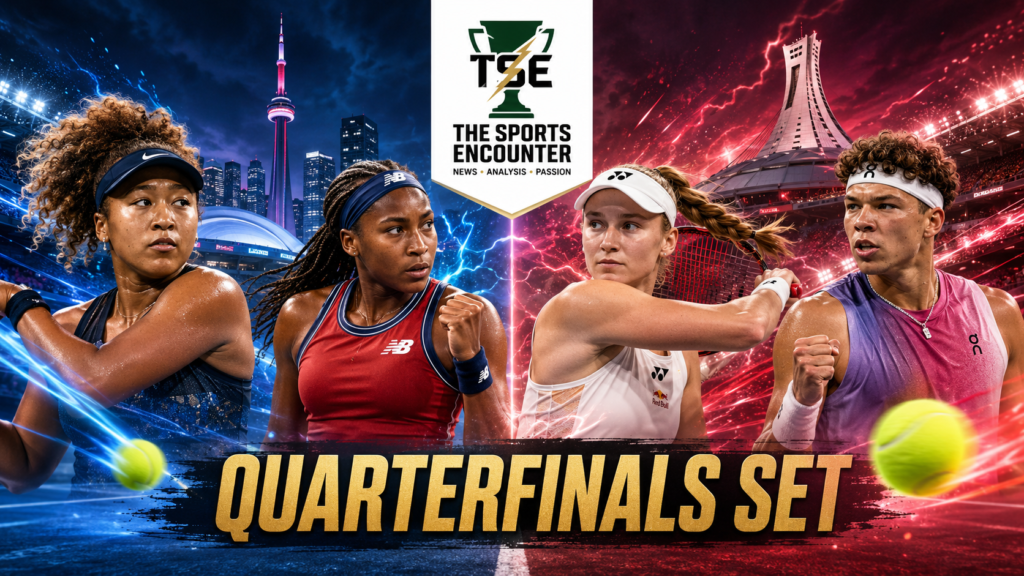
The National Bank Open 2026 has reached the quarterfinals with two very different stories unfolding across Canada. Toronto’s women’s draw is increasingly being controlled by proven champions, while Montreal has become a tournament of opportunity for a new generation of men’s contenders.
Naomi Osaka ended Canada’s singles hopes in Toronto by defeating Leylah Fernandez 6-4, 6-4 on Sunday night. Elena Rybakina survived a dramatic three-set battle with Liudmila Samsonova, Coco Gauff overwhelmed qualifier Alina Korneeva, and Belinda Bencic brought Alexandra Eala’s remarkable North American winning run to an end.
In Montreal, defending champion Ben Shelton stopped João Fonseca’s latest breakthrough attempt, Learner Tien continued his rise by reaching the quarterfinals, Daniel Merida produced another major step in his breakout season, and Jakub Mensik completed the last eight with a composed victory over Botic van de Zandschulp.
The results leave the National Bank Open with all quarterfinal places confirmed and several compelling paths to Thursday’s finals.
The Sports Encounter has followed the tournament throughout its chaotic opening week. Our Saturday wrap-up examined the exits of Aryna Sabalenka and Jessica Pegula, while our earlier National Bank Open analysis tracked the rise of Eala, Fernandez, Fonseca and the new contenders reshaping both draws.
National Bank Open 2026 Sunday Results at a Glance
| Event | Winner | Opponent | Score |
|---|---|---|---|
| Toronto WTA R16 | Elena Rybakina | Liudmila Samsonova | 6-4, 4-6, 6-4 |
| Toronto WTA R16 | Coco Gauff | Alina Korneeva | 6-3, 6-1 |
| Toronto WTA R16 | Naomi Osaka | Leylah Fernandez | 6-4, 6-4 |
| Toronto WTA R16 | Belinda Bencic | Alexandra Eala | 6-4, 6-0 |
| Montreal ATP R16 | Ben Shelton | João Fonseca | 6-3, 7-6(3) |
| Montreal ATP R16 | Learner Tien | Thiago Agustin Tirante | 6-4, 6-4 |
| Montreal ATP R16 | Jakub Mensik | Botic van de Zandschulp | 6-4, 7-5 |
| Montreal ATP R16 | Daniel Merida | Tallon Griekspoor | 6-3, 6-1 |
Osaka Ends Fernandez’s Home Run and Sends Another Warning
Naomi Osaka’s revival is becoming increasingly difficult to dismiss as a short-term surge.
The four-time Grand Slam champion defeated Leylah Fernandez 6-4, 6-4 in front of a Toronto crowd desperate to carry the Canadian deeper into the tournament.
Fernandez competed well enough to keep both sets close, but Osaka controlled the decisive points more effectively.
The first set briefly appeared capable of developing into a long fight when Osaka broke and Fernandez immediately responded. Osaka broke again late in the set, however, and the Canadian could not convert two opportunities to get back on serve.
From there, Osaka became much harder to disturb.
She did not face another break point for the remainder of the match and needed only one break of serve in the second set to close out the victory.
That control matters because Osaka’s strongest tennis has traditionally been built around first-strike authority.
She serves big enough to create short balls, takes returns early and becomes particularly dangerous when opponents allow her to dictate from inside the baseline.
Fernandez’s movement and left-handed patterns made the match tactically interesting, but Osaka refused to let the rallies consistently develop on the Canadian’s terms.
Fernandez still leaves Toronto with something significant
The result should not erase what Fernandez achieved during the week.
She reached the round of 16 and produced her biggest win of the season when she eliminated world No. 5 Mirra Andreeva.
For a Canadian player carrying enormous home expectations, that matters.
The tournament also provided another useful reference point ahead of the US Open.
Fernandez has already shown she can thrive under New York pressure. Her challenge now is producing that quality repeatedly rather than waiting for another major tournament to unlock it.
Rybakina Survives a Match She Looked Ready to Lose
Elena Rybakina’s 6-4, 4-6, 6-4 victory over Liudmila Samsonova may ultimately prove more valuable than an easy straight-sets win.
The world No. 2 was in genuine danger.
Samsonova led 3-0 in the deciding set after breaking Rybakina twice.
For a player who relies so heavily on first-strike tennis, that deficit can become difficult because chasing a match often encourages unnecessary aggression.
Rybakina did the opposite.
She stabilized.
Then she began applying pressure to every Samsonova service game.
Rybakina won six of the final seven games, broke three times during the comeback and completed the turnaround by breaking to love.
The first set was strange enough to warn both players
Seven breaks of serve occurred in the opening set despite both women possessing some of the biggest serves on the WTA Tour.
Six of the first eight games were breaks.
That is almost the opposite of what anyone would expect from this particular matchup.
Rybakina eventually found the decisive seventh break as Samsonova served to stay in the set.
The instability continued through the match, but the second seed’s ability to recover from two breaks down in the final set may be the detail worth carrying into the quarterfinals.
Rybakina vs Osaka Is Suddenly One of the Matches of the Tournament
The quarterfinal gives Toronto exactly the kind of matchup the tournament needs after losing Sabalenka and Pegula.
Rybakina against Osaka brings two of the cleanest power games in women’s tennis together.
Remarkably, it will be their first career meeting.
Both want to control the first two shots of the rally.
Both possess serves capable of removing the returner from the point immediately.
Both are comfortable hitting through hard courts.
The tactical question is therefore not complicated.
Who takes time away first?
Osaka has looked increasingly comfortable throughout this tournament. Rybakina remains the higher-ranked player and survived exactly the kind of difficult match that can sharpen a contender before the final rounds.
Readers looking ahead to New York can also see how both fit into the wider Grand Slam picture in The Sports Encounter’s complete US Open 2026 preview.
Coco Gauff Ends Korneeva’s Breakthrough Run
Alina Korneeva had already removed seeded American opponents and arrived in the fourth round with enough momentum to make the matchup interesting.
Coco Gauff removed the uncertainty quickly.
The fourth seed won 6-3, 6-1 in 75 minutes.
Korneeva actually broke Gauff in the opening game.
That turned out to be the best moment of her afternoon.
Gauff immediately broke back and began a five-game run that effectively established the direction of the match.
Her returning was particularly destructive.
Gauff created break points in every Korneeva service game and broke seven times across the match.
The statistic reveals something important about Gauff’s current hard-court level.
Her serve can still fluctuate.
Her return gives her a route into almost every opponent’s service game.
That allows her to remain dangerous even when other parts of the performance are imperfect.
Gauff reaches another major WTA 1000 benchmark
The victory sent Gauff into the 25th WTA 1000 quarterfinal of her career.
At this point, deep runs at elite tour events are no longer exceptional for her.
The conversation is increasingly about conversion.
Can she turn another quarterfinal into a title?
Bencic Ends Eala-Mania, but Toronto Confirms the Filipina’s Rise
Alexandra Eala finally looked tired.
That may sound obvious for a player who arrived in Toronto only days after winning the biggest title of her career in Washington.
Until Sunday, she had barely behaved like fatigue existed.
Belinda Bencic changed that.
The 2015 Toronto champion defeated Eala 6-4, 6-0 and repeatedly attacked the 21-year-old’s serve.
Bencic broke three times in the opening set.
Eala responded twice.
She could not do it a third time.
The second set became much more one-sided.
Bencic broke in every Eala service game and did not face a break point herself.
The match lasted long enough to reveal a clear physical difference.
Eala had been playing high-intensity tennis almost continuously since her historic run in Washington.
Eventually, legs matter.
Eala’s defeat does not change what the last two weeks accomplished
The Sports Encounter covered Eala’s breakthrough Washington title, when she became the first player from the Philippines to win a WTA Tour singles championship.
Toronto answered the obvious follow-up question.
Was Washington one extraordinary week?
No.
Eala immediately carried that level into another WTA 1000 tournament and reached the round of 16.
Her ranking has risen dramatically, her confidence has changed, and opponents can no longer treat her as an emerging player who might become dangerous later.
She is dangerous now.
Bencic vs Gauff Gives Toronto a Different Kind of Quarterfinal
Gauff will now face Bencic.
The matchup contrasts athletic defense and elite returning against one of the tour’s best early ball-strikers.
Bencic likes to take time away by playing close to the baseline.
Gauff often creates time through movement.
If Bencic consistently gets the first attack, she can prevent Gauff from settling into defensive patterns.
If Gauff turns the match into repeated physical exchanges and attacks Bencic’s second serve, the American becomes much harder to contain.
Toronto’s Quarterfinals Are Now Fully Set
| Quarterfinal | Main Storyline |
|---|---|
| Ekaterina Alexandrova vs Elina Svitolina | Sabalenka conqueror faces former Toronto champion |
| Diana Shnaider vs Iga Swiatek | Pegula conqueror meets six-time Grand Slam champion |
| Belinda Bencic vs Coco Gauff | 2015 champion against elite American returner |
| Naomi Osaka vs Elena Rybakina | First career meeting between two major champions and power hitters |
The draw now looks very different from the one Toronto began with.
World No. 1 Aryna Sabalenka is gone.
Jessica Pegula is gone.
Wimbledon champion Linda Noskova is gone.
Mirra Andreeva is gone.
Amanda Anisimova is gone.
Yet the final eight still contain enormous championship experience.
Rybakina.
Gauff.
Osaka.
Swiatek.
Bencic.
Svitolina.
That gives Toronto something Montreal currently lacks: a last eight dominated by players who already know what winning major titles or the biggest tour events feels like.
Montreal Has Become the Opposite Tournament
If Toronto is about proven champions surviving chaos, Montreal is about what happens when the established hierarchy disappears.
Jannik Sinner never arrived.
Novak Djokovic skipped the tournament.
Carlos Alcaraz was already unavailable.
Felix Auger-Aliassime withdrew with a back injury.
Alexander Zverev lost.
Daniil Medvedev lost.
Taylor Fritz lost.
Casper Ruud lost.
Lorenzo Musetti lost.
The tournament has been losing recognizable title contenders almost every day.
The Sports Encounter documented that transformation in our report on Zverev, Medvedev and Fritz crashing out in Montreal.
By Sunday night, only one top-10 player remained.
Ben Shelton.
Shelton Stops Fonseca and Keeps His Title Defense Alive
João Fonseca had become one of Montreal’s biggest attractions.
The 19-year-old defeated Stefanos Tsitsipas and Casper Ruud during his run and arrived against Shelton without dropping a set.
Shelton had not dropped one either.
The defending champion won the collision 6-3, 7-6(3).
The score suggests control.
The match required considerably more work.
Shelton fell behind by an early break in both sets and had to navigate windy conditions that made clean attacking tennis difficult.
His response was exactly what defending champions need.
He stopped searching for perfect tennis.
He competed.
Shelton gradually improved his court position, attacked the net more decisively and took control of the second-set tiebreak through aggressive play.
He later described the victory as a test of grit.
Shelton is now carrying the favorite label almost by default
That can be dangerous.
The American entered as the fifth seed.
Now he is the only top-10 player remaining and the defending champion.
He is also pursuing his fourth title of the season after winning Dallas, Munich and Stuttgart.
Suddenly, every opponent can play freely against him.
Shelton has become the man with something to lose.
Fonseca Leaves Montreal With More Evidence That His Rise Is Real
The defeat should not obscure Fonseca’s week.
The Brazilian teenager beat former world No. 3 Tsitsipas and ninth seed Ruud.
He also reached the round of 16 without dropping a set.
Shelton simply provided a higher-pressure version of the same test.
The next stage in Fonseca’s development will be learning how to beat an elite opponent who can match his aggression and still defend the biggest points better.
That is a very different problem from proving he belongs.
He already does.
Learner Tien Reaches a Milestone American Tennis Has Waited 24 Years to See
Learner Tien defeated Thiago Agustin Tirante 6-4, 6-4 to reach his second Masters 1000 quarterfinal.
The historical detail is better.
At 20, Tien became the youngest American man to reach the Canadian quarterfinals since Andy Roddick did it as a 19-year-old in 2002.
That puts another marker beside what has already been a significant season.
Tien won Geneva earlier this year and reached the Indian Wells quarterfinals, losing there to eventual champion Jannik Sinner.
In Montreal, he has also beaten Tommy Paul and Gael Monfils.
The pattern is becoming meaningful.
Tien is no longer arriving at major tournaments simply to gain experience.
He expects to advance.
His return game may be the most transferable part of his rise
Sunday’s conditions were windy enough to disrupt clean hitting.
Tien adapted through return positioning and rally tolerance rather than relying on first-strike power.
That gives him a different profile from many young American men.
He does not have to serve opponents off the court to stay competitive.
That may eventually make him particularly dangerous at Grand Slam level.
Daniel Merida Is Producing the Tournament’s Most Unexpected Breakthrough
Daniel Merida arrived in Montreal without a tour-level hard-court victory.
He is now a Masters 1000 quarterfinalist.
The 21-year-old Spaniard dismantled Tallon Griekspoor 6-3, 6-1 in 69 minutes.
Griekspoor had already eliminated top seed Alexander Zverev.
Merida did not care.
His backhand controlled much of the match, and Griekspoor never established the intensity that had carried him through the earlier upset.
Merida has now defeated Liam Draxl, Ugo Humbert, Alex Michelsen and Griekspoor during his Montreal run.
That is not a lucky bracket.
It is a breakthrough.
His ranking rise tells the story
Merida began the season outside the top 160.
His Montreal run has pushed him to approximately No. 40 in the ATP live rankings and guaranteed his first top-50 breakthrough.
He also won his first ATP Tour title in Umag last month.
The improvement is arriving fast.
Merida vs Tien May Be the Quarterfinal That Best Represents Montreal
Neither player entered the tournament as a favorite.
Both now have a legitimate path to a Masters 1000 semifinal.
Tien is 20.
Merida is 21.
That makes the matchup an ideal representation of what Montreal has become.
The biggest names disappeared.
The younger players did not merely survive the resulting space.
They occupied it.
Mensik Keeps Quietly Moving Through the Draw
Jakub Mensik’s 6-4, 7-5 victory over Botic van de Zandschulp may have received less attention than Shelton-Fonseca, but it reinforced an important point.
Mensik already knows how to win at Masters 1000 level.
The 20-year-old Czech was three points away from losing the second set when Van de Zandschulp led 5-4.
Mensik won the next three games.
Match over.
That composure separates his current position from players who are simply enjoying a surprising week.
He has already experienced elite tournament pressure.
Now he gets the defending champion.
Shelton vs Mensik Could Decide Who Becomes Montreal’s Clear Favorite
The quarterfinal brings together the only two remaining players in the draw who have already won Masters 1000 titles.
Shelton has the home-continent momentum and defending-champion status.
Mensik has enough first-strike power to challenge Shelton’s serving patterns and enough confidence to avoid treating the American as untouchable.
The match may ultimately be decided by second-serve pressure.
Both players want short points.
The one forced into defensive rallies more often will be operating outside his preferred rhythm.
Montreal’s Quarterfinals Are Fully Locked In
| Quarterfinal | Main Storyline |
|---|---|
| Rafael Jodar vs Arthur Fils | Teenage Spanish breakout faces one of Europe’s most explosive young stars |
| Luciano Darderi vs Brandon Nakashima | Tour-leading quarterfinal consistency against first-time Masters quarterfinalist |
| Ben Shelton vs Jakub Mensik | Only remaining former Masters 1000 champions collide |
| Learner Tien vs Daniel Merida | 20-year-old American against 21-year-old Spanish breakthrough star |
Rafael Jodar Has Become One of the Stories of the Entire North American Swing
Jodar’s quarterfinal with Arthur Fils was confirmed during Saturday’s action, but his presence deserves renewed attention now that the entire draw is visible.
The 19-year-old Spaniard has gone from emerging prospect to a player capable of beating established tour names within months.
His run follows a strong Washington campaign in which he reached the final before losing to Taylor Fritz.
The Sports Encounter covered Jodar’s breakthrough Washington final against Fritz, and Montreal has already demonstrated that the run was no isolated week.
Jodar defeated Lorenzo Musetti earlier in Montreal and then swept past Jiri Lehecka 6-3, 6-3.
His rise is becoming one of the most important pre-US Open developments on the men’s tour.
Toronto and Montreal Are Producing Opposite Versions of the Same Tournament
This may be the central story of the 2026 National Bank Open.
The women’s draw lost several major seeds.
Its quarterfinals still contain a collection of champions.
Swiatek has six Grand Slam titles.
Osaka has four.
Gauff has two.
Rybakina has won Wimbledon and the Australian Open.
Bencic has previously won this tournament.
Svitolina is also a former Canadian champion.
The draw changed without losing its star power.
Montreal changed completely.
Shelton is now surrounded by players whose best achievements may still be ahead of them.
Tien.
Merida.
Jodar.
Mensik.
Fils.
Nakashima.
Darderi.
The contrast gives the closing four days unusual appeal.
The US Open Implications Are Getting Harder to Ignore
The National Bank Open is not taking place in isolation.
New York is approaching.
Toronto is testing whether Osaka’s return to elite hard-court contention is sustainable.
Rybakina is trying to establish herself as the strongest remaining woman in the Canadian draw.
Gauff is sharpening her return game.
Swiatek is attempting to build momentum after recovering from a poor opening set against Marta Kostyuk.
Eala leaves with further evidence that Washington fundamentally changed her status.
Montreal is producing a different set of questions.
Can Shelton defend a Masters title while carrying favorite pressure?
Is Tien ready for a serious US Open run?
How quickly is Jodar’s ceiling rising?
Is Merida about to become a regular top-30 presence?
Can Mensik convert his existing Masters pedigree into another major title challenge?
Those questions will follow the players directly into the rest of the North American hard-court swing.
TSE Analysis: The Draws Have Opened, but “Open” Means Something Different in Each City
Calling a tournament “wide open” can become lazy once several seeds lose.
Toronto is not truly wide open in the conventional sense.
Sabalenka and Pegula have disappeared, yet champions remain everywhere.
A semifinal featuring Swiatek, Gauff, Osaka and Rybakina would surprise nobody.
Alexandrova, Svitolina, Shnaider and Bencic are more than capable of destroying that assumption.
Montreal is genuinely open.
Only Shelton began the tournament inside the top 10.
Several quarterfinalists are reaching this level for the first time or remain in the early stages of their careers.
Opportunity can create two responses.
Freedom.
Pressure.
The players who understand the difference over the next few days will probably decide the title.
Who Has the Best Path to the Toronto Title?
Rybakina remains the highest-ranked player left.
Her path is not comfortable.
Osaka comes first.
Potentially another major champion after that.
Swiatek may have the strongest combination of experience and tactical adaptability remaining in the draw.
Gauff’s returning creates another route.
Osaka may carry the most intriguing momentum.
Bencic already owns the memory of winning Toronto in 2015.
This is an unusually difficult quarterfinal field to rank confidently.
Who Has the Best Path to the Montreal Title?
Shelton has to begin as the favorite.
He is the defending champion.
He is the only top-10 player left.
He has already won three titles this season.
That does not make his path easy.
Mensik has Masters-winning experience.
Fils is capable of overwhelming opponents physically.
Jodar has been climbing almost every week.
Tien looks increasingly comfortable at this level.
Darderi has already reached 10 tour-level quarterfinals this season.
Nakashima is playing with the freedom of someone enjoying his first Masters 1000 quarterfinal.
Merida may be the tournament’s least predictable player because his previous hard-court résumé provides almost no useful ceiling.
National Bank Open 2026 Quarterfinal Power Rankings
| Rank | Player | Event | TSE Assessment |
|---|---|---|---|
| 1 | Elena Rybakina | Toronto | Highest-ranked player remaining and survived a major scare |
| 2 | Iga Swiatek | Toronto | Elite championship experience and improving hard-court rhythm |
| 3 | Ben Shelton | Montreal | Defending champion and only top-10 man remaining |
| 4 | Coco Gauff | Toronto | Return game looks increasingly dangerous |
| 5 | Naomi Osaka | Toronto | Hard-court confidence is building rapidly |
| 6 | Belinda Bencic | Toronto | Former champion playing increasingly clean first-strike tennis |
| 7 | Jakub Mensik | Montreal | Already owns Masters-winning experience |
| 8 | Arthur Fils | Montreal | Physical ceiling makes him dangerous in an open draw |
The rankings are intentionally weighted toward current form, proven performance at elite events and the difficulty of each player’s remaining path.
What Happens Next at the National Bank Open?
The quarterfinals are spread across August 10 and 11 in Toronto and Montreal.
The semifinals are scheduled for August 12, with both singles finals set for August 13.
In Montreal, Monday’s scheduled quarterfinal action includes Rafael Jodar against Arthur Fils and Luciano Darderi against Brandon Nakashima.
Shelton-Mensik and Tien-Merida complete the remaining men’s quarterfinal schedule.
Toronto’s last eight consists of Alexandrova-Svitolina, Shnaider-Swiatek, Bencic-Gauff and Rybakina-Osaka.
Fans can follow the official scores, draws and match schedule through the National Bank Open presented by Rogers.
For continuing coverage of Toronto, Montreal, Cincinnati and the build-up to New York, visit The Sports Encounter’s Tennis hub.
Final Verdict: Toronto Has the Champions, Montreal Has the Future
Sunday did more than complete the quarterfinal lineup.
It clarified what the closing stages of the National Bank Open are going to be about.
Toronto still belongs to recognizable champions.
Osaka is dangerous again.
Rybakina survived a match that could easily have eliminated her.
Gauff’s return game dismantled another opponent.
Bencic reminded everyone why she already owns a Canadian title.
Swiatek remains in the opposite half.
The famous names that disappeared have not emptied the tournament of championship quality.
Montreal offers something less familiar and perhaps even more exciting.
Shelton remains the defending champion, but almost everyone around him represents some version of the future.
Tien became the youngest American Canadian quarterfinalist since Roddick.
Merida is having a Masters breakthrough almost nobody predicted.
Jodar’s extraordinary summer continues.
Mensik already looks comfortable carrying expectations normally reserved for older players.
Fonseca finally met a barrier in Shelton, but his week strengthened his case as another major piece of men’s tennis’ emerging generation.
The National Bank Open began with questions about the stars who were missing.
It is reaching the final four days with a better question.
Which of the players who remained will turn opportunity into something permanent?
Frequently Asked Questions
Who beat Leylah Fernandez at the National Bank Open on August 9?
Naomi Osaka defeated Fernandez 6-4, 6-4 in the Toronto round of 16.
Did Alexandra Eala reach the National Bank Open quarterfinals?
No. Belinda Bencic defeated Eala 6-4, 6-0, ending the Filipina’s strong run following her Washington title.
Who will Naomi Osaka play next?
Osaka will face second seed Elena Rybakina in the Toronto quarterfinals. It will be their first career meeting.
Who will Coco Gauff play in the quarterfinals?
Gauff will face 2015 National Bank Open champion Belinda Bencic.
How did Elena Rybakina reach the quarterfinals?
Rybakina defeated Liudmila Samsonova 6-4, 4-6, 6-4 after recovering from a 3-0 deficit and two breaks down in the deciding set.
Did Ben Shelton beat João Fonseca?
Yes. Defending champion Shelton defeated Fonseca 6-3, 7-6(3) in Montreal.
Who will Ben Shelton play next?
Shelton will face Jakub Mensik in the Montreal quarterfinals.
How old is Learner Tien?
Tien is 20 and became the youngest American man to reach the Canadian quarterfinals since 19-year-old Andy Roddick in 2002.
Who is Daniel Merida playing next?
Merida will face Learner Tien after defeating Tallon Griekspoor 6-3, 6-1.
What are the Montreal quarterfinal matchups?
The men’s quarterfinals are Rafael Jodar vs Arthur Fils, Luciano Darderi vs Brandon Nakashima, Ben Shelton vs Jakub Mensik, and Learner Tien vs Daniel Merida.
What are the Toronto quarterfinal matchups?
The women’s quarterfinals are Ekaterina Alexandrova vs Elina Svitolina, Diana Shnaider vs Iga Swiatek, Belinda Bencic vs Coco Gauff, and Naomi Osaka vs Elena Rybakina.
When are the National Bank Open semifinals and finals?
The semifinals are scheduled for August 12, with the singles finals taking place on August 13.
Who is the defending men’s National Bank Open champion?
Ben Shelton is the defending champion after winning his first ATP Masters 1000 title in Canada in 2025.
Where can fans follow more National Bank Open coverage?
Readers can follow tournament updates, analysis and US Open build-up through The Sports Encounter’s Tennis coverage.