Connect with us
Marcos Wetherfield | The Sports Encounter

Published

on

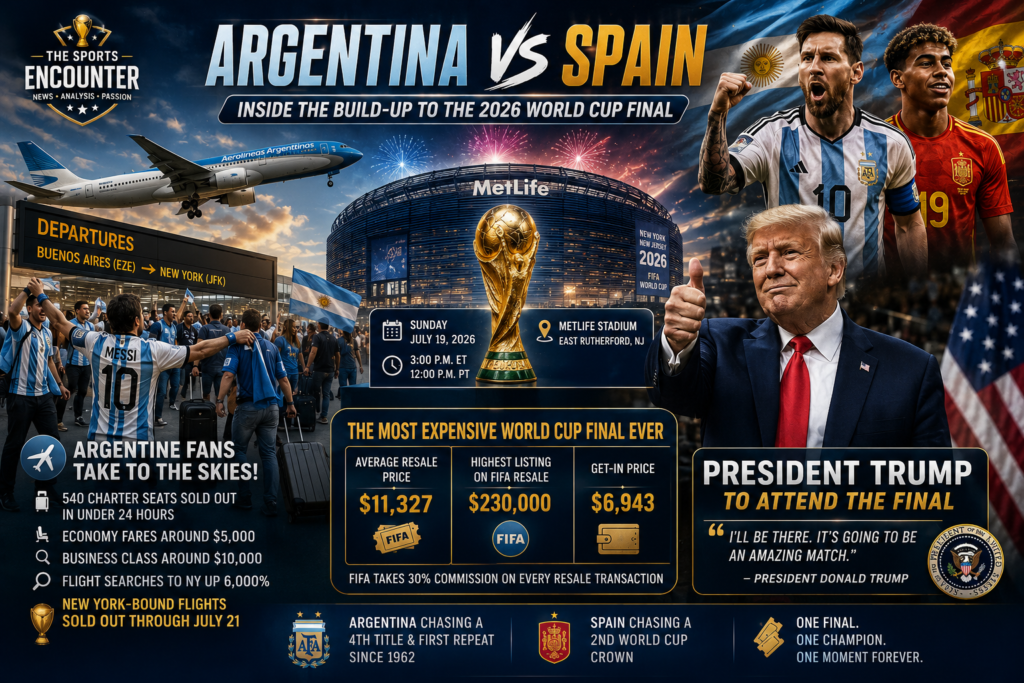
The 2026 FIFA World Cup final is set, and the world is already reorganizing itself around it. Lionel Messi’s Argentina will face Lamine Yamal’s Spain on Sunday, July 19, at MetLife Stadium in East Rutherford, New Jersey, in what promises to be one of the most-watched sporting events in history.

In the 72 hours since Argentina’s stunning 2-1 comeback win over England and Spain’s clinical 2-0 dismantling of France, the build-up has exploded into a story that stretches far beyond the pitch: sold-out charter flights, record-shattering ticket prices, a sitting U.S. president confirming his attendance, a Louis Vuitton-designed trophy trunk, and two national federations quietly managing injury concerns in their biggest stars.

Here is the complete, deeply reported picture of everything happening in the countdown to Argentina vs Spain.

🏆 2026 World Cup Final: Quick Facts

MatchArgentina vs. Spain
DateSunday, July 19, 2026
Kickoff3:00 p.m. ET / 12:00 p.m. PT
VenueMetLife Stadium (branded “New York New Jersey Stadium”), East Rutherford, NJ
CapacityApproximately 82,500
TV (English)FOX, Fox One, FoxSports.com
TV (Spanish)Telemundo, Peacock
Argentina’s PathDefending champions, beat England 2-1 in the semi-final
Spain’s PathEuropean champions, beat France 2-0 in the semi-final
What’s at StakeArgentina chasing a 4th title and first repeat since Brazil (1962); Spain chasing a 2nd title

Argentine Fans Are Emptying Their Wallets to Get to New Jersey

Nothing captures the emotional stakes of this final quite like what happened in Buenos Aires within hours of the final whistle in Atlanta. Argentina’s state-run carrier, Aerolineas Argentinas, released two special charter flights from Buenos Aires to New York late on Wednesday night. Both sold out completely by Thursday morning, filling all 540 available seats, with economy fares running around $5,000 and business-class seats commanding roughly $10,000, several multiples above typical transatlantic-style pricing for that route.

The demand did not stop there. Aerolineas’ own website showed zero available seats on its New York-bound services through July 21, and the carrier’s flights to Miami, often used as a stopover en route to the New York area, were also completely sold out. Other international carriers, including American Airlines, Copa, and LATAM, were still advertising Buenos Aires-to-New York and Buenos Aires-to-Miami fares on Thursday, though mostly through connecting itineraries rather than direct charter service.

Perhaps the most staggering data point came from Despegar, a major Latin American travel booking platform, which reported that searches for flights to New York spiked by 6,000 percent in the hours immediately following Argentina’s semi-final win. For a country whose relationship with its national football team borders on religious devotion, the message was clear: cost is not the deciding factor when Lionel Messi is one win away from history.

✈️ Argentina’s Flight Frenzy: By the Numbers

MetricFigure
Charter seats sold (Aerolineas Argentinas)540 (sold out in under 24 hours)
Economy fare (charter)Approximately $5,000
Business-class fare (charter)Approximately $10,000
Spike in NY flight searches (Despegar)6,000% increase
New York-bound availability by ThursdaySold out through July 21
Miami-bound availabilitySold out

The Most Expensive World Cup Final in History

If flights to the final are eye-watering, tickets to actually sit inside MetLife Stadium are on another planet entirely. According to secondary ticket marketplace TickPick, the average resale price for a final ticket has climbed to $11,327, officially making Argentina vs Spain the most expensive single ticketed sporting event ever hosted on American soil, surpassing the Super Bowl and the NBA Finals. The get-in price, meaning the cheapest available seat, sits at $6,943, only a modest drop from the roughly $7,200 get-in price the match commanded before Argentina had even confirmed their spot in the final.

Other data services paint an even more dramatic picture. SeatPick’s resale tracking put the average final ticket price at around $13,700, with some premium seats listed close to $200,000. On FIFA’s own official resale marketplace, at least one listing for a final ticket reportedly reached $230,000 earlier in the tournament cycle. FIFA does not set resale prices directly but collects a 30 percent commission on every resale transaction, a business model that has drawn sustained criticism from supporter groups.

For context on just how far prices have climbed compared to recent tournaments, fans applying for World Cup final tickets through their own national football associations, historically the cheapest and most accessible route, are now looking at a minimum spend of roughly £3,119 (about $4,028), compared to just £450 for the equivalent tier at the 2022 World Cup in Qatar. That is nearly a sevenfold increase in the cheapest official price point in a single tournament cycle.

💰 World Cup Final Ticket Prices: 2022 vs 2026

Pricing Tier2022 Qatar Final2026 New Jersey Final
Value / Cheapest Tier£450 (~$605)£3,119 (~$4,028)
Standard Tier£747 (~$1,005)£4,162 (~$5,600)
Premium Tier£1,197 (~$1,610)£6,615 (~$8,900)
Most Expensive Official Ticket~$1,600Category 1 listed at $8,680 (dynamic pricing)
Average Resale PriceNot comparable$11,327-$13,700
Highest Recorded Resale ListingN/AUp to $230,000

Fan advocacy group Football Supporters Europe has been openly critical of FIFA’s approach throughout the tournament, with executive director Ronan Evain telling reporters he believes “a significant proportion of tickets that are sold and put on the resale platform are there just for profit.” FIFA president Gianni Infantino has defended the pricing structure, pointing out that dynamic pricing and legal resale markets are standard practice under U.S. law, and has insisted that every one of the tournament’s 104 matches will effectively sell out regardless of price.

For fans priced out of the primary and secondary markets entirely, ticket costs for the third-place match between France and England in Miami on Saturday sit dramatically lower, with a get-in price near $900, underlining just how much of a category of its own the Argentina-Spain final has become.

Spain’s Injury Watch: Yamal and Porro Train Apart

While the commercial frenzy builds around them, both finalists are quietly managing fitness concerns heading into the biggest match of the tournament. Spain’s Lamine Yamal and Pedro Porro trained separately from the rest of Luis de la Fuente’s squad on Thursday at Red Bull New York’s training facility in East Hanover, New Jersey, with both players seen lying on the pitch during the session.
The Spanish football federation (RFEF) confirmed to Reuters that both players are expected to be available for Sunday’s final, describing the separate training as a precautionary workload-management measure rather than a sign of serious injury. Porro’s situation is the more concerning of the two: de la Fuente confirmed after Spain’s semi-final win over France that the full back had picked up a knock, which Reuters understands is a hamstring strain, though the issue is not considered serious. Yamal’s case appears more routine. De la Fuente said the 19-year-old phenom had “nothing” structurally wrong after the France match, but visible aches and bruises the following day reflected the physical toll of his duel with French defenders Lucas Digne and Theo Hernandez.

With three days to recover before kickoff, Spain’s entire camp is focused on freshness. The squad trained in humid conditions of around 30 degrees Celsius (86 degrees Fahrenheit) on Thursday, a preview of the kind of heat management both finalists will need to navigate, given that Sunday’s final will be just the second fully outdoor match Spain has played in the tournament.

🩹 Spain Injury Report Ahead of the Final

PlayerPositionIssueStatus
Pedro PorroRight backHamstring strain (per Reuters)Expected to play
Lamine YamalForwardGeneral soreness/bruising, no structural damageExpected to play

Trump Confirms Attendance as White House Talks Up “Most Secure” World Cup

The final’s political dimension grew even larger on Thursday when White House press secretary Karoline Leavitt confirmed that U.S. President Donald Trump will attend the World Cup final in person on Sunday. “We look forward to the final match on Sunday, and I know the president looks forward to attending,” Leavitt told reporters, adding that his presence “will cap what has been the most watched, most secure, and most successful World Cup in American history.” Leavitt said she was unsure whether the president has a favorite in the final, joking that reporters should ask him directly, predicting “he’ll have a fun answer for you.”

Trump’s Sunday appearance will follow a separate FIFA reception scheduled for Friday at Trump Tower in New York City. His attendance adds another layer of security planning and media attention to a final that was already shaping up to be the most heavily scrutinized single sporting event held on U.S. soil this decade.

Trump Confirms Attendance as White House Talks Up Most Secure World Cup

A Trophy Worthy of a Runway: Louis Vuitton’s Bespoke Trunk

Even the World Cup trophy itself is getting the red-carpet treatment. For the fifth consecutive tournament, following 2010, 2014, 2018, and 2022, French luxury house Louis Vuitton has designed the bespoke trunk that will transport the trophy to MetLife Stadium on final day. The case features a golden “V” for both “Victory” and “Vuitton” across the front, the brand’s signature monogram pattern, and gold-plated brass corner protectors, with an interior lined in beige leather and a patch commemorating the Louis Vuitton-FIFA partnership.

Louis Vuitton CEO and Chairman Pietro Beccari called the partnership emblematic of a shared “unwavering commitment to excellence,” noting the two organizations’ “shared belief in sport’s power to inspire and bring people together.” The collaboration sits within a broader trend of luxury brands embedding themselves in elite sport, echoing Tiffany & Co.’s decades-long role crafting the Vince Lombardi Trophy for the Super Bowl (since 1967) and Louis Vuitton’s own decade-long trophy-trunk partnership with Formula 1. Under normal circumstances, the actual World Cup trophy resides at the FIFA Museum in Zurich, making its journey to New Jersey, inside its couture luggage, a genuine spectacle in its own right.

Two Very Different Roads to New Jersey

Beyond the spectacle, the final itself is shaping up as a genuine clash of footballing philosophies. Spain arrive as the tournament’s most statistically dominant team, conceding just a single goal across seven matches, a defensive record built on suffocating semi-final performances against elite attacking talent. Their dismantling of France in the semi-final was built on a defense that limited joint-tournament-top-scorer Kylian Mbappe to only two shots, neither on target, while conceding an expected-goals value of just 0.31 for the entire match. Mikel Oyarzabal has emerged as Spain’s talisman in front of goal, leading the side with five tournament goals, while Nico Williams has returned from injury to add depth to an already dangerous attack.

Argentina, by contrast, have won the hard way. Rather than dominating games from start to finish, Lionel Scaloni’s side have made a habit of finding a way when it matters most, surviving scares against Cape Verde, needing three late goals to see off Egypt in the round of 16, needing extra time to eliminate ten-man Switzerland in the quarter-finals, and then producing their most dramatic escape yet against England, scoring twice in the final seven minutes to complete a 2-1 win. Messi has been the connective tissue running through nearly every one of those moments, sitting at eight goals and four assists heading into the final, with three of those assists coming in Argentina’s last two knockout matches alone.

⚔️ Path to the Final: Argentina vs. Spain Compared

CategoryArgentinaSpain
Semi-final resultBeat England 2-1 (comeback win)Beat France 2-0
Goals scored in tournament19Not directly comparable; defense-led run
Goals conceded in tournament71 (across 7 matches)
Style of playResilient, comeback specialists, Messi-centricPossession-based, defensively suffocating
Golden Boot leader on rosterLionel Messi (8 goals, co-leader)Mikel Oyarzabal (5 goals, team leader)
Key returning playerN/ANico Williams (back from injury)
Defending title statusDefending champions (won 2022)Chasing 2nd title (won 2010)
Historic milestone on the lineFirst repeat champion since Brazil (1962)First European team to win on U.S. soil

The Head-to-Head History Between Argentina and Spain

This will be just the second competitive World Cup meeting between these two nations at the tournament’s showpiece stage, and it comes with real historical texture. The two sides have met 14 times previously, with each side winning six matches and two ending level, though nearly all of those encounters have come in friendlies rather than high-stakes tournament football. Their most recent meeting came in a March 2018 exhibition in Madrid, which Spain won in emphatic fashion, 6-1, with Isco scoring a hat-trick against an Argentina side that was then managed by a different regime entirely. Argentina’s only win in that same span came in a 2010 friendly in Buenos Aires, a 4-1 result. Sunday’s final will be the first time the two nations have met in a genuinely consequential match in nearly a decade, and the first time ever with a World Cup trophy directly on the line between them.

🇦🇷 vs 🇪🇸 Head-to-Head Snapshot

StatTotal
All-time meetings15 (including Sunday’s final)
Argentina wins6
Spain wins6
Draws2
Most recent meetingSpain 6-1 Argentina (friendly, Madrid, March 2018)
Last Argentina winArgentina 4-1 Spain (friendly, Buenos Aires, 2010)
Previous World Cup final meetings0 (first-ever)

What the Odds Say

Bookmakers have installed Spain as favorites heading into Sunday, a notable reversal given that Argentina entered the tournament as reigning champions with Messi still on the roster. According to FanDuel Sportsbook lines circulating this week, Spain sit around +130 on the 90-minute money line (implying they are favored), with Argentina priced at roughly +255 to +270 and a draw at approximately +190 to +200. At BetMGM, Spain opened as -175 favorites to lift the trophy outright, with Argentina a +125 underdog. On the prediction market Kalshi, Spain’s implied win probability sits at 58 percent compared to 42 percent for Argentina.

Notably, the odds have shifted dramatically over the course of the tournament. Spain actually opened the World Cup at +450 to win it all, only marginally ahead of France, meaning oddsmakers now view Sunday’s version of this Spain team as significantly stronger than the pre-tournament version, a testament to how thoroughly they have dominated opponents defensively across seven matches.

📈 Betting Odds Snapshot (via FanDuel/BetMGM, as of July 16)

MarketSpainArgentinaDraw
90-minute money line+130+255 to +270+190 to +200
To lift the trophy (BetMGM)-175 (favorite)+125 (underdog)N/A
Kalshi win probability58%42%N/A
Anytime goal scorer favoriten/aMessi (+130)n/a

Star Power: Messi’s Farewell vs. Yamal’s Coronation

No storyline captures the emotional pull of this final better than the generational contrast at its center. At 39 years old, Lionel Messi is widely expected to be playing in his final World Cup match on Sunday, a farewell that ESPN’s own tournament coverage has explicitly framed as “com[ing] full circle against Spain.” Standing opposite him is 19-year-old Lamine Yamal, the most electric young talent in world football, playing in the biggest match of his young career for a Spain side built increasingly around his creativity.

The dynamic has not gone unnoticed by fans and media alike, with pre-final coverage repeatedly framing Sunday’s match as a passing-of-the-torch moment as much as a championship decider. As one preview summarized it, this final represents “a clash of eras: 19-year-old phenom Lamine Yamal and a relentless Spain machine against Lionel Messi and Argentina” in what could be the Argentine legend’s last dance on the sport’s biggest stage.

Halftime Show Fit for a Global Audience

FIFA is leaning fully into the spectacle of hosting a World Cup final in the United States, confirming the tournament’s first-ever dedicated halftime show, an 11-minute production curated by Coldplay frontman Chris Martin. The lineup announced so far includes Justin Bieber, Madonna, Shakira, BTS, and Burna Boy, positioning the final’s intermission as a genuine Super Bowl-style entertainment event rather than a simple pause in play, another signal of just how aggressively FIFA and its American broadcast partners are marketing this final to a mainstream U.S. audience beyond traditional soccer fandom.

Fan and Media Reaction: A Final Six Decades in the Making

Reaction across both fanbases has been electric, if colored by very different emotional registers. Argentine supporters, still riding the high of a stoppage-time miracle against England, have flooded social media with tributes to Messi’s late-career magic, with much of the conversation centered on the idea that this genuinely could be his last World Cup appearance. The scenes of Argentina’s charter flights selling out within hours echo the country’s historic devotion to the national team, a fanbase that has previously turned World Cup triumphs into some of the largest public gatherings in modern history, with an estimated five million people packing the streets of Buenos Aires after Argentina’s 2022 title win in Qatar.

On the Spanish side, the mood is one of quiet, data-backed confidence rather than triumphalism. Coverage has repeatedly emphasized Spain’s defensive numbers, just one goal conceded in seven matches, as the foundation for genuine belief that “La Roja” can win their second title and first since 2010. ESPN’s own panel of experts leaned toward Spain in their published predictions, with one writer picking a 3-1 Spain win and explicitly acknowledging Argentina will likely have the overwhelming crowd support inside MetLife Stadium regardless of the neutral U.S. venue.

Neutral fans, meanwhile, have gravitated toward the fairy-tale framing of the matchup: the sport’s greatest-ever number 10 chasing an unprecedented fourth title and a historic repeat-champion status not achieved since Brazil in 1962, against a Spanish side built for the modern era’s next global superstar in Yamal. Whatever the result, most previews agree on one thing: Sunday’s final in East Rutherford is shaping up to be remembered as one of the defining matches in World Cup history, on and off the pitch.

Final Thoughts: What to Watch For on Sunday

As kickoff approaches, three storylines will define the coverage of Argentina vs Spain. First, Spain’s suffocating defense against Argentina’s newfound gift for late drama, a matchup of styles that has defined both teams’ entire tournaments. Second, the human story of Messi’s presumed final World Cup appearance colliding with Yamal’s emergence as the sport’s next great singular talent. And third, the unprecedented commercial scale of the event itself, from record ticket prices and sold-out charter flights to a sitting U.S. president in attendance and a star-studded halftime show, all combining to make this the most-watched, most-discussed, and most expensive World Cup final in the tournament’s 96-year history.

Whichever team lifts the trophy on Sunday evening, the 2026 World Cup final has already secured its place as a landmark moment, not just for football, but for the broader cultural and commercial future of the sport in the United States. Follow The Sports Encounter’s FIFA World Cup 2026 coverage.

Frequently Asked Questions About the 2026 World Cup Final

When is the Argentina vs. Spain World Cup 2026 final?

The 2026 FIFA World Cup final between Argentina and Spain will be played on Sunday, July 19, 2026.

What time does the 2026 World Cup final start?

Kickoff is scheduled for 3:00 p.m. ET and 12:00 p.m. PT.

Where will Argentina vs. Spain be played?

The final will take place at MetLife Stadium in East Rutherford, New Jersey. FIFA refers to the venue as New York New Jersey Stadium during the tournament.

How can fans watch Argentina vs. Spain in the United States?

FOX, Fox One, and FoxSports.com will carry English-language coverage. Telemundo and Peacock will provide Spanish-language coverage.

How did Argentina reach the 2026 World Cup final?

Argentina reached the final after beating England 2-1 in the semifinal. Enzo Fernández equalized in the 85th minute before Lautaro Martínez scored the winner in stoppage time, with Lionel Messi assisting both goals.

How did Spain reach the 2026 World Cup final?

Spain qualified for the final by defeating France 2-0 in the semifinal. Their run has been built around possession, defensive control, and strong performances from Lamine Yamal, Mikel Oyarzabal, and the back line.

Is Lionel Messi playing in the 2026 World Cup final?

Messi is expected to start for Argentina unless a late injury or team decision changes his status. At 39, the match could be his final appearance at a FIFA World Cup.

Will Lamine Yamal play against Argentina?

Spain expects Lamine Yamal to be available. He trained separately from the main group as a precaution after the semifinal but was not reported to have suffered structural damage.

What is the latest Pedro Porro injury update?

Pedro Porro has been managing a hamstring issue, but Spain expects him to be available for the final. His fitness will remain under observation before kickoff.

Which team is favored to win the World Cup final?

Spain entered the final as the betting favorite after conceding only one goal during the tournament. Argentina remain a dangerous underdog because of their experience, resilience, and Lionel Messi’s influence.

What is Argentina trying to achieve in the final?

Argentina are chasing a fourth World Cup title and the first successful title defense since Brazil won consecutive tournaments in 1958 and 1962.

What is Spain trying to achieve?

Spain are seeking their second men’s World Cup title after winning the tournament in 2010. A victory would also make them the first European team to win a men’s World Cup staged in the United States.

How much do tickets for Argentina vs. Spain cost?

Secondary-market prices have reached historic levels. The cheapest resale seats have been listed around $6,943, while average resale prices have ranged from approximately $11,327 to $13,700. Some premium listings have approached or exceeded $200,000.

Why are so many Argentine fans flying to New York?

Demand surged after Argentina’s semifinal victory. Special charter flights from Buenos Aires sold out quickly, while searches for New York flights reportedly increased by 6,000 percent.

Will Donald Trump attend the World Cup final?

The White House confirmed that U.S. President Donald Trump plans to attend the final at MetLife Stadium.

Will there be a halftime show at the 2026 World Cup final?

FIFA has announced an 11-minute halftime production curated by Coldplay frontman Chris Martin. The announced lineup includes several major international music stars.

Who has the better head-to-head record, Argentina or Spain?

The teams have a closely balanced history, with six wins each and two draws before the 2026 final. Spain won their most recent meeting 6-1 in a 2018 friendly, while Argentina’s last victory came in 2010.

Could the World Cup final go to extra time or penalties?

Yes. If the score is level after 90 minutes, the match will move to two 15-minute periods of extra time. If the teams remain tied, the champion will be decided by a penalty shootout.


Marcos Wetherfield is a Boca Raton-based fitness expert and sports writer covering WWE, soccer, baseball, NHL, NBA, and major American sports. His background in fitness gives him a specialist perspective on athletic conditioning, strength, mobility, recovery, injury prevention, performance habits, and the physical demands athletes face across long and demanding seasons. At The Sports Encounter, Marcos combines sports reporting with performance-focused analysis, covering breaking news, player development, injuries, roster decisions, major competitions, and the physical factors that can influence careers and results. His work looks beyond statistics to examine how athletes train, recover, adapt, and maintain performance under pressure. Based in Florida, he also brings a strong perspective on American sports culture while covering major leagues, athletes, and global sporting stories.

CPL 2026

CPL 2026: Hetmyer’s Record-Equalling 40-Ball Ton Spoils TKR’s Independence Day as Guyana Stay Perfect

Shimron Hetmyer marked his 100th CPL appearance with a stunning unbeaten 111 from 43 balls as Guyana Amazon Warriors defeated Trinbago Knight Riders by nine runs via DLS and extended their perfect start to CPL 2026.

Published

on

Shimron Hetmyer celebrates his unbeaten 111 for Guyana Amazon Warriors against Trinbago Knight Riders in CPL 2026 Match 22.

Trinbago Knight Riders had Guyana Amazon Warriors in exactly the kind of position a home side would want on Independence Day. Guyana were 22 for two after 4.3 overs, rain had interrupted their innings, and TKR’s experienced spinners had already shown they could control the scoring.

What happened after the restart said much more about these two teams than the final nine-run margin.

Guyana adjusted immediately to a match reduced to 16 overs. They retired out a struggling Matthew Nandu, Shimron Hetmyer gave himself just enough time to understand the surface, and then the entire innings changed shape. By the end, Hetmyer had produced an unbeaten 111 from 43 balls in his 100th Caribbean Premier League appearance, equalled the CPL record for the fastest century with a 40-ball hundred, and driven the Warriors to 185 for five.

Trinbago were given a revised target of 182 under the Duckworth-Lewis-Stern method. Nicholas Pooran attacked hard enough to create an opening, Alex Hales kept the chase alive deep into the innings, but Mohammad Nabi’s three-wicket spell broke TKR’s middle order before the required rate became impossible to manage.

The Knight Riders finished on 172 for seven, leaving Guyana with a nine-run DLS victory, four wins from four matches, and a perfect start to the CPL 2026 campaign.

Trinbago Knight Riders vs Guyana Amazon Warriors: Match 22 at a Glance

Match Detail Information
Competition Republic Bank Caribbean Premier League 2026
Match Trinbago Knight Riders vs Guyana Amazon Warriors, Match 22
Date August 31, 2026
Venue Queen’s Park Oval, Port of Spain, Trinidad
Toss Trinbago Knight Riders elected to field
Guyana Amazon Warriors 185/5 in 16 overs
Trinbago Knight Riders target 182 from 16 overs under DLS
Trinbago Knight Riders 172/7 in 16 overs
Result Guyana Amazon Warriors won by 9 runs, DLS method
Player of the Match Shimron Hetmyer, 111* from 43 balls

At 22/2, TKR Had the Match Moving Their Way

The first phase belonged to Trinbago.

Akeal Hosein removed Glenn Phillips without scoring, while CPL debutant Lahiru Kumara dismissed Shai Hope for 16. Guyana were only 19 for two when Hope fell and had reached 22 for two after 4.3 overs when rain sent the players from the field.

For TKR, that was close to the ideal start against the only unbeaten team left in the competition. Hosein had conceded very little, Sunil Narine still had most of his allocation available, and Guyana had yet to establish any meaningful momentum.

The rain break could easily have made the situation worse for the Warriors. Instead, it gave them a different problem to solve.

The Rain Changed the Match, but Guyana Changed Faster

When play resumed, the contest had been reduced to 16 overs per side. Guyana no longer had the time to rebuild a conventional T20 innings, and their response was ruthless.

Matthew Nandu had struggled to 13 from 21 balls. With only seven overs remaining after the ninth, Guyana retired him out at 67 for three rather than allow the innings to remain trapped at the same pace.

That decision deserves attention because it showed the kind of tactical clarity that has defined Guyana’s start to this tournament. They were prepared to remove a set batter from the crease because the match situation had changed. Sentiment did not enter the calculation.

Hetmyer had already started finding his range. Once the batting order opened around him, he took complete control.

Shimron Hetmyer Turns His 100th CPL Match Into a Career Night

Hetmyer’s innings was explosive, but the most revealing part came before the explosion.

After the match, he explained that people close to him had encouraged him to give himself a few more deliveries instead of trying to dominate immediately.

“Just give yourself a few more balls. Just give yourself some time, and you can always catch up.”

That advice could be seen in the way the innings developed. Hetmyer reached his half-century from 27 balls. From there, he needed only another 13 deliveries to reach 100.

His acceleration became brutal once TKR had to return to their seamers. Kumara suffered most heavily, conceding 30 runs in the 13th over as Hetmyer attacked pace with almost no margin for error.

Romario Shepherd then joined him and immediately understood what the situation required. Shepherd struck an unbeaten 27 from only seven deliveries, including two fours and three sixes.

Guyana scored 85 runs from the final four overs.

Hetmyer reached his century from 40 balls, matching the fastest hundred in CPL history. The official CPL match report also confirmed that the innings came in his 100th appearance in the competition.

He finished on 111 not out from 43 balls with eight fours and nine sixes. Of those 111 runs, 86 came in boundaries.

Captain Imran Tahir described the performance simply after the match: “Class is permanent.”

TKR’s Spin Was Excellent. Their Pace Was Punished Again

The bowling numbers explain one of the biggest problems in TKR’s season.

Akeal Hosein, Sunil Narine and Usman Tariq combined to bowl nine overs for only 54 runs while taking three wickets. That is an economy rate of exactly six runs per over in a match where Guyana eventually scored at 11.56 per over.

The contrast with Trinbago’s seam options was enormous.

TKR Bowling Group Overs Runs Wickets Economy
Hosein, Narine and Usman Tariq 9 54 3 6.00
Kumara, Drakes and Greaves 6 113 1 18.83

Lahiru Kumara finished with 1 for 55 from three overs. Dominic Drakes conceded 40 from two, while Justin Greaves went for 18 in his only over.

It was the same weakness Nicholas Pooran identified afterward. He admitted that TKR have “struggled big time” in the fast-bowling department and have tried several combinations without finding enough control to complement their spinners.

That concern had been less visible when Sunil Narine helped TKR end a three-match losing run against Barbados Tridents. In that game, Trinbago bowled 15 overs of spin and controlled almost every phase.

It was exposed far more clearly here. Once rain shortened the innings and forced TKR to use pace during the highest-risk overs, Hetmyer and Shepherd attacked relentlessly.

Pooran Gives TKR the Start They Needed

Chasing 182 from 16 overs required aggression from the beginning, and TKR initially found it.

Sunil Narine made only one before Glenn Phillips completed a superb catch off Dwaine Pretorius, but Colin Munro and Pooran kept the scoring rate moving. Trinbago reached 50 in only 4.3 overs and closed the shortened powerplay on 52 for one.

Pooran was the main reason.

The captain struck 43 from only 16 deliveries, hitting three fours and four sixes at a strike rate of 268.75. For a brief period, Guyana were being forced to defend rather than dictate.

Then Nabi changed the innings.

Mohammad Nabi Takes Three Wickets and Breaks the Chase

Nabi had already played a major role when Guyana opened their CPL campaign by beating Jamaica Kingsmen. Against TKR, his impact came during the most dangerous phase of the chase.

He removed Munro for 22 with the score on 52. Pooran continued attacking, but Nabi struck again at 67 when Quentin Sampson held the catch.

Three balls later, Jyd Goolie was trapped leg before without scoring.

Imran Tahir then bowled Justin Greaves for one soon afterward.

TKR had moved from 52 for one to 68 for five. Four wickets had fallen for only 16 runs.

Pooran’s dismissal carried the most weight because he was scoring fast enough to keep the DLS target within reach. Once he disappeared, every incoming batter inherited a required rate that was becoming harder to manage.

Nabi finished with 3 for 20 from three overs, another significant performance during what Tahir confirmed will be one of his final stretches with the Warriors this season before he leaves the squad.

Alex Hales Refuses to Let the Chase Die

Alex Hales found himself in an awkward position. TKR had lost too many wickets for him to play recklessly, but the required rate gave him no time to rebuild slowly.

He chose attack.

Hales and Akeal Hosein added 43 runs in only 21 deliveries, giving the home crowd another reason to believe a comeback was possible. Hosein contributed 18 from 11 before Khary Pierre removed him at 111 for six.

Hales continued.

He reached his half-century from just 23 balls and eventually made 55 from 24, with seven sixes and one four. His strike rate of 229.16 would normally be enough to decide many T20 matches.

On this night, the collapse around him had left too much work.

Shamar Joseph finally bowled Hales with the score on 150 after 14.4 overs. TKR had only eight deliveries left and still needed 32 runs to reach the target.

The result was effectively decided.

Shepherd Defends the Final Over

Trinbago entered the final over on 158 for seven, needing 24 runs to win.

Romario Shepherd had already damaged TKR with the bat. He was now given responsibility for closing the match with the ball.

Joshua Da Silva and Dominic Drakes continued swinging, and Drakes finished proceedings by launching the final delivery for six. The late boundaries improved the final score but never seriously threatened Guyana’s control of the over.

TKR finished on 172 for seven, nine runs below the DLS par score required to tie the match.

Guyana Have Now Found Four Different Ways to Win

The most encouraging part of Guyana’s four-match start is that the same player has not needed to rescue them every night.

Mohammad Nabi controlled their opening victory over Jamaica. Dwaine Pretorius led the attack when Guyana beat St Lucia Kings by seven wickets. Khary Pierre was Player of the Match when the Warriors demolished Antigua and Barbuda Falcons.

Hetmyer owned Match 22.

Four matches have therefore produced four wins and a changing group of decisive performers. That is a far healthier sign than one batter carrying an otherwise inconsistent team.

Tahir repeatedly returned to the same idea after this victory: team culture. He spoke about senior players helping younger members, players celebrating each other’s success, and training with a clear purpose even after a long break between fixtures.

The Warriors have now completed their first four CPL matches away from home and won all four.

Guyana’s Road Form Makes Their Homecoming Even More Important

Before Match 22, our CPL 2026 playoff race analysis showed why Guyana’s position was already unusually strong. They had six points from only three matches while several rivals had already used most of their schedule.

This victory takes the Warriors to eight points from four games while preserving a 100 percent winning record.

They now return home with six league matches still available, giving them considerable control over their route toward the playoffs and, potentially, a top-two finish.

Tahir refused to look too far forward. He said the team would “hit the reset button” and continue treating each match as if it were their last.

That approach makes sense because the Warriors have already shown what can happen when a successful team carries momentum from one competition into another.

They entered this CPL shortly after defending 85 to retain the Global Super League title against San Francisco Unicorns. One supporter watching this latest win joked that the Warriors were playing “like they’re some kind of Global champions.”

Technically, they are.

TKR’s Season Is Running Out of Comfortable Explanations

Trinbago can point to the rain, the wet ball and problems controlling it after the interruption. Pooran said a team built heavily around spin has been hurt repeatedly when rain arrives at difficult moments.

Those conditions were real, but they do not explain everything.

The seam-bowling numbers remain a concern. So does the inability to keep partnerships intact after making good starts. Against Guyana, TKR reached 52 for one and then lost four wickets for 16 runs.

A similar middle-over collapse proved costly when St Lucia Kings beat Trinbago by 36 runs. Even their recent improvement against Barbados has not removed the wider inconsistency.

Pooran remains optimistic because T20 tables can change quickly. He said TKR need to concentrate on winning their remaining matches and hope other results help them.

Kieron Pollard’s fitness may become important as well. Pooran said the veteran is working to return for the next match and stressed how much TKR need his experience and skill.

The mathematics may still offer hope. Their performances now have to justify it.

Top Performers in CPL 2026 Match 22

Player Team Performance
Shimron Hetmyer Guyana Amazon Warriors 111* from 43 balls, 8 fours, 9 sixes
Mohammad Nabi Guyana Amazon Warriors 3/20 from 3 overs
Romario Shepherd Guyana Amazon Warriors 27* from 7 balls
Alex Hales Trinbago Knight Riders 55 from 24 balls, 7 sixes
Nicholas Pooran Trinbago Knight Riders 43 from 16 balls
Akeal Hosein Trinbago Knight Riders 1/11 from 2 overs and 18 from 11 balls

What Match 22 Told Us

Hetmyer supplied the unforgettable performance, but the deeper story was Guyana’s ability to adjust when the match stopped looking like the one they had prepared for.

Rain reduced the overs. Guyana changed their batting order. Nandu was retired out. Hetmyer adjusted his tempo. Shepherd attacked immediately. Then Nabi responded to Pooran’s counterattack by taking wickets rather than simply trying to defend the boundary.

TKR had strong individual performances too. Their spinners were excellent, Pooran attacked brilliantly and Hales nearly dragged the chase back into contention. The gaps elsewhere were simply too large.

Guyana leave Trinidad unbeaten after four road matches. TKR leave their Independence Day fixture knowing the playoff race is still open but their room for another incomplete performance is becoming smaller.

For updated fixtures, results and official tournament information, visit the Caribbean Premier League match center. Readers can also follow every developing story through The Sports Encounter’s cricket coverage.

Frequently Asked Questions

Who won Trinbago Knight Riders vs Guyana Amazon Warriors in CPL 2026 Match 22?

Guyana Amazon Warriors defeated Trinbago Knight Riders by nine runs under the DLS method at Queen’s Park Oval in Port of Spain.

What did Shimron Hetmyer score against TKR?

Hetmyer scored an unbeaten 111 from 43 balls, hitting eight fours and nine sixes.

Did Shimron Hetmyer equal the CPL fastest-century record?

Yes. Hetmyer reached 100 from 40 deliveries, equalling the CPL record for the fastest century. The innings came in his 100th CPL appearance.

What was the DLS target for Trinbago Knight Riders?

TKR were set a revised target of 182 from 16 overs after rain shortened Guyana’s innings.

Why did Guyana win by nine runs when they scored 185 and TKR scored 172?

The DLS method adjusted Trinbago’s target to 182. A score of 181 would therefore have tied the match. TKR finished on 172, leaving them nine runs below the DLS par score.

Who was Player of the Match?

Shimron Hetmyer was named Player of the Match for his unbeaten 111 from 43 balls.

How many wickets did Mohammad Nabi take?

Nabi took three wickets for 20 runs from three overs. He dismissed Colin Munro, Nicholas Pooran and Jyd Goolie.

Are Guyana Amazon Warriors still unbeaten in CPL 2026?

Yes. Guyana have won all four of their opening matches and have eight points from four games.

Continue Reading

Editor's Choice

FIH Hockey World Cup 2026: Germany Build a Dynasty as Argentina End the Dutch Era

Germany retained the men’s FIH Hockey World Cup with a 1-0 win over Spain, while Argentina ended the Netherlands’ women’s dynasty in a shootout to cap a tournament full of records, surprises and shifting global power.

Published

on

Germany celebrate winning the men’s FIH Hockey World Cup 2026 while Argentina are crowned women’s champions after defeating the Netherlands in a dramatic shootout.

The FIH Hockey World Cup 2026 in Belgium and the Netherlands ended with two champions, two completely different forms of pressure, and one tournament that changed several assumptions about the balance of power in international hockey.

Germany successfully defended the men’s title by beating Spain 1-0 in Wavre, becoming the first men’s nation to win consecutive World Cups on two separate occasions. Argentina’s women produced the more emotional ending, drawing 1-1 with the Netherlands in Amsterdam before winning the shootout 3-1 and ending the Dutch run of three consecutive world titles.

Across 100 matches, 32 national teams and two countries, the tournament produced 421 goals. The men contributed 244 and the women 177. There were 176 penalty-corner goals across the two events, but the final weekend reminded everyone that World Cups are rarely won through volume alone.

Germany scored once in the men’s final.

Argentina needed one regulation-time equalizer and three successful shootout attempts in the women’s final.

Those small margins decided two enormous championships.

The final results also completed a tournament that The Sports Encounter had followed from the moment the 32-team field, pools and new competition format were first mapped out. What began with questions about Germany’s title defense, Dutch women’s dominance, Belgium’s home advantage, Spain’s ceiling, India’s medal ambitions and Pakistan’s attempt to reconnect with its World Cup history ended with answers that were far less predictable than they looked before August 15.

FIH Hockey World Cup 2026: The Final Picture

Competition Champion Runner-up Bronze Fourth
Men Germany Spain Argentina Netherlands
Women Argentina Netherlands Belgium Australia

The official FIH Hockey World Cup 2026 tournament center confirms the full results, standings, statistics and awards from both competitions.

Germany’s Men Did Not Need to Dominate Spain to Become Champions Again

Germany’s 1-0 victory over Spain was almost a summary of how André Henning’s teams approach major tournaments.

They do not always need to look superior for 60 minutes.

They need to understand the match better when the decisive moment arrives.

Spain arguably produced more of the pressure during significant stretches of the final. Borja Lacalle forced Jean-Paul Danneberg into a sharp glove save during the second quarter, and Spain continued creating circle entries after halftime.

Germany absorbed it.

Then, with only 80 seconds remaining in the third quarter, Michel Struthoff appeared across the goalmouth during Germany’s only circle entry of the period and touched the ball into an exposed goal.

One entry.

One finish.

One World Cup-winning goal.

Spain removed goalkeeper Luis Calzado late and pushed desperately for an equalizer. Germany defended the circle, managed the final minutes and walked away with a fourth men’s World Cup title.

Christopher Rühr was named Player of the Match.

His post-match assessment captured the mentality inside the German camp: people had questioned whether this German team remained capable of winning another global title, and the group had carried that doubt with them throughout the competition.

Germany Have Now Won Four Men’s World Cups

The historical sequence places this generation inside elite company.

Germany Men’s World Cup Title Year
First 2002
Second 2006
Third 2023
Fourth 2026

Germany are now the first men’s team to win back-to-back Hockey World Cups twice.

The first consecutive titles came in 2002 and 2006.

The second sequence has now arrived in 2023 and 2026.

That achievement becomes even more impressive when placed beside their recent tournament record. Germany won the 2023 World Cup, reached the Olympic final in Paris in 2024, won the 2025 EuroHockey Championship and have now defended the world crown.

This is no isolated championship.

It is a sustained major-event cycle.

The Men’s Final Explained Germany Better Than Any Earlier Match

Germany had experienced difficult moments before reaching the final.

France held them to a 1-1 draw during the opening phase.

Spain beat them 2-1 during the second stage.

The Sports Encounter’s August 21 World Cup analysis identified that Spanish victory as one of the first signs that the defending champions were vulnerable.

They were vulnerable.

They were not eliminated.

Germany continued progressing through the tournament while other teams produced more spectacular scorelines. They then edged Argentina 2-1 in the semifinal and reached another final carrying the type of pressure they have repeatedly handled well.

Germany’s greatest tournament strength is often psychological structure.

Players remain connected when momentum shifts.

The team does not appear to panic when chances are limited.

Defenders trust their goalkeeper.

Attackers remain prepared for one meaningful opportunity.

The final supplied the cleanest example of all four characteristics.

Jean-Paul Danneberg Was Central to Germany’s Control

Spain’s pressure could have changed the final before Struthoff ever reached the circle.

Danneberg prevented it.

His second-quarter save from Lacalle was one of those interventions that does not always survive in a final scorecard but changes everything around it.

A Spanish goal at that stage would have forced Germany to chase.

The tactical geometry of the match would have changed.

Germany remained level because their goalkeeper kept them there.

That gave the team time to wait for the moment that eventually arrived late in the third quarter.

Spain Lost the Final but Changed Their Position in World Hockey

Spain’s tournament should not be reduced to another silver medal.

The Red Sticks reached their first men’s World Cup final since 1998.

Their semifinal against the Netherlands may have been the most important performance in Spanish men’s hockey for decades.

The Dutch had home advantage.

They scored first.

They looked comfortable early.

Spain responded and eventually won 4-3.

José Basterra scored twice, Pepe Cunill converted from a penalty corner, and Spain punished the Netherlands during a key period when Duco Telgenkamp was serving a 10-minute yellow card.

Luis Calzado produced another major performance in goal and later received the tournament’s Best Goalkeeper award.

Spain’s silver medal was therefore built on much more than one good fortnight.

The competition confirmed that they now belong inside the serious championship tier.

Argentina’s Men Created Their Own Historic Ending

Argentina’s bronze medal carried a different emotional weight.

They defeated the Netherlands 2-1 and reached the World Cup podium for only the second time in their history.

Tomas Domene opened the scoring in the 41st minute with a deft deflection.

The Netherlands equalized through Floris Middendorp eight minutes later.

The match appeared destined for a tense finish when the Dutch had another effort ruled out.

Argentina found one final penalty-corner opportunity.

Matias Rey, still competing internationally at 41, scored in the 59th minute.

The Dutch removed their goalkeeper and won late penalty corners.

Argentina survived them all.

For Rey, Domene and an Argentine generation that had spent the tournament living around narrow margins, the bronze felt closer to validation than consolation.

Tomas Domene Was the Men’s World Cup’s Most Complete Individual Story

Domene finished with nine goals.

He won both the Top Scorer and Best Player awards.

His tournament included three field goals, four penalty-corner goals and two penalty strokes.

That distribution matters because it shows a scorer capable of hurting opponents from multiple phases rather than relying on one set-piece mechanism.

Men’s Leading Scorer Team Goals
Tomas Domene Argentina 9
Mustaphaa Cassiem South Africa 8
Harmanpreet Singh India 8

Domene had already entered the World Cup following an exceptional international season. His continued scoring confirmed that the pressure of a global event did not reduce his influence.

The Netherlands Men Produced Enough Hockey to Win, but Not Enough Control

Fourth place will hurt the Dutch precisely because so much of the tournament appeared to be moving toward a home medal.

The Netherlands progressed strongly, reached the semifinal and possessed enough speed, depth and attacking quality to win the competition.

Spain exposed the weakness.

The semifinal became emotional.

The yellow card to Telgenkamp shifted numbers and momentum.

Spain scored while the Dutch were reduced.

Control disappeared.

The bronze-medal game created another opportunity to finish the tournament positively, but Argentina again punished critical moments.

The Netherlands therefore finished fourth despite hosting the competition and remaining one of the tournament’s strongest technical sides.

It was the first time in 20 years that the Dutch men left a World Cup without a medal.

Australia Finished Fifth Without Ever Fully Entering the Title Conversation

Australia defeated England 2-0 in the fifth-place playoff.

The final ranking is respectable.

It is still below the standard the Kookaburras traditionally carry into a World Cup.

The problem was not a lack of attacking talent.

Australia’s tournament repeatedly contained stretches of excellent direct hockey.

The problem was consistency through the new two-stage format.

Teams could no longer rely on recovering from one disappointing pool match through a straightforward crossover route.

Results carried consequences deeper into the competition.

Australia never created the sustained run needed to reach the semifinals.

England Finished Sixth After an Early Tournament That Promised More

England had looked increasingly dangerous during the opening week.

They beat India 4-2.

They demolished Wales 8-2.

The Sports Encounter’s Day 3 analysis described England as one of the men’s teams beginning to build genuine momentum.

The momentum did not last.

England’s scoring became harder to sustain against stronger second-stage defenses, and a 2-0 defeat to Australia left them sixth.

The tournament nevertheless showed that England’s attacking ceiling is high.

The next step is learning how to carry that threat through games where transitions become fewer and penalty-corner defenses improve.

Belgium’s Seventh Place Was the Men’s Tournament’s Biggest Home Disappointment

Belgium entered the World Cup as the world No. 1 side, reigning Pro League champions and host nation.

They possessed Tom Boon, Alexander Hendrickx, Arthur Van Doren, Victor Wegnez and Vincent Vanasch.

They did not reach the semifinals.

Germany had already produced an early warning by beating Belgium 1-0 during pool play.

Australia later held them.

The new tournament format increased the cost of those points.

Belgium eventually met India in the seventh-place playoff and needed a shootout to win after a 3-3 draw.

Seventh is not a reflection of Belgium suddenly becoming a poor team.

It reflects how little space this World Cup gave strong teams once earlier damage accumulated.

India Finished Eighth After an Eight-Goal Harmanpreet Tournament

India’s World Cup produced both major attacking performances and familiar frustrations.

Harmanpreet Singh scored eight goals, all from penalty corners, and India finished with a tournament-best nine penalty-corner goals as a team.

The most emotionally charged victory came against Pakistan.

India won 5-3 in a match that effectively ended Pakistan’s championship path.

The Sports Encounter’s full India-Pakistan World Cup analysis documented Abhishek’s two-goal performance and how India handled one of international hockey’s most difficult rivalry environments.

India later suffered against stronger second-stage opposition.

Argentina defeated them 5-3 in the match that sent Los Leones into the semifinals.

The late Indian goals made the scoreboard closer but did not hide the earlier damage.

India eventually drew 3-3 with Belgium in the seventh-place playoff and lost the shootout 4-3.

Eighth place feels low for a team with Olympic pedigree and one of the tournament’s strongest set-piece weapons.

Pakistan Finished 11th, but the Tournament Was More Complicated Than the Ranking

Pakistan’s 11th-place finish carries obvious disappointment for the most successful nation in men’s World Cup history.

The numbers need context.

Pakistan drew 3-3 with Wales after allowing a match they appeared capable of winning to escape.

They then lost 5-3 to India.

Those results pushed the former champions away from the medal path early.

The classification stage still contained positive attacking signs.

Hannan Shahid scored four goals, all from open play.

Pakistan eventually faced South Africa in the 11th-place match, drawing 4-4 before winning the shootout 4-3.

The final ranking was therefore:

11th, but with the final match won under pressure.

The larger issue remains structural.

Pakistan can still attack at international pace.

The consistency required across four quarters remains harder to sustain.

That pattern had already appeared when they allowed Wales back into the contest during the opening phase.

New Zealand Finished Ninth and Somehow Scored More Goals Than Every Men’s Team

This was one of the tournament’s strangest statistical outcomes.

New Zealand finished ninth.

They scored 21 goals, the most of any men’s team.

That figure says something important about classification matches and tournament structure.

Scoring volume does not necessarily correlate with medal contention.

New Zealand’s 6-3 win against Ireland in the ninth-place playoff boosted the total, but their championship campaign had already been damaged much earlier.

Argentina’s 7-1 destruction of New Zealand during the opening phase was one of the clearest examples.

The Sports Encounter’s August 20 wrap identified that Argentine performance as the day the men’s tournament began revealing which teams could accelerate suddenly enough to break opponents.

Men’s FIH Hockey World Cup 2026 Final Standings

Position Team
1Germany
2Spain
3Argentina
4Netherlands
5Australia
6England
7Belgium
8India
9New Zealand
10Ireland
11Pakistan
12South Africa
13France
14Japan
15Wales
16Malaysia

The official FIH men’s final standings confirm Germany at No. 1, Spain second, Argentina third and the Netherlands fourth.

Men’s Tournament Awards

Award Winner Team
Best Player Tomas Domene Argentina
Top Scorer Tomas Domene Argentina
Best Goalkeeper Luis Calzado Spain
Rising Star Justus Warweg Germany

The Women’s World Cup Ended the Longest Active Dynasty in the Sport

If the German men’s title felt like confirmation, Argentina’s women produced something closer to liberation.

The Netherlands had won the previous three World Cups.

They were playing the 2026 final at home in Amstelveen.

They had scored more goals than any other women’s team.

Yibbi Jansen was the tournament’s leading scorer.

The Dutch had not lost a World Cup match since 2010.

Argentina still found a way through.

The final finished 1-1.

Las Leonas won the shootout 3-1.

For the first time in 16 years, Argentina were world champions.

Argentina Had to Survive Before They Could Celebrate

The women’s final was tight from the beginning.

The teams shared possession more evenly than many Dutch opponents had managed throughout the tournament.

Clear chances were limited.

Cristina Cosentino produced an important early intervention when Pien Dicke broke through alone.

The Netherlands then found the breakthrough with only 51 seconds remaining before halftime.

A Dutch penalty corner gave Jansen the opportunity.

She fired into the left side of the goal.

1-0 Netherlands.

The timing could have broken Argentina.

They had competed evenly for almost an entire half and still entered the interval behind.

Las Leonas returned to the second half without chasing the game recklessly.

They continued building pressure through penalty corners.

The equalizer did not arrive immediately.

Argentina waited until six minutes remained.

Another penalty-corner sequence broke loose.

María Granatto reacted first to the rebound and drove the ball home.

1-1.

Amsterdam suddenly became nervous.

Cristina Cosentino Owned the Shootout

The final had reached the type of moment where months of preparation become irrelevant if a goalkeeper loses conviction.

Cosentino did the opposite.

Argentina won the shootout 3-1.

Her composure earned her Player of the Match.

Afterward, Cosentino described a team that had been waiting for this moment across multiple major tournaments and believed it had finally earned the right to celebrate.

Her performance became the perfect ending to Argentina’s campaign because the goalkeeper had already been central to their rise before the World Cup.

The shootout simply gave her the largest possible stage.

Argentina Are Women’s World Champions for the Third Time

Argentina Women’s World Cup Title Year
First 2002
Second 2010
Third 2026

All three championships share one remarkable opponent.

Argentina defeated the Netherlands in each of those title-winning tournaments.

That history gave the 2026 final another layer.

Las Leonas were not trying to beat a random defending champion.

They were trying to beat the team that has defined the modern women’s World Cup.

The Netherlands Had Not Lost a World Cup Match Since 2010

This may be the statistic that gives Argentina’s victory its proper scale.

Dutch women had moved through three complete World Cup cycles without defeat.

They won in 2014.

They won in 2018.

They won again in 2022.

Their 2026 campaign looked capable of producing a fourth.

The Netherlands opened with a 2-0 win over Chile, beat Australia 4-2 and destroyed Japan 9-0.

The Sports Encounter’s August 19 World Cup wrap recorded that nine-goal performance, including four goals from Jansen.

The Dutch later became the first women’s side to qualify for the semifinals.

The Sports Encounter’s second-phase analysis showed how efficiently they handled India and carried their early results forward.

Belgium pushed them hard in the semifinal.

The Netherlands won 1-0.

Argentina pushed them harder.

This time they did not escape.

Yibbi Jansen Finished as Top Scorer, but the Final Belonged to Argentina

Jansen scored eight goals and finished as the women’s tournament’s leading scorer.

She also scored the Dutch goal in the final.

Her penalty-corner threat was one of the most reliable attacking weapons anywhere in the competition.

The Netherlands scored 23 goals overall, more than any other women’s team.

Those numbers make the defeat more painful.

The most prolific team and the leading scorer both reached the final and performed.

Argentina still survived.

It was one of the clearest reminders of the difference between tournament dominance and one championship match.

Charlotte Englebert Became the World Cup’s Best Player Without Reaching the Final

Belgium’s Charlotte Englebert won the Best Player of the Tournament award.

That recognition tells its own story about Belgium’s rise.

The Red Panthers did not reach the final.

They nevertheless produced one of the strongest tournaments in their history.

Belgium reached the semifinals and pushed the Netherlands through a 1-0 match.

They then defeated Australia 1-0 in the bronze-medal game.

Englebert scored the decisive goal from Belgium’s first penalty corner in the 20th minute.

Australia pushed hard late and removed its goalkeeper with more than four minutes remaining.

Belgium refused to concede.

The bronze medal ended a 48-year wait for a women’s World Cup podium finish.

Belgium had last medaled in 1978.

Belgium’s Bronze May Matter More Than a Routine Third Place

Belgian hockey has already experienced a transformation through the men’s program.

The Red Lions became Olympic champions, world champions and eventually world No. 1.

The women’s program has been building toward a similar level of credibility.

A home World Cup medal gives that development a tangible landmark.

Belgium entered the tournament with rising expectations.

They leave with proof.

Third place also pushed the Red Panthers into an increasingly strong global position alongside the Netherlands and Argentina.

Australia Finished Fourth but Found the Tournament’s Best Goalkeeper

Jocelyn Bartram was named Best Goalkeeper of the women’s World Cup.

Australia’s fourth-place finish therefore carries mixed emotions.

The Hockeyroos reached the semifinals.

Argentina stopped them 1-0.

Belgium then stopped them by the same score in the bronze match.

Two one-goal defeats separated Australia from a medal.

That is painful.

It also shows how close they were.

Australia’s ability to remain competitive despite a difficult international cycle before the World Cup should give the program something meaningful to build upon.

India’s Women Finished Fifth and Produced One of the Best Classification Responses

India defeated Germany 3-1 in the fifth-place match.

The result gave the women’s side a positive finish after missing the semifinals.

India’s tournament had already included a major six-goal performance earlier in the competition and a 0-0 draw with England during the opening phase.

The new two-stage structure made qualification especially unforgiving.

Fifth place still places India as the highest-finishing Asian women’s team at this World Cup.

For a program targeting sustained global competitiveness, finishing directly behind the four semifinalists represents genuine progress even if a medal remained out of reach.

Germany Women Finished Sixth After a Strong Recovery

Germany’s women experienced one of the tournament’s more uneven arcs.

Argentina beat them 3-2 early.

The United States threatened their qualification path.

Germany responded by winning the matches required to advance.

They later defeated Spain 4-1 during the second stage, one of their strongest performances.

The medal route eventually closed.

India then beat them 3-1 in the fifth-place playoff.

Sixth feels disappointing for a team with Germany’s technical quality, but the tournament exposed a broader issue: the women’s field below the Netherlands and Argentina is becoming much deeper.

Spain Finished Seventh After Showing More Than the Ranking Suggests

Spain’s women had strong moments throughout the competition.

They defeated New Zealand 3-0 during the opening phase and advanced into the championship side of the second stage.

Argentina then struck three times in the opening quarter of their second-stage meeting and won 3-0.

Germany followed with a 4-1 victory.

Spain eventually finished seventh after beating China in a shootout following a 1-1 draw.

The result completed an extraordinary World Cup for Spanish hockey as a whole.

The women finished seventh.

The men reached the final.

The country leaves 2026 with more evidence that its technical pathway is producing teams capable of competing across both competitions.

China Finished Eighth but Remain Asia’s Highest-Ranked Women’s Team

China entered the tournament with medal expectations.

They finished eighth.

That makes their World Cup one of the more obvious underperformances relative to ranking.

The talent remains clear.

China scored five against South Africa during the opening phase and produced high-level defensive stretches elsewhere.

They never assembled enough consistent attacking output against the strongest European and South American teams.

China nevertheless remained fourth in the post-World Cup world rankings, the highest position held by an Asian women’s side.

Women’s FIH Hockey World Cup 2026 Final Standings

Position Team
1Argentina
2Netherlands
3Belgium
4Australia
5India
6Germany
7Spain
8China
9England
10United States
11Japan
12Scotland
13Ireland
14South Africa
15New Zealand
16Chile

The official FIH women’s tournament page confirms Argentina as champions, the Netherlands second, Belgium third and Australia fourth, followed by the complete classification order.

Women’s Tournament Awards

Award Winner Team
Best Player Charlotte Englebert Belgium
Top Scorer Yibbi Jansen Netherlands
Best Goalkeeper Jocelyn Bartram Australia
Rising Star Zoe Diaz Argentina

Argentina’s Zoe Diaz Represents the Next Layer of Las Leonas

Zoe Diaz receiving the Rising Star award matters because Argentina’s title was not built only around established veterans.

Las Leonas have spent decades renewing themselves without losing their identity.

Players change.

The pressure culture remains.

Diaz belongs to the generation expected to carry that identity toward Los Angeles 2028 and the next World Cup cycle.

Winning a global title while young players are already becoming influential creates exactly the kind of transition every successful national program wants.

Justus Warweg Gives Germany a Similar Future Signal

Warweg winning the men’s Rising Star award adds another reason Germany’s championship feels sustainable.

The defending champions did not simply rely on established names such as Rühr and Danneberg.

Younger players contributed meaningful minutes.

Warweg had already scored during Germany’s 5-1 opening victory over Malaysia.

By the end of the tournament he had a world championship and an individual award.

The challenge for the rest of men’s hockey is therefore uncomfortable.

Germany have won again while continuing to refresh the squad.

The New Two-Stage Format Rewarded Teams That Could Carry Pressure Forward

Before the World Cup, the format was one of the biggest unknowns.

The Sports Encounter’s complete tournament guide explained how teams progressed from four initial pools into a second stage while carrying relevant results from matches against other advancing teams.

That structure changed the psychology of pool hockey.

A match could look like an ordinary early-round result and still affect the semifinal race several days later.

Germany’s defeat to Spain mattered.

Belgium’s draw with Australia mattered.

Pakistan’s draw with Wales mattered.

Australia’s women dropping points mattered.

There was less opportunity to mentally reset after leaving the first pool.

Teams carried parts of their history with them.

The Format Also Reduced the Value of One Huge Win

New Zealand’s men eventually scored more goals than anyone else.

The Netherlands women scored nine against Japan.

England men scored eight against Wales.

Argentina men scored seven against New Zealand.

Ireland men scored seven against Malaysia during the second stage.

Those performances were spectacular.

None guaranteed a medal.

The second-stage system rewarded teams capable of collecting the right results against the right opponents.

This is why Germany could lose to Spain and still become champions.

It is also why a high-scoring side could finish outside the top eight.

421 Goals Showed How Attacking International Hockey Has Become

Competition Total Goals Penalty-Corner Goals
Men 244 96
Women 177 80
Combined 421 176

Penalty corners accounted for a huge part of the scoring environment.

India’s men scored nine penalty-corner goals.

Harmanpreet scored eight personally.

Jansen’s drag-flicking threat repeatedly moved the Dutch women through difficult matches.

Domene mixed field goals, corners and strokes.

Modern international hockey increasingly demands that teams can both manufacture and defend penalty corners at elite efficiency.

The knockout phase repeatedly reinforced it.

The World Cup Also Showed That Field Goals Still Decide Championships

Set pieces dominated statistical discussion.

The men’s final was won from open play.

Struthoff’s movement across the goalmouth created the decisive German finish.

The women’s final equalizer came from a penalty-corner rebound, but Granatto’s reaction and finishing instinct were open-play skills inside a broken set-piece phase.

Teams that become overly dependent on the first drag-flick option become easier to scout.

The tournament’s best sides could continue attacking after the initial pattern broke.

Home Advantage Produced Pressure as Often as Energy

Belgium and the Netherlands had unusual advantages.

Both hosted significant parts of the competition.

Both could draw energy from familiar crowds.

Neither won a title.

The Netherlands women reached the final and came within six minutes of another championship before Argentina equalized.

The Dutch men reached the semifinal but finished fourth.

Belgium’s women earned bronze.

The Belgian men finished seventh.

Home support therefore amplified emotion without guaranteeing control.

Germany and Argentina eventually won the two titles on their opponents’ broader home stage.

Belgium and Netherlands Still Benefited From a World Cup Built Around Hockey Culture

The joint-host concept succeeded because the competition was placed inside two countries with deeply established hockey audiences.

Wagener Hockey Stadium in Amstelveen provided the historic Dutch setting.

Belfius Hockey Arena in Wavre gave Belgium a modern home platform for a sport that has grown rapidly there.

The split also allowed the men’s and women’s competitions to retain their own final-day identities.

Argentina won the women’s championship in Amsterdam on August 29.

Germany won the men’s championship in Wavre on August 30.

Two venues.

Two celebrations.

Two completely different stories.

Argentina Became the Tournament’s Most Successful Nation Across Both Events

No country left Belgium and the Netherlands with a stronger combined medal return.

Argentina Team Result
Women World champions
Men Bronze medal

Argentina therefore finished with two medals from two competitions.

Germany won the men’s title but their women finished sixth.

The Netherlands won silver in the women’s event and finished fourth in the men’s.

Belgium earned women’s bronze but finished seventh in the men’s competition.

Argentina’s combined tournament says something important about the depth of the country’s hockey system.

The men and women succeed through slightly different tactical identities, but both remain comfortable inside emotionally intense international matches.

Spain May Have Made the Largest Combined Competitive Leap

Spain’s men finished second.

The women finished seventh.

That may not look as powerful as Argentina’s medal double, but Spain’s men reaching their first World Cup final since 1998 changes how opponents will approach them over the next cycle.

They beat Germany during the second stage.

They beat the Netherlands in the semifinal.

They pushed Germany hard in the final.

Calzado was named the tournament’s best goalkeeper.

Basterra produced decisive semifinal goals.

The Spanish men did not arrive at the medal table because the draw opened conveniently.

They beat champions and hosts along the way.

What the Tournament Told Us About India and Pakistan

South Asian hockey entered the World Cup carrying enormous historical weight.

India have won the men’s World Cup once.

Pakistan have won it four times.

Neither reached the 2026 semifinals.

India finished eighth.

Pakistan finished 11th.

The rivalry match still became one of the tournament’s most emotionally powerful group fixtures, and India’s 5-3 victory deserved its significance.

The deeper lesson is less comfortable.

Both countries continue producing players capable of elite attacking moments.

Harmanpreet’s eight goals prove that.

Hannan Shahid’s four field goals prove that.

The European and South American medal teams currently sustain tactical control for longer periods.

Closing that gap requires more than individual skill.

World Rankings After the World Cup Confirm the Shift

The tournament immediately changed the ranking picture.

The Netherlands women remained world No. 1 because their pre-tournament advantage was large enough to survive the final defeat.

Argentina closed the gap significantly and strengthened their position at No. 2.

Belgium remained third after earning bronze.

China remained fourth despite finishing eighth.

Spain, Germany and England followed closely behind.

The rankings therefore tell a slightly different story from the final standings.

A World Cup captures tournament performance.

World rankings capture results over a broader period.

Argentina’s championship has narrowed the distance between those two pictures.

Germany’s Men Leave With the Hardest Reputation in International Hockey

Every sport develops teams that opponents dislike facing in major events.

Germany have become that team in men’s hockey.

They can win a shootout.

They can defend a one-goal lead.

They can recover from a poor pool result.

They can win without having the most circle entries.

They can absorb home crowds.

They can handle finals.

That profile is difficult to attack tactically because the opponent cannot rely on making Germany uncomfortable.

Germany already expect discomfort.

Argentina’s Women Leave With Something Even More Valuable Than a Trophy

Las Leonas now know they can beat the Netherlands in the exact environment where the Dutch are supposed to be hardest to beat.

At home.

In a World Cup final.

After falling behind.

With the Dutch leading scorer converting.

With six minutes remaining.

Argentina still found the equalizer and then controlled the shootout.

That memory will travel with this generation for years.

The 2026 World Cup Changed the Next Olympic Cycle

Los Angeles 2028 now looks different.

Germany will enter the men’s Olympic cycle as back-to-back world champions.

Spain now possess a World Cup final group with evidence that they can beat the best.

Argentina’s men have another major medal.

The Netherlands will have to process two painful home finishes.

Belgium’s men must understand why a world No. 1 side finished seventh.

On the women’s side, Argentina have ended the psychological monopoly the Netherlands carried into almost every major event.

Belgium have a world medal.

Australia have a best-goalkeeper-level foundation.

India finished fifth.

Los Angeles will not begin from the same hierarchy that existed before August.

Seven Moments That Defined the FIH Hockey World Cup 2026

1. Germany Beat Belgium 1-0

The defending champions walked into the host nation’s arena and immediately demonstrated that their tournament instincts remained intact. Our Day 3 report identified it as one of the first major psychological results of the tournament.

2. India Beat Pakistan 5-3

The rivalry delivered goals, pressure and major qualification consequences. India advanced. Pakistan’s championship route effectively ended.

3. Argentina Men Beat New Zealand 7-1

That was the match in which Argentina stopped looking like a difficult opponent and started looking like a medal team.

4. Spain Beat Germany 2-1

The result foreshadowed the final and confirmed that Spain could beat the defending champions rather than merely compete with them.

5. Spain Beat Netherlands 4-3

The men’s semifinal transformed Spain’s tournament from impressive to historic.

6. María Granatto Equalized With Six Minutes Left

Without that rebound finish, the Netherlands win a fourth consecutive women’s World Cup.

7. Michel Struthoff Scored From Germany’s Only Third-Quarter Circle Entry

The entire German championship mentality existed inside one attacking sequence.

TSE Tournament Verdict: The Teams That Understood Pressure Won

The 2026 Hockey World Cup produced enough attacking hockey to fill highlight reels for months.

There were 421 goals.

There were huge wins.

There were penalty-corner specialists.

There were breakout players.

There were home crowds in two hockey nations.

The final weekend stripped everything back to a simpler question.

What happens when the game becomes uncomfortable?

Germany answered by defending.

Spain attacked and could not score.

Argentina’s women answered by refusing to accept a 1-0 deficit with six minutes remaining.

The Netherlands had spent three World Cups answering every difficult question.

This time Argentina found one they could not solve.

The medal table therefore reflects more than technical quality.

It reflects emotional durability.

Germany have made that quality part of their modern identity.

Argentina rediscovered it at the perfect moment.

Final Analysis: Germany Extended a Dynasty, Argentina Ended One

There may be no better way to summarize the FIH Hockey World Cup 2026.

Germany arrived as defending men’s champions and left as defending champions again.

Their fourth title extended one of the strongest major-event runs in modern men’s hockey.

Spain changed its global position even in defeat.

Argentina won only the second men’s World Cup medal in their history.

The Netherlands left their home tournament without a men’s medal for the first time in two decades.

The women’s event produced an even larger shift.

The Netherlands had owned the World Cup since 2014.

Argentina had spent 16 years waiting to return to the top.

Las Leonas went into Amsterdam, survived Dutch pressure, recovered from Jansen’s late first-half goal and found Granatto’s equalizer with six minutes remaining.

Cosentino then controlled the shootout.

Argentina became world champions.

Belgium completed its own historic tournament by winning a first women’s World Cup medal since 1978.

Australia finished fourth but produced the tournament’s best goalkeeper.

India reached fifth.

The world order remains strong at the top, but it no longer looks static.

The Netherlands women are still No. 1 in the rankings.

They are no longer world champions.

Belgium’s men are still an elite side.

They finished seventh.

Spain had not reached a men’s World Cup final since 1998.

They nearly won this one.

Argentina’s men had only one previous World Cup medal.

Now they have two.

Germany entered the tournament with people questioning whether another championship cycle was realistic.

They answered with the trophy.

That is what this World Cup ultimately gave international hockey.

Not simply winners.

New evidence.

Germany have become the standard for surviving major tournaments.

Argentina’s women have proved the Dutch can be beaten when everything favors the Netherlands.

Spain have become a real men’s championship threat.

Belgium’s women have reached a new level.

And 32 national teams leave Belgium and the Netherlands knowing that the path toward Los Angeles 2028 has changed.

The World Cup is over.

The consequences have only started.

Frequently Asked Questions

Who won the men’s FIH Hockey World Cup 2026?

Germany defeated Spain 1-0 in the final in Wavre to win their fourth men’s Hockey World Cup title and successfully defend the championship they won in 2023.

Who won the women’s FIH Hockey World Cup 2026?

Argentina defeated the Netherlands in a shootout after the final finished 1-1 in regulation time. Las Leonas won the shootout 3-1 and claimed their third women’s World Cup title.

Who scored the winning goal in the men’s World Cup final?

Michel Struthoff scored for Germany with 80 seconds remaining in the third quarter. Germany defended the 1-0 lead for the rest of the match.

Who scored in the women’s World Cup final?

Yibbi Jansen gave the Netherlands a 1-0 lead shortly before halftime. María Granatto equalized for Argentina with six minutes remaining before Las Leonas won the shootout.

Who was the men’s Player of the Tournament?

Argentina’s Tomas Domene was named Best Player and also finished as the tournament’s top scorer with nine goals.

Who was the women’s Player of the Tournament?

Belgium’s Charlotte Englebert was named Best Player after helping the Red Panthers win the bronze medal.

Where did India finish in the 2026 Hockey World Cup?

India’s men finished eighth after losing a shootout to Belgium in the seventh-place match. India’s women finished fifth after defeating Germany 3-1.

Where did Pakistan finish?

Pakistan finished 11th in the men’s tournament after drawing 4-4 with South Africa and winning the classification shootout 4-3.

How many goals were scored at the 2026 Hockey World Cup?

The two tournaments produced 421 goals combined. The men’s competition had 244 goals and the women’s competition had 177.

Who finished as the women’s top scorer?

Netherlands penalty-corner specialist Yibbi Jansen finished with eight goals.

Continue Reading

Breaking News

Carlos Alcaraz Returns with a Win as Travis Scott and Nike Turn His US Open Comeback Into a Cultural Event

Carlos Alcaraz returned to singles after four months out and beat Roman Safiullin in straight sets while debuting a Travis Scott x Nike look that brought fashion, celebrity and elite tennis together at the US Open.

Ruben Santos | The Sports Encounter

Published

on

Carlos Alcaraz celebrates during his US Open 2026 first-round win over Roman Safiullin while wearing a Travis Scott x Nike Cactus Jack tennis outfit.

Carlos Alcaraz returned to Grand Slam singles competition on Monday and immediately reminded New York why his presence matters far beyond the scoreline.

The defending US Open champion defeated Roman Safiullin 6-4, 6-4, 6-4 on Arthur Ashe Stadium in his first singles match since April, completing a controlled first-round victory after a four-month absence caused by a right wrist injury.

But the return carried another layer.

Alcaraz walked onto court in a new Travis Scott x Cactus Jack x Nike look that transformed his comeback into part tennis match, part fashion launch and part cultural event.

Travis Scott watched from Alcaraz’s player box.

The Spaniard wore a brown ombré tank top, matching shorts and a special edition of the Nike Vapor 12 featuring Cactus Jack branding and Scott’s signature reverse Swoosh.

The shoes, reported as the Travis Scott x Cactus Jack x Nike Zoom Vapor 12 HC in a pale ivory and cacao colorway, are expected to receive a wider release later this year.

Then Alcaraz did the more important part.

He won.

The official ATP Tour match report confirmed that the 23-year-old defeated Safiullin in two hours and 22 minutes, saving five of six break points and producing a 95 mph forehand winner during a performance that became increasingly convincing as the match progressed.

The US Open’s official tournament coverage also highlighted the unusual challenge facing Alcaraz this fortnight: no man has won the US Open in the hard-court era without playing at least one North American hard-court tournament between Wimbledon and New York.

Alcaraz vs Safiullin: Match at a Glance

Category Carlos Alcaraz Roman Safiullin
Result Won Lost
Score 6-4, 6-4, 6-4 4-6, 4-6, 4-6
Round First Round First Round
Match time 2 hours, 22 minutes
Break points faced 6 Not used as a headline metric
Break points saved 5 Not used as a headline metric
Next opponent Jaime Faria Eliminated

The First Question Was Never the Outfit

Alcaraz’s appearance attracted immediate attention.

The hair was different.

The kit was different.

The shoes were different.

Travis Scott was sitting in the box.

None of that would have mattered much if Alcaraz had looked physically compromised.

His wrist has shaped the entire second half of his 2026 season.

The defending champion had not played a singles match since April.

He missed the clay and grass stretches that normally provide some of the most important competitive weeks of his year.

The Sports Encounter’s US Open 2026 curtain-raiser identified Alcaraz’s wrist as one of the tournament’s central uncertainties long before the first round began.

Our full US Open draw analysis added another layer: Safiullin was not a ceremonial first-round opponent. He had beaten Alcaraz in their first meeting at the Paris Masters in 2023.

That made Monday less about style and more about whether the defending champion still looked like himself.

Alcaraz Looked Cautious Before He Looked Comfortable

The opening stages were measured.

Alcaraz played with white strapping on his right arm.

His serving and forehand appeared controlled rather than fully unleashed early in the match.

That was understandable.

Four months away from singles competition is not something a player erases during the warm-up.

Timing has to return.

Trust in the body has to return.

Players recovering from wrist problems often face an additional mental test because the forehand and serve repeatedly expose the injured area to high-speed load.

Alcaraz gradually began hitting through the court with more freedom.

The clearest sign arrived when he fired a 95 mph forehand winner to break Safiullin in the seventh game.

Arthur Ashe Stadium responded immediately.

The crowd had arrived expecting the defending champion.

That shot looked much closer to him.

Safiullin Had Chances, but Alcaraz Managed the Important Points

Safiullin was never completely overwhelmed.

The Russian created six break-point opportunities.

Alcaraz saved five.

That number matters because return matches often become difficult when pressure accumulates around the recovering player’s serve.

A poor service game can quickly create hesitation.

Alcaraz repeatedly avoided that sequence.

He did not need his most spectacular tennis.

He needed enough precision at the important moments.

Three identical 6-4 sets eventually produced a scoreline that looked routine.

The path was useful precisely because it was not completely effortless.

Four Months Away, Then Straight Back Into Arthur Ashe Stadium

There was no gentle re-entry into singles competition.

Alcaraz did not return at a smaller event.

He did not use Montreal or Cincinnati to build match rhythm.

His first singles match since April came inside the largest tennis stadium in the world while defending a Grand Slam title.

The Sports Encounter’s men’s US Open title-race analysis described Alcaraz as the major uncertainty in a draw already reshaped by Jannik Sinner’s withdrawal and Novak Djokovic’s pursuit of a 25th Grand Slam title.

Monday provided the first actual evidence.

The evidence was encouraging.

The Travis Scott Collaboration Made the Return Feel Bigger Than Tennis

Alcaraz has always been unusually comfortable as both athlete and public figure.

That quality has become increasingly valuable in a sport searching for personalities capable of reaching younger audiences beyond traditional tennis followers.

The Travis Scott partnership pushed that crossover into another space.

Shortly before Alcaraz’s match, Nike released a promotional video featuring Scott and Alcaraz.

The collaboration then moved directly from advertising into live competition.

Alcaraz appeared in the Cactus Jack-designed kit on Arthur Ashe.

Scott watched courtside.

The footwear became instantly visible to television audiences and photographers covering the match.

That timing made the product launch difficult to separate from the sporting comeback.

The Shoes Were Built Around Nike’s Vapor 12 Platform

The special footwear is based on Nike’s Vapor 12 performance tennis line.

Nike describes the Vapor 12 hard-court shoe as a model designed around lighter construction, Air Zoom cushioning, lateral stability and traction for aggressive movement.

The Travis Scott version adds the visual language associated with Cactus Jack.

The reverse Swoosh is the most recognizable element.

The pale ivory and cacao styling also moved far away from the more traditional white tennis-shoe aesthetic that has dominated Grand Slam fashion for generations.

This was performance footwear presented as culture.

The US Open Has Become the Perfect Stage for This Kind of Collaboration

New York has always allowed tennis to behave differently.

Wimbledon protects tradition.

Roland Garros has its own visual identity.

The US Open has long been the major where crowd energy, celebrity attendance, music, fashion and sport overlap most naturally.

That environment made Alcaraz’s Cactus Jack debut feel less like a distraction and more like part of the tournament’s identity.

The Sports Encounter’s feature on Roger Federer’s New York return explored the same idea from another direction: Arthur Ashe Stadium has become a place where tennis history and entertainment culture regularly occupy the same night.

Alcaraz represents the younger version of that crossover.

He Had Already Tested the Fashion Direction in Mixed Doubles

The Cactus Jack look was not Alcaraz’s first unusual outfit of the tournament.

During the US Open’s redesigned mixed doubles event, he wore a purple-and-orange Nike jersey while partnering Serena Williams.

That pairing was already one of the tournament’s biggest celebrity attractions.

Our US Open mixed-doubles coverage documented how the new format brought together major singles stars and established doubles players, including Alcaraz and Williams, Novak Djokovic and Aryna Sabalenka, and several other high-profile partnerships.

The tournament has deliberately embraced crossover appeal.

Alcaraz is becoming one of its most natural vehicles.

The Clothing Changed, but the Tennis Identity Did Not

The most useful observation from Monday was how little the broader spectacle seemed to affect Alcaraz once the match settled.

There were cameras focused on the shoes.

There were cameras focused on Scott.

There was conversation about the kit.

There was still a dangerous opponent on the other side of the net.

Alcaraz gradually reduced all of it to tennis.

That is a skill in itself.

Modern elite athletes increasingly carry responsibilities far beyond competition.

They launch products.

They appear in campaigns.

They become global lifestyle brands.

The successful ones still have to separate commercial noise from competitive focus when play begins.

Alcaraz Is Trying to Break a 48-Year US Open Pattern

The physical challenge remains significant.

The US Open’s own research identified something remarkable before Monday’s match.

Every men’s champion since the tournament switched to hard courts in 1978 had played at least one North American hard-court event between Wimbledon and the US Open.

That streak covers 48 consecutive champions.

Alcaraz skipped the entire summer hard-court swing while recovering from injury.

If he successfully defends his title, he will become the first man of the hard-court era to win New York without that preparation.

That gives his comeback a historical dimension unrelated to clothing, sneakers or celebrity.

The Absence From Cincinnati Looks Even More Important Now

Most US Open contenders arrived in New York after accumulating meaningful hard-court matches.

The Sports Encounter’s Cincinnati men’s wrap showed Arthur Fils arriving at the US Open with a Masters 1000 title and substantial competitive momentum.

Others had used Montreal or Cincinnati to test form, fitness and tactics.

Alcaraz had none of that.

He entered New York with training rather than tournament evidence.

Monday was therefore not only a first round.

It was his first real hard-court examination of the summer.

The Match Also Strengthened an Already Remarkable Major Record in 2026

Alcaraz improved to 8-0 in Grand Slam matches this season.

He began the year by completing the Career Grand Slam at the Australian Open.

The wrist injury then interrupted the momentum that should have carried him through Roland Garros and Wimbledon.

His season therefore contains a strange contrast.

When available at a major, he has not lost.

The problem has been availability itself.

New York now becomes a test of whether his body can remain reliable for seven rounds.

Winning One Match Does Not Answer the Wrist Question

The straight-sets victory is encouraging.

It is not a medical clearance for the next two weeks.

Grand Slam stress accumulates.

Best-of-five tennis exposes the body differently from one controlled opening-round match.

Longer rallies, late-night scheduling, consecutive matches and increasingly dangerous opponents create new physical demands.

Alcaraz showed no obvious signs of serious physical trouble against Safiullin.

The tournament still needs more evidence.

Jaime Faria Comes Next

Alcaraz will face Jaime Faria in the second round.

Faria advanced after defeating American Jenson Brooksby.

On paper, Alcaraz will be expected to move forward.

The more important question may be whether he can continue increasing his physical intensity without producing a reaction in the wrist.

The ideal early rounds for a returning champion are not necessarily spectacular.

They are efficient.

Every unnecessary hour avoided now may matter later.

The Men’s Draw Has Already Changed Around Him

Alcaraz returned to a US Open that had already lost one of its biggest names.

Novak Djokovic was stunned by Mariano Navone in five sets in one of the tournament’s biggest opening-round shocks.

The Sports Encounter has been tracking that rapidly changing field through its August 27 US Open wrap and August 28 qualifying wrap.

Jannik Sinner’s withdrawal had already altered the hierarchy.

Djokovic’s exit changed it again.

Every round Alcaraz survives now carries greater significance.

Sabalenka Also Began Her Title Defense With a Win

Day Two was not only about Alcaraz.

Aryna Sabalenka opened her attempt to win a third consecutive US Open title by defeating Camila Osorio 6-2, 6-4.

Her result continued a tournament in which defending champions on both sides began successfully despite arriving with different pressures.

Sabalenka entered New York after an uneven North American summer.

The Sports Encounter’s Cincinnati round-of-16 analysis covered her defeat to Sara Bejlek shortly before the US Open.

Alcaraz arrived with almost no recent singles match play.

Both passed their opening tests.

Alcaraz Is Becoming One of Tennis’ Most Valuable Cultural Bridges

This is where the Travis Scott collaboration becomes more meaningful than a sneaker story.

Tennis has spent years trying to broaden its cultural reach.

It wants younger audiences.

It wants relevance beyond Grand Slam finals.

It wants athletes who can exist inside fashion, music and entertainment without weakening the sport itself.

Alcaraz has increasingly become that athlete.

His tennis remains the foundation.

Seven Grand Slam titles provide the credibility.

His personality, movement, style and willingness to experiment make the commercial layer easier to build around him.

Travis Scott Brings a Different Audience to Tennis

Scott’s involvement matters because Cactus Jack operates in a cultural space that reaches far beyond traditional tennis consumers.

The reverse-Swoosh Nike collaborations have become recognizable streetwear products.

Moving that design language into a performance tennis shoe creates an unusual bridge.

People who may never follow ATP rankings can still recognize the collaboration.

Tennis fans who would never track sneaker launches suddenly encounter Cactus Jack during a Grand Slam match.

That overlap is valuable to Nike.

It can also be valuable to tennis.

The Bigger Test Is Whether Performance Keeps Supporting the Brand

Fashion partnerships work best when the athlete remains competitive enough to make the product feel connected to elite performance.

Alcaraz understands that equation better than most.

If he loses early, the kit becomes a memorable first-round fashion moment.

If he reaches the second week, every match extends the visibility.

If he wins the tournament, the shoes become associated with a historic title defense after a four-month injury absence.

The commercial stakes therefore rise alongside the sporting ones.

Arthur Ashe Has Become Alcaraz’s Most Natural Stage

Alcaraz has a deep relationship with New York.

He won his first Grand Slam title here.

He became the youngest men’s world No. 1 after that breakthrough.

He returned as defending champion in 2026 carrying another layer of expectation.

The arena suits him.

The noise suits him.

The late-night atmosphere suits him.

Even the fashion experimentation makes more sense here than it would at most other tournaments.

TSE Analysis: The Return Was Bigger Than the Outfit, but the Outfit Was Part of the Return

It would be easy to dismiss the Travis Scott collaboration as decoration around a tennis match.

That misses what elite sport increasingly looks like.

Modern stars do not arrive at major events carrying only rackets and rankings.

They arrive carrying brands, campaigns, commercial partnerships and cultural identities.

The question is whether any of that interferes with performance.

For one round, Alcaraz handled both worlds comfortably.

He arrived wearing one of the most discussed tennis looks of the tournament.

He had one of the world’s biggest musicians sitting in his box.

He was returning from four months away.

He was defending a Grand Slam title.

He faced an opponent who had beaten him before.

He won 6-4, 6-4, 6-4.

That is why the day worked.

The collaboration created attention.

The tennis justified it.

Final Verdict

Carlos Alcaraz returned to US Open singles competition with a straight-sets victory over Roman Safiullin and moved into the second round without showing any obvious physical breakdown from the wrist injury that had kept him away since April.

The performance was controlled rather than spectacular.

That may have been exactly what he needed.

He saved five of six break points.

He gradually increased his forehand intensity.

He avoided a long opening-round battle.

He improved to 8-0 in Grand Slam matches this season.

And he did it while debuting a Cactus Jack x Nike look designed with Travis Scott, turning the defending champion’s return into one of the first major crossover moments of the 2026 US Open.

The shoes generated attention.

The straight-sets win generated something more valuable.

Evidence.

Alcaraz is back on court.

Now New York gets to discover how far back he really is.

Frequently Asked Questions

Did Carlos Alcaraz win his first match at the 2026 US Open?

Yes. Alcaraz defeated Roman Safiullin 6-4, 6-4, 6-4 in the first round.

How long was Carlos Alcaraz out before the US Open?

Alcaraz had not played a singles match since April because of a right wrist injury.

What shoes did Carlos Alcaraz wear at the 2026 US Open?

He debuted a Travis Scott x Cactus Jack x Nike Zoom Vapor 12 HC design in a pale ivory and cacao colorway featuring the reverse Swoosh associated with Scott’s Nike collaborations.

Was Travis Scott at Carlos Alcaraz’s match?

Yes. Travis Scott watched Alcaraz’s first-round victory from the Spaniard’s player box at Arthur Ashe Stadium.

Who does Carlos Alcaraz play next?

Alcaraz will face Jaime Faria in the second round.

How many Grand Slam matches has Alcaraz won in 2026?

His victory over Safiullin improved his Grand Slam record for the season to 8-0.

Continue Reading

FIFA World Cup 2026 Hub

Leandro Paredes and Argentina players during the fallout from the 2026 FIFA World Cup final as FIFA announces suspensions and disciplinary sanctions. Leandro Paredes and Argentina players during the fallout from the 2026 FIFA World Cup final as FIFA announces suspensions and disciplinary sanctions.
Breaking News2 weeks ago

FIFA Hits Argentina with Heavy World Cup Sanctions as Paredes Gets 10-Game Ban

FIFA has handed Argentina major disciplinary sanctions after the 2026 World Cup final brawl, including a 10-game suspension for Leandro...

Gianni Infantino at the center of a cinematic FIFA power struggle as UEFA, AFC and CONCACAF weigh a possible no-confidence move against the FIFA president. Gianni Infantino at the center of a cinematic FIFA power struggle as UEFA, AFC and CONCACAF weigh a possible no-confidence move against the FIFA president.
Breaking News2 weeks ago

Can FIFA Oust Gianni Infantino? Regional Powerhouses Now Weigh Historic No-Confidence Vote

Gianni Infantino is facing the most serious political challenge of his FIFA presidency as UEFA, the AFC and CONCACAF discuss...

AFC President Sheikh Salman and Qatar football officials depicted in a dramatic split-screen graphic as the Gianni Infantino crisis deepens divisions inside Asian football. AFC President Sheikh Salman and Qatar football officials depicted in a dramatic split-screen graphic as the Gianni Infantino crisis deepens divisions inside Asian football.
Editor's Choice2 weeks ago

AFC-Qatar Rift Deepens as Infantino Crisis Divides Asian Football

AFC President Sheikh Salman bin Ebrahim Al-Khalifa has hit back at Qatar after its football federation challenged the confederation’s stance...

Kevin Lamour and Gianni Infantino feature in a FIFA governance graphic highlighting Lamour’s departure after criticism of the abandoned World Cup investment plan. Kevin Lamour and Gianni Infantino feature in a FIFA governance graphic highlighting Lamour’s departure after criticism of the abandoned World Cup investment plan.
Breaking News2 weeks ago

Why FIFA COO Kevin Lamour Was Shown the Exit Way

FIFA COO Kevin Lamour has left the organization weeks after accusing staff of being deceived over the abandoned FIFA Forward...

Gianni Infantino pictured against an Ireland football backdrop as the FAI withdraws support for his FIFA re-election campaign. Gianni Infantino pictured against an Ireland football backdrop as the FAI withdraws support for his FIFA re-election campaign.
Breaking News3 weeks ago

Ireland Turns on Infantino as FIFA Election Revolt Spreads Beyond Europe’s Heavyweights

Ireland has withdrawn its support for Gianni Infantino’s re-election as FIFA president, adding another national association to a widening governance...

Donald Trump backs Gianni Infantino as UEFA, AFC and CONCACAF intensify pressure on the FIFA president ahead of the 2027 election. Donald Trump backs Gianni Infantino as UEFA, AFC and CONCACAF intensify pressure on the FIFA president ahead of the 2027 election.
Breaking News3 weeks ago

Donald Trump Comes to Gianni Infantino’s Rescue as FIFA Crisis Turns Political

Donald Trump has thrown his support behind Gianni Infantino as UEFA, AFC and CONCACAF deepen their challenge to the FIFA...

Gianni Infantino appears under intense scrutiny as UEFA, AFC and CONCACAF challenge his FIFA leadership over the abandoned World Cup commercial rights stake-sale plan. Gianni Infantino appears under intense scrutiny as UEFA, AFC and CONCACAF challenge his FIFA leadership over the abandoned World Cup commercial rights stake-sale plan.
Editor's Choice3 weeks ago

UEFA, AFC and CONCACAF Turn on Infantino as FIFA Crisis Becomes a Fight for His Presidency

UEFA, the AFC and CONCACAF have jointly accused FIFA President Gianni Infantino of breaking trust over the abandoned World Cup...

Gianni Infantino stands under intense scrutiny in a cinematic FIFA leadership crisis scene, surrounded by press cameras, officials, global football imagery, and the headline “Infantino Under Pressure.” Gianni Infantino stands under intense scrutiny in a cinematic FIFA leadership crisis scene, surrounded by press cameras, officials, global football imagery, and the headline “Infantino Under Pressure.”
Editor's Choice3 weeks ago

FIFA Says Infantino Is Being Undermined as Leadership Crisis Turns Into a Battle Over Legitimacy

FIFA has escalated its defense of Gianni Infantino, warning of a concerted effort to undermine its president as the fallout...

Lionel Messi raises both index fingers toward the sky in Argentina’s No. 10 jersey during a match, illustrating the uncertainty around when the 39-year-old legend will retire from international football. Lionel Messi raises both index fingers toward the sky in Argentina’s No. 10 jersey during a match, illustrating the uncertainty around when the 39-year-old legend will retire from international football.
Editor's Choice3 weeks ago

When Will Lionel Messi Retire? Argentina President Says Only Messi Has the Answer

Lionel Messi’s retirement remains an open question after his eight-goal 2026 World Cup. Argentina president Claudio Tapia says only Messi...

Cinematic FIFA governance graphic showing a somber football executive at a FIFA Congress podium, a glowing FA letter stamped “Support Withdrawn,” the headline “FA Turns Against Infantino,” international flags, a connected globe, and The Sports Encounter logo. Cinematic FIFA governance graphic showing a somber football executive at a FIFA Congress podium, a glowing FA letter stamped “Support Withdrawn,” the headline “FA Turns Against Infantino,” international flags, a connected globe, and The Sports Encounter logo.
Breaking News4 weeks ago

English FA Turns Its Back on Gianni Infantino, Withdraws Support for Re-Election

The English FA has formally withdrawn its support for Gianni Infantino’s bid for another term as FIFA president, adding major...

A suited FIFA official bows at a crisis meeting beneath a fractured world football graphic, surrounded by delegates, torn $4.2 billion deal papers and the headline “World Cup Not for Sale.” A suited FIFA official bows at a crisis meeting beneath a fractured world football graphic, surrounded by delegates, torn $4.2 billion deal papers and the headline “World Cup Not for Sale.”
Editor's Choice4 weeks ago

FIFA President Apologizes to Member Nations After FIFA World Cup Selloff Plan Fails to Inspire

FIFA has apologized to its member associations after abandoning a controversial plan to sell a 20% stake in a new...

Gianni Infantino stands under pressure as FIFA officials hold crisis talks in Morocco following the rejected World Cup commercial stake sale proposal. Gianni Infantino stands under pressure as FIFA officials hold crisis talks in Morocco following the rejected World Cup commercial stake sale proposal.
Breaking News4 weeks ago

Infantino in Survival Mode After World Cup Stake Sale Idea Results in Global Revolt

Gianni Infantino’s abandoned World Cup commercial rights proposal has triggered an internal FIFA revolt, lost European support, and drawn a...

Gianni Infantino stands isolated at a FIFA podium as Arsène Wenger, Mattias Grafstrom, Prince Ali and divided football officials surround him, with fractured blue-and-red VFX imagery, The Sports Encounter logo, and the headline “Allies Break Ranks.” Gianni Infantino stands isolated at a FIFA podium as Arsène Wenger, Mattias Grafstrom, Prince Ali and divided football officials surround him, with fractured blue-and-red VFX imagery, The Sports Encounter logo, and the headline “Allies Break Ranks.”
Editor's Choice4 weeks ago

Crisis Plagues FIFA as Wenger, Grafstrom and Federations Break Ranks

Gianni Infantino’s grip on FIFA is under growing pressure after senior officials, European federations and former allies distanced themselves from...

Gianni Infantino stands between representatives of smaller football nations and the rejected UEFA and CONCACAF blocs, with a glowing world map, voting imagery, and the headline “Small Nations, Big Power” beneath The Sports Encounter logo. Gianni Infantino stands between representatives of smaller football nations and the rejected UEFA and CONCACAF blocs, with a glowing world map, voting imagery, and the headline “Small Nations, Big Power” beneath The Sports Encounter logo.
Editor's Choice4 weeks ago

Infantino Looks to Smaller Nations After UEFA, CONCACAF Snub

Gianni Infantino’s FIFA future may depend on smaller and emerging nations after UEFA and CONCACAF lost confidence in his leadership....

Gianni Infantino appears under a fractured World Cup trophy as UEFA, AFC, and other football stakeholders reject FIFA’s failed private investment stake plan. Gianni Infantino appears under a fractured World Cup trophy as UEFA, AFC, and other football stakeholders reject FIFA’s failed private investment stake plan.
Editor's Choice4 weeks ago

FIFA’s World Cup Stake Plan Failed in Three Days. The Damage to Gianni Infantino May Last Much Longer

FIFA’s attempt to sell a 20% stake in a new World Cup commercial entity collapsed within days after a global...

Cinematic tribute to Cristiano Ronaldo’s World Cup career, showing his rise, record-breaking goals and six-tournament journey on one side, and his emotional final farewell with Portugal on the other, under the headline “Goals. Records. Farewell.” with The Sports Encounter logo. Cinematic tribute to Cristiano Ronaldo’s World Cup career, showing his rise, record-breaking goals and six-tournament journey on one side, and his emotional final farewell with Portugal on the other, under the headline “Goals. Records. Farewell.” with The Sports Encounter logo.
Editor's Choice1 month ago

Cristiano Ronaldo’s World Cup Career: Goals, Records and Final Farewell

Cristiano Ronaldo became the first man to score in six FIFA World Cups, but football’s greatest tournament never gave him...

Cinematic VFX featured image showing fictionalized World Cup legend silhouettes walking toward a glowing stadium tunnel, with farewell confetti, The Sports Encounter logo, and the headline “The Last Dance: World Cup Legends Say Goodbye.” Cinematic VFX featured image showing fictionalized World Cup legend silhouettes walking toward a glowing stadium tunnel, with farewell confetti, The Sports Encounter logo, and the headline “The Last Dance: World Cup Legends Say Goodbye.”
Editor's Choice1 month ago

The Golden Generation Saying Goodbye After the FIFA World Cup 2026

The 2026 World Cup did more than crown a champion. It marked the emotional farewell of a generation that shaped...

Cinematic tribute to Neymar Jr.’s World Cup journey, showing his Brazilian flair and rainbow-flick skill on one side and his pain, injuries and emotional heartbreak on the other, with the headline “Skill. Pain. Legacy.” and The Sports Encounter logo. Cinematic tribute to Neymar Jr.’s World Cup journey, showing his Brazilian flair and rainbow-flick skill on one side and his pain, injuries and emotional heartbreak on the other, with the headline “Skill. Pain. Legacy.” and The Sports Encounter logo.
Editor's Choice1 month ago

Neymar’s World Cup Career: Skill, Pain, and the Rainbow Flick Legacy

Neymar carried Brazil’s World Cup hopes across four tournaments, producing unforgettable goals while enduring injuries, criticism and elimination heartbreak. His...

Cinematic FIFA World Cup 2030 graphic showing the golden trophy at the center of a global football revolt, with protesting delegates, distressed executives, collapsing financial charts, torn investment documents, and the headline “World Cup 2030: Not for Sale?” alongside The Sports Encounter logo. Cinematic FIFA World Cup 2030 graphic showing the golden trophy at the center of a global football revolt, with protesting delegates, distressed executives, collapsing financial charts, torn investment documents, and the headline “World Cup 2030: Not for Sale?” alongside The Sports Encounter logo.
Editor's Choice1 month ago

Is the FIFA World Cup 2030 Not for Sale Anymore?

FIFA’s proposal to sell a minority stake in a $20 billion World Cup commercial company appears to have collapsed after...

A cinematic World Cup 2030 graphic compares a 48-team format with a proposed 64-team expansion, surrounded by national teams, global flags, the trophy, and contrasting calls to grow or protect the tournament. A cinematic World Cup 2030 graphic compares a 48-team format with a proposed 64-team expansion, surrounded by national teams, global flags, the trophy, and contrasting calls to grow or protect the tournament.
Editor's Choice1 month ago

FIFA Explores 64-Nation World Cup for 2030: Is Another Expansion Worth It?

FIFA is examining whether the 2030 World Cup should expand from 48 to 64 teams. The proposal could increase global...

ASEAN Championship 2026

English Premier League 2026

NHL 2026

The Hundred 2026

Wimbledon 2026

French Open 2026

Lanka Premier League 2026

Global Super League 2026

The World of LeBron James

NFL 2026-27

Boxing Gloves On

US Open 2026

Breaking News