What Made Paraguay the Best Lucky 8 Team at the FIFA World Cup 2026
Paraguay were considered one of the Lucky 8 teams least likely to survive the FIFA World Cup 2026 Round of 32. Their compact defense, Orlando Gill’s goalkeeping, Julio Enciso’s efficiency, and superior emotional control helped them eliminate Germany and become the only third-place qualifier to reach the last 16.
Paraguay entered the FIFA World Cup 2026 Round of 32 with the weakest attacking record among the eight third-place qualifiers and perhaps the most difficult assignment of them all.
Germany had won its group. Paraguay had scored only twice in three matches and qualified with four points, a negative goal difference, and a playing style built more around resistance than control.
Yet Paraguay became the only member of the Lucky 8 to reach the last 16.
While Ecuador, Senegal, DR Congo, Algeria, Ghana, Bosnia and Herzegovina, and Sweden were eliminated in their first knockout matches, Gustavo Alfaro’s team survived 120 minutes against Germany and won the penalty shootout 4-3.
Their progress was not driven by superior possession, a deeper squad, or a sudden attacking transformation. Paraguay advanced because they understood the type of match they needed and remained committed to it long after Germany became frustrated.
That clarity separated them from the other seven teams.
TL;DR
- Paraguay were the only Lucky 8 team to reach the Round of 16.
- They held Germany to a 1-1 draw before winning 4-3 on penalties.
- Paraguay accepted long periods without possession and protected central areas.
- Germany were repeatedly pushed toward lower-value crossing positions.
- Goalkeeper Orlando Gill delivered in open play and during the shootout.
- Paraguay remained emotionally stable when the match became uncomfortable.
- Julio Enciso gave them the attacking moment their defensive work needed.
- Other Lucky 8 teams either conceded early, lost control late, or exposed themselves while chasing the game.
- Senegal offered attacking danger but lacked defensive balance.
- DR Congo led England but could not manage the closing stages.
- Sweden and Algeria entered knockout football with defensive weaknesses already visible.
- Paraguay’s run ended against France, but they again forced an elite opponent into a tight match.
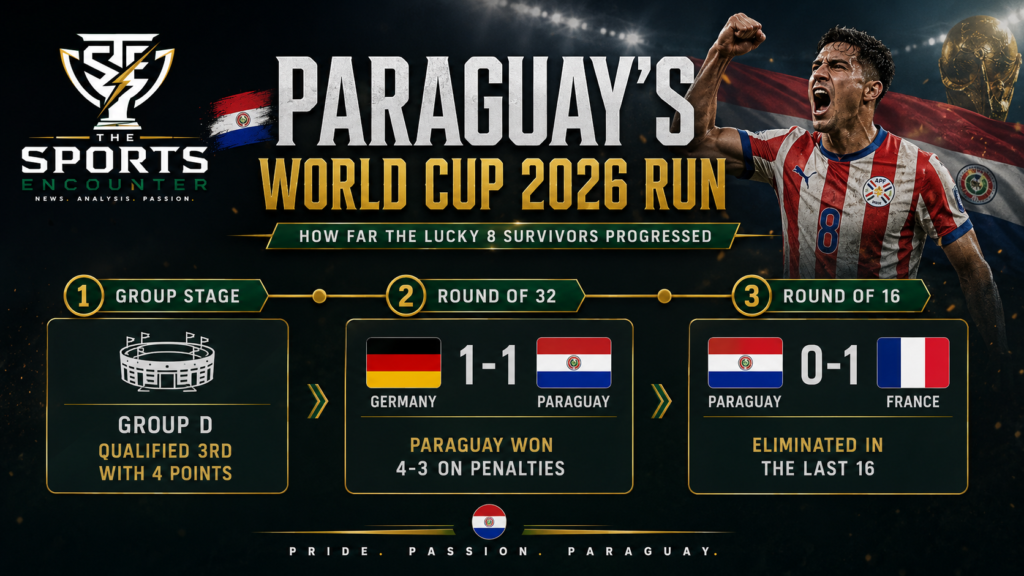
Paraguay’s Lucky 8 Path
| Stage | Opponent | Result | What decided the match |
|---|---|---|---|
| Group stage | Group D | Third place, four points | Defensive survival and enough points to qualify |
| Round of 32 | Germany | 1-1, Paraguay won 4-3 on penalties | Compact defending, goalkeeper performance, emotional control |
| Round of 16 | France | Lost 1-0 | France needed a 70th-minute Kylian Mbappé penalty |
| Final position | Last 16 | Only Lucky 8 team to advance | Clear tactical identity and knockout discipline |
Paraguay Did Not Pretend to Be Germany
Several underdogs damage their own chances by trying to prove that they can match a favorite in every phase of the game.
Paraguay avoided that mistake.
Germany were always likely to dominate possession, push their fullbacks forward, and surround Paraguay’s penalty area. Alfaro’s players did not waste energy trying to win a territorial battle they were unlikely to control.
Instead, they concentrated bodies around the central defensive zone and challenged Germany to find a clean route through them.
At one stage of the first half, Germany held more than 80 percent of possession. That statistic looked dominant, but possession alone did not mean Paraguay’s plan was failing. Germany were often circulating the ball outside the areas from which they could cause the greatest damage, a pattern also reflected in The Guardian’s live coverage of Germany against Paraguay.
Paraguay defended the match they wanted rather than the match Germany wanted to play.
The distinction became important as the minutes passed. Germany saw more of the ball, but Paraguay controlled the type of chances they were willing to concede.
Paraguay Forced Germany Away From the Center
Paraguay’s deepest defensive success came from closing the middle of the field.
Germany wanted Jamal Musiala, Florian Wirtz, and their other technical players to receive between the lines, turn toward goal, and combine through narrow spaces. Paraguay compressed those areas and placed enough bodies around the penalty box to make central progression slow and crowded.
Germany increasingly moved the ball toward the wings and relied on crosses.
A tactical review by Northeastern University’s World Cup analysis found that Germany attempted far more crosses against Paraguay than during an average group-stage match. The shift reflected how effectively Paraguay had denied the central routes Germany normally preferred.
Other tactical analysis also highlighted how little success Germany gained from repeatedly sending the ball into a crowded penalty area. The exact crossing totals vary depending on how each data provider defines a cross, but the tactical message remains clear.
Paraguay forced Germany toward an inefficient attacking method.
That was not passive defending. It was defensive direction.
Paraguay decided where Germany could have the ball and trusted their center backs, midfield screen, and goalkeeper to deal with what came next.
Julio Enciso Gave the Defensive Plan a Reward
A low block can keep an underdog alive, but it still needs an attacking moment.
Julio Enciso supplied Paraguay’s.
The forward’s goal changed the psychological balance of the match. Germany could no longer remain patient and wait for Paraguay’s defensive shape to weaken. They had to pursue an equalizer against a team that was already comfortable protecting space.
Enciso’s contribution also gave Paraguay something several other Lucky 8 teams lacked: an attacking player capable of turning a limited opportunity into a meaningful result.
Paraguay did not create chances in large numbers. They did enough with one of the few moments they produced.
That efficiency mattered because the other Lucky 8 teams often reached promising positions without converting them. Ghana stayed within one goal of Colombia but failed to find an equalizer. Algeria could not punish Switzerland. Ecuador’s attack disappeared against Mexico. Bosnia and Herzegovina left its match against the United States without scoring.
Paraguay’s system created little margin for waste. Enciso ensured that their best opening counted.
The details of Paraguay’s victory can also be followed through FIFA’s official World Cup 2026 tournament coverage.
Orlando Gill Changed Paraguay’s Margin for Error
A team defending deep against Germany will eventually allow opportunities.
Paraguay survived those moments because Orlando Gill gave them security behind the defensive line.
Gill’s importance extended beyond routine saves. He allowed Paraguay’s defenders to remain committed to their positions because they trusted the goalkeeper to handle shots, crosses, and second balls that escaped the first defensive line.
His presence also mattered during the most psychologically demanding phase of the match.
Germany had entered the shootout with one of the strongest penalty reputations in World Cup history. Paraguay were carrying the pressure of potentially losing after defending for two hours.
Gill helped reverse that expectation.
Paraguay won the shootout 4-3. José Canale converted the decisive kick, but Gill’s performance gave the takers the platform to remain calm. The emotional shift during the shootout was captured in The Guardian’s match report on Paraguay’s upset of Germany.
Penalty shootouts are often described as lotteries. Preparation, goalkeeper analysis, taker confidence, and emotional control still influence the outcome.
Paraguay reached the shootout believing it represented an opportunity. Germany reached it carrying the frustration of having failed to remove a third-place qualifier across 120 minutes.
That difference was visible.
Paraguay Remained Comfortable With Discomfort
Knockout football creates emotional pressure long before the final whistle.
Underdogs can lose shape when they begin thinking about the result. Defenders retreat too close to their goalkeeper. Midfielders stop pressing at the right moments. Clearances replace controlled decisions. Players begin wasting energy arguing with officials or reacting to every missed opportunity.

Paraguay continued doing the same basic things.
They defended narrow areas, challenged second balls, delayed German attacks, and waited for transitions. Their performance did not become adventurous after taking the lead or chaotic after conceding.
That emotional stability may have been their greatest advantage over the other Lucky 8 teams.
The Sports Encounter had ranked Paraguay among the teams facing the steepest route before the Round of 32. The original assessment suggested that their most believable path involved suffering, staying compact, frustrating Germany, and waiting for Enciso or Miguel Almirón to produce a decisive moment.
That is almost exactly what happened. Readers can revisit the full assessment in our analysis of which Lucky 8 teams could survive the World Cup 2026 Round of 32.
Paraguay’s players never appeared offended by the match’s demands. They accepted them.
DR Congo Could Not Protect the Match They Had Built
DR Congo came closest to joining Paraguay in the Round of 16.
They took the lead against England and forced one of the tournament favorites into a difficult recovery. Their direct running, physical strength, and willingness to attack gave England more trouble than many expected.
The problem appeared in the closing stages.
As the match moved toward its decisive minutes, DR Congo struggled to protect the spaces that had kept England uncomfortable. Fatigue affected distances between the lines, while England introduced greater urgency and committed more quality players forward.
Two late goals turned DR Congo’s potential historic victory into a 2-1 defeat.
Paraguay faced a similar problem against Germany but handled it differently. They did not begin defending the score emotionally. Their distances remained compact, and their tactical behavior changed very little after Germany equalized.
DR Congo created a stronger attacking threat than Paraguay for stretches of its match. Paraguay managed the full 120 minutes more effectively.
That is why one team earned admiration and elimination while the other earned a place in the last 16.
Senegal Had Fire but Could Not Control It
Senegal scored more group-stage goals than any other Lucky 8 team.
Their eight goals suggested attacking power, confidence, and the ability to hurt Belgium. That promise remained visible in a 3-2 Round of 32 defeat.
Senegal scored twice and forced Belgium into a serious contest. Their forwards attacked space, committed defenders, and showed why their three-point qualification record did not reflect the full danger of the team.
However, the same openness that made Senegal exciting also made them vulnerable.
Belgium found space when Senegal’s attacks broke down. The distance between the African side’s defensive and attacking units grew, creating a match based on repeated transitions.
Paraguay refused to let its meeting with Germany become that kind of contest.
Senegal tried to win through attacking exchanges. Paraguay tried to remove the favorite’s preferred strengths and reduce the match to a few controllable moments.
Belgium possessed enough quality to win an open game. Germany found itself trapped in a closed one.
Ecuador Could Not Reproduce Its Group-Stage Courage
Ecuador appeared to have the strongest upset credentials among the Lucky 8.
They had beaten Germany 2-1 in the group stage, conceded only twice, and carried a compact defensive profile into their match against Mexico.
Their group-stage victory over Germany had become one of the key moments of World Cup Day 15 and secured their place among the Lucky 8.
Mexico changed the conditions.
Playing in front of a home crowd, the co-hosts started with intensity and scored twice before halftime. Ecuador were then forced to attack a settled defense while managing the emotional pressure of a hostile stadium.
Their structure was far less useful once they had to chase.
Paraguay never fell into that position against Germany. Enciso’s goal gave them control of the match state. Even after the equalizer, the score remained level, allowing Paraguay to preserve their shape and continue toward extra time.
Ecuador entered the Round of 32 with a better statistical profile. Paraguay managed the knockout situation more intelligently.
Sweden’s Group-Stage Warning Signs Followed Them
Sweden’s seven goals in the group stage suggested attacking ambition. Their seven goals conceded revealed the danger beneath it.
France exploited those weaknesses immediately.
Kylian Mbappé’s movement stretched the Swedish back line, while France’s speed punished turnovers and spaces behind the midfield. The 3-0 result became the heaviest Round of 32 defeat suffered by a Lucky 8 team.
Sweden attempted to compete with France across larger areas of the field. Paraguay reduced the useful area available to Germany.
That tactical contrast explains much of the difference.
Once France scored, Sweden had to push higher and expose even more space. Paraguay’s match remained within a one-goal margin and never required them to abandon their defensive identity.
Sweden possessed more attacking variety than Paraguay. They lacked Paraguay’s ability to deny an elite opponent room to use its most dangerous qualities.
Ghana’s Early Concession Gave Colombia Control
Ghana lost 1-0 to Colombia after Jhon Arias scored in the 14th minute.
That early goal placed Colombia in a comfortable position. They could protect central areas, slow the match, and wait for Ghana to take greater risks.
The Black Stars remained competitive but struggled to create the final pass or finish needed to recover.
Paraguay reversed that relationship against Germany.
Germany held the ball, but Paraguay shaped the conditions. Ghana spent most of its match reacting to Colombia’s early advantage.
The difference was not effort. Ghana worked, competed, and stayed within one goal.
Paraguay made its key moment arrive before Germany’s.
Bosnia and Herzegovina Could Not Slow the United States
Bosnia and Herzegovina needed to quiet the home crowd and prevent the United States from establishing a fast rhythm.
They could not.
The Americans won 2-0 through greater energy, depth, and control of the important phases. Bosnia had shown attacking promise in the group stage but failed to reproduce it when the tournament became a direct elimination contest.
The United States later lost 4-1 to Belgium in the Round of 16, showing that its own knockout level had limits. Bosnia simply never made the first match uncomfortable enough to expose them.
Paraguay created discomfort from the opening stages against Germany.
Bosnia needed to disrupt the hosts. Paraguay built its entire plan around disruption.
Algeria’s Defensive Instability Finally Cost Them
Algeria entered the Round of 32 having scored five goals and conceded seven.
That record suggested a team capable of attacking but unable to manage matches consistently. Switzerland punished those weaknesses in a disciplined 2-0 victory.
Algeria’s creative players, including Riyad Mahrez, struggled to operate against a compact Swiss structure. At the other end, defensive mistakes gave Switzerland the control it needed.
The Swiss later eliminated Colombia on penalties and reached the quarterfinals, confirming that Algeria had faced a tactically mature opponent.
Still, Paraguay’s path was hardly easier. Germany were a group winner and a four-time champion. France awaited in the next round.
Paraguay’s advantage came from having a clearer understanding of its limitations.
Algeria wanted to attack, create, and express its technical quality. Paraguay prioritized the actions that would keep the match alive.
Paraguay Prepared for the Match That Actually Happened
The other Lucky 8 teams entered the knockout phase with certain strengths.
Senegal had goals. Ecuador had a major group-stage victory. DR Congo had athletic power. Sweden offered attacking ambition. Ghana could compete physically. Algeria had experienced creators. Bosnia had enough attacking talent to threaten the hosts.
Paraguay had a plan that remained useful at 0-0, 1-0, 1-1, after 90 minutes, through extra time, and during penalties.
That continuity became its greatest strength.
Their defensive block did not rely on scoring first, even though Enciso’s goal helped. Their emotional control did not disappear after Germany equalized. Gill’s performance remained valuable at every stage. The team’s penalty preparation mattered once open play could no longer separate the sides.
The other Lucky 8 teams carried qualities into their matches. Paraguay carried a complete knockout strategy.
France Confirmed That Paraguay’s Germany Result Was No Accident
France ended Paraguay’s run with a 1-0 Round of 16 victory.
The score still strengthened Paraguay’s case.
After scoring three times against Sweden, France were forced into a slower, more physical, and much less comfortable match. Paraguay again closed central areas, protected the penalty box, and limited the freedom available to Mbappé.
France needed a 70th-minute Mbappé penalty to break the resistance.
The Sports Encounter’s Paraguay versus France match report documented how the last Lucky 8 survivor frustrated one of the tournament favorites for long periods.
Paraguay did not reach the quarterfinals, but it remained competitive against Germany and France across 210 minutes of knockout football.
That record matters more than possession percentages or pre-match expectations.
What the Other Lucky 8 Teams Can Learn
Paraguay’s run offers a practical lesson for underdogs in expanded tournaments.
A second chance only has value when a team understands how to use it.
Third-place qualifiers are often drawn against group winners with deeper squads and greater attacking quality. Trying to match those opponents across every area can create the type of open match the favorite wants.
Paraguay narrowed the contest.
They protected the center, forced Germany wide, trusted their goalkeeper, converted a limited chance, accepted long periods without the ball, and prepared for penalties. Most importantly, they remained committed to the same plan when the match became physically and emotionally exhausting.
The other Lucky 8 teams did not all play badly. DR Congo nearly eliminated England. Senegal scored twice against Belgium. Ghana remained within one goal of Colombia. Ecuador arrived with genuine confidence.
Each lacked one part of the knockout equation.
Some could not score. Others could not defend. A few lost control when the match state turned against them. Paraguay combined enough defending, goalkeeping, attacking efficiency, tactical patience, and emotional discipline to survive.
That is why the team originally viewed as one of the Lucky 8’s longest shots became its only last-16 representative.
Readers can follow the complete third-place qualification story through our World Cup 2026 Lucky 8 qualification tracker, revisit the Round of 16 picture after Paraguay eliminated Germany, or explore the latest reports in The Sports Encounter’s FIFA World Cup 2026 coverage.
Official fixtures, results, and tournament information are available through the FIFA World Cup 2026 tournament portal.
FAQs
Why was Paraguay the only Lucky 8 team to reach the Round of 16?
Paraguay combined a compact defensive structure, strong goalkeeping, emotional control, attacking efficiency, and successful penalty preparation. They forced Germany away from central attacking areas and remained disciplined for 120 minutes.
Who did Paraguay beat in the Round of 32?
Paraguay eliminated Germany after a 1-1 draw. They won the penalty shootout 4-3.
Who eliminated Paraguay from the World Cup?
France beat Paraguay 1-0 in the Round of 16. Kylian Mbappé scored the decisive penalty in the 70th minute.
Which other teams were part of the Lucky 8?
The other seven teams were DR Congo, Ecuador, Sweden, Ghana, Bosnia and Herzegovina, Algeria, and Senegal.
Why did the other Lucky 8 teams fail?
Their problems varied. DR Congo could not protect its position late, Senegal lacked defensive balance, Ecuador and Ghana struggled after conceding, Sweden and Algeria carried defensive weaknesses into the knockouts, and Bosnia failed to disrupt the United States.
Did Paraguay deserve to eliminate Germany?
Yes. Germany dominated possession, but Paraguay controlled central space, forced Germany toward inefficient crossing positions, scored through Julio Enciso, defended consistently, and performed better during the penalty shootout.

Breaking News
Workload Management: Were Old Fast Bowlers Better at Test Cricket, or Do We Remember Them Differently?
Walsh and Ambrose have reopened cricket’s workload debate, raising a bigger question about skill, endurance, T20 money, and the changing value of Test fast bowling.
Fast bowlers once measured readiness through overs bowled. Modern cricket measures almost every delivery they send down, then decides when they have entered a physical “red zone.”
That change has turned “workload management” into one of cricket’s most disputed terms. It began as a sports-science tool to reduce injuries. Today, many supporters see it as an explanation used whenever a leading quick misses Test cricket but remains available for a lucrative franchise league.
Courtney Walsh and Curtly Ambrose recently challenged the modern approach during their appearance on the Stick to Cricket podcast with Michael Vaughan, Sir Alastair Cook, Phil Tufnell, and David Lloyd. Their comments also raised a deeper question: Were previous generations more skillful and durable in Test cricket, or has nostalgia made their achievements look untouchable?
TL;DR
- Courtney Walsh believes regular bowling maintains match fitness and rhythm.
- Curtly Ambrose said watching from the sidelines when fit would have “destroyed” him.
- Earlier greats developed through sustained red-ball bowling and learned how to build dismissals across long spells.
- T20 leagues offer shorter spells, larger financial rewards, schedule flexibility, and faster global fame.
- Modern bowlers face heavier travel, crowded calendars, aggressive batting, video analysis, and multiple-format demands.
- James Anderson, Stuart Broad, Mitchell Starc, Tim Southee, Kemar Roach, Kagiso Rabada, and Matt Henry challenge the idea that modern bowlers lack Test skill.
- The real generational difference may involve preparation and priorities rather than talent.
Old and Modern Fast Bowlers: Test Career Comparison
Earlier Generation
| Fast Bowler | Country | Tests | Test Wickets | ODIs | Defining Test Qualities |
|---|---|---|---|---|---|
| Courtney Walsh | West Indies | 132 | 519 | 205 | Durability, bounce, control, and long-spell discipline |
| Curtly Ambrose | West Indies | 98 | 405 | 176 | Steep bounce, accuracy, intimidation, and tactical patience |
| Wasim Akram | Pakistan | 104 | 414 | 356 | Conventional swing, reverse swing, seam movement, and variation |
| Waqar Younis | Pakistan | 87 | 373 | 262 | Late reverse swing, pace, yorkers, and relentless stump attacks |
| Glenn McGrath | Australia | 124 | 563 | 250 | Accuracy, seam movement, patience, and batter-specific planning |
Modern Generation
| Fast bowler | Country | Tests | Test wickets | Test status | Defining Test qualities |
|---|---|---|---|---|---|
| James Anderson | England | 188 | 704 | Retired | Swing, seam control, adaptation, and technical efficiency |
| Stuart Broad | England | 167 | 604 | Retired | Seam movement, bounce, competitive instinct, and match-changing spells |
| Tim Southee | New Zealand | 107 | 391 | Retired | Outswing, control, tactical intelligence, and new-ball skill |
| Mitchell Starc | Australia | 105 | 433 | Active | Pace, late swing, yorkers, and old-ball threat |
| Kemar Roach | West Indies | 89 | 300 | Active | Seam movement, accuracy, adaptability, and intelligent use of the crease |
| Trent Boult | New Zealand | 78 | 317 | Limited Test involvement | Left-arm swing, control, angle, and early breakthroughs |
| Kagiso Rabada | South Africa | 73 | 340 | Active | Pace, bounce, aggression, and elite strike rate |
| Matt Henry | New Zealand | 35 | 152 | Active | Seam movement, accuracy, persistent lengths, and new-ball control |
Statistics are updated through July 15, 2026.
Walsh and Ambrose Reject Stop-Start Fast Bowling
Walsh played 132 Tests and 205 ODIs, taking 519 wickets in the longer format. According to the discussion around the podcast, he missed only one Test through injury.
“If you’re going to rest me and bring me back, I’m going to start all over again,” Walsh said. “Once you’re match fit, it’s maintenance.”
His argument centers on rhythm. Fast bowlers condition their bodies by bowling, recover between matches, and learn how to operate when physically tired. Repeatedly removing a healthy bowler can interrupt the very resilience a management team wants to build.
Ambrose offered the player’s emotional perspective.
“I want to win,” he said. “To sit and watch cricket and not be a part of it, that destroys me.”
Walsh also recalled Glenn McGrath saying that interruptions to his playing rhythm were “killing him” toward the end of his career. For that generation, availability formed part of a fast bowler’s reputation.
Were Previous Generations More Skillful?
The old masters developed techniques perfectly suited to Test cricket.
Wasim could swing the ball in either direction and became one of reverse swing’s greatest exponents. Waqar attacked toes and stumps at pace. McGrath dismissed elite batters through control and careful planning. Ambrose generated steep bounce without sacrificing accuracy, while Walsh adjusted his pace and methods as his body changed.
Those bowlers understood how to create a dismissal over several overs. They watched a batter’s footwork, altered their position on the crease, changed the angle, and waited for pressure to produce an error.
Their education came through red-ball cricket. Domestic competitions, county seasons, Tests, and extended spells gave them thousands of deliveries in which to understand fatigue, rhythm, pitch deterioration, and the ageing ball.
The Sports Encounter’s features on Kapil Dev’s influence on Indian fast bowling and Sir Ian Botham’s demanding all-round career offer further examples of players whose skills were shaped by the longer game.
Nostalgia Cannot Explain Everything
Memory favors greatness. Supporters remember Ambrose taking 7 for 1, Wasim producing unplayable swing, Waqar crushing stumps, and McGrath controlling entire sessions. Less effective spells gradually disappear from the conversation.
Modern bowlers face challenges earlier generations never experienced at the same scale. Video analysts study every release point and bowling pattern. Batters attack from the opening session, while improved bats and shorter boundaries punish small errors. Constant travel between international series and franchise competitions also reduces proper preparation time.
T20 bowling involves genuine technical skill. Wide yorkers, slower-ball variations, hard lengths, and rapid tactical adjustments have become essential weapons. However, four high-intensity overs cannot fully prepare someone for a third spell late on the fourth afternoon of a Test.
That gap may explain why older bowlers often looked more complete in the longer format. Their cricketing education gave Test bowling the most time.
Modern Cricket Still Produces Great Test Bowlers
James Anderson and Stuart Broad provide the clearest response to claims that modern bowlers lack durability or red-ball intelligence.
Anderson played 188 Tests and took 704 wickets. Broad collected 604 wickets across 167 matches. Together, they repeatedly adapted their lengths, pace, and tactics while carrying England’s attack through different captains, coaches, and playing styles.
Tim Southee finished with 391 Test wickets, while Kemar Roach recently became only the fifth West Indian to reach 300. The Sports Encounter covered Roach’s milestone during West Indies’ victory over Sri Lanka.
Matt Henry’s Test career developed slowly, yet his recent 11-wicket performance against England showed the value of persistent seam bowling. His rise is examined in our report on New Zealand’s commanding Oval victory.
Rabada’s strike power and Starc’s longevity offer further evidence that today’s game still produces complete Test quicks.
Starc Uses Workload Management to Protect Test Cricket
Mitchell Starc offers the most important counterargument to the idea that workload management always pushes players toward T20 leagues.
When he retired from T20 internationals in 2025, Starc said Test cricket had “always been my highest priority.” He stepped away from the shortest international format to stay fresh for Test assignments and the 2027 ODI World Cup, according to the International Cricket Council.
Starc managed his workload by removing T20Is from his schedule. Test cricket benefited from that decision.
His approach proves that the purpose behind workload management matters as much as the number of overs saved.
T20 Money Has Changed the Career Equation
Franchise cricket offers fast bowlers an attractive bargain: four overs per match, compact tournaments, substantial contracts, and immediate global exposure.
Test cricket can demand 20 overs in a day, another spell the following morning, and five days of physical and mental strain. Flat pitches may offer little assistance, yet the bowler must return and keep working.
The financial gap makes shorter cricket difficult to resist. Tournaments covered through The Sports Encounter’s Lanka Premier League hub provide players with clear roles and defined schedules. Test series offer far less physical certainty.
Trent Boult’s decision to leave New Zealand’s central contract gave him greater control over his availability and access to franchise opportunities. His choice reflected cricket’s changing economy, where players can achieve money and fame without chasing 100 Tests.
Workload Management Needs Credibility
Medical research has found links between sudden increases in bowling volume and injury risk. Cricket would be irresponsible to ignore that evidence.
Supporters lose trust when the policy appears selective. If a bowler is physically unavailable for Test cricket, the same medical caution should follow him into his next franchise tournament.
Earlier fast bowlers may not have possessed more natural ability. They received a deeper education in Test bowling because the longer format stood at the center of their careers.
Modern quicks remain capable of equal greatness. Anderson, Broad, Starc, Southee, Roach, Rabada, and Henry have proved that. The larger question concerns what cricket asks young bowlers to master first: the patient craft of taking 20 wickets or the profitable art of surviving four overs.
Workload management should help fast bowlers build sustainable Test careers. When it mainly clears a path toward the next T20 contract, the term begins to sound like an excuse.
For more international reports, records, and analysis, visit The Sports Encounter’s Cricket hub.
Breaking News
Messi Engineers Argentina’s Late Escape as England Falter in Atlanta
Lionel Messi created two late goals as Argentina punished England’s retreat, completed a dramatic 2-1 comeback in Atlanta, and reached the World Cup final against Spain.
England stood five minutes from their first World Cup final since 1966. Nine minutes later, Lionel Messi and Argentina had taken it away.
Enzo Fernández’s spectacular equalizer and Lautaro Martínez’s stoppage-time header overturned Anthony Gordon’s 55th-minute opener as Argentina beat England 2-1 in a fiercely contested FIFA World Cup 2026 semifinal at Atlanta Stadium.
Messi created both Argentine goals. His short-corner combination opened the space for Fernández in the 85th minute before his curling cross found Lautaro in the 92nd.
England had defended bravely, with Jordan Pickford producing several important saves. Yet their decision to protect a one-goal lead for more than half an hour invited a level of pressure they could not sustain.
TL;DR
- Argentina beat England 2-1 in the second FIFA World Cup 2026 semifinal.
- Anthony Gordon gave England the lead in the 55th minute.
- Enzo Fernández equalized with a superb long-range strike in the 85th minute.
- Lionel Messi assisted both Argentine goals, including Lautaro Martínez’s 90+2-minute winner.
- England collected one yellow card, while Argentina received three. No player was sent off.
- Argentina will face Spain in the World Cup final on July 19.
Argentina vs England Semifinal Scorecard
| Detail | Information |
|---|---|
| Match | England vs Argentina |
| Competition | FIFA World Cup 2026 semifinal |
| Final score | England 1-2 Argentina |
| Goalscorers | Anthony Gordon 55’; Enzo Fernández 85’; Lautaro Martínez 90+2’ |
| Venue | Atlanta Stadium, Atlanta, Georgia |
| Date | July 15, 2026 |
| Top performer | Lionel Messi, two assists |
| Turning point | England withdrew after Gordon’s opener and allowed Argentina to control the final half-hour |
| Yellow cards | England: Elliot Anderson; Argentina: Lisandro Martínez, Cristian Romero, Rodrigo De Paul |
| Red cards | None |
| What it means | Argentina advance to face Spain in the July 19 final |
Physical Confrontations Overshadow the First Half
The opening ten minutes contained more confrontation than soccer.
Hard challenges, body contact, arguments, and players surrounding referee Ismail Elfath repeatedly interrupted the flow. Enzo Fernández’s early collision with Elliot Anderson triggered the first major scuffle, setting the tone for a half shaped by fouls and simmering hostility.
Argentina committed 12 of the 19 first-half fouls. Anderson entered the referee’s book after catching Messi, while Lisandro Martínez received Argentina’s first caution. Cristian Romero was also booked later in the match.
Neither side produced a shot on target before halftime. England tried to attack through Gordon and Morgan Rogers, but Argentina crowded the midfield and prevented Jude Bellingham from finding space between the lines.
Messi remained unusually quiet during that period. England’s compact positioning limited his access to the penalty area, while Anderson and Declan Rice worked hard to close the central passing routes.
The teams entered halftime level at 0-0, with the contest balanced but rarely controlled.
Gordon Gives England the Breakthrough
England returned with greater purpose and created the first decisive attacking move of the semifinal.
Rice helped advance the ball before Rogers delivered the final pass into Gordon’s path. The Newcastle forward finished calmly in the 55th minute, giving England a 1-0 lead and placing the country within touching distance of its first men’s World Cup final in 60 years.
The goal should have encouraged England to keep attacking. Instead, it changed their mindset.
Thomas Tuchel’s side began dropping deeper, surrendering territory and asking Pickford and the defense to survive wave after wave of Argentine pressure. Gordon left the field for Ezri Konsa in the 72nd minute as England shifted toward a five-man defensive line.
The change removed one of England’s most effective counterattacking outlets. Argentina could now send more players forward without worrying as much about space behind their defense.
England had already required late interventions from Bellingham to survive Norway in the quarterfinal. Against the defending champions, protecting a narrow advantage carried far greater risk.
Pickford and the Woodwork Delay Argentina
Pickford did everything possible to protect England’s lead.
He denied Julián Álvarez shortly after halftime and produced his best save in the 69th minute, reacting sharply to keep out Nicolás González’s downward header. His positioning and reflexes kept England ahead while Argentina increased the pressure.
The woodwork also came to England’s rescue. Alexis Mac Allister met Rodrigo De Paul’s cross with a stooping header in the 76th minute, only to see the ball strike the post.
Another Mac Allister effort hit the woodwork shortly before Argentina’s winning goal.
Those escapes gave England warnings, but they did not produce a meaningful tactical response. The team remained close to its own penalty area and struggled to retain possession whenever it cleared the ball.
The pattern carried an uncomfortable echo of England’s 2018 semifinal defeat by Croatia. England led that match before losing control, conceding an equalizer, and falling in extra time. In Atlanta, the collapse arrived even faster.
Messi Finds the Openings That England Left Behind
Messi had spent much of the match operating outside its central drama. When England’s concentration began to fade, he took control.
Argentina worked a short corner in the 85th minute. Messi received the return ball and found Fernández in space approximately 25 yards from goal. The midfielder struck a dipping shot beyond Pickford and into the far corner.
The equalizer reflected Argentina’s sustained control, but the defending champions were not interested in waiting for extra time.
Five minutes of normal time had passed when Messi moved beyond Nico O’Reilly on the right. His curling cross reached Lautaro between John Stones and Reece James, and the substitute powered his header home from close range in the 92nd minute.
Argentina had turned the semifinal around in seven minutes.
Rodrigo De Paul received a yellow card during the delayed restart following the winning goal. That caution completed the official disciplinary list at four yellow cards and no dismissals, according to the live match feed. The official FIFA World Cup match center provides the governing body’s tournament results and disciplinary records.
England’s Retreat Brings Another Semifinal Defeat
England’s approach after taking the lead will face intense scrutiny.
The defensive substitutions made tactical sense in isolation, but the collective retreat handed Argentina possession, territory, and repeated opportunities. England stopped playing through midfield and relied on clearances that returned the ball almost immediately.
Harry Kane became isolated. Bellingham could no longer influence attacks, while Gordon’s departure reduced England’s ability to threaten on the break.
Pickford’s saves postponed the problem. They could not solve it.
England had shown resilience throughout the knockout rounds, including their dramatic victories over Mexico in the round of 16 and Norway in the quarterfinal. This time, complacency after taking the lead allowed Argentina to dictate the match’s decisive phase.
Argentina and Spain Set Up the World Cup Final
Argentina now head to New York New Jersey Stadium on July 19 for a final against Spain.
Spain earned their place by beating France 2-0 in the first semifinal, combining defensive discipline with greater control in possession.
Argentina arrive with a different strength. They have repeatedly survived difficult situations, including their extra-time quarterfinal victory over Switzerland.
At 39, Messi remains the player who recognizes the decisive opening before anyone else. England contained him for long periods, but he only needed two moments to reshape the semifinal.
Readers can follow the buildup, confirmed lineups, final result, and tournament analysis through The Sports Encounter’s FIFA World Cup 2026 coverage and wider soccer news and analysis. The tournament’s leading individual performers are also assessed in our ranking of the top 10 players at the FIFA World Cup 2026.
England had the lead and a route to the final. Argentina had Messi, patience, and the courage to keep attacking. In Atlanta, those qualities made the difference.
The Sports Encounter’s World Cup 2026 coverage focuses on fixtures, team news, match analysis, fan stories, tournament trends, and the biggest talking points from football’s global stage.
Cricket
Zimbabwe Rule Bangladesh Again, Win 1st T20I by 32 Runs
Zimbabwe beat Bangladesh by 32 runs in the 1st T20I at Bulawayo as Richard Ngarava and Blessing Muzarabani took four wickets each. After winning the Test and ODI series earlier, Zimbabwe moved 1-0 ahead in the T20Is with another disciplined all-round performance.
After winning the one-off Test and sealing the ODI series, Zimbabwe carried the same authority into the shortest format with a 32-run victory in the first T20I at Queens Sports Club, Bulawayo.
A total of 170 for 6 looked competitive at the halfway mark. By the time Bangladesh were bowled out for 138 in 19 overs, it looked more than enough.
This was not a wild T20 win built on one freakish innings or a single collapse. It was another complete Zimbabwe performance against a Bangladesh side that keeps finding new ways to fall behind in the same contest. Zimbabwe batted with enough clarity, defended with intensity, and then allowed Richard Ngarava and Blessing Muzarabani to turn pressure into wickets.
For readers following the full arc of this tour, this result felt like a natural continuation of what started when Zimbabwe stunned Bangladesh after turning 141 into a winning total. It grew stronger when Bangladesh lost control again in the second ODI, where Ben Curran and Zimbabwe sealed the series in Harare. Bangladesh did save themselves from an ODI whitewash through Tanzid Hasan’s 94, but that consolation win now looks like a pause rather than a turnaround.
Zimbabwe have moved the story back to familiar territory.
They are winning the key moments. Bangladesh are explaining why they missed them.
TL;DR
- Zimbabwe beat Bangladesh by 32 runs in the 1st T20I at Queens Sports Club, Bulawayo.
- Zimbabwe scored 170 for 6 after Brian Bennett made 44, Ryan Burl added an unbeaten 30, and Brad Evans finished with 19 not out from 10 balls.
- Bangladesh were bowled out for 138 in 19 overs despite Yasir Ali’s 54 from 38 balls.
- Richard Ngarava took 4 for 26 and was named Player of the Match.
- Blessing Muzarabani also took 4 wickets, finishing with 4 for 17 from four overs.
- Nahid Rana was Bangladesh’s standout bowler with 4 for 26, but the batting unit failed to build the partnerships needed in a chase of 171.
- Zimbabwe lead the three-match T20I series 1-0 after already winning the Test and ODI series earlier in the tour.
Scorecard and Key Information
| Detail | Information |
|---|---|
| Match | Zimbabwe vs Bangladesh, 1st T20I |
| Result | Zimbabwe won by 32 runs |
| Venue | Queens Sports Club, Bulawayo |
| Date | July 15, 2026 |
| Toss | Bangladesh won and fielded first |
| Zimbabwe | 170/6 in 20 overs |
| Bangladesh | 138 all out in 19 overs |
| Player of the Match | Richard Ngarava, 4/26 |
| Best Bowling | Blessing Muzarabani, 4/17 |
| Top Score | Yasir Ali, 54 from 38 balls |
| Series Status | Zimbabwe lead 1-0 in the three-match T20I series |
| Turning Point | Bangladesh falling to 34 for 3 inside five overs during the chase |
Zimbabwe Turn 170 Into a Statement
Bangladesh’s decision to bowl first was understandable. They had Nahid Rana in rhythm, Taskin Ahmed to control the new ball, and a surface that Towhid Hridoy later described as a good wicket to bat on.
The early overs did not run away from Bangladesh completely, but Zimbabwe’s intent was clear. Tadiwanashe Marumani made 14 from 9 balls before falling to Nahid Rana, while Brian Bennett gave Zimbabwe the base they needed with 44 from 30. Bennett’s innings mattered because it stopped Zimbabwe from becoming trapped between caution and aggression.
He hit six fours and a six, reached scoring areas quickly, and gave the innings enough pace to survive later slowdowns.
Dion Myers made 20 from 20. Sikandar Raza added 20 from 13. Neither innings became decisive on its own, yet both kept Zimbabwe moving toward a total that could stretch Bangladesh under pressure.
The final push came from Ryan Burl and Brad Evans. Burl’s unbeaten 30 from 25 balls gave Zimbabwe stability after the middle-order wickets. Evans then supplied the late acceleration with 19 not out from 10 deliveries, including four boundaries.
That finish pushed Zimbabwe to 170 for 6.
Raza later said the pitch felt like a 150 or 155 par surface. If that reading was accurate, Zimbabwe did more than reach a defendable score. They forced Bangladesh into a chase that demanded structure, calm, and at least one major top-order partnership.
Bangladesh did not find it.
Nahid Rana Gave Bangladesh a Chance
Bangladesh’s best player in the first innings was Nahid Rana.
His 4 for 26 from four overs prevented Zimbabwe from moving out of reach. He removed Marumani, Bennett, Milton Shumba, and Tashinga Musekiwa, and his 15 dot balls helped Bangladesh pull the innings back at different stages.
Taskin Ahmed also bowled with control, finishing wicketless but conceding only 22 from his four overs.
Those two spells should have given Bangladesh a stronger platform. Instead, the support bowling leaked enough runs to undo some of that discipline. Nasum Ahmed went for 32 from three overs, Mahedi Hasan conceded 41 from four, and Mohammad Saifuddin’s two wickets came at a cost of 35 from four.
Zimbabwe did not dominate every phase of the innings. That is important. Bangladesh had enough moments to believe they could restrict the hosts.
The difference was that Zimbabwe kept extracting value from smaller contributions. Bangladesh, once again, needed a near-perfect correction after letting a winnable situation drift.
Ngarava and Muzarabani Break the Chase Open
Bangladesh needed a steady start.
They got the opposite.
Saif Hassan fell for 12 in the fourth over. Tanzid Hasan followed three balls later after making 16 from 8. Parvez Hossain Emon then fell to Muzarabani for 5, leaving Bangladesh 34 for 3 inside five overs.
That powerplay shaped the chase.
Bangladesh were not chasing 210. They were chasing 171, but the early wickets turned a manageable target into a control problem. Every boundary felt necessary. Every dot ball carried extra weight. Every new batter walked in with the equation already tightening.
Ngarava understood the surface better than anyone. His left-arm angle, hard length, and adjustment to the slower Bulawayo deck made him difficult to line up. He finished with 4 for 26, removing Saif, Tanzid, Yasir Ali, and Mohammad Saifuddin.
Muzarabani was even more economical. His 4 for 17 included a maiden, 16 dot balls, and the final wicket of Nahid Rana with a yorker that knocked back off stump. It was a fitting finish for a bowling performance built on accuracy rather than noise.
Zimbabwe’s fast bowling has become the clearest difference between these sides.
Ngarava and Muzarabani are no longer just producing good spells. They are defining matches.
Yasir Ali Fights Alone, but Bangladesh Needed More
Yasir Ali gave Bangladesh their only real batting resistance.
His 54 from 38 balls included two fours and three sixes. He reached his half-century from 33 balls and added 50 for the sixth wicket with Mahedi Hasan, who made 19 from 18.
For a short period, Bangladesh had a route back into the game.
The problem was timing. By the time Yasir and Mahedi settled, Bangladesh had already lost too much of the top order. Towhid Hridoy made 14. Nurul Hasan was run out for 3. Saifuddin, Nasum Ahmed, Taskin Ahmed, and Nahid Rana could not turn the lower order into a meaningful finish.
Bangladesh collapsed from 130 for 5 to 138 all out.
That eight-run slide killed any faint hope of a late twist.
Hridoy admitted after the match that Bangladesh needed one or two big partnerships at the top when chasing 170 or 180. His point was simple, but it captured the biggest failure of the innings. Bangladesh did not lose because the target was impossible. They lost because they never built the chase.
Zimbabwe’s Fielding and Bowling Reflect a Team With Direction
Raza’s post-match comments were revealing.
He rated Zimbabwe’s fielding eight out of ten. He praised the bowling as spot on. He also made it clear that the World Cup had forced the team to identify areas where they needed to improve.
That context matters because Zimbabwe are playing like a side using this Bangladesh tour as more than a bilateral assignment.
The hosts are building habits. They are defending totals with belief. Their fast bowlers are setting standards. Their batters are creating enough depth across the innings. Fielding errors still exist, but the energy has changed from survival to expectation.
Zimbabwe’s recent leadership structure also fits this mood. Richard Ngarava has been placed in charge of the Test and ODI sides, while Raza continues to lead in T20Is. That gives Zimbabwe two strong senior voices across formats and keeps responsibility close to the players shaping the team’s current rise.
For broader cricket coverage and match analysis, visit The Sports Encounter’s Cricket Hub.
Bangladesh’s Tour Is Turning Into a Pattern
Bangladesh can point to Nahid Rana. They can point to Taskin’s economy. They can point to Yasir Ali’s half-century.

Those are valid positives, but they do not change the larger pattern.
Across this tour, Bangladesh have repeatedly failed to convert opportunity into control. They had Zimbabwe under pressure in the first ODI and lost. They had phases of strength in the second ODI and still allowed Zimbabwe to close the series. They did win the final ODI, yet that came when Zimbabwe rested key fast bowlers and dropped six catches.
The T20I opener gave Bangladesh another chance to reset the tour.
Instead, the same problems returned: early batting damage, thin partnerships, pressure errors, and an inability to match Zimbabwe’s intensity for long enough.
This is now more than a bad match. It is a tour-long warning.
Bangladesh need runs from the top order, a clearer chase tempo, and more control after the first 10 overs of an opposition innings. Their bowlers cannot keep being asked to create perfect conditions for a batting unit that keeps collapsing under manageable pressure.
For recent examples of how quickly T20 weakness can become a larger concern, readers can revisit our analysis of India’s T20I problems after England’s ruthless win.
Why This Win Matters Beyond 1-0
A 1-0 lead in a three-match T20I series is useful.
For Zimbabwe, this one feels bigger because of what came before it.
They have already won the Test. They have already won the ODI series. Now they have opened the T20Is by bowling Bangladesh out on a surface their opponents believed was good enough for batting.
That changes the psychological balance.
Bangladesh are no longer trying to win one format. They are trying to stop a tour from becoming a full-scale Zimbabwe statement. The hosts, meanwhile, will feel they can wrap up the series in the next match and turn this run into one of their most satisfying multi-format performances in recent years.
Zimbabwe also have the more settled identity in this series.
They know their pace attack can carry them. They trust Bennett, Raza, Burl, and Evans to build enough batting weight. They have a captain who understands T20 rhythm. Their fielding is alive enough to support the bowlers.
Bangladesh are still searching for the right shape.
Final Verdict
Zimbabwe’s 32-run win over Bangladesh was another reminder that this tour has changed the way these two sides look beside each other.
Bangladesh arrived with more established white-ball reputation. Zimbabwe have played with greater clarity, discipline, and hunger.
Brian Bennett gave the innings shape. Ryan Burl and Brad Evans gave it a finish. Richard Ngarava and Blessing Muzarabani then gave Bangladesh no room to breathe.
Yasir Ali’s half-century stopped the chase from becoming a complete batting embarrassment, but it could not hide the larger truth. Bangladesh did not bat like a side chasing 171 on a good surface. They batted like a side still carrying the pressure of every missed chance from the tour.
Zimbabwe are one win away from adding the T20I series to their Test and ODI success.
That is no longer a surprise.
It is the story of this tour.
Follow more updates, match reports, and cricket analysis through The Sports Encounter’s Cricket coverage. For official international cricket fixtures, rankings, and tournament updates, visit the International Cricket Council.