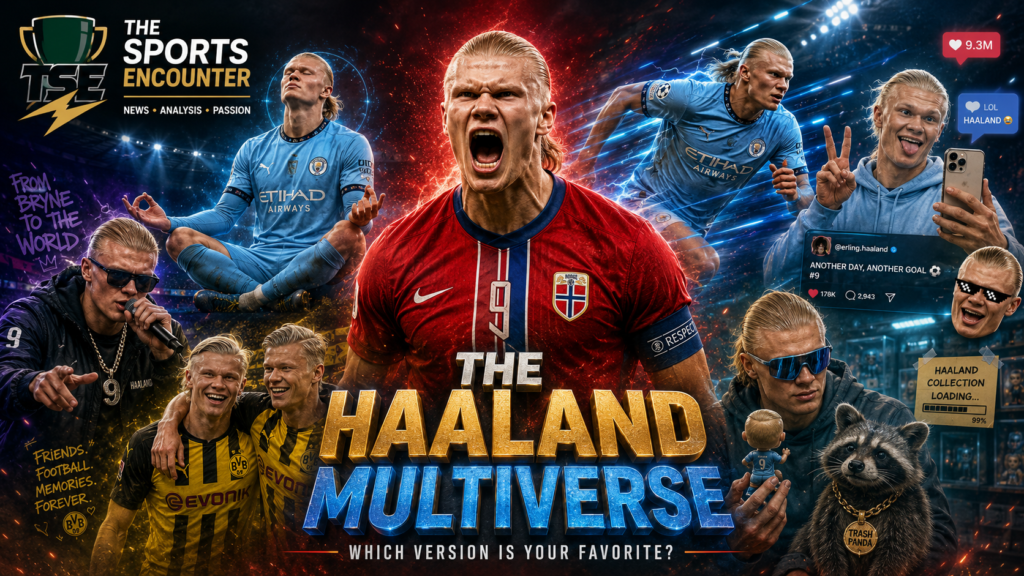
Haaland Multiverse: Which Version of Erling Haaland Is Your Favorite?
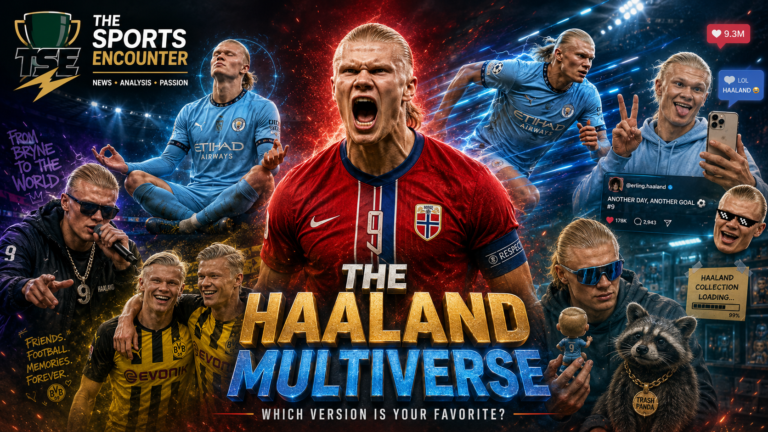
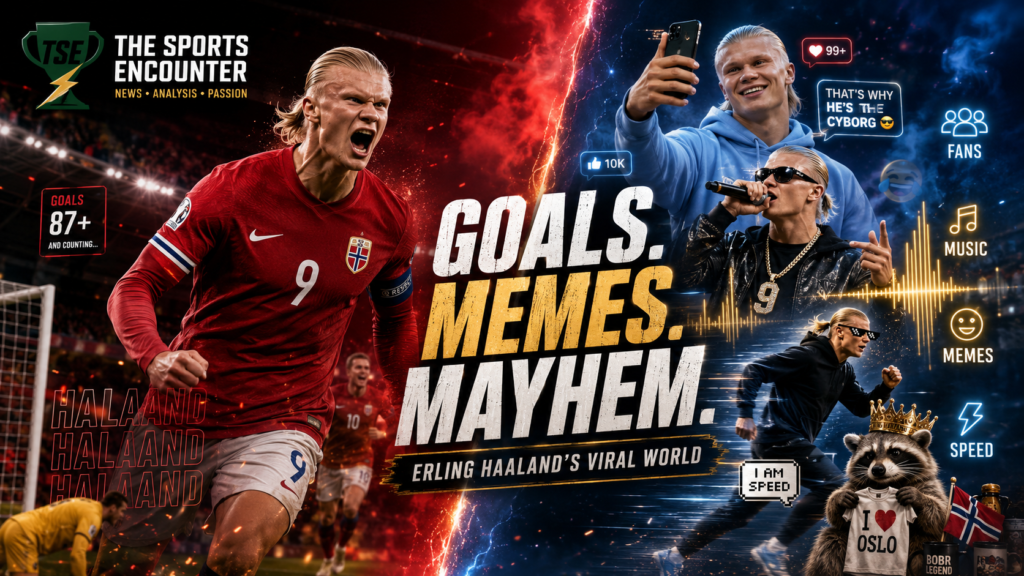
Erling Haaland’s World Cup included seven goals, a viral rap revival, running memes, Dragon Ball comparisons, social-media chaos, and an unforgettable raccoon. Which version is your favorite?
Most football stars spend years building a carefully controlled public identity.
Erling Haaland appears to have collected several of them by accident.
There is the striker who attacks penalty areas with the force of a runaway machine. Another version meditates after goals, posts deliberately strange photographs, laughs at comparisons with animated villains, and watches a teenage rap song return from the internet’s forgotten corners.
Then there is the Haaland who ended his first FIFA World Cup by stepping off a plane in Norway with a taxidermied raccoon holding a whiskey bottle.
Every version somehow feels believable.
The FIFA World Cup 2026 introduced Haaland to millions of casual viewers who knew about his scoring record but had never paid close attention to the personality behind it. Norway’s historic run gave them the football. Social media supplied everything else.
Welcome to the Haaland Multiverse.
TL;DR
- Erling Haaland scored seven goals during Norway’s run to the FIFA World Cup 2026 quarterfinals.
- His World Cup popularity spread into memes, music, anime comparisons, fashion, friendships, and social media.
- Haaland recorded the rap song “Kygo Jo” with friends as a teenager in Norway.
- He responded positively when fans compared him with Majin Buu from Dragon Ball.
- His distinctive running style became a major source of memes and speed-related searches.
- Haaland returned from the United States carrying a taxidermied “Whiskey Raccoon” purchased in Dallas.
- His willingness to enjoy the jokes has helped fans connect with him beyond his goals.
The Haaland Multiverse at a Glance
| Version of Haaland | What Defines Him | Why Fans Love It |
|---|---|---|
| Goal-Machine Haaland | Power, movement, finishing, records, and seven World Cup goals | He makes elite scoring look brutally simple |
| Norway Hero Haaland | Leading his country into a historic World Cup quarterfinal | Fans finally saw him carry a national team on the biggest stage |
| Rapper Haaland | The teenage “Kygo Jo” music video with Flow Kingz | The awkward sincerity makes it endlessly replayable |
| Meme Haaland | Running clips, facial expressions, poses, and online edits | He usually joins the joke instead of resisting it |
| Majin Buu Haaland | The Dragon Ball comparison embraced by fans and Haaland himself | His physical power makes the comparison strangely convincing |
| Dortmund Friend Haaland | His playful bond with Jude Bellingham and former teammates | It reveals a warmer side behind the intimidating striker |
| Social-Media Haaland | Unusual captions, relaxed humor, fashion, and self-aware posts | His account rarely feels like a corporate publicity feed |
| Raccoon Haaland | Returning home with an unusual souvenir from Dallas | Few footballers could make the moment feel so natural |
Goal-Machine Haaland Built the Entire Multiverse
The memes would carry far less weight without the goals.
Haaland entered his first senior World Cup with enormous expectations. Norway had returned to the tournament for the first time since 1998, and its chances of progressing depended heavily on a striker accustomed to setting records at club level.
He delivered seven goals in four appearances before the quarterfinal, averaging one every 51 minutes. FIFA named his powerful strike against Brazil the best goal of the Round of 16 after a fan vote.
That performance helped Norway eliminate Brazil 2-1 and reach its first World Cup quarterfinal. The victory transformed Haaland’s tournament from an impressive scoring run into a national sporting moment.
Readers can explore the numbers behind that rise in The Sports Encounter’s complete guide to Erling Haaland’s records, career, and World Cup impact.
His success also gave every off-field moment a larger audience. A strange photograph posted by a reserve player might disappear. The same photograph shared by a striker who has just eliminated Brazil travels around the world.
Football performance powered the algorithm.
Norway Hero Haaland Finally Found His International Stage
For years, Haaland’s club career carried an uncomfortable international question.
Could one of the world’s best strikers ever experience a major tournament with Norway?
The answer arrived in North America. Haaland scored, celebrated, embraced supporters, and became the face of Norway’s deepest World Cup run in the modern era. His goals gave a new generation of Norwegian fans memories that had previously belonged to older relatives.
England ended that journey with a 2-1 extra-time victory in Miami. Jude Bellingham scored both goals, while Haaland experienced the strange pain of seeing a close friend end his country’s dream.
The Sports Encounter’s England vs Norway quarterfinal report explains how Bellingham decided the contest and why Norway came so close to another historic result.
Haaland later said the World Cup had changed him. He left without the trophy, but his status within Norway had grown far beyond his individual scoring record.
Rapper Haaland Refuses to Disappear
Long before Manchester City, World Cup goals, and global sponsorships, Haaland was part of a teenage rap group called Flow Kingz.
He recorded “Kygo Jo” with friends Erik Botheim and Erik Tobias Sandberg while they were involved with Norway’s youth setup. The video features tracksuits, sunglasses, low-budget visual effects, and the absolute confidence available only to teenagers who have not yet learned to be embarrassed.
Manchester City’s profile of Haaland’s lesser-known history quotes him explaining that the friends had time to fill while away with the national team and decided to make a music video.
“Maybe we should make a music video, why not?” Haaland recalled.
He also defended the finished product with characteristic confidence.
“In the end it is a really nice song and it has had a lot of views.”
The song resurfaced during the World Cup as fans searched for translations, remixes, and the story behind the video. Norwegian producer Kygo then joined the fun by releasing a remix after Haaland’s performance against Brazil.
Rapper Haaland may never headline a stadium tour. He has already survived longer online than many serious musicians.
Running Haaland Looks Different From Everyone Else
Haaland’s running style has become one of his most recognizable features.
At 6 feet 4 inches, he covers ground with long, forceful strides. His upper body can appear unusually upright, while his arms and legs produce a movement that looks less smooth than the sprinting style associated with smaller forwards.
The visual effect is difficult to ignore. Fans have compared him with a robot, a cartoon character, a charging Viking, and a video-game player whose speed setting has been turned too high.
Those jokes obscure an important football reality. Haaland moves exceptionally quickly for a player of his size. His acceleration allows him to attack space behind defenders before they can adjust their body position.
The run may look unusual. It remains one of the most effective weapons in modern football.
World Cup searches around “Haaland running” and “Haaland running speed” show how a physical detail can become entertainment in its own right. Supporters do not only watch where he finishes. They watch how he arrives.
Majin Buu Haaland Joined the Joke
One of the World Cup’s most unexpected Haaland searches connected him with Majin Buu, the powerful pink character from the Dragon Ball universe.
The comparison has circulated online for years, driven by Haaland’s broad build, rounded facial features, pale complexion, and occasionally expressionless stare. The World Cup gave the joke another surge as his performances reached new audiences.
Haaland could have ignored the comparison. He chose the more effective response.
“I mean, I don’t disagree,” he said.
That short reply strengthened the meme because it gave fans permission to keep enjoying it. Haaland did not react defensively or demand that every conversation return to his scoring record.
He understood that the comparison was affectionate.
The moment also showed why his public personality works online. Haaland often appears aware of his own unusual presence without trying to explain it away.
Dortmund Haaland Is Still a Fan Favorite
Many supporters first connected emotionally with Haaland during his Borussia Dortmund years.
He scored relentlessly, celebrated wildly, and formed visible friendships with teammates including Jude Bellingham. Training clips, interviews, celebrations, and deliberately awkward club videos captured a younger version of both players before Manchester City and Real Madrid turned them into global commercial figures.
Their relationship later survived transfers, Champions League competition, and a World Cup quarterfinal.
Our feature on Erling Haaland and Jude Bellingham’s friendship follows the story from Dortmund to their emotional World Cup meeting.
Dortmund Haaland remains popular because fans remember the sense of discovery. He was already an elite scorer, but he had not yet become the unavoidable global figure he is today.
Social-Media Haaland Rarely Feels Overmanaged
Modern footballers often have social accounts that read like extensions of a marketing department.
Match photograph. Sponsor message. Training image. Motivational caption. Repeat.
Haaland’s posts can include all of those things, but his personality regularly breaks through. His captions are often short, odd, obvious, or deliberately flat. He uses photographs that other stars might reject and appears comfortable allowing fans to laugh with him.
That distinction matters.
Haaland’s size, scoring record, and physical intensity could make him seem distant. Humor reduces that distance. The striker capable of frightening defenders becomes the man posting an awkward pose or carrying home a ridiculous souvenir.
The Sports Encounter examined the scale of this appeal in our comparison of the most viral players at FIFA World Cup 2026.
Messi and Ronaldo retain larger established global audiences. Haaland produced the tournament’s widest range of fresh viral moments.
Raccoon Haaland Completed the World Cup Story
Norway’s quarterfinal defeat could have ended Haaland’s tournament news cycle.
Instead, he stepped off the team plane carrying a taxidermied raccoon posed with a whiskey bottle.
Reports identified the souvenir as a $750 item purchased from Wild Bill’s Western Store in Dallas. Haaland also collected cowboy-themed clothing during Norway’s stay in the United States.
His explanation was simple.
“It followed me home.”
The image spread across sports, entertainment, fashion, and celebrity media. Fans began asking where he bought the raccoon, what it cost, and what he planned to call it.
Haaland later invited followers to vote on possible names through an Instagram poll. Options reportedly included Cowboy, Ranger, TEX, and R.O.W., meaning Raccoon on Wheels.
The episode captured his World Cup perfectly. Football created the attention, but personality extended it into places traditional match coverage could never reach.
Why the Haaland Multiverse Works
These versions do not feel like separate brand campaigns.
Goal-Machine Haaland supports everything because his performances command attention. Norway Hero Haaland gives those performances emotional meaning. Rapper Haaland reveals an awkward teenage past. Meme Haaland shows self-awareness, while Raccoon Haaland confirms that his taste can be wonderfully unpredictable.
Fans respond because the contradictions feel human.
He can be physically intimidating and socially playful. His football is ruthlessly efficient, but his public presence can be chaotic. He looks like a carefully designed super-athlete until he starts talking about rap videos or carrying woodland taxidermy through an airport.
Haaland rarely seems desperate to convince people that he is interesting.
That may be the most interesting thing about him.
Fan Poll: Which Haaland Is Your Favorite?
Which version of Erling Haaland lives rent-free in your head?
- Goal-Machine Haaland
- Norway Hero Haaland
- Rapper Haaland
- Running-Meme Haaland
- Majin Buu Haaland
- Dortmund Haaland
- Social-Media Haaland
- Raccoon Haaland
Share your vote in the comments and tell us which Haaland moment should be added to the multiverse next.
Final Verdict
Erling Haaland arrived at the World Cup as one of football’s most feared scorers.
He left as something broader.
Seven goals and a historic Norwegian run proved that his club dominance could transfer to the international stage. The music, memes, friendships, social posts, anime comparisons, running clips, and raccoon gave millions of new fans a reason to follow him between matches.
The goal machine remains the foundation. Rapper Haaland may be the most unexpectedly entertaining. Norway Hero Haaland carries the deepest emotional meaning.
Raccoon Haaland, however, may be impossible to defeat.
Readers can follow more player features, fan stories, and tournament analysis through The Sports Encounter’s FIFA World Cup 2026 hub and wider soccer coverage.
The Sports Encounter’s World Cup 2026 coverage focuses on fixtures, team news, match analysis, fan stories, tournament trends, and the biggest talking points from football’s global stage.
Cricket
Zimbabwe Rule Bangladesh Again, Win 1st T20I by 32 Runs
Zimbabwe beat Bangladesh by 32 runs in the 1st T20I at Bulawayo as Richard Ngarava and Blessing Muzarabani took four wickets each. After winning the Test and ODI series earlier, Zimbabwe moved 1-0 ahead in the T20Is with another disciplined all-round performance.
After winning the one-off Test and sealing the ODI series, Zimbabwe carried the same authority into the shortest format with a 32-run victory in the first T20I at Queens Sports Club, Bulawayo.
A total of 170 for 6 looked competitive at the halfway mark. By the time Bangladesh were bowled out for 138 in 19 overs, it looked more than enough.
This was not a wild T20 win built on one freakish innings or a single collapse. It was another complete Zimbabwe performance against a Bangladesh side that keeps finding new ways to fall behind in the same contest. Zimbabwe batted with enough clarity, defended with intensity, and then allowed Richard Ngarava and Blessing Muzarabani to turn pressure into wickets.
For readers following the full arc of this tour, this result felt like a natural continuation of what started when Zimbabwe stunned Bangladesh after turning 141 into a winning total. It grew stronger when Bangladesh lost control again in the second ODI, where Ben Curran and Zimbabwe sealed the series in Harare. Bangladesh did save themselves from an ODI whitewash through Tanzid Hasan’s 94, but that consolation win now looks like a pause rather than a turnaround.
Zimbabwe have moved the story back to familiar territory.
They are winning the key moments. Bangladesh are explaining why they missed them.
TL;DR
- Zimbabwe beat Bangladesh by 32 runs in the 1st T20I at Queens Sports Club, Bulawayo.
- Zimbabwe scored 170 for 6 after Brian Bennett made 44, Ryan Burl added an unbeaten 30, and Brad Evans finished with 19 not out from 10 balls.
- Bangladesh were bowled out for 138 in 19 overs despite Yasir Ali’s 54 from 38 balls.
- Richard Ngarava took 4 for 26 and was named Player of the Match.
- Blessing Muzarabani also took 4 wickets, finishing with 4 for 17 from four overs.
- Nahid Rana was Bangladesh’s standout bowler with 4 for 26, but the batting unit failed to build the partnerships needed in a chase of 171.
- Zimbabwe lead the three-match T20I series 1-0 after already winning the Test and ODI series earlier in the tour.
Scorecard and Key Information
| Detail | Information |
|---|---|
| Match | Zimbabwe vs Bangladesh, 1st T20I |
| Result | Zimbabwe won by 32 runs |
| Venue | Queens Sports Club, Bulawayo |
| Date | July 15, 2026 |
| Toss | Bangladesh won and fielded first |
| Zimbabwe | 170/6 in 20 overs |
| Bangladesh | 138 all out in 19 overs |
| Player of the Match | Richard Ngarava, 4/26 |
| Best Bowling | Blessing Muzarabani, 4/17 |
| Top Score | Yasir Ali, 54 from 38 balls |
| Series Status | Zimbabwe lead 1-0 in the three-match T20I series |
| Turning Point | Bangladesh falling to 34 for 3 inside five overs during the chase |
Zimbabwe Turn 170 Into a Statement
Bangladesh’s decision to bowl first was understandable. They had Nahid Rana in rhythm, Taskin Ahmed to control the new ball, and a surface that Towhid Hridoy later described as a good wicket to bat on.
The early overs did not run away from Bangladesh completely, but Zimbabwe’s intent was clear. Tadiwanashe Marumani made 14 from 9 balls before falling to Nahid Rana, while Brian Bennett gave Zimbabwe the base they needed with 44 from 30. Bennett’s innings mattered because it stopped Zimbabwe from becoming trapped between caution and aggression.
He hit six fours and a six, reached scoring areas quickly, and gave the innings enough pace to survive later slowdowns.
Dion Myers made 20 from 20. Sikandar Raza added 20 from 13. Neither innings became decisive on its own, yet both kept Zimbabwe moving toward a total that could stretch Bangladesh under pressure.
The final push came from Ryan Burl and Brad Evans. Burl’s unbeaten 30 from 25 balls gave Zimbabwe stability after the middle-order wickets. Evans then supplied the late acceleration with 19 not out from 10 deliveries, including four boundaries.
That finish pushed Zimbabwe to 170 for 6.
Raza later said the pitch felt like a 150 or 155 par surface. If that reading was accurate, Zimbabwe did more than reach a defendable score. They forced Bangladesh into a chase that demanded structure, calm, and at least one major top-order partnership.
Bangladesh did not find it.
Nahid Rana Gave Bangladesh a Chance
Bangladesh’s best player in the first innings was Nahid Rana.
His 4 for 26 from four overs prevented Zimbabwe from moving out of reach. He removed Marumani, Bennett, Milton Shumba, and Tashinga Musekiwa, and his 15 dot balls helped Bangladesh pull the innings back at different stages.
Taskin Ahmed also bowled with control, finishing wicketless but conceding only 22 from his four overs.
Those two spells should have given Bangladesh a stronger platform. Instead, the support bowling leaked enough runs to undo some of that discipline. Nasum Ahmed went for 32 from three overs, Mahedi Hasan conceded 41 from four, and Mohammad Saifuddin’s two wickets came at a cost of 35 from four.
Zimbabwe did not dominate every phase of the innings. That is important. Bangladesh had enough moments to believe they could restrict the hosts.
The difference was that Zimbabwe kept extracting value from smaller contributions. Bangladesh, once again, needed a near-perfect correction after letting a winnable situation drift.
Ngarava and Muzarabani Break the Chase Open
Bangladesh needed a steady start.
They got the opposite.
Saif Hassan fell for 12 in the fourth over. Tanzid Hasan followed three balls later after making 16 from 8. Parvez Hossain Emon then fell to Muzarabani for 5, leaving Bangladesh 34 for 3 inside five overs.
That powerplay shaped the chase.
Bangladesh were not chasing 210. They were chasing 171, but the early wickets turned a manageable target into a control problem. Every boundary felt necessary. Every dot ball carried extra weight. Every new batter walked in with the equation already tightening.
Ngarava understood the surface better than anyone. His left-arm angle, hard length, and adjustment to the slower Bulawayo deck made him difficult to line up. He finished with 4 for 26, removing Saif, Tanzid, Yasir Ali, and Mohammad Saifuddin.
Muzarabani was even more economical. His 4 for 17 included a maiden, 16 dot balls, and the final wicket of Nahid Rana with a yorker that knocked back off stump. It was a fitting finish for a bowling performance built on accuracy rather than noise.
Zimbabwe’s fast bowling has become the clearest difference between these sides.
Ngarava and Muzarabani are no longer just producing good spells. They are defining matches.
Yasir Ali Fights Alone, but Bangladesh Needed More
Yasir Ali gave Bangladesh their only real batting resistance.
His 54 from 38 balls included two fours and three sixes. He reached his half-century from 33 balls and added 50 for the sixth wicket with Mahedi Hasan, who made 19 from 18.
For a short period, Bangladesh had a route back into the game.
The problem was timing. By the time Yasir and Mahedi settled, Bangladesh had already lost too much of the top order. Towhid Hridoy made 14. Nurul Hasan was run out for 3. Saifuddin, Nasum Ahmed, Taskin Ahmed, and Nahid Rana could not turn the lower order into a meaningful finish.
Bangladesh collapsed from 130 for 5 to 138 all out.
That eight-run slide killed any faint hope of a late twist.
Hridoy admitted after the match that Bangladesh needed one or two big partnerships at the top when chasing 170 or 180. His point was simple, but it captured the biggest failure of the innings. Bangladesh did not lose because the target was impossible. They lost because they never built the chase.
Zimbabwe’s Fielding and Bowling Reflect a Team With Direction
Raza’s post-match comments were revealing.
He rated Zimbabwe’s fielding eight out of ten. He praised the bowling as spot on. He also made it clear that the World Cup had forced the team to identify areas where they needed to improve.
That context matters because Zimbabwe are playing like a side using this Bangladesh tour as more than a bilateral assignment.
The hosts are building habits. They are defending totals with belief. Their fast bowlers are setting standards. Their batters are creating enough depth across the innings. Fielding errors still exist, but the energy has changed from survival to expectation.
Zimbabwe’s recent leadership structure also fits this mood. Richard Ngarava has been placed in charge of the Test and ODI sides, while Raza continues to lead in T20Is. That gives Zimbabwe two strong senior voices across formats and keeps responsibility close to the players shaping the team’s current rise.
For broader cricket coverage and match analysis, visit The Sports Encounter’s Cricket Hub.
Bangladesh’s Tour Is Turning Into a Pattern
Bangladesh can point to Nahid Rana. They can point to Taskin’s economy. They can point to Yasir Ali’s half-century.

Those are valid positives, but they do not change the larger pattern.
Across this tour, Bangladesh have repeatedly failed to convert opportunity into control. They had Zimbabwe under pressure in the first ODI and lost. They had phases of strength in the second ODI and still allowed Zimbabwe to close the series. They did win the final ODI, yet that came when Zimbabwe rested key fast bowlers and dropped six catches.
The T20I opener gave Bangladesh another chance to reset the tour.
Instead, the same problems returned: early batting damage, thin partnerships, pressure errors, and an inability to match Zimbabwe’s intensity for long enough.
This is now more than a bad match. It is a tour-long warning.
Bangladesh need runs from the top order, a clearer chase tempo, and more control after the first 10 overs of an opposition innings. Their bowlers cannot keep being asked to create perfect conditions for a batting unit that keeps collapsing under manageable pressure.
For recent examples of how quickly T20 weakness can become a larger concern, readers can revisit our analysis of India’s T20I problems after England’s ruthless win.
Why This Win Matters Beyond 1-0
A 1-0 lead in a three-match T20I series is useful.
For Zimbabwe, this one feels bigger because of what came before it.
They have already won the Test. They have already won the ODI series. Now they have opened the T20Is by bowling Bangladesh out on a surface their opponents believed was good enough for batting.
That changes the psychological balance.
Bangladesh are no longer trying to win one format. They are trying to stop a tour from becoming a full-scale Zimbabwe statement. The hosts, meanwhile, will feel they can wrap up the series in the next match and turn this run into one of their most satisfying multi-format performances in recent years.
Zimbabwe also have the more settled identity in this series.
They know their pace attack can carry them. They trust Bennett, Raza, Burl, and Evans to build enough batting weight. They have a captain who understands T20 rhythm. Their fielding is alive enough to support the bowlers.
Bangladesh are still searching for the right shape.
Final Verdict
Zimbabwe’s 32-run win over Bangladesh was another reminder that this tour has changed the way these two sides look beside each other.
Bangladesh arrived with more established white-ball reputation. Zimbabwe have played with greater clarity, discipline, and hunger.
Brian Bennett gave the innings shape. Ryan Burl and Brad Evans gave it a finish. Richard Ngarava and Blessing Muzarabani then gave Bangladesh no room to breathe.
Yasir Ali’s half-century stopped the chase from becoming a complete batting embarrassment, but it could not hide the larger truth. Bangladesh did not bat like a side chasing 171 on a good surface. They batted like a side still carrying the pressure of every missed chance from the tour.
Zimbabwe are one win away from adding the T20I series to their Test and ODI success.
That is no longer a surprise.
It is the story of this tour.
Follow more updates, match reports, and cricket analysis through The Sports Encounter’s Cricket coverage. For official international cricket fixtures, rankings, and tournament updates, visit the International Cricket Council.
Editor's Choice
Top 10 Players of the FIFA World Cup 2026
Mbappé leads the tournament in goal contributions, Messi keeps rewriting World Cup history, and Haaland transformed Norway. We rank the 10 best players through the quarterfinals.
A World Cup player ranking cannot be reduced to a goals table.
Kylian Mbappé and Lionel Messi entered the semifinals tied at the top of the Golden Boot race. Erling Haaland scored seven times in only four appearances. Jude Bellingham repeatedly rescued England when their tournament looked vulnerable.
Other players influenced matches through creation, defensive control, goalkeeping, leadership, and the ability to change the emotional direction of a knockout tie.
The strongest performers combined production with consequence. Their goals, assists, saves, passes, and decisions directly shaped how far their countries traveled.
This ranking assesses the tournament through the quarterfinals. It rewards individual quality, consistency, opposition level, knockout influence, and importance to the team.
TL;DR | The Very Best of the Best!
- Kylian Mbappé ranks first after producing a tournament-leading 11 goal contributions through the quarterfinals.
- Lionel Messi remains close behind after reaching eight goals and 10 total goal contributions while leading Argentina into another semifinal.
- Erling Haaland scored seven goals in four matches and carried Norway to a historic quarterfinal.
- Jude Bellingham scored six times, including braces against Mexico and Norway during the knockouts.
- Ousmane Dembélé and Michael Olise helped make France the tournament’s most dangerous attacking team.
- Harry Kane became England’s leading World Cup scorer and entered the semifinals with six goals.
- Lamine Yamal’s creativity and one-on-one threat remained central to Spain’s title challenge.
- Mikel Oyarzabal supplied goals and intelligent movement throughout Spain’s run.
- Paraguay goalkeeper Orlando Gill earns the final place after helping eliminate Germany and carrying a third-place qualifier into the Round of 16.
World Cup 2026 Top 10 Players at a Glance
| Rank | Player | Country | Primary Impact | Tournament Status at Cutoff |
|---|---|---|---|---|
| 1 | Kylian Mbappé | France | Eight goals, three assists, and decisive knockout production | Semifinalist |
| 2 | Lionel Messi | Argentina | Eight goals, two assists, leadership, and historic records | Semifinalist |
| 3 | Erling Haaland | Norway | Seven goals in four matches and a historic national-team run | Eliminated in quarterfinal |
| 4 | Jude Bellingham | England | Six goals and repeated knockout interventions | Semifinalist |
| 5 | Ousmane Dembélé | France | Five goals, two assists, movement, and attacking balance | Semifinalist |
| 6 | Harry Kane | England | Six goals, one assist, and England World Cup scoring record | Semifinalist |
| 7 | Michael Olise | France | Chance creation, five goal contributions, and tactical versatility | Semifinalist |
| 8 | Lamine Yamal | Spain | Creativity, ball progression, width, and constant one-on-one threat | Semifinalist |
| 9 | Mikel Oyarzabal | Spain | Four goals, one assist, and intelligent final-third movement | Semifinalist |
| 10 | Orlando Gill | Paraguay | Goalkeeping, penalty-shootout composure, and underdog leadership | Eliminated in Round of 16 |
Statistics reflect FIFA’s published tournament data through the quarterfinals. The final ranking should be updated after the World Cup final on July 19, 2026.
10. Orlando Gill, Paraguay
A top-player list dominated by attackers would miss one of the tournament’s strongest underdog performances.
Orlando Gill helped Paraguay become the only Lucky 8 team to progress beyond the Round of 32. Germany controlled possession, created pressure, and appeared to score an extra-time winner through Jonathan Tah.
VAR disallowed the goal after officials decided Waldemar Anton had obstructed the goalkeeper.
Gill remained composed through the rest of extra time and helped Paraguay win the penalty shootout 4-3.
His influence extended beyond individual saves. Paraguay defended deep because they trusted their goalkeeper to manage crosses, second balls, and the pressure created by Germany’s territorial control.
France eventually ended their run with a 1-0 victory in the Round of 16. Gill again gave Paraguay a chance to remain competitive against a much stronger attacking team.
The Sports Encounter examined that unlikely run in our analysis of why Paraguay succeeded where the other Lucky 8 teams failed.
Several elite goalkeepers produced strong tournaments. Gill receives this place because his performance changed the historical ceiling of his team.
9. Mikel Oyarzabal, Spain
Spain’s football often draws attention toward its midfielders and wide creators.
Oyarzabal supplied the movement that helped turn possession into goals.
He reached four goals and one assist through the quarterfinals, placing him among the tournament leaders in total attacking contributions.
His value came from timing rather than physical dominance. Oyarzabal moved between center backs, dropped into spaces that opened passing lanes, and arrived inside the area when defenders became occupied by Lamine Yamal and Spain’s midfield rotations.
The 3-0 victory over Austria showed how effectively Spain could control a knockout match once their forward movement matched the speed of their passing.
Belgium presented a more difficult quarterfinal, but Oyarzabal continued to provide a reference point while Spain worked through pressure and won 2-1.
He has not produced the same viral moments as Mbappé, Messi, or Yamal. His intelligent movement has been essential to Spain’s attack.
8. Lamine Yamal, Spain
Lamine Yamal entered the World Cup carrying expectations that would overwhelm many established players.
He remained willing to demand the ball.
Spain use Yamal to stretch the right side, isolate defenders, and create passing routes into central areas. His first touch can take him away from pressure, while his ability to cut inside forces the opposing fullback to defend several possibilities at once.
Statistics capture only part of that influence.
Defenses shift toward Yamal before he receives possession. That movement creates space for midfield runners, Oyarzabal, and the fullback supporting from behind.
His youth also makes his composure remarkable. World Cup knockout football creates little patience for unnecessary risk, yet Yamal has continued taking on defenders and attempting decisive passes.
The semifinal against France offered another opportunity to strengthen his Golden Ball case. Our France vs Spain semifinal preview explored whether Yamal could overcome Mbappé and France’s deeper attacking resources.
7. Michael Olise, France
Michael Olise may be the most tactically adaptable attacker in France’s squad.
He can start wide, operate between midfield and defense, carry possession centrally, deliver set pieces, and combine around the penalty area.
Olise reached five goal contributions through the quarterfinals. The number tells only part of his tournament.
France’s forward line contains several players who prefer decisive attacking actions. Olise helps connect them. His passing gives Mbappé opportunities to receive while moving toward goal, while his movement supports Dembélé and prevents opponents from directing all their defensive attention toward France’s captain.
He also contributes without the ball. France can adjust their pressing shape because Olise understands when to move centrally and when to protect the wide area.
The Golden Ball conversation usually favors scorers. Olise’s case rests on making an already elite attack function more smoothly.
6. Harry Kane, England
Harry Kane entered the World Cup with questions about whether England could give him enough service.
He responded with six goals and one assist through the quarterfinals.
Kane also moved beyond Gary Lineker to become England’s leading scorer in World Cup history. His record-breaking goal came during the group-stage victory that secured first place in Group L.
His tournament has not been flawless. England struggled for attacking rhythm in several knockout matches, and Kane occasionally became isolated while dropping too far from the penalty area.
He still provided goals, leadership, and a technical reference point.
Kane can receive under pressure, connect midfield with attack, and release runners before moving toward the box himself. That versatility matters when England cannot progress through direct dribbling or fast combinations.
Bellingham has produced England’s most dramatic knockout interventions. Kane remains the forward every opponent must organize around.
5. Ousmane Dembélé, France
France’s attacking depth makes individual evaluation difficult.
Ousmane Dembélé has remained central despite the competition around him.
Five goals and two assists gave him seven total goal contributions through the quarterfinals. He combined direct production with the movement required to prevent France’s attack from becoming dependent on Mbappé.
Dembélé can operate centrally or from either wing. His ability to use both feet makes him difficult to show toward one side, while his acceleration creates chances before defensive blocks can settle.
He also stretches the back line horizontally. When defenders move toward Mbappé, Dembélé can attack the opposite channel or arrive through the center.
Reuters reported that Mbappé, Dembélé, and Olise had combined for 11 goals and nine assists through France’s opening four matches. Their output placed the French attack in conversations about the strongest forward lines in World Cup history.
Dembélé ranks below the tournament’s leading four because France can distribute responsibility across several elite attackers. His performance remains one of the main reasons that luxury has worked.
4. Jude Bellingham, England
England’s tournament repeatedly reached moments when control disappeared and individual authority became necessary.
Bellingham responded.
He scored twice against Mexico in the Round of 16 as England survived a 3-2 battle. Another brace followed against Norway, including the extra-time winner that carried England into the semifinals.
Those goals took him to six for the tournament.
The timing separates Bellingham from other high scorers. Four of his goals arrived during consecutive knockout matches when England faced elimination or extra time.
Against Norway, he equalized in first-half stoppage time and later delivered the decisive goal. The performance ended Haaland’s World Cup and extended England’s run.
The Sports Encounter’s England vs Norway match report explains how Bellingham rescued his team twice.
His midfield influence can still fluctuate. England have not controlled every game, and Bellingham sometimes operates closer to a second striker than a traditional midfielder.
When the match needs a decisive player, he has answered more often than anyone else in Thomas Tuchel’s squad.
3. Erling Haaland, Norway
Erling Haaland played only four matches.
He scored seven goals.
No other leading scorer matched his rate of one goal approximately every 51 minutes. More importantly, those goals changed Norway’s place in World Cup history.
The country had not appeared at the tournament since 1998. Haaland led them into their first quarterfinal and scored twice as Norway eliminated Brazil 2-1 in the Round of 16.
His second goal in that match captured his tournament: power, movement, and the ability to turn a small opening into a decisive moment.
England limited him more effectively in the quarterfinal. Haaland remained dangerous, had a goal ruled out following a foul in the buildup, and forced the defense to remain compact around him.
Norway lost 2-1 after extra time.
His early exit prevents him from ranking above Mbappé or Messi. Four matches also provide a smaller body of work than the semifinalists have produced.
The impact was historic. Our detailed guide to Haaland’s records, career, and first World Cup examines how quickly he transformed Norway’s tournament.
Haaland also became the competition’s most broadly viral figure through goals, memes, music, friendships, and off-field moments. Readers can explore that wider story in our feature asking who became the most viral player at World Cup 2026.
2. Lionel Messi, Argentina
Lionel Messi arrived at his sixth World Cup as the defending champion and the oldest central figure in the Golden Ball race.
He responded by setting records that may survive for generations.
Messi became the World Cup’s all-time leading scorer after moving beyond Miroslav Klose. He also became the first player to score in seven consecutive World Cup matches.
Through the quarterfinals, he had eight goals and 10 total goal contributions.
His influence extended beyond finishing. Argentina continued using Messi to connect midfield with attack, slow the game when control became necessary, and produce the final pass around the penalty area.
The team’s path was not straightforward.
Egypt pushed Argentina into a controversial 3-2 Round of 16 match. Switzerland forced extra time in the quarterfinal before Argentina won 3-1.
Messi remained the player around whom every attacking decision revolved.
His scoring record strengthens the statistical case. The emotional and tactical responsibility strengthens it further.
Argentina’s semifinal against England offered another chapter in a rivalry shaped by the 1966 quarterfinal, Diego Maradona’s 1986 performance, David Beckham’s 1998 red card, and repeated World Cup controversy. Our Argentina vs England semifinal preview examines whether Messi can reach another final.
1. Kylian Mbappé, France
Kylian Mbappé has produced the strongest combination of goals, assists, records, and team progress.
He entered the semifinals with eight goals and three assists, giving him a tournament-leading 11 goal contributions.
Mbappé scored the only goal against Paraguay in the Round of 16. He added another during France’s 2-0 quarterfinal victory over Morocco, moving to 20 career World Cup goals.
That left him one behind Messi’s newly established record of 21.
Mbappé also reached the total across fewer tournament appearances than the Argentine captain. The possibility of overtaking Messi during the same World Cup added another layer to France’s title pursuit.
His quarterfinal contained an imperfection. Mbappé missed a penalty before scoring later in the match and left the field with an injury concern.
France still depend on his acceleration and finishing more than any other attacking weapon. Defenses retreat when he receives possession, creating space for Olise and Dembélé even when Mbappé does not take the final shot.
He ranks first because his numbers lead the tournament and his production has continued into the knockout rounds.
The final matches will decide whether he converts that statistical lead into the Golden Ball.
Players Who Narrowly Missed the Top 10
Martin Ødegaard, Norway
Ødegaard gave Norway creative control and helped connect midfield with Haaland. His leadership was central to their historic run, but Haaland’s scoring had the greater direct impact.
Johan Manzambi, Switzerland
Five goal contributions placed Manzambi among the tournament leaders. Switzerland’s quarterfinal exit and the influence of the leading semifinalists kept him outside the final 10.
Vinícius Júnior, Brazil
Five goal contributions showed his quality. Brazil’s Round of 16 elimination against Norway limited his opportunity to strengthen the case.
Julián Quiñones, Mexico
Quiñones produced five goal contributions and became one of the host nation’s strongest performers. Mexico’s elimination against England reduced the weight of his tournament.
Ismaïla Sarr, Senegal
Sarr’s five goal contributions reflected Senegal’s attacking ceiling. Their inability to protect a two-goal lead against Belgium ended his run too early.
Pedri and Rodri, Spain
Both midfielders deserve recognition for Spain’s control and progression. Their influence is harder to isolate statistically than Yamal’s or Oyarzabal’s final-third contribution.
Who Is Leading the Golden Ball Race?
Mbappé holds the advantage through the quarterfinals.
Messi remains close enough to take first place with another decisive knockout performance. Bellingham can strengthen his case if England reach the final, while Yamal and Olise remain central to their countries’ semifinal hopes.
Haaland’s elimination makes winning the award less likely, even though his scoring rate and historical influence remain elite.
| Golden Ball Position | Player | What Could Change the Race |
|---|---|---|
| Leader | Kylian Mbappé | A final appearance or another decisive scoring display |
| Closest challenger | Lionel Messi | Leading Argentina past England and influencing the final |
| Knockout riser | Jude Bellingham | Another decisive performance against Argentina |
| Creative contender | Michael Olise | Controlling the semifinal and final for France |
| Breakout contender | Lamine Yamal | Producing the defining moment of Spain’s title run |
Fan Poll: Who Has Been the Best Player?
Who gets your vote as the best player at the FIFA World Cup 2026 through the quarterfinals?
- Kylian Mbappé
- Lionel Messi
- Erling Haaland
- Jude Bellingham
- Ousmane Dembélé
- Harry Kane
- Michael Olise
- Lamine Yamal
- Another player
Share your choice in the comments and explain which performance defined the player’s tournament.
Final Verdict
Kylian Mbappé leads this ranking because no player matched his combination of eight goals, three assists, knockout influence, and progress into the semifinals.
Messi remains close enough to change the order. His scoring record, leadership, and influence over Argentina’s attack have kept another Golden Ball within reach.
Haaland produced the tournament’s most explosive short run. Bellingham delivered its strongest sequence of pressure goals. France placed three players in the top seven because its attack combined individual quality with collective balance.
The final ranking cannot be settled before the final whistle on July 19.
World Cups remember the player who finishes the story.
Follow every remaining match, player performance, and tournament record through The Sports Encounter’s FIFA World Cup 2026 hub and complete soccer news and analysis.
The Sports Encounter will update this ranking after the World Cup final to reflect the semifinal and final performances, official awards, and complete tournament statistics.
Editor's Choice
How VAR Became a WAR at the FIFA World Cup 2026?
VAR was introduced to correct obvious mistakes. At World Cup 2026, sensors, expanded reviews, disputed red cards, and accusations of favoritism turned it into a battle over who controls football.
VAR was introduced to stop a FIFA World Cup from being decided by an obvious refereeing mistake.
At the 2026 tournament, it became part of the argument almost every time a major decision changed a match.
Goals disappeared because sensors detected touches few viewers could see. Officials travelled backward through long attacking moves to identify earlier fouls. Penalties were awarded after light contact in one game and rejected after apparently stronger contact in another.
Red cards were given, overturned, reinstated, or debated long after the final whistle. Coaches accused officials of inconsistency. National federations demanded explanations. Supporters created claims of favoritism, while FIFA defended its referees and warned against attacks on their integrity.
The dispute was no longer limited to whether one decision was technically correct.
Players, officials, broadcasters, federations, and fans were fighting over a bigger question: how much control should technology have over football?
VAR had become a WAR.
TL;DR | Tug of VAR
- FIFA used connected-ball technology, semi-automated offside systems, and an expanded VAR protocol at World Cup 2026.
- Croatia had a late equalizer against Portugal cancelled after a sensor detected a slight touch during the move.
- Germany had an extra-time goal ruled out against Paraguay for goalkeeper obstruction before losing on penalties.
- Egypt had a goal disallowed and a penalty appeal rejected during its dramatic defeat by Argentina.
- Switzerland’s Breel Embolo received a second yellow for simulation after an expanded VAR intervention.
- Belgium received a decisive late penalty against Senegal, while Ghana and France had major penalty appeals rejected in other matches.
- Iran lost a potential qualification-winning goal to a marginal offside call.
- Vinícius Júnior had a goal cancelled for a foul against Scotland.
- England experienced a denied Harry Kane penalty, an overturned Djed Spence penalty, and a separate camera-cable controversy against Norway.
- Folarin Balogun’s red card and suspension reversal moved the debate from video officiating into FIFA governance and political influence.
- The main problem was not accuracy alone. Fans lost trust in VAR’s scope, consistency, and transparency.
World Cup 2026 VAR Controversies at a Glance
| Match or Incident | Decision | Main Dispute | Impact |
|---|---|---|---|
| Portugal vs Croatia | Late Croatia equalizer disallowed after connected-ball technology detected a touch | Microscopic contact invisible to most viewers | Portugal advanced and Croatia were eliminated |
| Germany vs Paraguay | Jonathan Tah’s extra-time goal ruled out for goalkeeper obstruction | Whether light contact justified cancelling the goal | Paraguay survived and won on penalties |
| Argentina vs Egypt | Egypt goal cancelled for a foul earlier in the move | How far VAR should travel backward through an attack | Argentina recovered to win 3-2 |
| Argentina vs Switzerland | Breel Embolo received a second yellow for simulation | Whether VAR had moved into full re-refereeing | Switzerland played with 10 men before losing in extra time |
| Belgium vs Senegal | Belgium awarded a late extra-time penalty | Low threshold for VAR intervention | Belgium completed a 3-2 comeback |
| France vs Senegal | Mbappé penalty appeal rejected after an on-field review | Referee rejected the video official’s interpretation | Renewed debate over contact initiated by attackers |
| England vs Ghana | Ghana penalty appeal rejected | VAR did not intervene after apparent defensive contact | A possible group-changing decision went against Ghana |
| Brazil vs Scotland | Vinícius Júnior goal disallowed for a foul in the buildup | Whether slight contact materially affected the goal | The decision added to concerns over review thresholds |
| Iran vs Egypt | Stoppage-time Iran goal disallowed for marginal offside | Millimeter-level accuracy versus the spirit of the law | Iran lost its chance to reach the knockout stage |
| England penalty incidents | Kane appeal rejected and Spence penalty overturned | Inconsistent interpretation of goalkeeper and defender contact | England experienced both sides of VAR intervention |
| England vs Norway cable dispute | FIFA data rejected Norway’s claim that the ball hit a camera cable | Trust in connected-ball and stadium technology | The argument continued after FIFA’s technical explanation |
| Folarin Balogun suspension | Red card issued through VAR, but suspension later lifted | Governance, transparency, and alleged political pressure | National federations questioned FIFA’s disciplinary authority |
The incidents involved different laws and review mechanisms. Together, they explain why refereeing technology became one of the defining stories of World Cup 2026.
VAR Was Originally Meant to Correct Obvious Errors
The original case for video assistance was difficult to oppose.
A referee cannot see every incident clearly from one angle and at full speed. Video could correct a missed handball, an obvious offside, a mistaken red card, or a serious foul that escaped attention.
Football had already produced World Cup decisions that lived for decades. Diego Maradona’s “Hand of God” against England in 1986 remained the obvious example of an injustice modern technology should prevent.
VAR entered the World Cup in 2018 with four main review categories:
- Goals and offenses during the attacking phase
- Penalty decisions
- Direct red cards
- Mistaken identity
The phrase “clear and obvious error” was meant to protect the authority of the on-field referee.
By 2026, the system had become more technologically advanced and operationally ambitious.
World Cup 2026 Gave Officials More Technology and More Power
FIFA equipped match officials with an advanced semi-automated offside system, connected-ball technology, goal-line technology, multiple video angles, and new camera systems.
FIFA confirmed the tournament’s refereeing technology before the World Cup, describing the tools as support systems for match officials.
The connected ball could register touches that did not produce an obvious visual change. Semi-automated offside technology could map player positions with extraordinary precision. Video officials could review several phases of play from different angles.
Better information did not automatically create greater trust.
Supporters often learned the practical boundaries of the system only after a decision damaged their team.
The Sports Encounter explored that changing relationship in our analysis of why World Cup 2026 fans became obsessed with referees.
Portugal vs Croatia Became the Symbol of Sensor Football
Croatia thought they had forced extra time against Portugal when Joško Gvardiol scored deep into stoppage time.
The celebration ended after VAR examined an earlier touch during the move.
Connected-ball technology detected contact before the ball reached Gvardiol. The touch affected the offside calculation and caused the goal to be disallowed.
Most viewers could not identify the contact through normal replays. The ball’s movement appeared unchanged, creating speculation that the sensor had detected only the slightest brush.
Croatia described the intervention as an abuse of technology. Luka Modrić questioned whether VAR had moved beyond correcting an obvious mistake and into searching for technical reasons to erase a goal.
Portugal won 2-1, ending Croatia’s tournament and possibly Modrić’s final World Cup appearance.
The Sports Encounter documented the full drama in our report on Portugal’s victory over Croatia after four disallowed goals and a late winner.
Germany’s Disallowed Goal Saved Paraguay
Germany’s Round of 32 match against Paraguay produced another debate over how much contact VAR should punish.
Jonathan Tah appeared to score an extra-time goal that would have put Germany ahead. VAR reviewed the move and decided that Waldemar Anton had obstructed goalkeeper Orlando Gill.
The contact looked limited, and critics questioned whether Gill had a realistic chance of reaching the ball regardless of Anton’s position.
The goal was cancelled. Paraguay survived extra time and eliminated Germany on penalties.
This decision belonged in the wider VAR debate because it combined interpretation with direct tournament consequences. Technology did not identify a simple factual error. Officials had to judge whether contact was meaningful enough to invalidate a potentially match-winning goal.
Our analysis of how Paraguay progressed farther than the other Lucky 8 teams provides more context on the resilience that carried them through the knockout stage.
Argentina vs Egypt Tested How Far Back VAR Can Look
Egypt believed they had scored a second goal against Argentina during the Round of 16.
VAR reviewed the attacking possession and identified Marwan Attia stepping on Lisandro Martínez’s foot earlier in the move. The goal was disallowed.
The controversy centered on time and consequence.
The foul did not occur immediately before the finish. Egypt had continued moving the ball through several actions before scoring. Critics argued that Argentina had opportunities to reorganize, making the earlier contact too distant from the final goal.
Egypt also appealed for a penalty shortly before Argentina completed a dramatic 3-2 comeback.
The Egyptian Football Association filed a formal complaint and questioned the consistency of VAR’s application. FIFA refereeing chief Pierluigi Collina maintained that a foul remains relevant if it forms part of the attacking possession that produces a goal.
Reuters reported widespread criticism of the decisions and the EFA’s demand for greater transparency. Read Reuters’ report on Egypt’s formal VAR complaint.
The Sports Encounter also explained the Egypt coach’s protest gesture and accusations after the Argentina defeat.
Embolo’s Red Card Raised the Re-Refereeing Question
Switzerland’s Breel Embolo received a second yellow card for simulation during the quarterfinal against Argentina.
The initial incident involved a possible foul and questions over player identity. Once VAR entered the process, officials reconsidered the entire action and concluded that Embolo had simulated contact.
Swiss coach Murat Yakin called the decision unacceptable. Former FIFA referee Christina Unkel argued that the expanded protocol had opened the door to complete re-refereeing.
The distinction matters.
VAR correcting the identity of an offending player is a factual intervention. Reinterpreting the full incident and producing a new yellow card moves beyond identification into football judgment.
Switzerland had just equalized and were pushing for another goal. Embolo’s dismissal changed the balance before Argentina won 3-1 after extra time.
The decision strengthened the “VARgentina” narrative, although no evidence established deliberate favoritism. Reuters reported both the Swiss complaint and FIFA’s defense of referee independence.
Belgium’s Late Penalty Against Senegal Changed a Knockout Match
Senegal appeared close to completing an important World Cup victory before a late VAR review changed the direction of the match.
Youri Tielemans went down after contact, and Belgium received an extra-time penalty following a lengthy review.
Critics considered the contact light and questioned why the incident met the threshold for video intervention.
Belgium converted the penalty and completed a 3-2 comeback.
This controversy became more damaging when compared with penalty appeals that VAR ignored or rejected elsewhere in the tournament.
Mbappé’s Denied Penalty Showed the Referee Still Had Authority
Kylian Mbappé believed Sadio Mané had fouled him inside the penalty area during France’s meeting with Senegal.
VAR recommended an on-field review after replays showed that Mané had not clearly played the ball.
The referee watched the incident and still rejected the penalty, deciding that Mbappé had initiated or exaggerated the contact.
The decision demonstrated that the on-field official retained the power to reject a VAR recommendation.
It also created another argument over consistency. Supporters compared Mbappé’s denied appeal with softer-looking incidents that resulted in penalties elsewhere.
Ghana’s Denied Penalty Against England Became a Non-Intervention Controversy
VAR controversies are not limited to decisions the system changes.
Its silence can provoke the same level of anger.
Ghana appealed for a penalty after Ezri Konsa appeared to make contact with Prince Adu inside the area. The referee allowed play to continue, and VAR did not recommend a review.
A converted penalty could have affected the result and the final Group L standings.
The incident became an example of the central VAR contradiction. Supporters saw officials examine minor contact in some matches while stronger contact elsewhere failed to trigger visible intervention.
Vinícius Júnior’s Goal Against Scotland Was Cancelled for Earlier Contact
Vinícius Júnior thought he had scored for Brazil against Scotland before VAR identified a foul against Jack Hendry during the buildup.
The contact appeared slight, and the decision had limited effect on the final outcome because Brazil still won comfortably.
It remained important to the wider VAR debate.
Supporters again questioned whether the system was correcting a clear mistake or searching through an attacking move until it found a reason to cancel the goal.
Iran’s Marginal Offside Ended a World Cup Dream
Iran appeared to score a stoppage-time winner against Egypt that could have taken the team into the knockout stage.
Semi-automated offside technology found a marginal infringement.
The decision may have been technically accurate. Its tournament consequence was enormous.
Iran’s players and supporters moved from celebration to elimination after a margin no referee or fan could have detected naturally.
Offside technology creates a difficult philosophical question. If the system can measure the position precisely, officials must apply the law. Yet the law was created to stop attackers gaining an unfair advantage, not necessarily to punish differences too small to affect the play.
Harry Kane and Djed Spence Experienced Opposite VAR Outcomes
England’s tournament included several penalty controversies.
Harry Kane went down after contact with a goalkeeper, but the referee rejected the appeal and VAR supported the decision.
In another knockout incident, England initially received a penalty after Djed Spence went down inside the area. The decision was overturned following video review.
England therefore experienced both sides of the system: a possible penalty denied and another award removed.
The two incidents reinforced the difficulty of evaluating contact. Replays can show where bodies touched, but they cannot automatically determine whether the contact caused the fall, prevented a legal action, or justified a penalty.
Cable-Gate Showed That Fans Distrusted More Than VAR
Norway claimed that a goal kick struck an overhead camera cable before England’s equalizer in their quarterfinal.

The claim created another technology-driven controversy because it involved stadium equipment that supporters believed may have interfered with live play.
FIFA later released connected-ball data indicating that the ball had not touched the cable.
The technical explanation should have ended the issue. Many fans remained skeptical.
That reaction showed how far trust had declined. Once supporters believe the process lacks transparency, even sensor data can look like part of the dispute rather than an independent answer.
Our England vs Norway quarterfinal report explains how Jude Bellingham’s two goals eventually ended Norway’s historic run.
The Balogun Suspension Turned VAR Into a Governance Crisis
Folarin Balogun received a red card after a VAR review during the United States’ match against Bosnia and Herzegovina.
The review concluded that his boot had made dangerous contact with an opponent’s ankle.
The controversy intensified when FIFA later lifted the resulting suspension, allowing Balogun to play against Belgium.
U.S. President Donald Trump publicly criticized the original decision and said he had contacted FIFA President Gianni Infantino. FIFA denied that political pressure influenced the disciplinary outcome and defended referee Raphael Claus.
Other national federations questioned the reversal and its effect on the authority of match officials.
Reuters reported that the case raised wider concerns about governance, transparency, and whether high-level access could influence disciplinary processes.
VAR did not make the later suspension decision. Fans still viewed the full episode as one chain: review, red card, political criticism, FIFA intervention, and reversal.
Argentina Became the Center of the Bias Allegations
Argentina’s progress generated several refereeing complaints.
Algeria objected after Lionel Messi avoided a possible red card during the group stage. Egypt challenged the disallowed goal and denied penalty. Switzerland protested Embolo’s dismissal.
Supporters combined the incidents into the label “VARgentina.”
FIFA rejected the accusation.
“We are not influenced by anyone,” Collina said while defending the independence of the refereeing team.
Criticism of individual decisions remains a legitimate part of football. Claims of corruption require evidence.
FIFA still faced a credibility problem. Once several controversial decisions involved the same team, each new incident strengthened the public narrative regardless of the legal explanation.
The Real Problem Was Inconsistency
Many individual World Cup decisions could be defended under the laws.
A sensor-detected touch can change offside. An earlier foul can invalidate a goal. Goalkeeper obstruction can affect a scoring opportunity. Simulation may deserve a caution.
Supporters judged the system across matches rather than one incident at a time.
Why did light contact produce Belgium’s penalty against Senegal while Ghana’s appeal against England received no intervention? Why did VAR invite a review for Mbappé but allow the referee to reject the recommendation? Why did officials travel backward through Egypt’s attack but appear more restrained elsewhere?
The Sports Encounter’s guide to what counts as a foul in soccer explains why contact alone cannot settle these decisions.
Referees must assess force, consequence, position, control, intent, and whether the challenge fits the law.
Technology provides evidence. Human judgment still determines its meaning.
Stadium Fans Paid the Emotional Price
Television viewers receive slow-motion replays, diagrams, commentary, and expert analysis.
Fans inside the stadium often receive silence and delay.
A goal goes in. Players run toward the corner. Supporters hug, scream, and believe the match has changed.
Then everyone waits.
The review may produce the legally correct outcome. The original emotional moment cannot be restored.
Celebration becomes conditional. Supporters begin watching the referee after every goal before deciding whether they can enjoy it.
That hesitation changes football’s rhythm.
What VAR Got Right at World Cup 2026
VAR also corrected genuine mistakes.
Serious fouls that escaped the referee could be identified. Semi-automated offside technology produced faster decisions than manual line drawing. Mistaken identity could be resolved. Goalkeeper obstruction and illegal movement received closer scrutiny.
FIFA’s technology was not useless. The problem came from its widening scope and inconsistent public explanation.
The debate should therefore move beyond keeping or abolishing VAR.
Football needs to decide where video review improves justice and where it damages the game without delivering enough benefit.
How FIFA Can Stop the Next VAR War
Three reforms would improve the system.
1. Set a clearer limit on attacking-phase reviews
VAR should not travel indefinitely backward unless the earlier offense directly creates the scoring opportunity.
2. Release review audio after major controversies
Supporters and federations should hear what officials saw, which law they applied, and why the review crossed the intervention threshold.
3. Apply a stricter “clear and obvious” standard
Subjective decisions should remain with the on-field referee unless video shows a significant and unmistakable error.
4. Explain connected-ball evidence visually
When a sensor decides a World Cup match, FIFA should publish a clear visual explanation rather than expect supporters to accept unseen data.
5. Separate disciplinary appeals from political access
Suspension decisions need a transparent process that protects referees and avoids any appearance that outside influence matters.
Fan Poll: Did VAR Improve or Damage World Cup 2026?
What is your verdict on VAR at the FIFA World Cup 2026?
- It improved the tournament by correcting major mistakes
- It was useful, but FIFA allowed it to intervene too often
- It damaged the tournament through inconsistency
- It should only decide factual calls such as offside and goal-line incidents
- Football should remove VAR completely
Share your vote in the comments and name the decision that most strongly shaped your opinion.
Final Verdict
VAR did not become a war because every decision was wrong.
The conflict grew because the boundaries became harder to understand.
Croatia lost a goal to a sensor-detected touch. Germany saw an extra-time winner cancelled for goalkeeper obstruction. Egypt lost a goal because of an earlier foul. Belgium received a decisive penalty while Ghana’s appeal brought no intervention.
Iran were eliminated by a marginal offside. Switzerland lost Embolo after a review expanded beyond mistaken identity. England and Norway argued over a camera cable, while the Balogun case created questions about political access and FIFA governance.
The technology became more precise. Public confidence moved in the opposite direction.
Football cannot solve a trust problem by adding more cameras, sensors, and officials without defining clear limits.
Accuracy matters. Consistency, restraint, transparency, and emotional continuity matter too.
VAR was designed to protect football from obvious injustice. At World Cup 2026, the fight over its power became one of the tournament’s defining stories.
Follow more tournament reporting through The Sports Encounter’s FIFA World Cup 2026 hub and complete soccer news and analysis.
Readers can also revisit our Round of 16 analysis of VAR drama and the Lucky 8 teams for more context on how officiating shaped the knockout stage.
The Sports Encounter covers World Cup refereeing through verified match details, official laws, tactical context, and the effects of major decisions on players and supporters.