


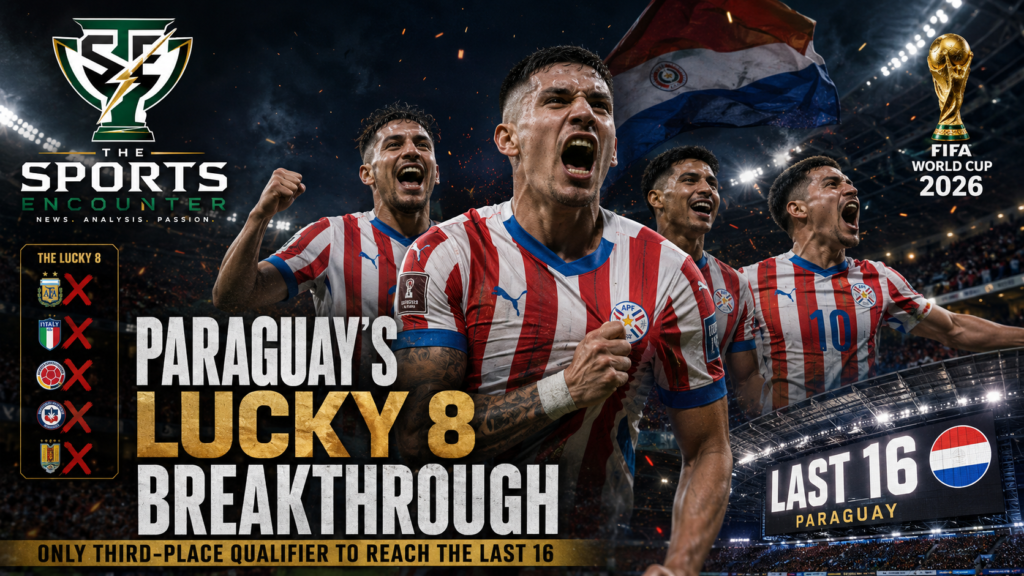
Paraguay entered the FIFA World Cup 2026 Round of 32 with the weakest attacking record among the eight third-place qualifiers and perhaps the most difficult assignment of them all.
Germany had won its group. Paraguay had scored only twice in three matches and qualified with four points, a negative goal difference, and a playing style built more around resistance than control.
Yet Paraguay became the only member of the Lucky 8 to reach the last 16.
While Ecuador, Senegal, DR Congo, Algeria, Ghana, Bosnia and Herzegovina, and Sweden were eliminated in their first knockout matches, Gustavo Alfaro’s team survived 120 minutes against Germany and won the penalty shootout 4-3.
Their progress was not driven by superior possession, a deeper squad, or a sudden attacking transformation. Paraguay advanced because they understood the type of match they needed and remained committed to it long after Germany became frustrated.
That clarity separated them from the other seven teams.
TL;DR
- Paraguay were the only Lucky 8 team to reach the Round of 16.
- They held Germany to a 1-1 draw before winning 4-3 on penalties.
- Paraguay accepted long periods without possession and protected central areas.
- Germany were repeatedly pushed toward lower-value crossing positions.
- Goalkeeper Orlando Gill delivered in open play and during the shootout.
- Paraguay remained emotionally stable when the match became uncomfortable.
- Julio Enciso gave them the attacking moment their defensive work needed.
- Other Lucky 8 teams either conceded early, lost control late, or exposed themselves while chasing the game.
- Senegal offered attacking danger but lacked defensive balance.
- DR Congo led England but could not manage the closing stages.
- Sweden and Algeria entered knockout football with defensive weaknesses already visible.
- Paraguay’s run ended against France, but they again forced an elite opponent into a tight match.
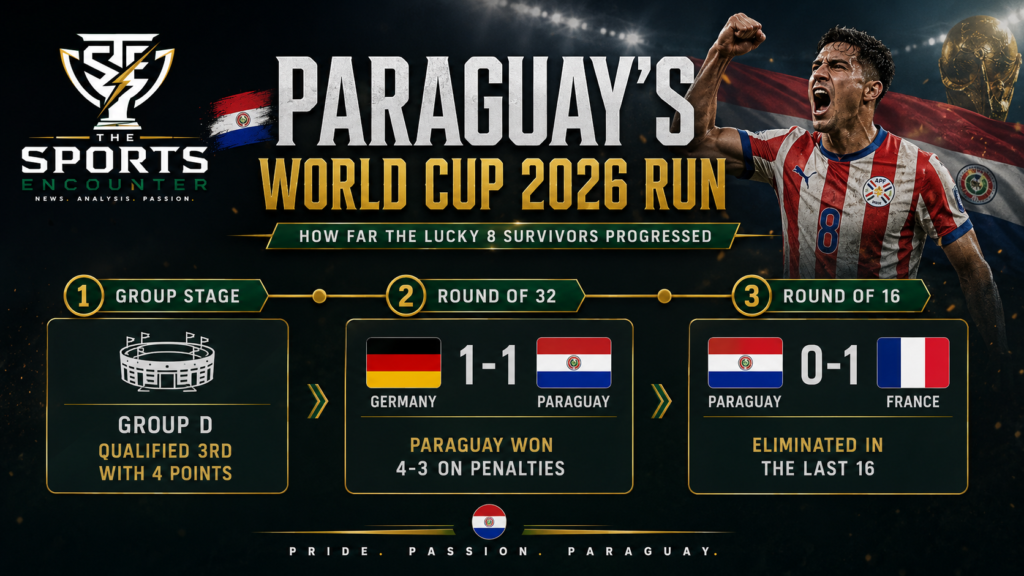
Paraguay’s Lucky 8 Path
| Stage | Opponent | Result | What decided the match |
|---|---|---|---|
| Group stage | Group D | Third place, four points | Defensive survival and enough points to qualify |
| Round of 32 | Germany | 1-1, Paraguay won 4-3 on penalties | Compact defending, goalkeeper performance, emotional control |
| Round of 16 | France | Lost 1-0 | France needed a 70th-minute Kylian Mbappé penalty |
| Final position | Last 16 | Only Lucky 8 team to advance | Clear tactical identity and knockout discipline |
Paraguay Did Not Pretend to Be Germany
Several underdogs damage their own chances by trying to prove that they can match a favorite in every phase of the game.
Paraguay avoided that mistake.
Germany were always likely to dominate possession, push their fullbacks forward, and surround Paraguay’s penalty area. Alfaro’s players did not waste energy trying to win a territorial battle they were unlikely to control.
Instead, they concentrated bodies around the central defensive zone and challenged Germany to find a clean route through them.
At one stage of the first half, Germany held more than 80 percent of possession. That statistic looked dominant, but possession alone did not mean Paraguay’s plan was failing. Germany were often circulating the ball outside the areas from which they could cause the greatest damage, a pattern also reflected in The Guardian’s live coverage of Germany against Paraguay.
Paraguay defended the match they wanted rather than the match Germany wanted to play.
The distinction became important as the minutes passed. Germany saw more of the ball, but Paraguay controlled the type of chances they were willing to concede.
Paraguay Forced Germany Away From the Center
Paraguay’s deepest defensive success came from closing the middle of the field.
Germany wanted Jamal Musiala, Florian Wirtz, and their other technical players to receive between the lines, turn toward goal, and combine through narrow spaces. Paraguay compressed those areas and placed enough bodies around the penalty box to make central progression slow and crowded.
Germany increasingly moved the ball toward the wings and relied on crosses.
A tactical review by Northeastern University’s World Cup analysis found that Germany attempted far more crosses against Paraguay than during an average group-stage match. The shift reflected how effectively Paraguay had denied the central routes Germany normally preferred.
Other tactical analysis also highlighted how little success Germany gained from repeatedly sending the ball into a crowded penalty area. The exact crossing totals vary depending on how each data provider defines a cross, but the tactical message remains clear.
Paraguay forced Germany toward an inefficient attacking method.
That was not passive defending. It was defensive direction.
Paraguay decided where Germany could have the ball and trusted their center backs, midfield screen, and goalkeeper to deal with what came next.
Julio Enciso Gave the Defensive Plan a Reward
A low block can keep an underdog alive, but it still needs an attacking moment.
Julio Enciso supplied Paraguay’s.
The forward’s goal changed the psychological balance of the match. Germany could no longer remain patient and wait for Paraguay’s defensive shape to weaken. They had to pursue an equalizer against a team that was already comfortable protecting space.
Enciso’s contribution also gave Paraguay something several other Lucky 8 teams lacked: an attacking player capable of turning a limited opportunity into a meaningful result.
Paraguay did not create chances in large numbers. They did enough with one of the few moments they produced.
That efficiency mattered because the other Lucky 8 teams often reached promising positions without converting them. Ghana stayed within one goal of Colombia but failed to find an equalizer. Algeria could not punish Switzerland. Ecuador’s attack disappeared against Mexico. Bosnia and Herzegovina left its match against the United States without scoring.
Paraguay’s system created little margin for waste. Enciso ensured that their best opening counted.
The details of Paraguay’s victory can also be followed through FIFA’s official World Cup 2026 tournament coverage.
Orlando Gill Changed Paraguay’s Margin for Error
A team defending deep against Germany will eventually allow opportunities.
Paraguay survived those moments because Orlando Gill gave them security behind the defensive line.
Gill’s importance extended beyond routine saves. He allowed Paraguay’s defenders to remain committed to their positions because they trusted the goalkeeper to handle shots, crosses, and second balls that escaped the first defensive line.
His presence also mattered during the most psychologically demanding phase of the match.
Germany had entered the shootout with one of the strongest penalty reputations in World Cup history. Paraguay were carrying the pressure of potentially losing after defending for two hours.
Gill helped reverse that expectation.
Paraguay won the shootout 4-3. José Canale converted the decisive kick, but Gill’s performance gave the takers the platform to remain calm. The emotional shift during the shootout was captured in The Guardian’s match report on Paraguay’s upset of Germany.
Penalty shootouts are often described as lotteries. Preparation, goalkeeper analysis, taker confidence, and emotional control still influence the outcome.
Paraguay reached the shootout believing it represented an opportunity. Germany reached it carrying the frustration of having failed to remove a third-place qualifier across 120 minutes.
That difference was visible.
Paraguay Remained Comfortable With Discomfort
Knockout football creates emotional pressure long before the final whistle.
Underdogs can lose shape when they begin thinking about the result. Defenders retreat too close to their goalkeeper. Midfielders stop pressing at the right moments. Clearances replace controlled decisions. Players begin wasting energy arguing with officials or reacting to every missed opportunity.
Paraguay continued doing the same basic things.
They defended narrow areas, challenged second balls, delayed German attacks, and waited for transitions. Their performance did not become adventurous after taking the lead or chaotic after conceding.
That emotional stability may have been their greatest advantage over the other Lucky 8 teams.
The Sports Encounter had ranked Paraguay among the teams facing the steepest route before the Round of 32. The original assessment suggested that their most believable path involved suffering, staying compact, frustrating Germany, and waiting for Enciso or Miguel Almirón to produce a decisive moment.
That is almost exactly what happened. Readers can revisit the full assessment in our analysis of which Lucky 8 teams could survive the World Cup 2026 Round of 32.
Paraguay’s players never appeared offended by the match’s demands. They accepted them.
DR Congo Could Not Protect the Match They Had Built
DR Congo came closest to joining Paraguay in the Round of 16.
They took the lead against England and forced one of the tournament favorites into a difficult recovery. Their direct running, physical strength, and willingness to attack gave England more trouble than many expected.
The problem appeared in the closing stages.
As the match moved toward its decisive minutes, DR Congo struggled to protect the spaces that had kept England uncomfortable. Fatigue affected distances between the lines, while England introduced greater urgency and committed more quality players forward.
Two late goals turned DR Congo’s potential historic victory into a 2-1 defeat.
Paraguay faced a similar problem against Germany but handled it differently. They did not begin defending the score emotionally. Their distances remained compact, and their tactical behavior changed very little after Germany equalized.
DR Congo created a stronger attacking threat than Paraguay for stretches of its match. Paraguay managed the full 120 minutes more effectively.
That is why one team earned admiration and elimination while the other earned a place in the last 16.
Senegal Had Fire but Could Not Control It
Senegal scored more group-stage goals than any other Lucky 8 team.
Their eight goals suggested attacking power, confidence, and the ability to hurt Belgium. That promise remained visible in a 3-2 Round of 32 defeat.
Senegal scored twice and forced Belgium into a serious contest. Their forwards attacked space, committed defenders, and showed why their three-point qualification record did not reflect the full danger of the team.
However, the same openness that made Senegal exciting also made them vulnerable.
Belgium found space when Senegal’s attacks broke down. The distance between the African side’s defensive and attacking units grew, creating a match based on repeated transitions.
Paraguay refused to let its meeting with Germany become that kind of contest.
Senegal tried to win through attacking exchanges. Paraguay tried to remove the favorite’s preferred strengths and reduce the match to a few controllable moments.
Belgium possessed enough quality to win an open game. Germany found itself trapped in a closed one.
Ecuador Could Not Reproduce Its Group-Stage Courage
Ecuador appeared to have the strongest upset credentials among the Lucky 8.
They had beaten Germany 2-1 in the group stage, conceded only twice, and carried a compact defensive profile into their match against Mexico.
Their group-stage victory over Germany had become one of the key moments of World Cup Day 15 and secured their place among the Lucky 8.
Mexico changed the conditions.
Playing in front of a home crowd, the co-hosts started with intensity and scored twice before halftime. Ecuador were then forced to attack a settled defense while managing the emotional pressure of a hostile stadium.
Their structure was far less useful once they had to chase.
Paraguay never fell into that position against Germany. Enciso’s goal gave them control of the match state. Even after the equalizer, the score remained level, allowing Paraguay to preserve their shape and continue toward extra time.
Ecuador entered the Round of 32 with a better statistical profile. Paraguay managed the knockout situation more intelligently.
Sweden’s Group-Stage Warning Signs Followed Them
Sweden’s seven goals in the group stage suggested attacking ambition. Their seven goals conceded revealed the danger beneath it.
France exploited those weaknesses immediately.
Kylian Mbappé’s movement stretched the Swedish back line, while France’s speed punished turnovers and spaces behind the midfield. The 3-0 result became the heaviest Round of 32 defeat suffered by a Lucky 8 team.
Sweden attempted to compete with France across larger areas of the field. Paraguay reduced the useful area available to Germany.
That tactical contrast explains much of the difference.
Once France scored, Sweden had to push higher and expose even more space. Paraguay’s match remained within a one-goal margin and never required them to abandon their defensive identity.
Sweden possessed more attacking variety than Paraguay. They lacked Paraguay’s ability to deny an elite opponent room to use its most dangerous qualities.
Ghana’s Early Concession Gave Colombia Control
Ghana lost 1-0 to Colombia after Jhon Arias scored in the 14th minute.
That early goal placed Colombia in a comfortable position. They could protect central areas, slow the match, and wait for Ghana to take greater risks.
The Black Stars remained competitive but struggled to create the final pass or finish needed to recover.
Paraguay reversed that relationship against Germany.
Germany held the ball, but Paraguay shaped the conditions. Ghana spent most of its match reacting to Colombia’s early advantage.
The difference was not effort. Ghana worked, competed, and stayed within one goal.
Paraguay made its key moment arrive before Germany’s.
Bosnia and Herzegovina Could Not Slow the United States
Bosnia and Herzegovina needed to quiet the home crowd and prevent the United States from establishing a fast rhythm.
They could not.
The Americans won 2-0 through greater energy, depth, and control of the important phases. Bosnia had shown attacking promise in the group stage but failed to reproduce it when the tournament became a direct elimination contest.
The United States later lost 4-1 to Belgium in the Round of 16, showing that its own knockout level had limits. Bosnia simply never made the first match uncomfortable enough to expose them.
Paraguay created discomfort from the opening stages against Germany.
Bosnia needed to disrupt the hosts. Paraguay built its entire plan around disruption.
Algeria’s Defensive Instability Finally Cost Them
Algeria entered the Round of 32 having scored five goals and conceded seven.
That record suggested a team capable of attacking but unable to manage matches consistently. Switzerland punished those weaknesses in a disciplined 2-0 victory.
Algeria’s creative players, including Riyad Mahrez, struggled to operate against a compact Swiss structure. At the other end, defensive mistakes gave Switzerland the control it needed.
The Swiss later eliminated Colombia on penalties and reached the quarterfinals, confirming that Algeria had faced a tactically mature opponent.
Still, Paraguay’s path was hardly easier. Germany were a group winner and a four-time champion. France awaited in the next round.
Paraguay’s advantage came from having a clearer understanding of its limitations.
Algeria wanted to attack, create, and express its technical quality. Paraguay prioritized the actions that would keep the match alive.
Paraguay Prepared for the Match That Actually Happened
The other Lucky 8 teams entered the knockout phase with certain strengths.
Senegal had goals. Ecuador had a major group-stage victory. DR Congo had athletic power. Sweden offered attacking ambition. Ghana could compete physically. Algeria had experienced creators. Bosnia had enough attacking talent to threaten the hosts.
Paraguay had a plan that remained useful at 0-0, 1-0, 1-1, after 90 minutes, through extra time, and during penalties.
That continuity became its greatest strength.
Their defensive block did not rely on scoring first, even though Enciso’s goal helped. Their emotional control did not disappear after Germany equalized. Gill’s performance remained valuable at every stage. The team’s penalty preparation mattered once open play could no longer separate the sides.
The other Lucky 8 teams carried qualities into their matches. Paraguay carried a complete knockout strategy.
France Confirmed That Paraguay’s Germany Result Was No Accident
France ended Paraguay’s run with a 1-0 Round of 16 victory.
The score still strengthened Paraguay’s case.
After scoring three times against Sweden, France were forced into a slower, more physical, and much less comfortable match. Paraguay again closed central areas, protected the penalty box, and limited the freedom available to Mbappé.
France needed a 70th-minute Mbappé penalty to break the resistance.
The Sports Encounter’s Paraguay versus France match report documented how the last Lucky 8 survivor frustrated one of the tournament favorites for long periods.
Paraguay did not reach the quarterfinals, but it remained competitive against Germany and France across 210 minutes of knockout football.
That record matters more than possession percentages or pre-match expectations.
What the Other Lucky 8 Teams Can Learn
Paraguay’s run offers a practical lesson for underdogs in expanded tournaments.
A second chance only has value when a team understands how to use it.
Third-place qualifiers are often drawn against group winners with deeper squads and greater attacking quality. Trying to match those opponents across every area can create the type of open match the favorite wants.
Paraguay narrowed the contest.
They protected the center, forced Germany wide, trusted their goalkeeper, converted a limited chance, accepted long periods without the ball, and prepared for penalties. Most importantly, they remained committed to the same plan when the match became physically and emotionally exhausting.
The other Lucky 8 teams did not all play badly. DR Congo nearly eliminated England. Senegal scored twice against Belgium. Ghana remained within one goal of Colombia. Ecuador arrived with genuine confidence.
Each lacked one part of the knockout equation.
Some could not score. Others could not defend. A few lost control when the match state turned against them. Paraguay combined enough defending, goalkeeping, attacking efficiency, tactical patience, and emotional discipline to survive.
That is why the team originally viewed as one of the Lucky 8’s longest shots became its only last-16 representative.
Readers can follow the complete third-place qualification story through our World Cup 2026 Lucky 8 qualification tracker, revisit the Round of 16 picture after Paraguay eliminated Germany, or explore the latest reports in The Sports Encounter’s FIFA World Cup 2026 coverage.
Official fixtures, results, and tournament information are available through the FIFA World Cup 2026 tournament portal.
FAQs
Why was Paraguay the only Lucky 8 team to reach the Round of 16?
Paraguay combined a compact defensive structure, strong goalkeeping, emotional control, attacking efficiency, and successful penalty preparation. They forced Germany away from central attacking areas and remained disciplined for 120 minutes.
Who did Paraguay beat in the Round of 32?
Paraguay eliminated Germany after a 1-1 draw. They won the penalty shootout 4-3.
Who eliminated Paraguay from the World Cup?
France beat Paraguay 1-0 in the Round of 16. Kylian Mbappé scored the decisive penalty in the 70th minute.
Which other teams were part of the Lucky 8?
The other seven teams were DR Congo, Ecuador, Sweden, Ghana, Bosnia and Herzegovina, Algeria, and Senegal.
Why did the other Lucky 8 teams fail?
Their problems varied. DR Congo could not protect its position late, Senegal lacked defensive balance, Ecuador and Ghana struggled after conceding, Sweden and Algeria carried defensive weaknesses into the knockouts, and Bosnia failed to disrupt the United States.
Did Paraguay deserve to eliminate Germany?
Yes. Germany dominated possession, but Paraguay controlled central space, forced Germany toward inefficient crossing positions, scored through Julio Enciso, defended consistently, and performed better during the penalty shootout.