


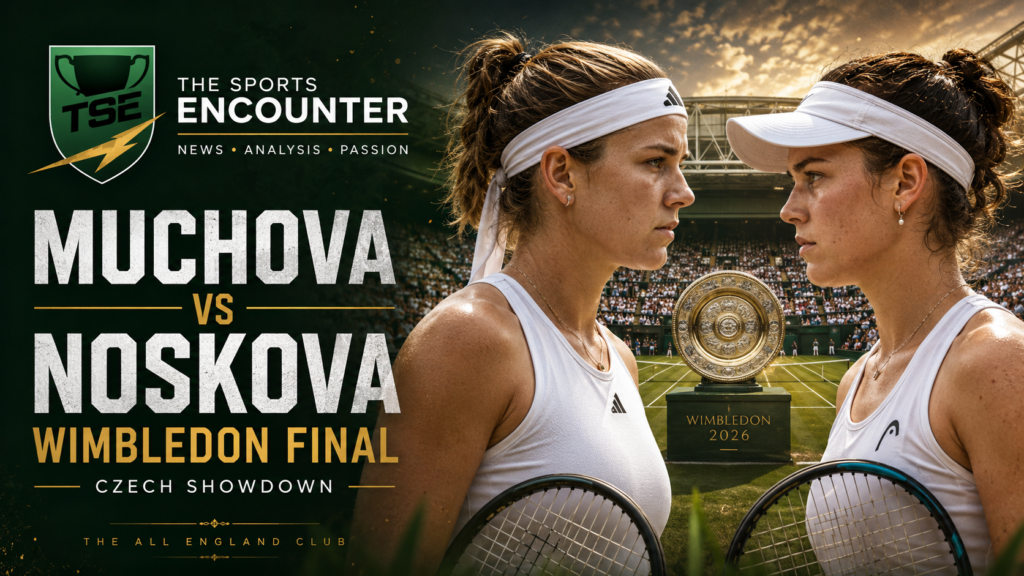
Wimbledon’s women’s singles final will belong to Czech tennis. Karolina Muchova and Linda Noskova came through two very different semi-finals on Thursday to create a historic all-Czech women’s singles final at Wimbledon 2026.
This year, it won’t be a nostalgic footnote.
Not even another nice story from a country with a proud tennis past.
This time, Czech tennis owns the main event.
Muchova survived Coco Gauff in a dramatic Centre Court battle, winning 6-2, 1-6, 7-6(10), while Noskova beat Marta Kostyuk 6-4, 6-4 with the calm of a player who looked ready for her first Grand Slam final before she officially reached it.
The official Wimbledon 2026 ladies’ singles draw now shows a final between the No. 10 seed Muchova and the No. 9 seed Noskova. That final will be the first women’s singles Grand Slam title match between two Czech players in the professional era.
For readers following The Sports Encounter’s wider tennis coverage, this is one of the strongest storylines of Wimbledon 2026: a tournament that started with chaos has reached a final built around national identity, grass-court craft, and two very different Czech personalities.
Muchova Survives Gauff in the Match of the Day
Muchova’s semi-final against Gauff had everything Wimbledon asks from a late-stage Centre Court match: heat, tension, variety, missed chances, physical strain, and a finish that refused to settle down until the last swing.
The Czech 10th seed started beautifully. She broke Gauff twice in the opening set, mixed pace smartly, moved forward when the chance appeared, and sealed the first set with a 111 mph ace. Her game looked made for grass because she refused to play one rhythm for too long. She sliced, volleyed, redirected, defended, attacked, and forced Gauff to solve a different problem almost every point.
Gauff then changed the temperature of the match. After missing her first eight break-point chances, she finally broke through in the second set, took a 3-1 lead, broke again at 5-1, and pushed the match into a decider. That set mattered because Gauff had spent much of this Wimbledon living dangerously, surviving tough matches, and finding ways to extend contests even when her best tennis arrived late.
Muchova had to manage more than Gauff’s comeback. She appeared physically uncomfortable at times, holding her side during the final set. Reuters also reported that she has to manage a grass allergy with medication, sprays, and eyedrops just to perform on the sport’s most famous lawns. Yet her court sense never faded.
The Tiebreak That Changed Everything
The third-set tiebreak became the defining passage of the women’s semi-finals.
Muchova moved ahead, Gauff fought back, and the American eventually held match point at 9-8. Gauff had a look at the court after Muchova floated a return back into play, but she chose a drop shot that fell into the net. Gauff later admitted she had panicked a little in that moment.
That one decision will stay with the match, but it should not reduce the quality of Muchova’s escape. The Czech kept attacking through pressure. She produced a diving volley that took the racket out of her hand and then used a topspin lob during the tiebreak to keep Gauff guessing. Even when she missed one match point of her own, she kept the match on her racket.
Muchova finally closed it after two hours and 35 minutes. Her 6-2, 1-6, 7-6(10) win sent her into a second Grand Slam final and her first Wimbledon final. For a player whose career has often been interrupted by injuries, this felt like more than a result. It felt like a body, a game, and a tennis mind all refusing to give in at the same time.
The performance also adds another layer to a tournament where women’s tennis has kept shifting every few rounds. The Sports Encounter tracked that volatility earlier in the fortnight when Wimbledon Day 6 blew the women’s draw wide open.
Noskova Keeps It Clean Against Kostyuk
If Muchova’s match was a nerve test, Noskova’s win over Kostyuk was a lesson in control.
The 21-year-old Czech beat the Ukrainian 12th seed 6-4, 6-4 in the second semi-final, reaching her first Grand Slam final without letting the occasion turn her tennis frantic. That detail matters. Kostyuk was chasing history of her own, trying to become the first Ukrainian woman in the professional era to reach a Grand Slam singles final. She had already beaten Jasmine Paolini in the quarter-finals and arrived with real momentum.
Noskova never allowed the match to become emotional theater. She served strongly, struck with clean depth, and used the full shape of her game without overcomplicating things. Her power from the baseline was obvious, but the key was how often she backed it with sensible court positioning and quick recovery.
The final point captured the match’s mood. Kostyuk sent a forehand into the tramlines on Noskova’s second match point, and only then did Noskova’s composure crack into disbelief. She later said players always want those moments, but when they actually happen, they do not always know how to react.
That reaction felt natural. Noskova had just reached her first major final at 21. She had also continued a grass-court run that now places her among the most dangerous players on the surface. According to the Reuters report shared before this article, Noskova has won 19 matches on grass over the last two years, more than any other player on tour.
Why Czech Tennis Keeps Working on Grass
The all-Czech final did not happen by accident.
Wimbledon has long rewarded Czech women because the country keeps producing players with a grass-friendly variety. Power alone can win points, but grass rewards players who understand low bounce, quick transitions, sliced variation, net movement, and early timing. Czech players often grow up with broad technical tools rather than one narrow pattern.
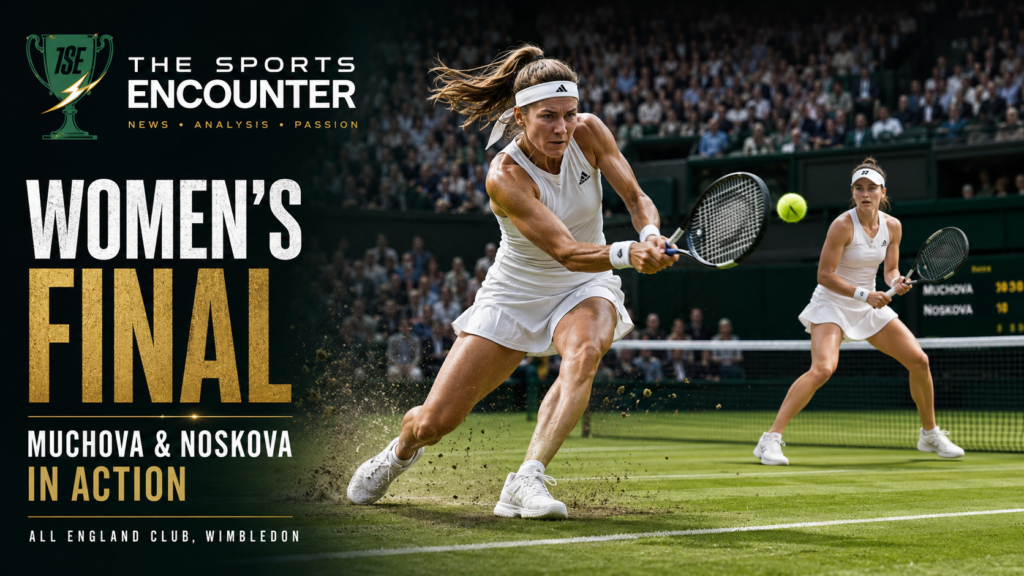
Noskova explained it well after her semi-final, saying Czech players are raised in similar tennis environments, yet remain different in style. She also pointed to creativity as a major reason Czech players keep thriving on grass.
That fits this final perfectly. Muchova is perhaps the more natural artist. She uses touch, angles, net play, and improvised defense. Noskova brings a more direct modern game built around serve, groundstroke weight, and controlled aggression. One wins by changing the picture. The other wins by making the picture too heavy to handle.
Together, they give Wimbledon a final that feels connected to Czech history without copying it.
The Czech Wimbledon Line Is Getting Longer
The Venus Rosewater Dish has already spent plenty of time in Czech hands.
Marketa Vondrousova won Wimbledon in 2023. Barbora Krejcikova followed in 2024. Before them came Petra Kvitova’s titles in 2011 and 2014, Jana Novotna’s emotional triumph in 1998, and Martina Navratilova’s extraordinary Wimbledon legacy, which began with her first singles title as a Czech-born player in 1978 before she later became an American citizen.
Now Muchova and Noskova have guaranteed another Czech champion. Whoever wins on Saturday, a Czech woman will lift the Wimbledon singles trophy for the third time in four years.
The Sports Encounter explored this broader Czech surge before the semi-finals in our feature on Linda Noskova, Karolina Muchova, and Czech Wimbledon history. Thursday’s results turned that angle from possibility into the main story of the tournament.
Gauff and Kostyuk Leave With Different Regrets
Gauff will carry the sharper pain because she had match point. Her drop shot at 9-8 in the tiebreak will be replayed often, but the wider picture is more balanced. This was her best Wimbledon run, and she found a level of resistance on grass that had not always been part of her story at the All England Club.
She said after the match that she left everything out there. That sounded right. She had fought through difficult rounds, forced Muchova into a deciding-set tiebreak, and stood one point from the final. The loss will hurt, but it also gives her proof that Wimbledon can become a serious Grand Slam target for her.
Kostyuk’s disappointment is different. She did not stand one point from the final. She was outplayed by a calmer opponent. Still, her Wimbledon run confirmed her growing place in the top tier of women’s tennis. A semi-final at the All England Club is not a small step. It is a marker.
The women’s draw has offered several such markers this fortnight, from Alexandra Eala’s early shock to Naomi Osaka’s emotional surge. For readers revisiting the shape of the tournament, Wimbledon Day 7 captured the reset created by Djokovic’s record chase and Osaka’s win over Sabalenka.
What the Final Now Becomes
Muchova vs Noskova is more than a national final.
It is experience against arrival. Craft against cleaner power. A 29-year-old who has fought through injuries against a 21-year-old who is learning how quickly a major breakthrough can change a career.
Muchova has already played a Grand Slam final before. Noskova has never been here. Muchova will bring variety, disguise, and risk. Noskova will bring confidence, serve pressure, and a grass record that suggests she belongs on this stage.
There is also a quiet contrast in their semi-final paths. Muchova survived chaos. Noskova avoided it. That may shape Saturday’s final. If the match becomes messy, Muchova may feel at home. If it becomes clean and serve-led, Noskova can make it very difficult for her older compatriot.
Either way, Wimbledon gets a final with history already secured before the first ball.
Key Facts From the Women’s Semi-Finals
| Match | Result | Key Detail |
|---|---|---|
| Karolina Muchova vs Coco Gauff | Muchova won 6-2, 1-6, 7-6(10) | Muchova saved match point and won the final-set tiebreak 12-10 |
| Linda Noskova vs Marta Kostyuk | Noskova won 6-4, 6-4 | Noskova reached her first Grand Slam final |
| Final | Muchova vs Noskova | First all-Czech women’s Grand Slam final in the professional era |
| National record | Czech champion guaranteed | Third Czech Wimbledon women’s singles champion in four years |
Final Word
Wimbledon 2026 needed only one afternoon to turn Czech excellence from a theme into the tournament’s headline.
Muchova gave Centre Court the drama. Noskova gave it the calm. Gauff and Kostyuk left with pain, but also with proof that their grass-court games have moved forward.
Now the final belongs to Czech tennis. Muchova will try to complete one of the most emotional major runs of her career. Noskova will try to turn her first Grand Slam final into the start of something bigger.
For a tournament already rich with stories, including Ostapenko and Arevalo’s mixed doubles title and the continued debate around Novak Djokovic’s Wimbledon title chase, this women’s final now has its own identity.
It is not just a final between two compatriots. It is the latest proof that Czech women still understand Wimbledon’s lawns as well as anyone in the sport.
FAQs
Who won the Wimbledon 2026 women’s semi-finals?
Karolina Muchova beat Coco Gauff 6-2, 1-6, 7-6(10), while Linda Noskova beat Marta Kostyuk 6-4, 6-4.
Who will play in the Wimbledon 2026 women’s singles final?
Karolina Muchova will face Linda Noskova in an all-Czech Wimbledon women’s singles final.
Why is the Muchova vs Noskova final historic?
It is the first women’s singles Grand Slam final between two Czech players in the professional era.
How many Czech women have recently won Wimbledon?
Marketa Vondrousova won Wimbledon in 2023 and Barbora Krejcikova won it in 2024. Either Muchova or Noskova will make it three Czech Wimbledon women’s singles champions in four years.
What was the key moment in Muchova vs Gauff?
Gauff held match point at 9-8 in the final-set tiebreak, but missed a drop shot into the net. Muchova recovered and later closed out the match.