


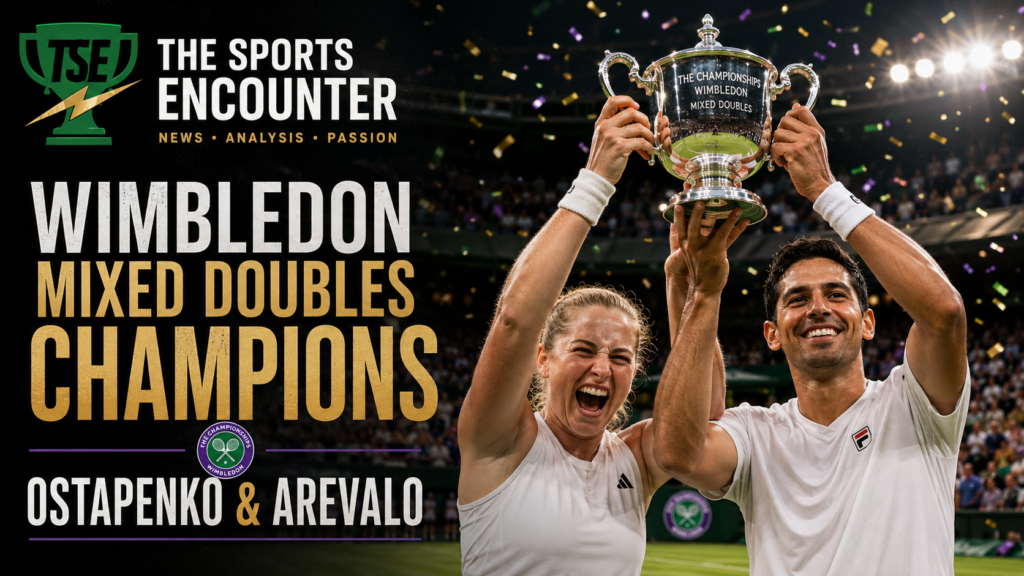
Jelena Ostapenko and Marcelo Arevalo walked into the Wimbledon mixed doubles final as the second seeds, but they left Centre Court with something far more lasting than a seeding beside their names.
They left with a comeback, a first Wimbledon mixed doubles crown, and a piece of tennis history for El Salvador.
Ostapenko and Arevalo fought back from a set down on Thursday to defeat Australia’s Storm Hunter and Marc Polmans 4-6, 7-5, 6-2 in the Wimbledon 2026 mixed doubles final, turning a difficult start into a title-winning finish at the All England Club.
The result gave Ostapenko another major trophy across different formats and made Arevalo the first Salvadoran player to win a Wimbledon title. In a tournament dominated by major singles storylines, this mixed doubles final quietly produced one of the cleanest examples of Grand Slam problem-solving under pressure.
For readers following The Sports Encounter’s full tennis coverage, this final added another important layer to a Wimbledon fortnight already shaped by upsets, comebacks, national breakthroughs, and shifting legacies.
A Fast Australian Start Put Ostapenko and Arevalo Under Pressure
Hunter and Polmans started the final with greater rhythm. The Australian pair broke early in the opening set, stayed compact on serve, and forced Ostapenko and Arevalo into uncomfortable positions in the exchanges.
The first set told a simple story. Hunter and Polmans were sharper at the beginning. They read the court better, handled the early pressure better, and forced the second seeds to chase the match emotionally as well as tactically.
Ostapenko, one of the most explosive ball-strikers in tennis, had to manage frustration after dropping serve in the first set. That detail mattered because mixed doubles can move quickly when one player loses rhythm. Service games are shorter, net pressure arrives faster, and momentum can turn on two loose points.
The Australians took the opener 6-4 and carried that confidence into the second set. For a while, the final looked like it might become their match to finish. They had the lead, the cleaner start, and enough early control to keep Ostapenko and Arevalo under pressure.
The Second Set Changed the Final
The match turned because Ostapenko and Arevalo did not rush the comeback.
Instead of chasing winners too early, they found a steadier rhythm. Arevalo’s calm presence became important beside Ostapenko’s power. The Salvadoran doubles specialist has built his career on structure, positioning, and clear decision-making in tight matches. Those qualities helped settle the partnership after a rough start.
Ostapenko later said she had been frustrated after losing serve in the opening set, but calmed herself down and kept fighting until the last point. She also credited Arevalo’s positivity as a major help during the comeback.
That was the emotional center of the final. Ostapenko brings the shot-making, aggression, and edge. Arevalo brings composure, doubles discipline, and court sense. Once those two qualities began working together, the match changed.
At 7-5 in the second set, the final was level. More importantly, the pressure had moved across the net.
The Decider Became a Statement
The third set was the clearest phase of the match. Ostapenko and Arevalo did not simply survive the comeback. They controlled the finish.
They won the deciding set 6-2, producing the most complete stretch of their final. Ostapenko’s timing improved, Arevalo became sharper at the net, and the Australian pair could no longer hold the same pressure that had defined the opening set.
That final scoreline, 4-6, 7-5, 6-2, captures the match’s arc neatly. The first set belonged to Hunter and Polmans. The second became a test of nerve. The third showed why Ostapenko and Arevalo were seeded second.
The victory also completed a strong run through the mixed doubles draw. The official Wimbledon 2026 mixed doubles draw listed Arevalo and Ostapenko as the No. 2 seeds, and their route included a semifinal win over the third-seeded pair of Christian Harrison and Zhang Shuai.
Why Arevalo’s Wimbledon Title Matters for El Salvador
Arevalo’s victory carries national meaning beyond the trophy ceremony.
He had already made history in men’s doubles by becoming a two-time French Open champion. Wimbledon now gives him a different kind of status. Winning at the All England Club makes him the first Salvadoran player to capture a Wimbledon title, a breakthrough that reaches far beyond doubles specialists and tennis statisticians.
Arevalo said the title meant a lot and spoke about wanting to inspire children in El Salvador to believe they can achieve great things through effort and belief.
That line should not be treated as a routine winner’s quote. For countries without deep Grand Slam infrastructure, one champion can become a reference point. Arevalo’s career has already shown young players from smaller tennis nations that elite doubles success is possible without coming from one of the sport’s traditional power bases.
Wimbledon makes that message louder.
Ostapenko Adds Another Major Chapter
For Ostapenko, this title adds another important line to an already varied Grand Slam resume.
She remains best known for her fearless run to the 2017 French Open singles title, one of the boldest major victories of the modern era. She later added the 2024 U.S. Open women’s doubles title, showing that her game could translate into team formats when paired with the right partner.
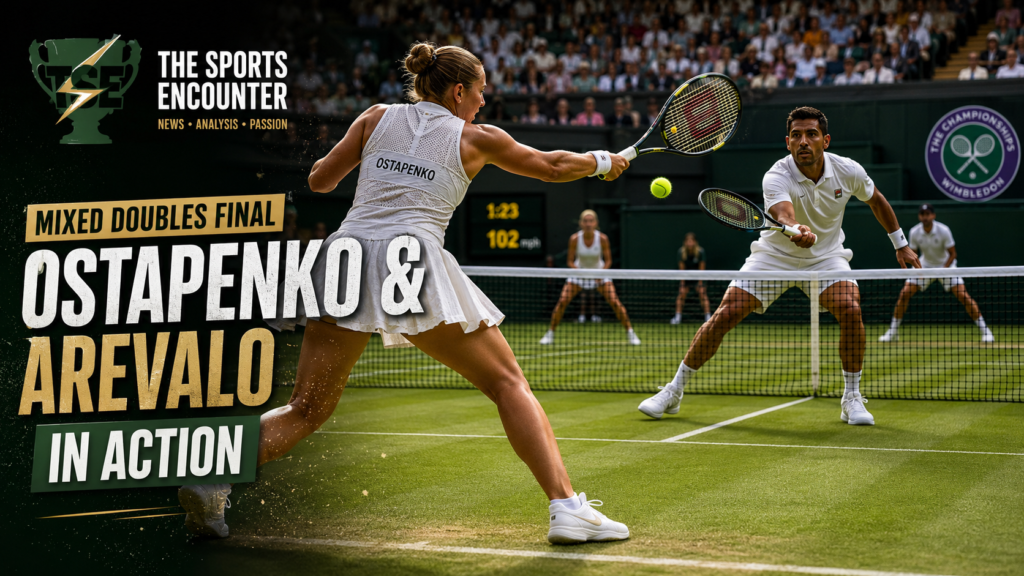
Now she has a Wimbledon mixed doubles crown.
That matters because Ostapenko’s tennis has always lived close to risk. When her timing is slightly off, her matches can become chaotic. When her timing lands, she can change the feel of a contest in minutes. Mixed doubles gives that style a different shape. It rewards bold returns, fast reactions, and the courage to hit through pressure.
In this final, she did not play a perfect match from the start. That made the win more telling. She had to absorb frustration, reset, trust Arevalo, and build her way back into the contest.
Hunter and Polmans Still Leave With a Strong Wimbledon Run
Hunter and Polmans will feel the pain of losing a final after winning the opening set, but their Wimbledon campaign deserves respect.
The Australian pair beat top seeds Andrea Vavassori and Sara Errani earlier in the draw and reached the final with a straight-sets semifinal win over Mate Pavic and Fanny Stollar. Their route was not soft. They earned their place in the title match with strong doubles instincts, court coverage, and early-match sharpness.
Hunter, an experienced doubles player with Grand Slam pedigree, gave the team stability. Polmans brought energy and quick reactions around the court. For a set and a half in the final, that combination looked good enough to win Wimbledon.
The difference came when Ostapenko and Arevalo raised their level at the same time.
Key Facts From the Wimbledon 2026 Mixed Doubles Final
| Detail | Information |
|---|---|
| Champions | Marcelo Arevalo and Jelena Ostapenko |
| Runners-up | Marc Polmans and Storm Hunter |
| Final Score | 4-6, 7-5, 6-2 |
| Event | Wimbledon 2026 Mixed Doubles |
| Seeds | Arevalo/Ostapenko were seeded No. 2 |
| Historic Note | Arevalo became the first Salvadoran to win a Wimbledon title |
| Ostapenko Major Resume | 2017 French Open singles, 2024 U.S. Open women’s doubles, 2026 Wimbledon mixed doubles |
Where This Final Fits in Wimbledon 2026
Wimbledon 2026 has already delivered several sharp storylines across the singles draws. The women’s tournament opened up after major shocks on Wimbledon Day 6, while Novak Djokovic’s record-breaking win and Naomi Osaka’s upset of Aryna Sabalenka gave the second week even more weight.
The mixed doubles final brought a different kind of drama. It had no long five-set format, no singles ranking pressure, and no Centre Court legacy debate. Instead, it offered a compact Grand Slam story built around teamwork, adjustment, and belief.
That is why this title should age well. Ostapenko and Arevalo were not flawless from the first ball. They were tested, pushed behind, forced to recover, and then strong enough to dominate the final set.
In doubles, that is often the truest measure of a champion.
Final Word
Ostapenko and Arevalo’s Wimbledon mixed doubles title was more than a comeback on the scoreboard. It was a reminder that doubles finals often reward the pair that solves problems fastest.
Hunter and Polmans had the first punch. Ostapenko and Arevalo had the better answer.
By the end, the second seeds had turned a nervous start into a controlled finish, giving Ostapenko another Grand Slam trophy and Arevalo a historic place in Salvadoran tennis.
The singles headlines may still dominate Wimbledon’s closing days, especially with Linda Noskova and Karolina Muchova chasing Czech Wimbledon history and Djokovic still pursuing another major milestone in his bid for an eighth Wimbledon title. But the mixed doubles final has already given the tournament one of its most complete title stories.
It had pressure, recovery, history, and a finish worthy of the trophies.