


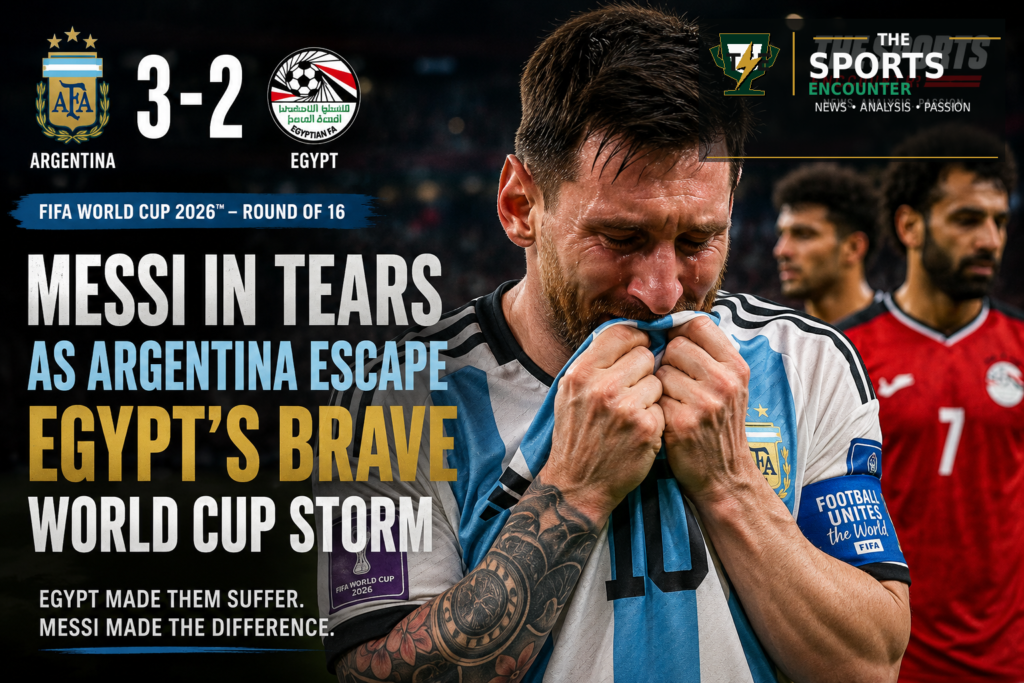
Atlanta had already seen Egypt believe. By the 78th minute, that belief looked strong enough to shake a world champion.
Egypt were two goals up, compact without being passive, brave without becoming reckless, and close to writing the biggest result of their football history. Argentina looked frustrated. Lionel Messi had missed a first-half penalty. Mostafa Shobeir had turned into a wall. The Pharaohs had survived wave after wave and still found the nerve to threaten on the break.
Then the match cracked.
Cristian Romero scored in the 79th minute. Messi equalized five minutes later. Enzo Fernández completed the comeback in stoppage time. In just over 13 minutes of football, Argentina dragged themselves from the edge of elimination into the FIFA World Cup 2026 quarterfinals.
After the final whistle, Messi was crying and emotional after one of the hardest knockout wins of Argentina’s title defense. His reaction told its own story. This was not a routine champion’s victory. Egypt had pushed Argentina to the limit and deserved full credit for a performance built on courage, discipline and belief.
For readers following the full tournament path, this result now sits beside Argentina’s tense extra-time escape against Cabo Verde as another warning sign wrapped inside another survival story.
TL;DR
- Argentina beat Egypt 3-2 in a dramatic FIFA World Cup 2026 Round of 16 match at Atlanta Stadium.
- Egypt led 2-0 deep into the second half before Argentina scored three late goals.
- Mostafa Shobeir produced a heroic first-half display, including a penalty save from Lionel Messi.
- Egypt had a second-half goal disallowed, a decision that shifted the emotional temperature of the match.
- Emam Ashour’s injury before halftime hurt Egypt’s midfield control after the break.
- Egypt received four yellow cards in a volatile knockout match, but there was no red card.
Match Information
| Detail | Information |
|---|---|
| Match | Argentina vs Egypt |
| Result | Argentina 3-2 Egypt |
| Competition | FIFA World Cup 2026 |
| Stage | Round of 16 |
| Venue | Atlanta Stadium, Atlanta |
| Date | July 7, 2026 |
| Top Performer | Lionel Messi, one goal and key creative influence after missing a penalty |
| Egypt Standout | Mostafa Shobeir, penalty save and several major first-half stops |
| Turning Point | Cristian Romero’s 79th-minute header cut Egypt’s lead and shifted the pressure |
| Discipline | Egypt received four yellow cards; no red cards were shown |
| What It Means | Argentina move into the quarterfinals, while Egypt exit after their bravest World Cup knockout performance |
Egypt Were Brave, Organized and Almost Ruthless
Egypt did not treat Argentina like a team to admire. They treated them like a team to trouble.
Yasser Ibrahim’s opening goal in the 15th minute gave Egypt more than a lead. It gave them emotional control. The header came from a set-piece, and it punished Argentina’s early lack of sharpness in the box. From there, Egypt leaned into their best qualities: numbers behind the ball, quick outlets toward Mohamed Salah and Mostafa Zico, and disciplined pressure around Argentina’s central midfield.
Their second goal, scored by Zico after a swift counter-attacking move, pushed the match into shock territory. Egypt were not merely hanging on by then. They had found a route through Argentina’s structure and made the defending champions look exposed in transition.
Credit must go to Egypt here. They were not lucky passengers in a dramatic match. They were organized, fearless and tactically sharp for long periods. Their players ran themselves into exhaustion, their goalkeeper gave them a platform, and their attack kept Argentina worried until the very end.
This was the same Egypt team that had already shown its nerve in the penalty shootout win over Australia. Against Argentina, the Pharaohs added another layer: they showed they could hurt elite opposition before fatigue, pressure and controversy pulled the match away from them.
Shobeir Gave Egypt a First-Half Platform
Mostafa Shobeir’s first half deserved a different ending.
The Egypt goalkeeper saved Messi’s penalty in the 20th minute, reading the low effort and stretching across his line to protect the lead. That moment could have broken a weaker team’s concentration. For Egypt, it deepened belief.
Shobeir then denied Alexis Mac Allister with a sharp reaction save, handled pressure from wide deliveries, and produced a superb low stop from Julián Álvarez before halftime. Argentina created enough openings to equalize early, but Shobeir kept closing the door.
His performance mattered because it turned Egypt’s lead into a tactical weapon. Argentina had the ball, but Egypt had the scoreboard. Every save made Argentina more anxious. Every missed chance made Egypt’s counters feel more dangerous.
The goalkeeper could not hold out forever, but he gave Egypt a real chance to eliminate the defending champions.
Did the Disallowed Egypt Goal Change the Match?
Yes, it changed the match’s emotional and tactical rhythm.
Egypt thought they had scored a stunning counter-attacking goal around the hour mark, only for VAR to intervene and rule it out. The move had everything Egypt wanted: a fast release, Salah’s intelligence, Zico’s timing, and a composed finish before the celebrations were cut short.
The decision did not directly decide the final score on its own, because Egypt later restored a two-goal cushion. Still, the disallowed goal mattered. It denied Egypt the chance to stretch the match into a far more dangerous psychological space for Argentina. At 2-0 earlier, or potentially 3-0 depending on the sequence and timing, the champions would have faced a completely different game state.
Zico’s yellow card after the disallowed goal added another layer of frustration. Egypt had gone from euphoria to punishment in the same passage of play, and that emotional swing fed into the volatility that later consumed the match.
For tournament context, this controversy belongs in the same wider discussion as the VAR-heavy knockout drama covered in The Sports Encounter’s Round of 16 preview.
Ashour’s Injury Hurt Egypt’s Second-Half Control
Emam Ashour’s injury just before halftime hurt Egypt in a very specific way.
Hamdi Fathy brought strength and defensive bite after replacing him, but Egypt lost some of the midfield timing that had helped them survive the first half. Ashour had given Egypt a bridge between pressure resistance and forward movement. Without him, Egypt became more reactive after the break.
That mattered once Argentina increased the tempo.
The Pharaohs still defended with courage, but their second-half possessions became shorter. Salah and Zico had fewer clean support angles. Marwan Attia had more ground to cover. Argentina sensed that Egypt’s midfield legs were beginning to stretch, and Lionel Scaloni’s side pushed more players forward.
Ashour’s absence did not cause Egypt’s collapse by itself. It reduced their ability to slow the match when Argentina needed chaos.
Messi Missed, Then Took Over
Messi’s night looked wounded before it became historic.
The missed penalty could have shaped the whole post-match conversation. Shobeir had denied him, Egypt had the lead, and Argentina’s captain looked visibly frustrated during a first half when his free kick struck the woodwork and his finishing lacked its usual calm.
Then came the late surge.
Messi’s cross helped Argentina find momentum through Romero’s header. Soon after, he scored the equalizer, turning a night of frustration into another defining World Cup scene. The goal also made Messi the only player to score in nine consecutive World Cup finals matches, underlining how long he has remained decisive at the highest level.
This was not the smooth Messi of highlight reels. It was the stubborn Messi of survival football, the version who absorbs a miss, waits for one more opening, and changes a knockout match when the air feels tight.
His emotion after the final whistle made sense. Argentina had been pushed to the edge by a team that refused to shrink. Messi’s tears felt less like celebration and more like release. The captain knew how close Argentina had come to losing control of their World Cup defense.
Argentina have leaned heavily on that quality throughout this tournament. Their group-stage rhythm, covered in the Day 12 World Cup highlights, already showed Messi’s scoring influence. The knockouts have now shown something more uncomfortable: Argentina still need him to rescue games they should control earlier.
Argentina’s Comeback Was Brilliant, but the Warning Signs Remain
Romero’s 79th-minute goal did more than cut the score. It changed Egypt’s body language.
Argentina suddenly attacked with belief instead of desperation. Egypt’s defensive line dropped deeper. The midfield gaps widened. Messi started receiving the ball closer to the box, and Argentina’s runners attacked crosses with greater conviction.
The equalizer arrived with the kind of inevitability that only pressure can create. By the time Enzo Fernández scored in stoppage time, Egypt were no longer playing the same match they had controlled for nearly 80 minutes. They were surviving inside Argentina’s final wave.
Still, this was not a clean Argentine performance. The defending champions again looked vulnerable to direct transitions. Their defensive concentration from set-pieces remains a concern. Their dependence on late moments has become a pattern, not an isolated scare.
For fans tracking the tournament’s broader heavyweight drama, this match now belongs beside the World Cup’s growing list of emotional swings, from Egypt’s historic first win earlier in the tournament to the expanded-format pressure explained in The Sports Encounter’s World Cup curtain raiser.
Cards, Discipline and Late Chaos
This match carried the emotional temperature of a final, and the discipline record reflected Egypt’s rising frustration as Argentina’s comeback gathered pace.
The correct disciplinary summary was four yellow cards to Egypt and no red card in the match. Egypt’s bookings came during a second half that became increasingly tense after the disallowed goal, Argentina’s late pressure, and the stoppage-time winner.
That detail matters because the story should focus on Egypt’s brave fight and emotional frustration without overstating the disciplinary chaos. The Pharaohs were intense, angry at key moments, and heartbroken by the finish, but they were not reduced to ten men, and no red-card dismissal shaped the result.
What This Means for Argentina and Egypt
Argentina move on, but they move on with questions.
Their comeback showed championship nerve. Their first 78 minutes showed why their title defense remains fragile. A team with Messi, Enzo Fernández, Julián Álvarez and Lautaro Martínez can always find a goal. A team that keeps giving opponents belief can also run out of escapes.
Egypt leave with pain, but also with proof.
They led the defending champions by two goals in a World Cup knockout match. They forced Messi into a missed penalty. Their goalkeeper produced one of the tournament’s great individual performances. Their structure, courage and counter-attacking threat gave Argentina more problems than many expected.
Salah’s World Cup run ends in heartbreak, yet Egypt’s tournament should not be reduced to the final 13 minutes. This was a team that turned belief into results, then nearly turned a Round of 16 tie into a national football landmark.
Messi’s emotional reaction after the final whistle captured the real weight of the night. Argentina survived, but Egypt made them suffer for every inch.
Argentina advanced because Messi found one more answer.
Egypt exited because knockout football can punish even the bravest team when control slips for a few minutes.
The Sports Encounter’s World Cup 2026 coverage focuses on fixtures, team news, match analysis, fan stories, tournament trends, and the biggest talking points from football’s global stage.