



Pakistan have gone back to Babar Azam. That sentence alone tells a story. The story of a failed Shan Masood captaincy project, a battered Test side, a fast-bowling identity crisis, a selection committee running out of attractive leadership options, and a cricket board that has spent too many years treating captaincy like a revolving door.
Babar Azam has been named Pakistan’s Test captain for the upcoming two-match series in the West Indies and the three-Test tour of England that follows. The Pakistan Cricket Board confirmed Babar’s appointment for both series while announcing the squad, with the West Indies Tests scheduled from July 25 to August 6 before Pakistan head to England later in August.
On paper, this is a leadership change. In reality, it is an admission.
Pakistan did not simply remove Shan Masood. They conceded that the red-ball reset after Babar’s earlier exit had collapsed. Masood’s record became historically poor. Pakistan’s Test reputation kept slipping. Babar’s own batting suffered in the years after his captaincy was taken away. And now, with Pakistan at the bottom end of the World Test Championship conversation and facing five tough Tests in quick succession, the PCB has returned to the man it once moved away from.
This is not a neat comeback story.
It is a rescue mission wrapped inside a familiar Pakistan cricket contradiction: the same system that unsettled Babar now wants him to restore order.
For more cricket coverage, player analysis, selection debates, and major Test cricket storylines, follow The Sports Encounter’s Cricket section.
The Breaking Point: Shan Masood’s Captaincy Had Run Out of Road
Shan Masood’s removal did not come out of nowhere. It came after a Test captaincy run that had become impossible to defend.
Masood captained Pakistan in 16 Tests and lost 12. That raw number is brutal enough. The deeper issue was not only losing. It was the way Pakistan kept losing.
They lost 3-0 in Australia. They suffered home and away embarrassment against Bangladesh. They failed to protect winning positions. They leaked decisive lower-order partnerships. They lost control at key moments. They became the kind of Test team that could compete for four sessions and still find a way to lose in the fifth.
That is why Aaqib Javed’s explanation matters. The selector and high-performance director pointed not just to results, but to repeated failures in game management: over-rate discipline, DRS calls, toss decisions, and the captain’s responsibility to finish matches. In other words, the PCB’s case against Masood was not merely statistical. It was operational.
Masood’s own batting complicates the picture. He was not removed because he personally failed with the bat. His Test average as captain rose to 34.06 from 28.51 before his appointment, and he produced two centuries and seven half-centuries during that period. The selectors have kept him in the squad, which shows they separated his place as a batter from his failure as captain.
That distinction is fair. It also makes the leadership decision clearer.
Pakistan did not drop Shan Masood the player. They abandoned Shan Masood the Test captain.
Why Babar Again?
The obvious answer is experience. The uncomfortable answer is lack of options.
Babar’s first Test captaincy stint was far from flawless, but it had more structure, more success, and more batting authority than what came after. He led Pakistan in 20 Tests and won 10 of them.
His early captaincy phase brought a sense of direction. Pakistan beat South Africa 2-0 at home. They swept Bangladesh away. They won in Sri Lanka. In 2021, Babar became the first Pakistan captain to win his opening four Tests. That detail now feels almost from another era.
There were problems too. The biggest one was the 3-0 home whitewash against England, the only such defeat in Pakistan’s Test history. That series badly damaged the Babar captaincy narrative because it suggested Pakistan had lost tactical control at home, where they should have been strongest.
Still, when placed beside Masood’s record, Babar’s earlier tenure looks considerably stronger. More importantly, Babar the batter was also better when he was captain. During his first Test leadership run, he averaged above 50 in the format. After losing the captaincy, his Test returns fell sharply. Under Masood, Babar averaged just over 27 in Tests.
That is the real human cost of Pakistan’s captaincy churn.
The board removed the armband, but it may also have removed something less visible: rhythm, authority, and security from its best batter.
Babar’s Batting Decline Was Not Just a Form Slump
Great batters go through lean periods. That is normal. What happened with Babar felt heavier because it arrived in the middle of public captaincy chaos, role changes, squad uncertainty, and Pakistan’s broader decline across formats.
Babar stepped down from captaincy in all formats after Pakistan’s disappointing 2023 ODI World Cup campaign. He was later reappointed as limited-overs captain in 2024, then resigned again from white-ball leadership to focus on his batting. By 2026, he had been dropped from Pakistan’s ODI squad for the Bangladesh series despite scoring an unbeaten century in his previous ODI against Sri Lanka.
That is not the normal arc of a settled world-class player.
It is the arc of a player repeatedly pulled into Pakistan cricket’s leadership storm, then pushed out of it, then dragged back toward it when the structure around him failed.
The Test decline after Babar’s removal cannot be blamed entirely on the PCB taking captaincy away from him. Cricket is not that simple. Pakistan had selection issues, domestic-structure problems, tactical confusion, bowling decline, and a batting order that did not consistently absorb pressure. But Babar’s own drop in Test output under Masood matters because it shows that leadership shuffles do not happen in isolation.
When a board changes captains too often, the damage does not stop at the toss. It affects dressing-room hierarchy. It affects player roles. It affects confidence. It affects how senior players see their future. It affects whether a batter feels trusted or constantly judged by the next administrative mood swing.
Babar was once Pakistan’s central cricketing figure. Then he became a former captain trying to find form inside a team that had lost its shape.
Now he is being asked to become the center again.
Pakistan’s Test Decline After Babar Was Removed
Pakistan did not become a stronger Test team after moving away from Babar.
That is the hard truth.
Under Shan Masood, Pakistan’s red-ball cricket produced one short burst of hope, a comeback series win over England, but the larger picture remained bleak. The team lost four of seven series under Masood, won only one, and finished at the bottom of the World Test Championship 2023-25 table during that cycle.
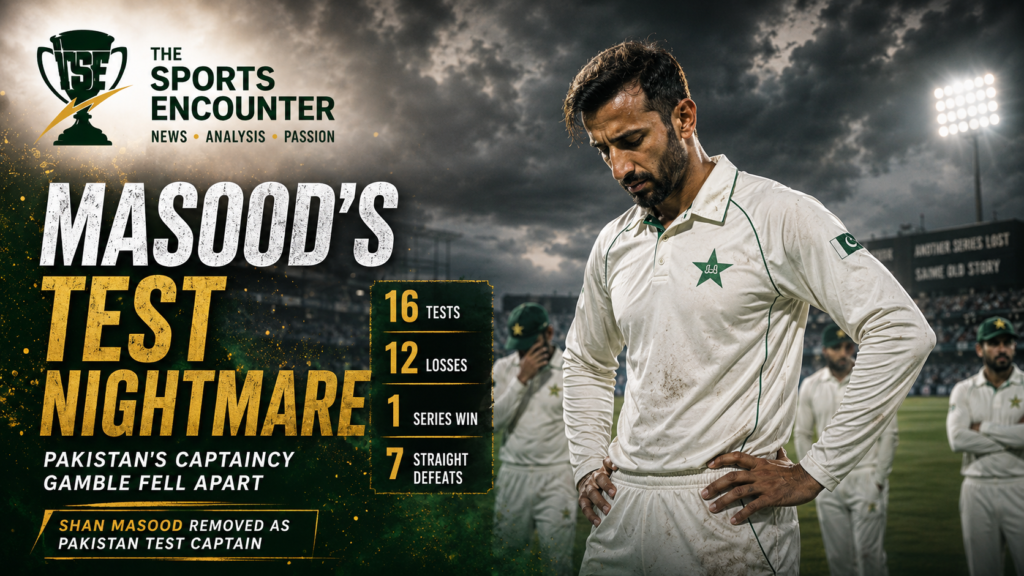
The post-Babar phase included a 3-0 defeat in Australia, historic trouble against Bangladesh, home failures, and a seven-Test losing streak that equaled Pakistan’s worst in the format.
Pakistan’s Test cricket also lost something harder to measure: intimidation.
For decades, even flawed Pakistan Test sides carried danger. They had mystery spin, reverse swing, unpredictable fast bowling, and batters who could turn a session. In recent years, that aura has weakened. Teams no longer fear Pakistan’s home conditions the same way. Touring sides have found ways to attack. Even the fast-bowling production line, once Pakistan’s most reliable cricketing identity, now looks uncertain.
That is why this captaincy change arrived alongside major selection surgery.
Pakistan’s upcoming England tour will also land against a wider debate around modern Test identity. England are going through their own red-ball reckoning, which we explored in our deep analysis of how Bazball changed and exposed England.
The Squad Tells Its Own Story: Pakistan Are Not Just Changing Captains
Babar’s return came with major omissions. Shaheen Shah Afridi, Hasan Ali, and Noman Ali were all left out of Pakistan’s squad for the West Indies and England Tests, while Saud Shakeel was ruled out of the West Indies tour because of fitness concerns.
This is not a cosmetic reshuffle. It is a red-ball reset.
Shaheen’s omission is the biggest signal. Since returning from a knee injury in 2023, he has not been the same Test bowler. The reporting around the squad noted that he had taken only 27 wickets in 16 Test innings at an average of 40.11, with a strike rate of 67.6. Those are not spearhead numbers. They are warning signs.
Aaqib Javed’s comments about pace were even sharper. He said Pakistan were concerned about fast bowlers’ speeds dropping to around 126 kph on the second or third day of Tests in Bangladesh. That single number tells a grim story. Pakistan cricket has spent generations celebrating pace as an instinct. Now the selectors are using speed-gun evidence from a camp to justify a refresh.
That is why Ubaid Shah has been fast-tracked.
Ubaid, the youngest of the Shah brothers, has taken 72 first-class wickets in 16 matches since his debut in October 2024. His selection is not just about promise. It is about Pakistan trying to rediscover velocity in a format where their attack has become too easy to survive.
Noman Ali’s omission and Ali Usman’s call-up also point to a more evidence-led selection approach. Ali Usman has 192 first-class wickets at 28.81 and topped the 2026-27 Quaid-e-Azam Trophy wicket charts with 48 wickets at 21.10, including six five-wicket hauls in eight matches for Multan.
Pakistan are trying to say performance matters again.
The challenge is whether the same system can stay patient long enough to let that principle work.
Pakistan’s fast-bowling identity has always been central to its Test cricket image. In England, that conversation will become even sharper because England’s own Test tradition has been built around elite all-rounders and seam pressure, a theme we revisited in Sir Ian Botham: England’s Greatest All-Rounder and Cricket’s Ultimate Showman.
The Musical Chairs Problem
Pakistan cricket’s captaincy churn has become more than a meme. It is now a performance issue.
Babar was captain. Then he was not. Masood came in. Rizwan took white-ball duties. Shaheen became ODI captain. Salman Ali Agha’s name floated around the Test conversation. Babar has been brought back.
That is not succession planning. That is reaction management.
Elite Test teams build identity over time. Australia know what kind of cricket they want to play. India have developed depth and role clarity. England, even when debated, have a recognizable Test philosophy. South Africa, New Zealand, and Sri Lanka have their own constraints, but they rarely look as administratively restless as Pakistan.
Pakistan, by contrast, often confuse change with progress.
A captain loses a series, so a new captain arrives. A batting star loses form, so the leadership question returns. A bowler slows down, so the whole pace structure is debated. A new selector enters, and the language changes again. Everyone talks about long-term planning, but too many decisions feel driven by the last bad scorecard.
This is how teams lose Test reputation.
Not in one defeat. Not in one collapse. Not in one bad tour.
They lose it through years of inconsistency, where no captain gets enough stability, no player feels fully protected, and no cricketing philosophy survives long enough to become culture.
The pressure on modern Test captains is not unique to Pakistan. England have faced similar questions around aggression, control, and leadership, which we explored in The Curious Case of Ben Stokes and His Opponents.
Babar’s First Stint: What Worked and What Failed
To understand why Pakistan returned to Babar, it is worth separating the myth from the record.
His first stint was not perfect. The England whitewash at home was a huge failure. Pakistan’s tactics at home were often questioned. His captaincy sometimes looked conservative. And critics argued that Babar the leader lacked the ruthlessness that elite Test captains need.
But his team did win. Pakistan won 10 of his 20 Tests as captain. They had a clearer top-order identity. Babar’s own batting was stronger. His authority inside the dressing room was obvious. The side looked less fractured than it later became.
His early captaincy achievement also mattered symbolically. Babar became the first Pakistan captain to win his opening four Tests, while Pakistan had also completed a strong series-winning run across formats during that period.
That does not mean Babar was a tactical genius. It does mean Pakistan had a period when leadership, batting form, and results moved in the same direction.
That alignment disappeared later.
Why the West Indies Series Is Bigger Than It Looks
A two-Test series in the West Indies may not sound like the biggest stage for a leadership restart, but for Babar, it is crucial.
Pakistan cannot afford to enter the England tour carrying fresh damage. The West Indies series must give Babar three things: a win, runs, and authority.
The first Test begins on July 25 at the Brian Lara Cricket Academy in Tarouba. The second is scheduled at Queen’s Park from August 2 to 6. After that, Pakistan travel to England for Tests at Headingley, Lord’s, and Edgbaston.
That schedule is unforgiving.
West Indies conditions will test patience and adaptability. England will test technique, temperament, seam movement, and captaincy under scrutiny. If Pakistan stumble in the Caribbean, Babar will reach England already under pressure. If they win well, the tour of England becomes a bigger, cleaner examination rather than another crisis response.
For Babar personally, the West Indies series is the reset before the storm.
That England tour will carry major leadership intrigue because England are also moving into a new phase after Ben Stokes’ retirement and England’s next Test chapter.
The Shaheen Question Adds Another Layer
Babar’s return also comes without Shaheen Shah Afridi in the Test squad.
That matters because Babar’s earlier captaincy identity was closely tied to a more threatening Pakistan bowling unit. Shaheen at full tilt gives any captain a different kind of power. He attacks new batters. He shapes sessions. He creates fear before lunch on day one.
The current Shaheen question is uncomfortable. Has Pakistan dropped him to manage his workload? Has his Test bowling declined too far? Is he now being nudged toward format specialization? Aaqib’s comments about format-wise central contracts suggest the PCB is thinking seriously about who belongs where.
For Babar, this means his second stint begins without the automatic strike weapon he might have expected in earlier years.
That makes his captaincy harder and more interesting. He must lead not only a team, but a transition.
What Babar Must Fix Immediately
Babar’s second Test captaincy stint will be judged on more than whether Pakistan beat West Indies.
He has to fix five things quickly.
1. Restore batting calm
Pakistan’s batting has too often moved between soft starts and sudden collapses. Babar must set the tempo himself. Runs from him will calm the dressing room faster than any press conference.
2. Give Shan Masood a clear role
Masood remains in the squad. That could be awkward, or it could be useful. Babar must make sure Masood is treated as a batter, not as a defeated former captain haunting the XI.
3. Protect the young players
Ubaid Shah, Ali Usman, and Awais Zafar cannot be treated as instant miracle fixes. Pakistan must give them clarity, not panic after one bad innings or spell.
4. Rebuild fast-bowling standards
If Pakistan’s pace is dropping deep into Tests, that is not only a selection issue. It is a conditioning, workload, and tactical issue. Babar will need to use his bowlers smarter.
5. Close games
This was the biggest criticism of Masood. Pakistan must stop letting strong positions drift. Babar’s first major test will be whether his team can finish sessions, days, and matches.
Scorecard of the Pakistan Test Reset
| Area | What Changed | What It Means |
|---|---|---|
| Captaincy | Babar Azam replaces Shan Masood | PCB returns to experience after failed red-ball reset |
| Former captain | Masood stays in squad | Batting form saved his place, captaincy record cost him leadership |
| Fast bowling | Shaheen and Hasan dropped, Ubaid Shah called up | Pakistan want more pace and stamina across long spells |
| Spin | Noman Ali out, Ali Usman in | Domestic red-ball performance rewarded |
| Middle order | Saud Shakeel unavailable for West Indies, Awais Zafar called up | Pakistan test new batting depth before England |
| Immediate schedule | West Indies then England | Babar gets no soft landing in his second stint |
Pakistan Squad for West Indies and England Tests
Babar Azam (capt), Aamir Jamal, Abdullah Fazal, Ali Usman, Azan Awais, Imam ul Haq, Khurram Shahzad, Mohammad Abbas, Mohammad Ali, Mohammad Rizwan (wk), Mohammad Awais Zafar, Mohammad Ghazi Ghouri, Sajid Khan, Salman Ali Agha, Shan Masood, Ubaid Shah.
Final Word: Babar Is Back, But Pakistan Must Stop Breaking Its Own Rhythm
Babar Azam’s return as Test captain will please many Pakistan fans, but it should not be treated as a magic fix.
He can bring authority. He can bring experience. He can bring a better record than Shan Masood. He can also bring personal motivation after a messy period in which his captaincy status, batting form, and standing inside Pakistan cricket all took hits.
But one man cannot repair a system that keeps changing direction every few months.
Pakistan’s Test decline after Babar’s first stint was not caused by one captain alone. It was built through unstable leadership, confused selection, declining pace standards, weak game management, and a board culture that too often reacts rather than plans.
Now Babar has the job again.
The West Indies series will be his first chance to show that Pakistan can still win Test cricket with clarity rather than chaos. England will be the harder examination. And the PCB, for once, must resist its oldest temptation: moving the chairs again before the music has even settled.
Babar is back.
Now Pakistan have to prove they know why.
FAQs
Why is Babar Azam back as Pakistan Test captain?
Babar Azam has returned after Shan Masood was removed following a poor Test captaincy run. Pakistan lost 12 of 16 Tests under Masood, and selectors decided a leadership change was needed before the West Indies and England tours.
What was Babar Azam’s Test record as Pakistan captain before this return?
Babar previously captained Pakistan in 20 Tests and won 10 of them. His tenure included home success against South Africa and away series wins in Bangladesh and Sri Lanka, but also a 3-0 home whitewash against England.
Why was Shan Masood removed as Pakistan Test captain?
Masood was removed because Pakistan’s Test results declined badly under his leadership. The selectors also pointed to repeated failures to finish close matches, poor game management, over-rate issues, DRS calls, toss decisions, and lack of results.
Has Shan Masood been dropped from the Pakistan Test squad?
No. Shan Masood has been removed as captain but remains in the squad. His batting improved during his captaincy tenure, so the selectors separated his role as a batter from his leadership record.
Why has Shaheen Shah Afridi been dropped from the Test squad?
Shaheen Shah Afridi has been left out after a difficult period in Test cricket since returning from a knee injury. His recent Test numbers have been poor, and selectors have also raised concerns about Pakistan fast bowlers losing pace during long matches.
When does Pakistan’s West Indies Test series begin?
Pakistan’s first Test against West Indies begins on July 25, 2026, at the Brian Lara Cricket Academy in Tarouba. The second Test will be played at Queen’s Park from August 2 to 6.
Who are Pakistan’s new players in the Test squad?
Ubaid Shah, Ali Usman, and Mohammad Awais Zafar have earned maiden call-ups. Ubaid strengthens the pace department, Ali Usman adds left-arm spin depth, and Awais Zafar provides a middle-order batting option.
The Sports Encounter’s cricket coverage focuses on match analysis, player form, team selection, tactical debates, tournament context, and the biggest stories shaping world cricket.