


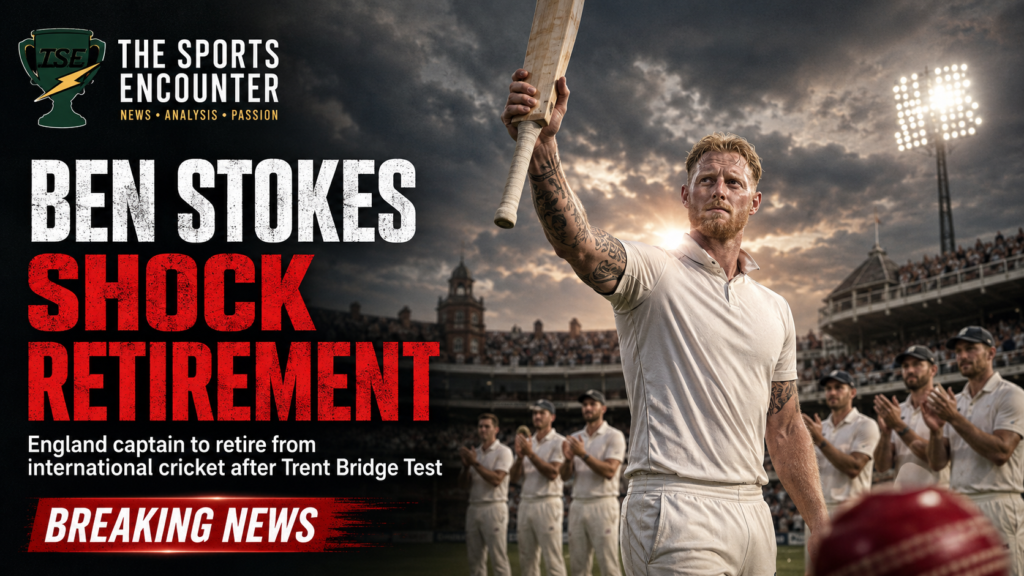
Ben Stokes has announced that he will retire from international cricket at the end of England’s third Test against New Zealand at Trent Bridge, sending a shockwave through English cricket during the middle of a live series decider.
The England Test captain told his teammates before play on the fourth morning in Nottingham that this would be his final match in international cricket. The ECB later confirmed the decision, bringing a 15-year England career and a four-year Test captaincy tenure to an abrupt close.
The timing makes the announcement even more dramatic. England are still fighting New Zealand in the final Test of the series, with the match, the series, and the future of the Test side all suddenly tied to Stokes’ farewell.
For more cricket coverage and England team analysis, follow The Sports Encounter’s Cricket section.
Key Facts: Ben Stokes Retirement Announcement
| Detail | Information |
|---|---|
| Player | Ben Stokes |
| Team | England |
| Role | Test captain and all-rounder |
| Announcement date | June 28, 2026 |
| Final international match | Third Test vs New Zealand |
| Venue | Trent Bridge, Nottingham |
| Retirement scope | All international cricket |
| England captain since | April 2022 |
| Immediate issue | England must appoint a new Test captain |
| Main succession names | Joe Root and Harry Brook |
Read Next
- New Zealand Force Series Decider With Crushing Win Over England
- The Curious Case of Ben Stokes and His Opponents
- Joe Root Reclaims No. 1 Test Ranking as England’s Modern Great Keeps Defying Time
Stokes Tells England Teammates Before Play
The news first reached the England dressing room before the start of day four at Trent Bridge.
According to ESPNcricinfo’s report by Matt Roller, Stokes told his teammates and the ECB of his decision on Sunday morning. He was emotional while speaking to the dressing room and urged England’s players to give everything for the remaining two days of the Test.
The ECB then confirmed through its official retirement announcement that Stokes would retire as England Men’s Test captain and from international cricket after the conclusion of the third Rothesay Test against New Zealand.
The scene quickly became one of the most unusual retirement moments in modern English cricket. Stokes was not watching from the sidelines or issuing a statement after a series had ended. He was still bowling, still captaining, and still trying to drag England through a tense Test match.
A Guard of Honor, Then a Wicket
Stokes returned to the field to a guard of honor after the news reached the crowd. Trent Bridge rose for a player who has carried England through some of its most dramatic cricketing days, but the emotional pause did not last long.
Shortly after the announcement, Stokes continued into another demanding spell. He received a loud ovation when he came back to bowl and immediately dismissed Zak Foulkes, caught at second slip.
That moment gave the retirement news a strange sense of theatre. England were processing the end of an era while Stokes was still shaping the session in real time.
Reuters reported that the decision brings an international career that began in 2011 to a close, while The Guardian’s live coverage captured the emotional atmosphere around the ground as New Zealand continued to build pressure in the match.
Why the Timing Matters
The retirement lands at a deeply unstable moment for England.
Stokes had only recently returned to the side after missing the second Test at The Oval on disciplinary grounds. Reuters reported earlier this week that Stokes had said his focus was solely on winning the series-deciding Test after a turbulent fortnight.
That context now looks even more significant.
Before the Trent Bridge Test, Stokes had been asked whether he was committed to seeing out the rest of his central contract. He avoided a long-term commitment and said he was focused on the outcome of the week.
Now England know why that answer carried so much weight.
His retirement also follows a difficult run of results. England entered the Trent Bridge decider having won only two of their previous nine Tests. New Zealand had already punished them heavily at The Oval, where Joe Root deputized as captain.
The Sports Encounter covered that setback in detail after New Zealand forced a series decider with a crushing win over England.
ECB Pays Tribute, But Stokes Offers No Public Explanation Yet
The ECB’s announcement included tributes from chair Richard Thompson and chief executive Richard Gould, but Stokes himself was not quoted in the statement.
That absence matters. It means his full explanation has not yet been publicly laid out.
Thompson described Stokes as one of England’s greatest cricketers and one of the defining figures of his generation. Gould praised his skill, resilience, passion, and influence on teammates and supporters.
Those comments underline the scale of the moment, but they do not answer the central question England fans will now ask: why now?
Stokes reportedly told teammates that the reason could wait. That leaves the immediate story focused on the decision itself, the timing, and the consequences for an England team already under pressure.
England Now Need a Captain
The biggest practical issue is captaincy.
Stokes has led England’s Test side since April 2022, when he replaced Joe Root and joined forces with Brendon McCullum. Together, they reshaped England’s red-ball identity around aggression, pressure, and risk.
Now England must decide whether that identity continues without the player who embodied it.
Root is the obvious short-term candidate. He has already captained England, remains the team’s most senior batter, and deputized at The Oval when Stokes was absent. His experience would make him a safe interim choice.
Harry Brook is the more natural long-term option. He is Stokes’ vice-captain and one of England’s central players for the next era. Yet the fact Root stepped in at The Oval shows England may not see the transition as simple.
The captaincy decision will shape more than team sheets. It will decide whether England continue with the Stokes-McCullum template, adjust it, or begin a more serious reset.
McCullum Era Faces Its Hardest Question
Brendon McCullum now faces the biggest red-ball question of his England tenure.
The Stokes-McCullum partnership worked because the captain and coach were aligned in personality, not just tactics. Stokes gave England the emotional permission to attack. McCullum gave that instinct structure and backing.
Without Stokes, the same methods may feel different.
A new captain can still play positively. England can still bat aggressively and chase boldly. But the Stokes era carried its authority because the captain lived the risk himself. He took the blows, bowled through pain, and framed pressure as something to attack.
Now England need to work out whether the approach survives as a team philosophy or whether it was too closely tied to one leader.
The timing, again, is brutal. England are not making this decision after a calm summer. They are facing it during a tense Test, after a disciplinary storm, amid poor recent results, and with no obvious automatic successor.
The Immediate Cricket Picture After Ben Stokes Bows Out
The Trent Bridge Test now has a double meaning.

England must still finish the match against New Zealand, but every session now sits inside the shadow of Stokes’ final international appearance. If England are left chasing a major fourth-innings target, the final day could become one of the strangest farewell acts in recent Test history.
New Zealand, meanwhile, will not be distracted by the emotion around Stokes. They have already shown in this series that they can expose England’s weaknesses, absorb pressure, and punish loose phases.
For England, the remaining cricket matters. A home series defeat would sharpen the questions around succession and direction. A fightback would give Stokes a more fitting exit, even if the larger uncertainty remains.
What Happens Next
Stokes has not yet confirmed whether he will continue playing cricket outside the international game.
His white-ball England career had already faded from view. He had not played a limited-overs international since the 2023 World Cup and had not featured in a white-ball match of any kind since suffering a hamstring injury during the Hundred in 2024.
The immediate England questions are more urgent.
Who captains the Test side next? What happens to McCullum’s approach? Does Root return as a short-term bridge? Is Brook ready now? How quickly does the ECB want to make the decision?
A special tribute to Stokes’ career, achievements, and greatest performances will come later. For now, the story is the shock of the announcement and the vacuum it leaves behind.
Final Verdict
Ben Stokes’ retirement announcement has turned the Trent Bridge Test into the end of an era.
The timing is startling. The emotional weight is obvious. The consequences for England are immediate.
Stokes is leaving international cricket before England have solved their captaincy succession, before the current series has finished, and before the future of the Test team feels secure.
That is why this is more than a retirement note. It is a breaking point for England’s red-ball project.
The tribute can wait.
The transition cannot.
FAQs
When will Ben Stokes retire from international cricket?
Ben Stokes will retire after the ongoing third Test between England and New Zealand at Trent Bridge.
Is Ben Stokes retiring from all international cricket?
Yes. The ECB confirmed that Stokes is retiring from international cricket, not only from Test cricket.
Did Ben Stokes explain why he is retiring?
Not fully. He told teammates of his decision before play on day four, but his complete public explanation has not yet been given.
Who could replace Ben Stokes as England Test captain?
Joe Root is the safest short-term option, while Harry Brook appears the leading long-term candidate.
Why is Ben Stokes’ retirement such a major issue for England?
England are losing their captain, senior all-rounder, tactical leader, and the central figure of the Stokes-McCullum Test era.
The Sports Encounter’s cricket coverage focuses on match reports, player performances, tactical analysis, selection debates, rankings, tournament trends, and the biggest stories shaping the modern game.