


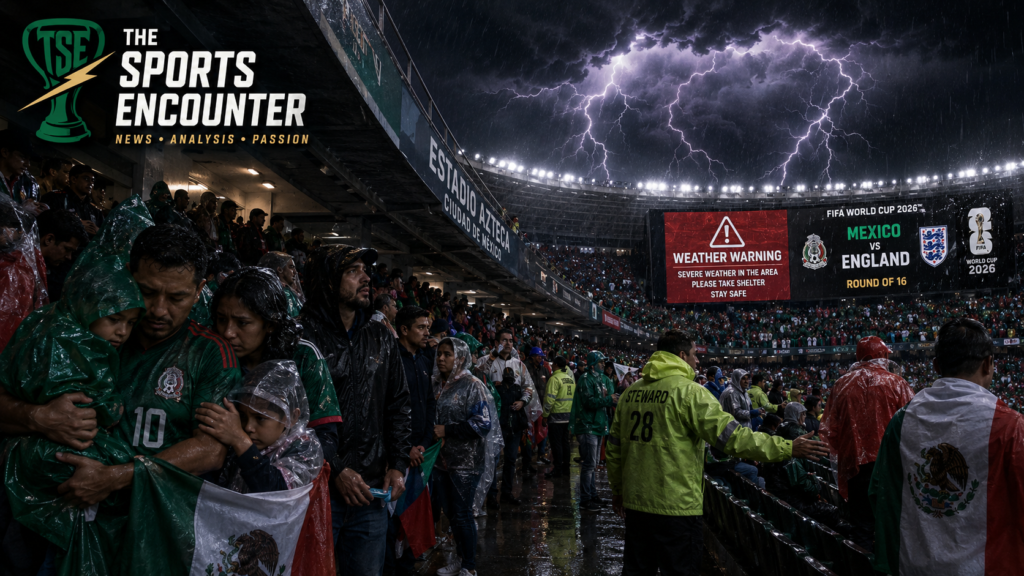
The first warning at the Azteca did not come from Mexico’s press, England’s counterattack, or the noise of a crowd ready to shake one of football’s most historic stadiums.
It came from the sky.
Mexico vs England was supposed to begin as a football storm. A host nation chasing a deeper World Cup run. A European heavyweight stepping into altitude, noise, pressure, and memory. A Round of 16 match carrying national hope on one side and tournament expectation on the other.
Then severe weather moved into the story.
Key Facts Box
| Detail | Information |
|---|---|
| Match | Mexico vs England |
| Competition | FIFA World Cup 2026 |
| Stage | Round of 16 |
| Venue | Estadio Azteca, Mexico City |
| Main issue | Thunderstorms near the stadium |
| FIFA action | Shelter-in-place order before kickoff |
| Stadium warning | “Thunderstorm activated, please take your seats” |
| Fans affected | Supporters traveling to the venue sought cover under bridges and awnings |
| Wider concern | Weather disruption, fan safety, kickoff planning, and tournament operations |
| Previous related issue | Mexico’s Round of 32 match against Ecuador was delayed due to rain |
A shelter-in-place order was issued before the Mexico vs England FIFA World Cup 2026 last-16 clash after thunderstorms developed around Estadio Azteca. FIFA said people working on the pitch were asked to move into the tunnel, while the big screen inside the stadium warned that severe weather was approaching. Outside the venue, displays told fans: “Thunderstorm activated, please take your seats.”
For supporters walking toward the stadium, the night suddenly became less about chants and more about cover. Some fans were seen sheltering under bridges and awnings as the weather threatened to disrupt one of the tournament’s biggest knockout matches.
This was not just rain before kickoff.
It was a storm before the storm.
For readers following the wider knockout picture, the weather scare now adds another layer to a tournament phase already shaped by pressure, VAR debate, late drama, and shifting momentum in the FIFA World Cup 2026 Round of 16.
The Azteca Was Ready for Noise. It Got Thunder First
Estadio Azteca does not need help creating drama.
The stadium carries football memory in its concrete, shadows, tunnels, and upper tiers. It has hosted World Cup history that still feels alive decades later. Every major match there arrives with echoes.
Mexico vs England gave the place another emotional charge.
Mexico entered the night with the kind of pressure only a host nation knows. Fans did not come only to watch a match. They came carrying years of expectation, the dream of a deeper run, and the old desire to turn home advantage into history.
England arrived with a different burden. Every tournament match involving England travels with noise, scrutiny, hope, and fear. Recent performances had already tested the team’s control, especially after Harry Kane’s late brilliance in England’s comeback against DR Congo.
However, weather changed the buildup before either team could impose itself.
Thunderstorms do not care about tactical plans. They do not respect kickoff windows, television schedules, player routines, or national emotion. A storm can turn a knockout match into an operational emergency within minutes.
That is why the Azteca warning mattered.
The stadium was ready for a football explosion. Instead, it had to manage a safety alert.
Why This Was More Than a Weather Delay
Football has always had a strange romance with rain.
Supporters remember soaked shirts, sliding tackles, muddy socks, goalkeepers punching crosses through mist, and fans singing through storms. Rain can make football feel raw and beautiful.
Thunderstorms are different.
Rain affects the game. Lightning threatens lives.
That distinction matters. Once severe weather approaches a stadium, the issue moves beyond sporting inconvenience. Pitch staff, volunteers, security teams, camera crews, players warming up, and fans moving through open areas all become part of the safety equation.
FIFA reportedly considered moving the match forward but kept the original kickoff time. Local reports also suggested the fixture could move to 12:00 p.m. local time because of the forecast. In the end, the original plan remained.
That decision can be understood.
A World Cup knockout match cannot be moved casually. Broadcasters, transport systems, police planning, ticket holders, hospitality teams, volunteers, stadium workers, international viewers, and team routines all depend on timing. A change of several hours can create a different set of problems.
Still, keeping the kickoff time carried its own risk.
When a shelter order appears before a match, tournament organizers must explain the thinking behind the decision. Fans need clarity. Teams need confidence. Workers need instructions. Broadcasters need certainty, but safety must sit above schedule protection.
This is where FIFA faces the bigger test.
The governing body does not only run matches. It runs trust.
Supporters can follow official tournament information through the FIFA World Cup 2026 official website, which FIFA describes as the 23rd edition of the tournament and the first to feature 48 teams across three host countries.
Weather Has Become a World Cup 2026 Story
The Mexico vs England warning did not happen in isolation.
Mexico’s Round of 32 match against Ecuador had already been delayed because of rain. That earlier disruption should have made one thing clear: weather is not background scenery in this tournament. It is part of the competition environment.
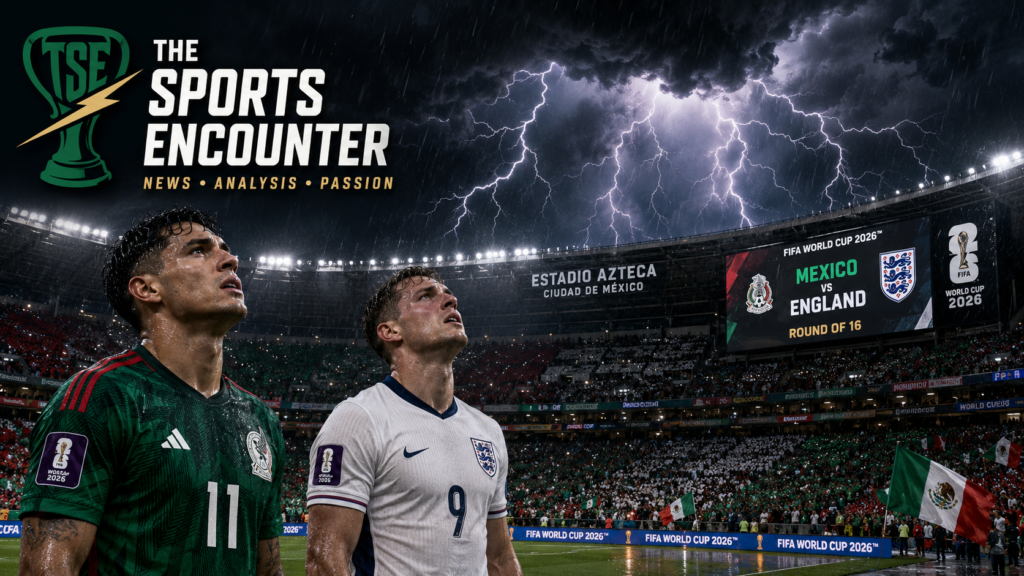
World Cup 2026 has already stretched football across different climates, cities, altitudes, kickoff windows, and travel patterns. The tournament’s scale has created a bigger event, but it has also created more exposure to disruption.
Heat has been one part of the story. The debate over player welfare and match rhythm grew after hydration breaks became one of World Cup 2026’s most divisive issues. Now storms have added another layer.
Weather affects more than comfort.
A delayed warmup changes player routines. A slick pitch alters passing speed. Heavy rain can make defenders hesitate and goalkeepers spill shots. Lightning warnings can empty active areas, pause preparation, and create anxiety before the first whistle.
Meanwhile, fans experience the situation in a more personal way.
A supporter may spend months saving for tickets, travel, lodging, shirts, food, transport, and one unforgettable night. If severe weather hits near the stadium, that fan does not think in terms of “operational protocols.” They think about safety, family, shelter, timing, and whether they will still get to see the match they traveled for.
That human side must sit at the center of World Cup planning.
Mexico’s Home Advantage Meets a Different Kind of Pressure
For Mexico, the Azteca crowd is part of the team’s emotional engine.
Home fans do not simply fill seats. They lift duels, amplify pressure, energize transitions, and turn defensive clearances into moments of belief. At the Azteca, noise can become a tactical force.
Weather can interrupt that force.
If fans are delayed outside the stadium, the emotional buildup changes. If supporters arrive wet, anxious, or scattered, the first wave of atmosphere may feel different. A shelter warning can also turn a crowd from aggressive to cautious before kickoff.
Mexico had already shown the power of home momentum earlier in the tournament. Their group-stage charge included a confident performance in Mexico’s win over Czechia, while their tense battle with Korea Republic showed how narrow World Cup margins can become when one mistake changes everything in Mexico’s group-stage fight against South Korea.
Against England, every small shift matters.
A slower start can calm the visiting team. A broken rhythm can reduce the early emotional punch. A slick surface can favor quick transitions or punish loose defending. For Mexico, the mission becomes mental as much as tactical: stay ready, keep the crowd close, and make the storm feel like part of the night rather than a disruption to it.
England Must Handle More Than the Ball
England’s challenge is also bigger than the weather.
The team must manage altitude, crowd hostility, knockout pressure, and a host nation with everything to gain. Add storm disruption, and the night becomes a test of emotional control.
A weather delay can hurt a team that likes structure. Players warm up, stop, wait, stretch again, and restart. Coaches adjust messaging. Medical staff manage body temperature. Goalkeepers need touch and rhythm. Strikers need sharpness. Midfielders need their first few passes to settle.
For England, this creates a familiar tournament question: can they stay calm when the match refuses to unfold cleanly?
The answer may define the night.
Kane’s leadership becomes important. So does the experience of senior players who understand that knockout football rarely gives perfect conditions. England cannot allow the weather warning to become an excuse if Mexico starts fast.
Instead, they need to treat the first 15 minutes like a separate match.
Win second balls. Avoid panic clearances. Slow the crowd when needed. Use possession to breathe. Then build into the contest.
A storm can unsettle both teams, but the more composed side usually gains first.
Could Weather Change the Match Itself?
Yes, and not only through a delay.
A wet surface can increase ball speed and make first touches harder. Defenders may mistime tackles. Goalkeepers may struggle with shots that skid low. Set pieces become more dangerous because attackers need only one mistimed clearance or one loose punch.
In addition, heavy rain changes risk calculations.
Fullbacks may think twice before overlapping. Center backs may clear earlier. Midfielders may avoid turning under pressure. Coaches may ask for more direct balls into channels. Teams with strong second-ball reactions can benefit because matches become less polished and more instinctive.
For Mexico, that could help if they feed off emotion and quick forward pressure.
For England, it could help if they use Kane as a control point and attack loose defensive moments.
However, lightning protocols are the real line. Rain can become part of football. Lightning cannot. If conditions become unsafe, the match must wait.
That principle should never be negotiable.
Did FIFA Make the Right Call?
FIFA made the right move by issuing the shelter order.
Once thunderstorms threatened the area, safety had to come first. Moving pitch workers into the tunnel and warning fans through stadium displays showed that protocols were active. No World Cup match, regardless of size, should put people at avoidable risk.
The more complex issue is scheduling.
FIFA may have had strong weather data supporting the decision to keep the original kickoff time. Moving a match forward can create transportation confusion, crowd-control problems, broadcast disruption, and sporting imbalance. It can also punish fans who planned around the published schedule.
Even so, tournament organizers should communicate these decisions with more detail.
A short public explanation would help fans understand why kickoff stayed unchanged despite forecasts. It would also show that safety, not television convenience, guided the call.
In a tournament of this size, FIFA should consider regular weather protocol briefings for high-risk matches. Those updates could explain lightning thresholds, shelter guidance, delay rules, pitch inspections, fan movement advice, and decision timelines.
That would not remove disruption.
It would reduce confusion.
The Bigger Lesson for World Cup 2026
The 2026 World Cup is the biggest edition football has ever staged.
More teams. More matches. More host cities. More travel. More local climates. More operational complexity. That scale creates opportunity, but it also makes disruption more likely.
Weather will continue to matter.
Heat can affect hydration and tempo. Rain can delay matches. Storms can trigger safety orders. Altitude can change physical load. Travel can reduce recovery. A tournament this large must plan for reality, not the ideal version of summer football.
The same World Cup week has already produced wildly different forms of drama. Norway’s stunning Round of 16 win over Brazil showed how one missed penalty and one elite striker can destroy a favorite in Brazil’s World Cup nightmare against Haaland and Norway. Elsewhere, Portugal’s match with Croatia reminded fans how VAR and fine margins can turn a knockout tie into chaos in Portugal’s Round of 32 survival act.
Now Mexico vs England has added another type of drama.
Nature.
The sport can control referees, schedules, stadium operations, video systems, and disciplinary procedures. It cannot control the sky. That makes communication, safety planning, and flexibility essential parts of modern tournament leadership.
Why This Night Will Stay With Fans
Fans will remember the football, of course.
They will remember the tackles, saves, chances, goals, and emotional swings. Yet for many people at the Azteca, the memory may begin earlier: the warning on the screen, the sky darkening, the rush for shelter, the strange feeling that one of the world’s great stadiums had paused before it could roar.
That is what makes this story powerful.
A World Cup match is never only a match. It is a journey, a gathering, a family memory, a national ritual, and a personal investment. When the weather interrupts that, the emotion changes. Supporters become part of the uncertainty before players do.
For Mexico fans, the night already carried history.
For England fans, it carried pressure.
For FIFA, it carried a warning.
The biggest tournament in football cannot treat weather as an inconvenience. It must treat weather as part of the event.
Final Whistle Before the First Whistle
Mexico vs England was built for noise.
The Azteca was ready to shake. Mexico was ready to believe. England was ready to prove its control. Fans were ready for a knockout match that could tilt the tournament’s emotional map.
Then the storm arrived first.
That does not make the match smaller. In some ways, it makes it bigger. Football now has to share the stage with safety, weather, planning, and human patience.
If the match goes ahead cleanly, the storm warning may become part of the night’s mythology. If delays return, it will become part of a larger debate about how FIFA manages weather risk in the largest World Cup ever staged.
Either way, the message is clear.
At the Azteca, the first contest was not Mexico against England.
It was football against the weather.
FAQs
Why was there a shelter order before Mexico vs England?
A shelter-in-place order was issued because thunderstorms were reported around Estadio Azteca before the Mexico vs England Round of 16 match. People working on the pitch were moved into the tunnel, while fans inside and outside the venue received storm warnings.
Did FIFA delay Mexico vs England because of the weather?
FIFA kept the original kickoff time despite weather concerns. The governing body had reportedly considered moving the match earlier, but the schedule remained unchanged.
Why are thunderstorms more serious than normal rain in football?
Rain can affect passing, footing, visibility, and goalkeeper handling. Thunderstorms create a safety risk because of lightning, especially for players, staff, broadcasters, volunteers, security teams, and fans in exposed areas.
How can weather affect Mexico vs England tactically?
A wet pitch can make the ball move faster, increase defensive errors, and make set pieces more dangerous. A delayed or disrupted warmup can also affect rhythm, especially during the opening minutes of a knockout match.
Why does weather matter more at World Cup 2026?
World Cup 2026 is staged across three countries, many cities, and different climates. That larger footprint increases exposure to heat, rain, altitude, travel demands, and severe weather disruptions.
Did Mexico already face weather disruption earlier in the tournament?
Yes. Mexico’s Round of 32 match against Ecuador was delayed because of rain, making the Azteca shelter order another sign that weather has become a real tournament-management issue.
Was FIFA right to issue the shelter order?
Yes. Once thunderstorms approached the stadium area, safety had to come first. The bigger question is whether FIFA should provide clearer public explanations when weather forecasts threaten kickoff timing.