Connect with us

Breaking News

A Storm Before the Storm? Mexico vs England Gets an Unwanted Visitor at the Azteca

Mexico vs England was already one of the biggest Round of 16 matches of FIFA World Cup 2026. Then thunderstorms arrived near the Azteca and turned the buildup into a weather drama.

Miley Rumer | The Sports Encounter

Published

on

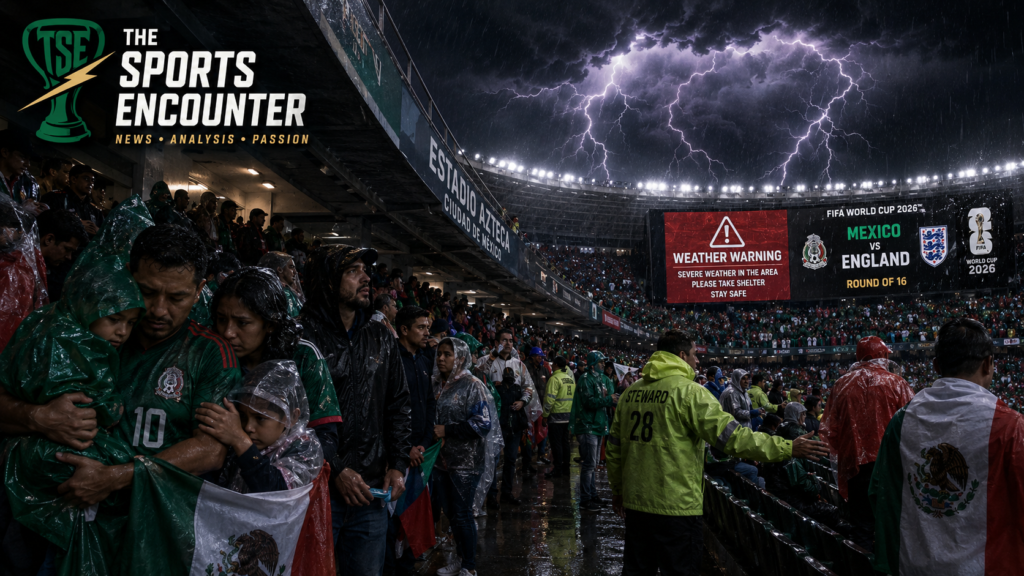
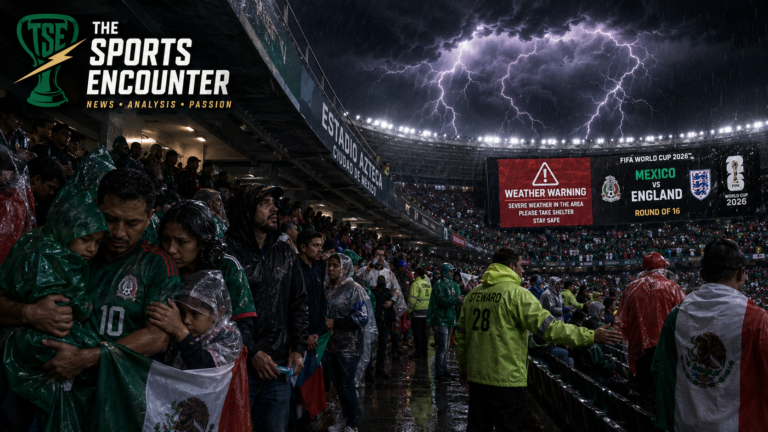
Soccer fans in rain ponchos take shelter at Estadio Azteca as a severe storm approaches before Mexico vs England at World Cup 2026.

The first warning at the Azteca did not come from Mexico’s press, England’s counterattack, or the noise of a crowd ready to shake one of football’s most historic stadiums.

It came from the sky.

Mexico vs England was supposed to begin as a football storm. A host nation chasing a deeper World Cup run. A European heavyweight stepping into altitude, noise, pressure, and memory. A Round of 16 match carrying national hope on one side and tournament expectation on the other.

Then severe weather moved into the story.

Key Facts Box

DetailInformation
MatchMexico vs England
CompetitionFIFA World Cup 2026
StageRound of 16
VenueEstadio Azteca, Mexico City
Main issueThunderstorms near the stadium
FIFA actionShelter-in-place order before kickoff
Stadium warning“Thunderstorm activated, please take your seats”
Fans affectedSupporters traveling to the venue sought cover under bridges and awnings
Wider concernWeather disruption, fan safety, kickoff planning, and tournament operations
Previous related issueMexico’s Round of 32 match against Ecuador was delayed due to rain

A shelter-in-place order was issued before the Mexico vs England FIFA World Cup 2026 last-16 clash after thunderstorms developed around Estadio Azteca. FIFA said people working on the pitch were asked to move into the tunnel, while the big screen inside the stadium warned that severe weather was approaching. Outside the venue, displays told fans: “Thunderstorm activated, please take your seats.”

For supporters walking toward the stadium, the night suddenly became less about chants and more about cover. Some fans were seen sheltering under bridges and awnings as the weather threatened to disrupt one of the tournament’s biggest knockout matches.

This was not just rain before kickoff.

It was a storm before the storm.

For readers following the wider knockout picture, the weather scare now adds another layer to a tournament phase already shaped by pressure, VAR debate, late drama, and shifting momentum in the FIFA World Cup 2026 Round of 16.

The Azteca Was Ready for Noise. It Got Thunder First

Estadio Azteca does not need help creating drama.

The stadium carries football memory in its concrete, shadows, tunnels, and upper tiers. It has hosted World Cup history that still feels alive decades later. Every major match there arrives with echoes.

Mexico vs England gave the place another emotional charge.

Mexico entered the night with the kind of pressure only a host nation knows. Fans did not come only to watch a match. They came carrying years of expectation, the dream of a deeper run, and the old desire to turn home advantage into history.

England arrived with a different burden. Every tournament match involving England travels with noise, scrutiny, hope, and fear. Recent performances had already tested the team’s control, especially after Harry Kane’s late brilliance in England’s comeback against DR Congo.

However, weather changed the buildup before either team could impose itself.

Thunderstorms do not care about tactical plans. They do not respect kickoff windows, television schedules, player routines, or national emotion. A storm can turn a knockout match into an operational emergency within minutes.

That is why the Azteca warning mattered.

The stadium was ready for a football explosion. Instead, it had to manage a safety alert.

Why This Was More Than a Weather Delay

Football has always had a strange romance with rain.

Supporters remember soaked shirts, sliding tackles, muddy socks, goalkeepers punching crosses through mist, and fans singing through storms. Rain can make football feel raw and beautiful.

Thunderstorms are different.

Rain affects the game. Lightning threatens lives.

That distinction matters. Once severe weather approaches a stadium, the issue moves beyond sporting inconvenience. Pitch staff, volunteers, security teams, camera crews, players warming up, and fans moving through open areas all become part of the safety equation.

FIFA reportedly considered moving the match forward but kept the original kickoff time. Local reports also suggested the fixture could move to 12:00 p.m. local time because of the forecast. In the end, the original plan remained.

That decision can be understood.

A World Cup knockout match cannot be moved casually. Broadcasters, transport systems, police planning, ticket holders, hospitality teams, volunteers, stadium workers, international viewers, and team routines all depend on timing. A change of several hours can create a different set of problems.

Still, keeping the kickoff time carried its own risk.

When a shelter order appears before a match, tournament organizers must explain the thinking behind the decision. Fans need clarity. Teams need confidence. Workers need instructions. Broadcasters need certainty, but safety must sit above schedule protection.

This is where FIFA faces the bigger test.

The governing body does not only run matches. It runs trust.

Supporters can follow official tournament information through the FIFA World Cup 2026 official website, which FIFA describes as the 23rd edition of the tournament and the first to feature 48 teams across three host countries.

Weather Has Become a World Cup 2026 Story

The Mexico vs England warning did not happen in isolation.

Mexico’s Round of 32 match against Ecuador had already been delayed because of rain. That earlier disruption should have made one thing clear: weather is not background scenery in this tournament. It is part of the competition environment.

Mexico and England players look up at lightning above Estadio Azteca before their FIFA World Cup 2026 Round of 16 match.

World Cup 2026 has already stretched football across different climates, cities, altitudes, kickoff windows, and travel patterns. The tournament’s scale has created a bigger event, but it has also created more exposure to disruption.

Heat has been one part of the story. The debate over player welfare and match rhythm grew after hydration breaks became one of World Cup 2026’s most divisive issues. Now storms have added another layer.

Weather affects more than comfort.

A delayed warmup changes player routines. A slick pitch alters passing speed. Heavy rain can make defenders hesitate and goalkeepers spill shots. Lightning warnings can empty active areas, pause preparation, and create anxiety before the first whistle.

Meanwhile, fans experience the situation in a more personal way.

A supporter may spend months saving for tickets, travel, lodging, shirts, food, transport, and one unforgettable night. If severe weather hits near the stadium, that fan does not think in terms of “operational protocols.” They think about safety, family, shelter, timing, and whether they will still get to see the match they traveled for.

That human side must sit at the center of World Cup planning.

Mexico’s Home Advantage Meets a Different Kind of Pressure

For Mexico, the Azteca crowd is part of the team’s emotional engine.

Home fans do not simply fill seats. They lift duels, amplify pressure, energize transitions, and turn defensive clearances into moments of belief. At the Azteca, noise can become a tactical force.

Weather can interrupt that force.

If fans are delayed outside the stadium, the emotional buildup changes. If supporters arrive wet, anxious, or scattered, the first wave of atmosphere may feel different. A shelter warning can also turn a crowd from aggressive to cautious before kickoff.

Mexico had already shown the power of home momentum earlier in the tournament. Their group-stage charge included a confident performance in Mexico’s win over Czechia, while their tense battle with Korea Republic showed how narrow World Cup margins can become when one mistake changes everything in Mexico’s group-stage fight against South Korea.

Against England, every small shift matters.

A slower start can calm the visiting team. A broken rhythm can reduce the early emotional punch. A slick surface can favor quick transitions or punish loose defending. For Mexico, the mission becomes mental as much as tactical: stay ready, keep the crowd close, and make the storm feel like part of the night rather than a disruption to it.

England Must Handle More Than the Ball

England’s challenge is also bigger than the weather.

The team must manage altitude, crowd hostility, knockout pressure, and a host nation with everything to gain. Add storm disruption, and the night becomes a test of emotional control.

A weather delay can hurt a team that likes structure. Players warm up, stop, wait, stretch again, and restart. Coaches adjust messaging. Medical staff manage body temperature. Goalkeepers need touch and rhythm. Strikers need sharpness. Midfielders need their first few passes to settle.

For England, this creates a familiar tournament question: can they stay calm when the match refuses to unfold cleanly?

The answer may define the night.

Kane’s leadership becomes important. So does the experience of senior players who understand that knockout football rarely gives perfect conditions. England cannot allow the weather warning to become an excuse if Mexico starts fast.

Instead, they need to treat the first 15 minutes like a separate match.

Win second balls. Avoid panic clearances. Slow the crowd when needed. Use possession to breathe. Then build into the contest.

A storm can unsettle both teams, but the more composed side usually gains first.

Could Weather Change the Match Itself?

Yes, and not only through a delay.

A wet surface can increase ball speed and make first touches harder. Defenders may mistime tackles. Goalkeepers may struggle with shots that skid low. Set pieces become more dangerous because attackers need only one mistimed clearance or one loose punch.

In addition, heavy rain changes risk calculations.

Fullbacks may think twice before overlapping. Center backs may clear earlier. Midfielders may avoid turning under pressure. Coaches may ask for more direct balls into channels. Teams with strong second-ball reactions can benefit because matches become less polished and more instinctive.

For Mexico, that could help if they feed off emotion and quick forward pressure.

For England, it could help if they use Kane as a control point and attack loose defensive moments.

However, lightning protocols are the real line. Rain can become part of football. Lightning cannot. If conditions become unsafe, the match must wait.

That principle should never be negotiable.

Did FIFA Make the Right Call?

FIFA made the right move by issuing the shelter order.

Once thunderstorms threatened the area, safety had to come first. Moving pitch workers into the tunnel and warning fans through stadium displays showed that protocols were active. No World Cup match, regardless of size, should put people at avoidable risk.

The more complex issue is scheduling.

FIFA may have had strong weather data supporting the decision to keep the original kickoff time. Moving a match forward can create transportation confusion, crowd-control problems, broadcast disruption, and sporting imbalance. It can also punish fans who planned around the published schedule.

Even so, tournament organizers should communicate these decisions with more detail.

A short public explanation would help fans understand why kickoff stayed unchanged despite forecasts. It would also show that safety, not television convenience, guided the call.

In a tournament of this size, FIFA should consider regular weather protocol briefings for high-risk matches. Those updates could explain lightning thresholds, shelter guidance, delay rules, pitch inspections, fan movement advice, and decision timelines.

That would not remove disruption.

It would reduce confusion.

The Bigger Lesson for World Cup 2026

The 2026 World Cup is the biggest edition football has ever staged.

More teams. More matches. More host cities. More travel. More local climates. More operational complexity. That scale creates opportunity, but it also makes disruption more likely.

Weather will continue to matter.

Heat can affect hydration and tempo. Rain can delay matches. Storms can trigger safety orders. Altitude can change physical load. Travel can reduce recovery. A tournament this large must plan for reality, not the ideal version of summer football.

The same World Cup week has already produced wildly different forms of drama. Norway’s stunning Round of 16 win over Brazil showed how one missed penalty and one elite striker can destroy a favorite in Brazil’s World Cup nightmare against Haaland and Norway. Elsewhere, Portugal’s match with Croatia reminded fans how VAR and fine margins can turn a knockout tie into chaos in Portugal’s Round of 32 survival act.

Now Mexico vs England has added another type of drama.

Nature.

The sport can control referees, schedules, stadium operations, video systems, and disciplinary procedures. It cannot control the sky. That makes communication, safety planning, and flexibility essential parts of modern tournament leadership.

Why This Night Will Stay With Fans

Fans will remember the football, of course.

They will remember the tackles, saves, chances, goals, and emotional swings. Yet for many people at the Azteca, the memory may begin earlier: the warning on the screen, the sky darkening, the rush for shelter, the strange feeling that one of the world’s great stadiums had paused before it could roar.

That is what makes this story powerful.

A World Cup match is never only a match. It is a journey, a gathering, a family memory, a national ritual, and a personal investment. When the weather interrupts that, the emotion changes. Supporters become part of the uncertainty before players do.

For Mexico fans, the night already carried history.

For England fans, it carried pressure.

For FIFA, it carried a warning.

The biggest tournament in football cannot treat weather as an inconvenience. It must treat weather as part of the event.

Final Whistle Before the First Whistle

Mexico vs England was built for noise.

The Azteca was ready to shake. Mexico was ready to believe. England was ready to prove its control. Fans were ready for a knockout match that could tilt the tournament’s emotional map.

Then the storm arrived first.

That does not make the match smaller. In some ways, it makes it bigger. Football now has to share the stage with safety, weather, planning, and human patience.

If the match goes ahead cleanly, the storm warning may become part of the night’s mythology. If delays return, it will become part of a larger debate about how FIFA manages weather risk in the largest World Cup ever staged.

Either way, the message is clear.

At the Azteca, the first contest was not Mexico against England.

It was football against the weather.

FAQs

Why was there a shelter order before Mexico vs England?

A shelter-in-place order was issued because thunderstorms were reported around Estadio Azteca before the Mexico vs England Round of 16 match. People working on the pitch were moved into the tunnel, while fans inside and outside the venue received storm warnings.

Did FIFA delay Mexico vs England because of the weather?

FIFA kept the original kickoff time despite weather concerns. The governing body had reportedly considered moving the match earlier, but the schedule remained unchanged.

Why are thunderstorms more serious than normal rain in football?

Rain can affect passing, footing, visibility, and goalkeeper handling. Thunderstorms create a safety risk because of lightning, especially for players, staff, broadcasters, volunteers, security teams, and fans in exposed areas.

How can weather affect Mexico vs England tactically?

A wet pitch can make the ball move faster, increase defensive errors, and make set pieces more dangerous. A delayed or disrupted warmup can also affect rhythm, especially during the opening minutes of a knockout match.

Why does weather matter more at World Cup 2026?

World Cup 2026 is staged across three countries, many cities, and different climates. That larger footprint increases exposure to heat, rain, altitude, travel demands, and severe weather disruptions.

Did Mexico already face weather disruption earlier in the tournament?

Yes. Mexico’s Round of 32 match against Ecuador was delayed because of rain, making the Azteca shelter order another sign that weather has become a real tournament-management issue.

Was FIFA right to issue the shelter order?

Yes. Once thunderstorms approached the stadium area, safety had to come first. The bigger question is whether FIFA should provide clearer public explanations when weather forecasts threaten kickoff timing.


Miley Rumer is The Sports Encounter’s U.S. correspondent for American sports coverage, focusing on the NHL, NBA, NFL, MLB, MLS, and major sporting stories across North America. Her coverage tracks the moments that shape games, seasons, rivalries, and fan conversations, with a sharp eye on performance, pressure, team identity, and the human stories behind the scoreboard. Based in St. Clairsville, Ohio, Miley brings a grounded American sports voice to The Sports Encounter’s coverage, helping readers follow the biggest developments from arenas, stadiums, locker rooms, and fan communities across the country.

Breaking News

Chelsea Bring Geovany Quenda Into Their Long Game Until 2034

Chelsea have completed the arrival of Geovany Quenda from Sporting Lisbon, with the Portuguese winger signing until 2034 after a deal agreed in 2025 allowed him to spend one more season developing in Portugal.

Jovana Zlatova | The Sports Encounter

Published

on

Geovany Quenda walks out of a blue-lit Chelsea stadium tunnel in a Chelsea-style kit, with “Quenda Joins Chelsea” headline and The Sports Encounter logo.

Chelsea have completed the arrival of Geovany Quenda from Sporting Lisbon, turning a transfer agreed more than a year ago into the latest piece of their long-term squad build.

The 19-year-old Portuguese winger has signed until 2034, giving Chelsea one of the most highly rated wide players to come out of Sporting’s development system in recent years. The move was agreed in March 2025, but Quenda stayed in Lisbon for the 2025/26 season before making the switch to Stamford Bridge.

That delay is the part of the story that matters most.

Chelsea did not sign Quenda as a short-term fix. They bought early, let him continue growing in a familiar environment, then brought him into England with another full senior season behind him. In a market where top young attackers become expensive very quickly, this was Chelsea trying to control the timeline before the rest of Europe could reset the price.

It follows the same broader Premier League pattern The Sports Encounter has tracked this summer, from Manchester United’s reported £50m midfield move for Andrey Santos to Leeds United’s decision to sign Harry Wilson on a four-year contract. Clubs are not only buying players. They are buying control, age profile and future flexibility.

Why Quenda Fits Chelsea’s Recruitment Model

Quenda fits Chelsea’s modern recruitment blueprint almost perfectly.

He is young, technically sharp, already battle-tested at senior level and flexible enough to play in more than one wide role. He has been used as a winger and wing-back, which gives Chelsea a player who understands both attacking width and defensive responsibility.

That matters in the Premier League.

Chelsea have collected plenty of young attacking talent in recent years, but Quenda brings a slightly different profile. He can stretch the pitch from the right side, attack defenders in isolated situations and give the team another left-footed option in wide areas. His Sporting education also means he arrives with experience in a demanding environment where young players are expected to mature quickly.

The challenge now is not talent.

The challenge is pathway.

Chelsea must decide whether Quenda is eased into the first team, used as a rotation winger, or given a more structured development plan across domestic cups, league minutes and European fixtures. The contract runs long, but football patience rarely does.

Quenda Leaves Sporting With More Than Potential

Quenda does not arrive as a mystery prospect.

During his two years around Sporting’s senior setup, he built a reputation as one of Portugal’s most exciting young wide players. He helped Sporting through a successful domestic cycle, gained European exposure and earned recognition as one of the standout young players in the Portuguese game.

He also made history at Sporting, becoming the club’s youngest-ever goalscorer and the youngest Portuguese player to score in the Champions League.

Those milestones are not decoration. They tell Chelsea that Quenda has already handled moments that many teenagers never reach. He has played in high-pressure games, carried expectation and produced at a club where academy graduates are judged against a serious tradition.

For Chelsea fans following the club’s wider squad direction through The Sports Encounter’s soccer transfer coverage, this signing should be viewed less as a flashy arrival and more as a long-term bet on attacking evolution.

What Quenda Can Bring to Stamford Bridge

Quenda’s biggest immediate value is width.

Chelsea have often needed players who can hold their position wide, receive under pressure and force defenders to make uncomfortable choices. Quenda can do that. He can stay outside and attack the full-back, or move inside to combine in tighter spaces.

His left foot gives him natural threat when cutting in from the right. His wing-back experience also helps him understand timing, recovery runs and the need to work without the ball.

That makes him more than a highlight-reel winger.

The Premier League will test his physicality and decision-making. English defenders will close space faster than he has often seen in Portugal. He will also need to adjust to Chelsea’s internal competition, where every young attacker is fighting for rhythm and relevance.

But the raw ingredients are clear: pace, courage, technical confidence and a profile Chelsea believe can grow over several seasons.

Why This Transfer Matters Beyond Chelsea

Quenda’s arrival says something about where elite recruitment has gone.

Big clubs are no longer waiting for young players to become obvious. They are moving earlier, accepting risk and building long contracts around future value. Chelsea’s 2034 agreement with Quenda is part of that reality.

Geovany Quenda dribbles the ball at speed in a Chelsea-style blue kit under stadium lights, with “Quenda in Blue” headline and The Sports Encounter logo.

The upside is obvious. If he develops into a first-team regular, Chelsea have secured a major wide talent before his value reaches another level.

The risk is just as clear. Long contracts create expectation. Crowded squads can slow development. Young players need minutes, trust and tactical clarity, not only a long-term deal and a big announcement graphic.

That is where Chelsea must get the next stage right.

Verdict: Chelsea Have Signed the Future, but Now They Must Build the Path

Geovany Quenda’s move to Chelsea is not only a transfer. It is a test of planning.

Chelsea have secured a young winger with serious Portuguese pedigree, senior Sporting experience and a contract that runs deep into the next decade. On paper, it looks like exactly the kind of move modern elite clubs want to make before the market catches up.

But the signing will not be judged by contract length.

It will be judged by development.

Quenda needs minutes, role clarity and patience. Chelsea FC need to make sure he does not become another talented name fighting for space in a crowded attacking group.

If they manage that balance, this could become one of the smarter long-term attacking moves of their current project.

If they do not, Quenda’s talent may become another reminder that buying potential is easier than building it.

FAQs

Has Geovany Quenda joined Chelsea?

Yes. Geovany Quenda has joined Chelsea from Sporting Lisbon and signed a contract running until 2034.

When did Chelsea agree the Geovany Quenda deal?

Chelsea agreed the deal in March 2025, with Quenda staying at Sporting Lisbon for the 2025/26 season before moving to Stamford Bridge.

How much did Chelsea pay for Geovany Quenda?

The deal was agreed for around £40m.

What position does Geovany Quenda play?

Geovany Quenda is mainly a right winger, but he has also played as a wing-back and can operate in wide attacking roles.

Why is Geovany Quenda considered a major talent?

Quenda made senior progress at Sporting Lisbon, became the club’s youngest-ever goalscorer and also became the youngest Portuguese player to score in the Champions League.

Continue Reading

Breaking News

Manchester United Agree £50m Deal With Chelsea for Andrey Santos

Manchester United have reportedly agreed a £50m deal with Chelsea to sign Brazilian midfielder Andrey Santos, with the package including £48m guaranteed, £2m in add-ons and a 10 percent sell-on clause.

Jovana Zlatova | The Sports Encounter

Published

on

Andrey Santos walks through a red-lit Old Trafford-style tunnel toward the pitch in a Manchester United arrival graphic, with Chelsea-blue fragments fading behind him and The Sports Encounter logo.

Manchester United have reportedly agreed a £50m deal with Chelsea to sign Brazilian midfielder Andrey Santos, in a move that could reshape the next phase of United’s midfield rebuild.

According to Sky Sports’ report on the Andrey Santos agreement, the deal is worth £50m in total. The structure includes a guaranteed £48m payment, £2m in add-ons and a 10 percent sell-on clause for Chelsea. Sky also reported that Santos joined Chelsea from Vasco da Gama in January 2023 and later spent loan spells at Nottingham Forest and Strasbourg.

At the time of writing, Manchester United and Chelsea had not both published full official club confirmation of the transfer. That makes the wording important: this is a reported agreement between the clubs, not yet a completed unveiled signing.

Still, the scale and structure of the deal suggest United have moved decisively for a player they see as part of their long-term midfield core.

Why United Wanted Santos

Santos, 22, gives Manchester United a younger midfield option with Premier League experience, European development time and a profile that fits the club’s need for energy through the middle of the pitch.

Andrey Santos signs a Manchester United transfer contract in a dramatic red-and-black breaking news graphic, with Old Trafford-style stadium lighting and The Sports Encounter logo.

United have been linked with several midfielders this summer, but Santos offers a different blend. He can operate as a deeper midfielder, but his best work at Strasbourg also showed his box-to-box instincts. He can carry the ball, arrive in attacking areas and compete physically, which gives United more than a holding-midfield body.

The Guardian had reported earlier this week that United were targeting Santos as Chelsea valued him around £50m, with the Brazilian open to leaving Stamford Bridge for more regular minutes. That background matters because Santos’ path at Chelsea was blocked by strong competition in midfield, especially with Moisés Caicedo and Enzo Fernández central to the club’s plans. (The Guardian)

Chelsea Turn Potential Into Profit

For Chelsea, the agreement represents another significant sale from a player signed during their long-term recruitment push.

Santos arrived from Vasco da Gama in 2023 as one of Brazil’s most highly rated young midfielders. His early Chelsea journey was not straightforward. A loan spell at Nottingham Forest failed to give him consistent momentum, but his time at Strasbourg changed the picture. Sky noted that he later returned to Chelsea and featured 43 times in all competitions last season, scoring three goals and adding four assists.

The Times also reported that United have finalized a £50m deal for Santos, with Chelsea securing the same 10 percent sell-on clause. Its report noted that Santos impressed during his Strasbourg loan spell and that United were looking for midfield reinforcements after Casemiro’s departure and Manuel Ugarte’s injury concerns. (The Times)

Chelsea may view the deal as smart business. They developed Santos through the BlueCo pathway, brought him into the Premier League picture and are now set to receive a major fee while retaining upside through the sell-on clause.

What Santos Adds to Manchester United

Santos gives United midfield legs, age-profile balance and room for tactical growth.

His arrival would not solve every issue at Old Trafford, but it would address a clear need. United have needed younger midfielders who can cover ground, progress play and handle Premier League intensity. Santos fits that profile better than a short-term veteran signing.

The fee also tells its own story. United are not treating Santos as a squad gamble. A £50m package suggests they believe he can become an important first-team player, not simply a developmental option.

There will be pressure, of course. Moving from Chelsea to Manchester United brings immediate scrutiny. The price tag will follow him, especially because Santos has not yet established himself as an undisputed Premier League starter. But his age, Brazil pedigree and Strasbourg development make this a transfer with clear upside.

For more Premier League transfer updates, follow The Sports Encounter’s latest soccer coverage.

Verdict: A Bold Midfield Bet From United

Manchester United’s reported £50m agreement for Andrey Santos is bold, expensive and highly strategic.

It gives United a young Brazilian midfielder with Premier League exposure and room to grow. It gives Chelsea a strong return on a player who still had limited guaranteed minutes in their midfield structure. It also adds another major move to a summer window where Premier League clubs are acting early to secure midfield control.

If Santos develops quickly, United may look back on this as a smart long-term investment.

If he struggles for minutes or rhythm, the fee will become a talking point almost immediately.

That is the risk with a deal like this.

But United clearly believe the upside is worth it.

FAQs

Have Manchester United signed Andrey Santos?

Manchester United have reportedly agreed a £50m deal with Chelsea to sign Andrey Santos, but full official club confirmation should still be checked before treating the transfer as completed.

How much will Manchester United pay for Andrey Santos?

The reported deal is worth £50m, made up of £48m guaranteed and £2m in add-ons.

Is there a sell-on clause in the Andrey Santos deal?

Yes. Reports say Chelsea have secured a 10 percent sell-on clause as part of the agreement.

What position does Andrey Santos play?

Andrey Santos is a Brazilian midfielder who can play in deeper midfield roles and as a box-to-box player.

When did Andrey Santos join Chelsea?

Santos joined Chelsea from Vasco da Gama in January 2023.

Continue Reading

Breaking News

Leeds United Sign Harry Wilson on Four-Year Deal After Fulham Exit

Leeds United have confirmed the signing of Wales forward Harry Wilson on a four-year contract after his Fulham deal expired, making him the club’s first summer signing.

Luke Edelman The Sports Encounter

Published

on

Harry Wilson signs a Leeds United contract in a dramatic blue-and-white transfer announcement graphic, with Elland Road in the background and The Sports Encounter logo at the top-left.

Leeds United have confirmed the signing of Wales forward Harry Wilson on a four-year contract, making him their first signing of the summer transfer window after his departure from Fulham.

The 29-year-old joins the Whites following the expiry of his contract at Craven Cottage, with Leeds stating that Wilson chose Elland Road “over several offers from elsewhere.” The club announced the deal on Wednesday, ending weeks of speculation around one of the more attractive free-agent options in the Premier League market. Leeds confirmed the four-year agreement in their official Harry Wilson announcement.

For Leeds, this is a smart early-market move. Wilson brings Premier League experience, international pedigree, set-piece quality and the kind of final-third versatility that can help Daniel Farke’s side add more control and creativity in attacking areas.

The Sports Encounter has been tracking how Premier League clubs are moving early in the summer market, including Arsenal’s decision to permanently sign Piero Hincapie after his loan from Bayer Leverkusen. Leeds’ move for Wilson fits the same pattern: clubs are trying to solve squad needs before the market becomes more expensive and chaotic.

Why Leeds Wanted Harry Wilson

Wilson is not a gamble in the normal sense of a free transfer. He arrives with a deep top-flight CV and a clear profile.

Leeds described him as an experienced top-flight and international attacker who can operate across the forward line. That versatility matters because Wilson can play wide, drift inside, link midfield with attack and threaten from dead-ball situations. He is not only a touchline winger. He gives Leeds a player who can create, finish and add variety to the right side or central attacking zones.

Sky Sports had reported in June that Leeds had agreed a deal to sign Wilson once his Fulham contract expired, with Aston Villa and Everton also among the interested clubs. Sky also noted that Fulham tried to keep Wilson after a career-best Premier League campaign, but he chose Leeds on a long-term deal.

That makes the deal more meaningful. Leeds have not simply picked up a player nobody wanted. They have beaten competition for a proven Premier League forward without paying a transfer fee.

For more football transfer context and wider market movement, readers can follow The Sports Encounter’s Soccer coverage.

Wilson Leaves Fulham After Productive Final Season

Wilson spent five years at Fulham after joining from Liverpool in 2021. Leeds’ official statement credited him with helping Fulham earn promotion to the Premier League during his first season at Craven Cottage, scoring 12 goals in that campaign. The club also noted that he leaves West London after making just shy of 200 appearances.

His final season strengthened his market position. Leeds said Wilson produced 11 goals and eight assists last term, was named Fulham’s Player of the Season, and won the BBC Goal of the Season award for his strike against Crystal Palace.

Those numbers explain why Fulham wanted him to stay and why Leeds moved with urgency.

Wilson’s exit also leaves Fulham with an attacking gap to address. The Guardian recently reported that Fulham were looking at Crysencio Summerville as part of their search for wide options after losing Wilson, showing how his departure has already shaped Fulham’s recruitment planning.

A Career Built Through Loans, Set Pieces and Wales Duty

Wilson’s career has rarely followed a straight line, but it has produced steady experience.

He began at Liverpool and made two senior appearances for the first team before building his reputation on loan. Leeds highlighted his impact at Hull City, where he scored seven goals in 13 appearances, and his later spell at Derby County, where he produced a memorable 30-yard free kick against Manchester United in the League Cup and finished the season with 15 goals.

A Premier League loan at Bournemouth followed, then a spell with Cardiff City, before Wilson settled at Fulham and became a key figure across their promotion and Premier League years.

Internationally, Wilson also brings major-tournament experience. Leeds said he became Wales’ youngest-ever player when he debuted in October 2013, taking the record from Gareth Bale, and has earned 69 caps. He has represented Wales at Euro 2020 and the 2022 World Cup, and scored an international hat-trick in a 7-1 win over North Macedonia.

That matters for a Leeds side trying to build more maturity around its Premier League core.

What This Means for Leeds

Wilson gives Leeds an immediate attacking option who does not need a long adaptation period. He knows the league, understands the physical demands, and arrives after one of the strongest seasons of his career.

For Farke, the key question will be role. Wilson can start wide, operate as an inverted creator, or serve as a flexible attacking piece depending on the opponent. His set-piece quality also adds value in tight Premier League matches where one delivery can change the result.

This is not a headline-grabbing superstar signing. It is a practical, experienced, low-fee-market move that strengthens Leeds without draining transfer funds.

The wider Premier League picture remains active, and The Sports Encounter will continue tracking how clubs reshape squads before the new season through our latest football news and transfer coverage.

FAQs

Has Harry Wilson joined Leeds United?

Yes. Leeds United have officially signed Harry Wilson on a four-year contract after his Fulham deal expired.

How long is Harry Wilson’s Leeds contract?

Harry Wilson has signed a four-year contract with Leeds United.

Why did Harry Wilson leave Fulham?

Wilson left Fulham after his contract expired. Fulham tried to keep him, according to Sky Sports, but he chose Leeds on a long-term deal.

What position does Harry Wilson play?

Wilson is a forward who can play across the attacking line, especially as a winger or inside forward.

How did Harry Wilson perform last season?

Leeds said Wilson scored 11 goals and provided eight assists last season, while also winning Fulham’s Player of the Season award.

Continue Reading

Breaking News