


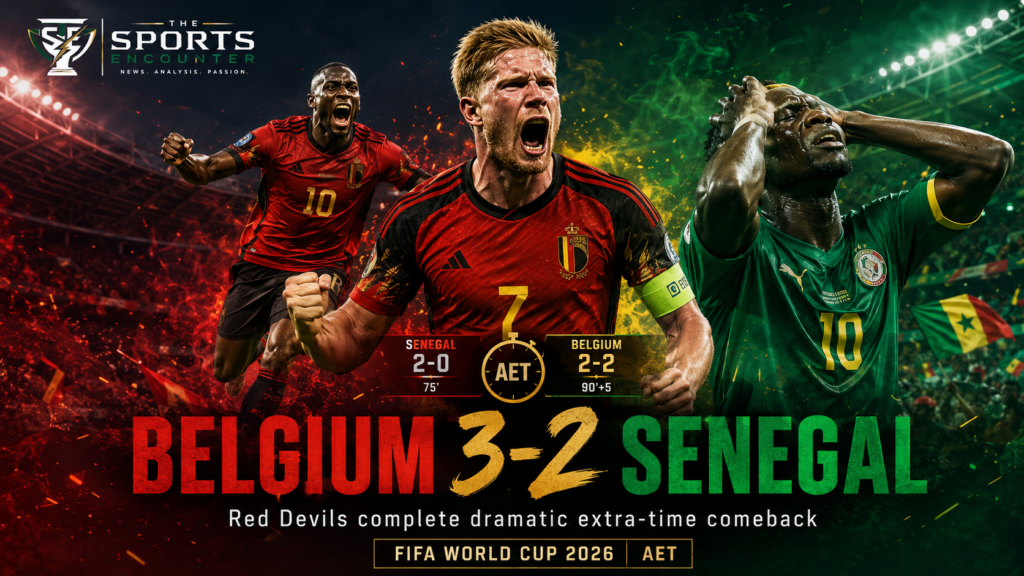
Belgium looked beaten, exposed, and seconds away from one of the biggest knockout defeats of FIFA World Cup 2026.
Then the match changed with the kind of speed only tournament football can produce.
Senegal led 2-0 until the final stretch of normal time in Seattle. They had scored through Habib Diarra and Ismaïla Sarr, controlled large parts of the emotional rhythm, and pushed Belgium into the uncomfortable space between panic and regret. By the 85th minute, the Lions of Teranga were close enough to the Round of 16 to feel it.
Belgium still found a way back.
Romelu Lukaku scored in the 86th minute. Youri Tielemans equalized in the 89th. Extra time followed. Then, in the 120+5th minute, Tielemans converted a controversial penalty to complete a 3-2 win that sent Belgium into the Round of 16 and left Senegal staring at one of the cruelest exits of the tournament.
For Belgium, this was survival with fire. For Senegal, it was heartbreak after a performance that deserved more than a footnote.
For wider tournament movement and knockout context, follow The Sports Encounter’s FIFA World Cup 2026 coverage.
Match Facts
Match: Belgium vs Senegal
Competition: FIFA World Cup 2026
Stage: Round of 32
Venue: Seattle Stadium
Final Score: Belgium 3-2 Senegal after extra time
Senegal Goals: Habib Diarra 25’, Ismaïla Sarr 51’
Belgium Goals: Romelu Lukaku 86’, Youri Tielemans 89’, Youri Tielemans 120+5’ penalty
Yellow Cards: Brandon Mechele, Belgium; Lamine Camara, Senegal
Red Cards: None reported
Next Match: Belgium vs United States, Round of 16
Senegal Played Like a Team Ready to Shake the Bracket
Senegal did not stumble into this match hoping Belgium would have an off day. They played with purpose.
Their first goal came in the 25th minute after Sadio Mané’s delivery created trouble inside Belgium’s box. Ismaïla Sarr attacked the cross, the ball came back into danger, and Habib Diarra reacted first. That finish gave Senegal the lead, but the larger message came through the build-up. Senegal had pace wide, courage in central areas, and a clear plan to make Belgium defend in motion.
That mattered because Belgium had arrived in Seattle with renewed confidence after their 5-1 win over New Zealand. The Red Devils had finally found attacking rhythm in that group-stage finale, a shift covered in detail by The Sports Encounter’s report on how Belgium finally found their bite against New Zealand. Senegal refused to let that confidence settle early.
After halftime, the African side grew even sharper.
Sarr’s 51st-minute goal was the kind of finish that turns a good performance into a serious upset threat. Lamine Camara’s diagonal pass opened Belgium’s back line, and Sarr handled the moment with calm and violence in the same movement. He brought the ball under control, drove through the space, and beat Thibaut Courtois with a finish that gave Senegal a 2-0 lead.
At that point, Senegal looked faster, cleaner, and more emotionally connected to the match. Their midfield pressed with intelligence. Their forwards ran with belief. Their defense accepted pressure without collapsing.
The painful part is that they did so much right for so long.
Belgium’s First 85 Minutes Raised Real Questions
Belgium’s comeback should not erase how poor they looked for most of normal time.
Rudi Garcia’s side had possession, names, and experience, but they lacked clarity for too long. Kevin De Bruyne could not fully dictate the game. Leandro Trossard drifted in and out. Charles De Ketelaere struggled to give Belgium the central threat they needed before Lukaku’s introduction changed the shape.
Senegal forced Belgium into rushed decisions. The Red Devils often looked like a team trying to solve three problems at once: break Senegal’s defensive block, stop the counterattack, and manage their own rising frustration.
That is why this comeback carries two meanings.
It shows Belgium still have character, depth, and late-game quality. It also shows they cannot afford another slow, loose, emotionally flat knockout start. Against stronger opponents, a two-goal hole may become final.
The earlier warning signs from Belgium’s campaign had not disappeared. Their group-stage draws against Egypt and Iran had already raised questions before the New Zealand win changed the mood. The Senegal match brought those questions back, even as the final score gave Belgium a dramatic answer.
Lukaku Changed the Weight of the Match
Belgium needed presence. Lukaku gave them that.
His 86th-minute goal did more than reduce the deficit. It changed the emotional balance inside the stadium. Senegal had defended a two-goal lead with growing confidence, but one goal gave Belgium belief and forced Senegal to think about survival instead of control.
That difference can break a team quickly.
Three minutes later, Tielemans scored the equalizer. Belgium had gone from beaten to level in four minutes. The comeback did not come from long dominance. It came from pressure, experience, and the sudden fear that grips a team when a secure lead starts slipping away.
Senegal had spent most of the match making Belgium uncomfortable. In that late spell, Belgium returned the favor with interest.
For readers tracking the knockout pattern of late drama, The Sports Encounter also covered how Harry Kane rescued England against DR Congo, another Round of 32 match where a favorite needed a late intervention to survive.
Tielemans Turned Relief Into History
Extra time carried tension rather than control.
Senegal still had chances to regain the lead, and Sarr remained dangerous whenever he found space. Belgium, meanwhile, looked caught between pushing for the winner and protecting themselves from a final Senegal break. Penalties began to feel likely.
Then came the decisive moment.
A late Belgium attack brought a challenge involving Lamine Camara and Tielemans. The decision went to VAR, and Belgium received the penalty deep into added time at the end of extra time. Senegal protested. Their frustration was understandable. Knockout exits hurt enough. A 120+5’ penalty after surrendering a two-goal lead cuts deeper.
Tielemans still had to score it.
He did.
That penalty completed one of the great Belgium comebacks in World Cup history and sent them into a Round of 16 meeting with the United States. For Belgium, the winner may become a psychological turning point. Teams often need one wild escape to start believing something bigger is possible.
For Senegal, it will feel like punishment for one bad spell after 85 minutes of strong tournament football.
Cards and Discipline
The match feed reported two yellow cards.
Brandon Mechele received Belgium’s booking, while Lamine Camara was shown Senegal’s yellow card. No red cards were reported.
Discipline did not decide the match in the usual sense, but Camara’s late involvement in the penalty incident will dominate Senegal’s post-match pain. His yellow card and the decisive VAR-reviewed foul will place him at the center of a brutal football conversation, even though Senegal’s collapse involved far more than one player or one decision.
What This Means for Belgium and Senegal
Belgium move forward with momentum, but also with warnings they cannot ignore.
They have Lukaku’s penalty-box force, Tielemans’ nerve, De Bruyne’s passing range, Courtois’ experience, and enough attacking depth to hurt teams late. Their bench changed this match. Their senior players stayed alive long enough to strike. That counts in knockout football.
Still, Belgium spent too long waiting for urgency. Against the United States, they will face a host nation carrying crowd energy, pace, and the lift of a 2-0 win over Bosnia. For more on that American storyline, read The Sports Encounter’s preview of USA vs Bosnia and the USMNT’s home knockout pressure.
Senegal leave with a different kind of truth.
They were close. Painfully close. Their 5-0 win over Iraq had restored their tournament belief, a result featured in The Sports Encounter’s Day 16 World Cup 2026 highlights. Against Belgium, they showed that the revival was real. Diarra gave them control. Sarr gave them brilliance. Mané gave them leadership. Their midfield gave Belgium problems for most of the night.
Then four minutes changed everything.
That is the cruelty of the World Cup. A team can play with intelligence, courage, and personality, then lose its place in the tournament because one late wave becomes too strong.
Belgium survive. Senegal suffer.
Seattle will remember both.