


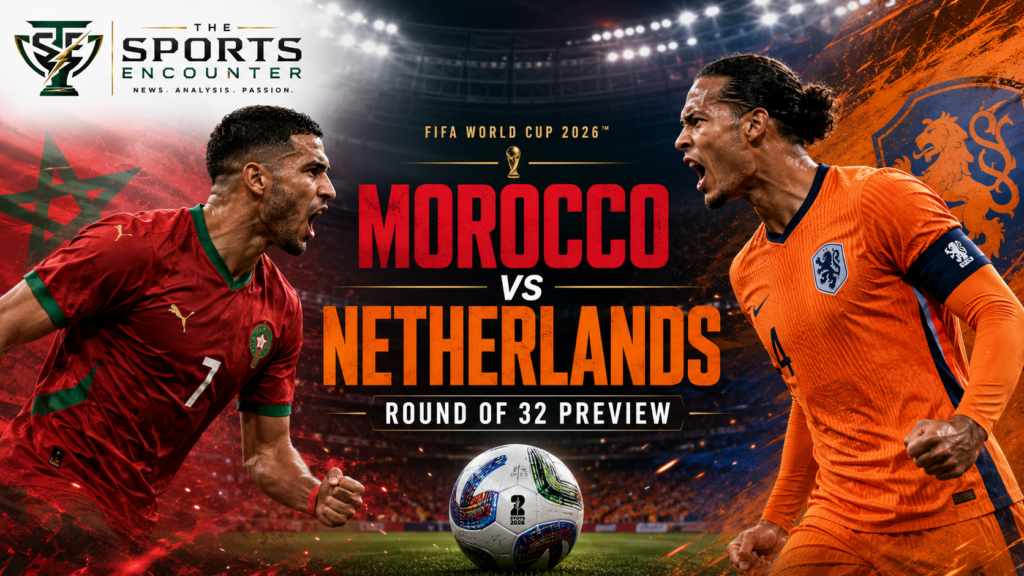
Morocco and the Netherlands have arrived at the same knockout door from different football worlds, but neither side enters Monterrey as a passenger.
This is one of those Round of 32 ties that feels too strong for the first knockout round. The Netherlands carry the weight of European pedigree, tournament history, elite defenders, and a group-stage campaign that showed control. Morocco bring something more dangerous than romance. They bring structure, belief, resilience, and the confidence of a team that has stopped treating major tournaments as survival exercises.
For readers tracking the wider tournament picture, The Sports Encounter’s FIFA World Cup 2026 coverage hub has followed how this expanded knockout stage has turned early elimination football into a real pressure test. Morocco vs Netherlands may be the clearest example yet.
Why This Tie Feels Bigger Than a Round of 32 Match
The expanded 48-team World Cup has created some uneven matchups, but this one carries proper knockout weight. Morocco reached the 2022 World Cup semifinals and changed how many fans viewed African and Arab football on the global stage. The Netherlands reached the quarterfinals in Qatar and pushed Argentina all the way before falling on penalties.
That recent history matters.
Both teams know what the late stages feel like. Both understand tournament pressure. Both have enough quality to believe the Round of 16 should be the minimum, not the dream.
The Netherlands reached this stage after topping Group F with seven points. Their 3-1 win over Tunisia confirmed first place and set up this dangerous meeting with Morocco. You can read our earlier report on how the Dutch sealed the matchup here: Netherlands Beat Tunisia 3-1 to Top Group F and Set Up Morocco Clash.
Morocco also finished with seven points, coming second in Group C behind Brazil on goal difference. That alone tells the story. Any team that can come through a group containing Brazil, Scotland, and Haiti without losing deserves serious respect.
Morocco’s Strength: Resilience With Real Attacking Bite
Morocco have not played perfect football in this tournament. They have done something more useful in knockout football: they have solved problems.
They drew 1-1 with Brazil, edged Scotland 1-0, then fought back twice to beat Haiti 4-2. That Haiti match showed both sides of Morocco’s tournament. They looked vulnerable at times, especially when transitions opened up. Yet they also showed the mental strength to recover after setbacks and the attacking depth to finish strongly.
Our match report on Morocco’s comeback win explains that resilience in detail: Morocco Fight Back Twice as Haiti Bow Out With Pride.
Achraf Hakimi remains central to Morocco’s identity. His energy from right back gives them width, speed, and leadership. Ismael Saibari has also become one of Morocco’s most important attacking pieces, while Brahim Díaz gives the team technical craft between the lines. Ayyoub Bouaddi adds freshness and intelligence in midfield, which could matter late if the match slows under Monterrey heat.
Morocco’s best path to victory is clear. They must stay compact, keep the Dutch from settling into passing rhythm, then attack space quickly through Hakimi, Saibari, and Brahim. If they turn this into a game of emotional momentum, they have a real chance.
Netherlands’ Strength: Balance, Size, and Knockout Control
The Netherlands look slightly more solid on paper because their structure feels more repeatable.
Virgil van Dijk gives them authority at the back. Denzel Dumfries offers power and width on the right. Cody Gakpo gives them movement, finishing, and big-match calm in the front line. Brian Brobbey has also given Ronald Koeman a strong central option, especially when the Dutch want direct pressure inside the box.
Their group-stage campaign showed range. They drew with Japan, thrashed Sweden, then handled Tunisia. That mix matters because they have already faced different match scripts. They have played a tight game, a dominant game, and a controlled final group match.
For a deeper look at how the expanded format shaped these knockout pairings, read The Sports Encounter’s breakdown of the World Cup 2026 knockout picture.
The Dutch advantage lies in their defensive maturity and physical profile. They can defend crosses, compete in set pieces, and punish loose Moroccan possession. If they score first, they may force Morocco into the kind of open game that suits Dutch attackers.
Key Battle: Hakimi vs the Dutch Left Side
Hakimi may decide how brave Morocco can be.
If he pushes high and pins the Dutch left side back, Morocco can create overloads and force the Netherlands to defend facing their own goal. If the Dutch trap him deep, Morocco lose one of their cleanest attacking routes.
This battle also affects Brahim Díaz. When Hakimi stretches the pitch, Brahim can drift inside and receive between midfield and defense. If Hakimi gets pinned, Brahim may receive the ball in crowded areas with fewer passing angles.
For the Netherlands, this is where control becomes vital. They must stop Morocco from turning recoveries into quick attacks. The Dutch do not need to dominate every phase, but they cannot allow repeated broken-field runs.
Can Morocco Cause the Upset?
Yes, Morocco can beat the Netherlands.
Calling it an upset still makes sense because the Netherlands carry deeper European pedigree and look more stable across defense, midfield, and attack. Yet Morocco’s current status makes this a dangerous “upset” label. They are African champions, recent World Cup semifinalists, and unbeaten in a group that included Brazil.
This is not a hopeful underdog waiting for a miracle. Morocco have a real football case.
Their route depends on three things: disciplined defending, controlled emotion, and clinical finishing. They cannot afford long spells of loose possession. They also cannot chase the match too early if the Dutch control the ball.
The Netherlands look more solid overall because they have fewer visible weaknesses. Their defensive base, set-piece threat, and group-stage authority give them a narrow edge. Still, Morocco may have the stronger emotional gear. If the match reaches the final 20 minutes level, the pressure could shift toward the Dutch.
Prediction: Netherlands Edge It, but Morocco Can Punish Any Drop
The Netherlands enter as slight favorites because their structure looks cleaner and their defensive spine gives them a safer platform. They should control more of the ball and create the higher volume of organized attacks.
Morocco, however, have already shown they can live with uncomfortable games. Their draw against Brazil and comeback against Haiti prove they do not panic when matches turn messy.
Prediction: Netherlands 2-1 Morocco
Morocco have enough quality to score and enough courage to make this uncomfortable. The Dutch look a touch more complete, but Monterrey could still become the stage where Africa’s champions remind Europe that reputation does not win knockout football.
For fans still following how the new elimination path works, The Sports Encounter’s guide to the FIFA World Cup 2026 qualification process explains why the Round of 32 has added another layer of pressure to this tournament.
The Sports Encounter’s World Cup 2026 coverage focuses on fixtures, team news, match analysis, fan stories, tournament trends, and the biggest talking points from football’s global stage.
Morocco vs Netherlands: Match Information
| Detail | Information |
|---|---|
| Match | Morocco vs Netherlands |
| Competition | FIFA World Cup 2026 |
| Stage | Round of 32 |
| Venue | Monterrey Stadium, Monterrey, Mexico |
| Winner Faces | Canada in the Round of 16 |
| Core Question | Can Morocco upset the Netherlands? |