


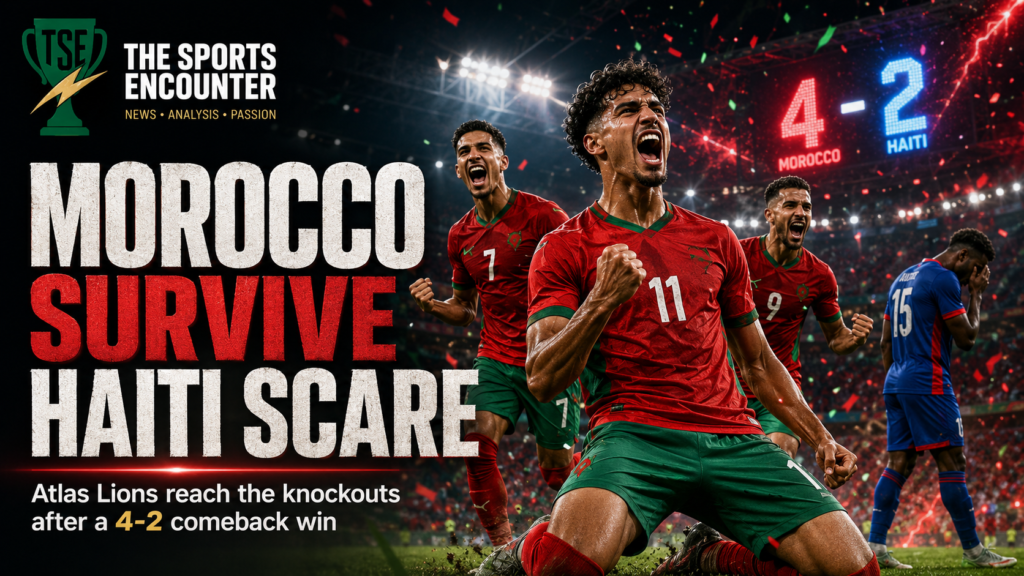
Morocco do not seem interested in taking the smooth road at this FIFA World Cup.
The Atlas Lions have made drama part of their tournament language. Against Haiti in Atlanta, they conceded first, fought back, conceded again, and still found enough quality, nerve, and attacking depth to win 4-2. It was not clean. It was not comfortable. But it was another reminder that Morocco’s World Cup run has moved beyond promise and into belief.
For readers following the wider tournament picture, The Sports Encounter’s FIFA World Cup 2026 coverage hub tracks the latest match reports, team stories, knockout updates, and daily tournament angles.
Haiti, already under pressure after defeats to Scotland and Brazil, gave Morocco a proper fright. They played with pride, energy, and emotional freedom, twice taking the lead in a wild Group C finale. Yet Morocco had the stronger finishing power when the match began to stretch.
Achraf Hakimi, Ismael Saibari, Soufiane Rahimi, and Gessime Yassine scored for Morocco. Haiti’s goals came through a Yassine Bounou own goal and a stunning Wilson Isidor strike.
The result sent Morocco into the Round of 32 as Group C runners-up behind Brazil. Haiti’s World Cup is over, but they did not leave quietly.
Haiti Strike First and Shake Morocco Early
Haiti had nothing to lose, and that made them dangerous.
In the 10th minute, they forced the first major twist of the match. Lenny Joseph’s clever backheeled effort from close range caused panic in the Morocco box, and the ball eventually deflected in off goalkeeper Yassine Bounou. It was later recorded as an own goal, but for Haiti, the moment still carried weight.
They had scored against one of the most respected teams in the tournament.
Morocco looked rattled for a spell. Haiti pressed with enthusiasm, ran directly at defenders, and forced the Atlas Lions to chase the rhythm instead of controlling it.
That has been one of the fascinating parts of Morocco’s World Cup campaign. They have not always looked dominant, but they have shown an ability to absorb pressure without losing their head. Against Brazil, they earned a 1-1 draw. Against Scotland, they found a way to win 1-0 in a match that completely changed the mood of Group C. Our earlier report on how Morocco edged Scotland through Saibari’s early strike now reads like a warning sign of what this team could become.
Against Haiti, Morocco had to show something different: recovery after chaos.
Hakimi Brings Morocco Back
Morocco needed a senior figure to settle the match, and Achraf Hakimi stepped forward.
The captain equalized in the 39th minute after Haiti goalkeeper Johny Placide could only parry a dangerous cross into the danger area. Hakimi reacted sharply and forced the ball over the line.
It was a captain’s goal in every sense. Not pretty, not polished, but vital.
Hakimi’s influence became one of the game’s major stories. He scored, assisted, drove attacks from wide areas, and gave Morocco the leadership they needed when Haiti refused to fade. In a match where Morocco’s defensive shape looked vulnerable, his attacking authority became the difference.
But Haiti had another punch ready.
Isidor’s Thunderbolt Gives Haiti Another Lead
In the 43rd minute, Wilson Isidor produced one of Haiti’s great World Cup moments.
After Jean-Kevin Duverne helped create the space, Isidor struck from distance with power and confidence. The shot flew past Bounou and restored Haiti’s lead at 2-1.
For a few minutes, Morocco were staring at a result that could have complicated the mood around their entire group-stage campaign. Haiti’s fans erupted. Their players believed. The game suddenly felt less like a formality and more like a proper World Cup test.
Morocco, however, responded almost immediately.
In first-half stoppage time, Hakimi drove down the right and pulled the ball back for Ismael Saibari, who finished calmly to make it 2-2. Saibari’s goal was especially important because it continued his excellent tournament. He has now scored in all three of Morocco’s group-stage matches.
That is not a small footnote. That is a player taking ownership of a World Cup story.
Morocco’s Bench Changes the Match
The second half was where Morocco’s depth told.
Haiti had spent a lot of energy in the first half. Morocco began to attack with more patience, more width, and more pressure from set pieces. The Atlas Lions kept asking questions until Haiti’s defensive line finally cracked.
In the 78th minute, substitute Soufiane Rahimi put Morocco ahead for the first time. Haiti failed to clear properly from a corner, and Rahimi punished them with a sharp finish from close range.
That goal changed the emotional temperature of the match.
Haiti had played with heart, but Morocco now had control. Late in the game, another substitute, 20-year-old Gessime Yassine, made it 4-2 after Rahimi kept the move alive and squared the ball for a simple finish. Haiti’s defenders believed the ball had gone out of play, but the goal stood after VAR review.
For Morocco, it was the perfect bench impact: one substitute scored the third, another scored the fourth, and the team’s knockout place was secured.
Morocco’s Dream Run Is No Accident
Morocco’s World Cup campaign now has a real shape.
They drew 1-1 with Brazil, beat Scotland 1-0, and defeated Haiti 4-2. Seven points from three matches in a group containing Brazil, Scotland, and Haiti is a serious return. Finishing behind Brazil only on goal difference should not reduce the scale of what Morocco have done.
This is a team with balance, personality, and resilience.
They can suffer without collapsing. They can score through different routes. Hakimi gives them leadership and thrust. Saibari has become one of the tournament’s breakout performers. Rahimi and Yassine showed the value of Morocco’s bench. Even when their defending looked loose against Haiti, their attacking response was mature enough to rescue the match.
Still, the warning is clear.
Morocco cannot keep giving opponents early belief. Knockout football is less forgiving. A slow start in the Round of 32 could become terminal if the opponent is sharper than Haiti in transition or more ruthless in the box.
That is the next stage of Morocco’s growth. The dream is alive, but the margins are getting thinner.
For readers still catching up with the expanded tournament structure, our guide explains how teams qualify from the FIFA World Cup 2026 group stage and why the Round of 32 has changed the pressure around final group matches.
Haiti Exit, But Not Empty-Handed
Haiti’s World Cup is over after three defeats, but this match gave them something real to carry home.
They were beaten by Scotland. They were beaten by Brazil. They were beaten by Morocco. On paper, that reads harshly. On the pitch, especially against Morocco, they showed spirit, ambition, and emotional courage.
Their two goals against Morocco mattered. The first came through pressure and movement. The second, Isidor’s strike, was a moment of genuine World Cup quality. Goalkeeper Johny Placide, playing what was reported as his final international match, also made several important saves despite Morocco scoring four.
Haiti may leave without a point, but they did not leave without a memory.
Their tournament had already taken a heavy blow when Brazil beat Haiti 3-0 in Group C, but this final match showed a side still willing to compete, still willing to attack, and still willing to make a stronger opponent sweat.
That matters for a team returning to the World Cup stage after such a long absence.
Cards Report: No Red Cards, Three Haiti Yellow Cards
There were no red cards in Morocco vs Haiti.
Three Haiti players were booked:
Duckens Nazon
Johny Placide
Josue Casimir
Casimir’s yellow card came in stoppage time for a bad foul. Morocco did not receive a yellow card in the official match facts reviewed.
Who Will Morocco Play Next?
Morocco will play the winner of Group F in the Round of 32.
That means their knockout opponent will be one of:
Netherlands
Japan
Sweden
The final Group F matches will decide Morocco’s exact opponent.
It is a fascinating next step. Morocco have already shown they can stand up to a heavyweight by drawing with Brazil. They have also shown they can win tight and messy matches. Now they need to prove they can turn resilience into knockout control.
Final Word
Morocco’s 4-2 win over Haiti was not a statement of perfection. It was a statement of survival, belief, and attacking response.
The Atlas Lions were behind twice. They still won by two goals. That says plenty about where this team is mentally.
Haiti are going home, but they gave the tournament one last burst of pride. Morocco are going forward, and their dream run now has a knockout chapter waiting.
The road gets harder from here.
But Morocco have already shown they are not easily shaken.