


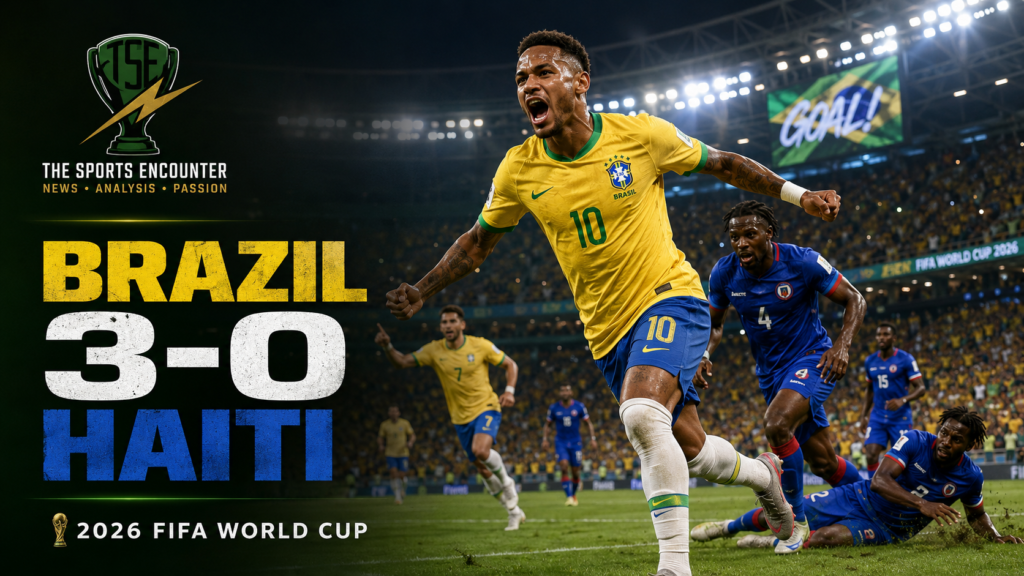
Brazil needed a sharper answer after their opening draw against Morocco.
They found it in the first half against Haiti.
Matheus Cunha scored twice, Vinicius Junior added a third before halftime, and Brazil moved back into control of their FIFA World Cup 2026 campaign with a 3-0 win over Haiti in Group C. It was not a perfect Brazilian performance, and Carlo Ancelotti will know that tougher tests will punish loose spells more severely. Still, after the frustration of the Morocco draw, this was the kind of result Brazil needed: clean, controlled, and decisive enough to calm the noise.
For Haiti, the result carried a cruel finality. Their effort was honest. Their defensive commitment was real. Their players kept running, kept pressing, and kept looking for moments even after Brazil had taken command. Yet effort alone rarely survives against elite quality when the margins open up. Haiti showed courage, but Brazil had the technique, timing, and final-third clarity to turn pressure into goals.
For full tournament coverage, follow The Sports Encounter’s FIFA World Cup 2026 hub.
Match Summary: Brazil Strike Early and Take Control Before Halftime
Brazil started with the urgency missing from parts of their opening match. The ball moved quicker through midfield, the wide players attacked earlier, and the front line showed more appetite to test Haiti’s defensive shape.
The breakthrough arrived in the 23rd minute through Matheus Cunha. Vinicius Junior was involved in the move, as he so often was during Brazil’s best attacking phases. Haiti goalkeeper Johny Placide did well to react initially, but Brazil kept the pressure alive and Cunha finished the chance that settled Brazilian nerves.
That goal changed the rhythm of the match.
Haiti had opened with energy and belief, but going behind against Brazil forces a team into an awkward choice. Sit deeper and invite pressure, or step forward and leave space for Vinicius, Cunha, and the runners around them. Haiti tried to stay brave. Brazil punished the gaps.
Cunha struck again in the 36th minute, this time with another piece of direct attacking play that showed why Brazil looked more dangerous when they attacked with fewer touches. Vinicius again found space and helped unlock the Haitian back line. Cunha’s second goal gave Brazil breathing room and put Haiti in survival mode before the break.
Then came the third.
Vinicius Junior scored in first-half stoppage time, finishing through Placide to cap a dominant opening 45 minutes. It was the goal that effectively ended the contest. Haiti could still fight for pride after halftime, but the match had already moved beyond them.
Brazil had done their real damage before the interval.
Yellow Cards and Discipline
There were no reported red cards in the match.
The yellow cards went to:
- Carlens Arcus, Haiti
- Frantzdy Pierrot, Haiti
- Danley Jean Jacques, Haiti
- Douglas Santos, Brazil
The card count reflected the match’s emotional pattern. Haiti had to defend under pressure for long spells, and frustration grew as Brazil’s movement kept stretching the defensive block. Pierrot’s booking summed up some of that tension, while Brazil’s own yellow for Douglas Santos showed that Ancelotti’s side also had moments where they needed to manage transitions more carefully.
The match never turned ugly, but Haiti’s physical workload was heavy. Chasing Brazil for 90 minutes is not just a tactical challenge. It is a mental drain.
Brazil’s Attack: Faster, Sharper, and Built Around Vinicius
Brazil’s attack looked far more convincing than it did in the 1-1 draw against Morocco.
The biggest reason was tempo.
Brazil did not always produce the flowing, irresistible football fans expect from the Seleção, but they attacked Haiti with clearer intention. They moved the ball into wide areas faster, looked for early runs behind the defensive line, and used Vinicius Junior as the main destabilizing force.
Vinicius was the key player in the match.
He helped create the first goal, assisted the second, and scored the third. Haiti struggled to handle his acceleration, especially when Brazil found him before the defense could settle into shape. His ability to attack space changed the entire mood of Brazil’s performance. Every time he received the ball near the left channel, Haiti’s defenders had to retreat, shift, or foul.
That opened room for Cunha.
Cunha’s two goals were important not only because they won the match, but because they gave Brazil another attacking reference point. Starting in place of Igor Thiago, he gave Ancelotti movement, penalty-area presence, and a clinical edge. Brazil needed someone to turn possession into scoreboard pressure. Cunha did exactly that.
The concern for Brazil was Raphinha’s first-half injury. Losing rhythm on one flank can affect the balance of the attack, especially in a tournament where recovery windows are short. Brazil still had enough quality to manage the match, but Ancelotti will want clarity on Raphinha’s condition before the decisive Group C meeting with Scotland.
Brazil’s attack scored three goals, created danger from wide areas, and gave fans a better look at how this team can hurt opponents. The caution is simple: Haiti gave Brazil more room than Morocco did, and stronger knockout-level teams will not always allow Vinicius to run into open grass so easily.
Still, this was progress.
After the Morocco draw, Brazil needed their forwards to look alive again. They did.
For wider context on how African and Caribbean underdogs have challenged bigger teams in this tournament, read our report on DR Congo holding Portugal in a World Cup shock.
Brazil’s Defence: Clean Sheet, But Not Untested
A 3-0 win suggests total comfort, but Brazil’s defence still had work to do.
Haiti did not create constant danger, yet they did produce moments that forced Brazil to stay alert. Ricardo Ade came closest for Haiti with a strong header that required Alisson to make a serious save. That moment mattered because it reminded Brazil that defensive concentration cannot drop simply because the attack has built a lead.
Alisson’s save protected the clean sheet and kept Haiti from gaining emotional momentum.
Brazil’s centre-backs handled most aerial and central threats well. Gabriel Magalhães and Marquinhos gave Brazil authority in the box, while the midfield screen helped reduce Haiti’s ability to carry the ball through central areas. Casemiro and Bruno Guimarães gave Brazil enough control to prevent the match from becoming too stretched.
The fullbacks had a more complex job.
Brazil wanted width and forward pressure, but Haiti’s willingness to break when possible meant Douglas Santos and Danilo had to balance ambition with recovery. Douglas Santos’ yellow card showed that Brazil were not completely immune to awkward defensive moments. Against a stronger transition team, those small details could become larger problems.
Still, Brazil’s defensive performance deserves credit.
They kept Haiti scoreless, limited the number of clear chances, and avoided the late sloppiness that sometimes appears when a stronger side eases off. Alisson’s presence helped, but the overall defensive structure looked calmer than it had against Morocco.
The next test will be more revealing.
Scotland are organized, direct, and full of belief after their strong start in Group C. Brazil’s defence will need the same concentration, with more physical duels and likely less open attacking comfort.
You can read more on Scotland’s start in our report on Scotland topping Group C after John McGinn’s winner against Haiti.
Haiti’s Brave Effort Was Not Enough
Haiti did not fold because of attitude.
They lost because Brazil had more quality in the decisive areas.
That distinction matters.
Haiti ran hard, defended with pride, and tried to keep their shape even after Brazil’s first-half burst took the match away. Their players did not treat the game like a ceremonial appearance against a football giant. They challenged, pressed, and searched for a goal that would have given their supporters a moment to carry home.
Ricardo Ade’s header was Haiti’s clearest route back into the match. Bellegarde tried to influence the game from midfield, while Frantzdy Pierrot worked through a difficult evening against Brazil’s centre-backs. Haiti also showed more courage than the scoreline might suggest by refusing to sit in complete retreat for the full match.
Yet the problem was familiar for underdogs at this level.
Haiti’s final pass lacked precision. Their attacks needed too many things to go right. Brazil’s defenders recovered quickly when danger appeared, and Alisson gave them elite security behind the back line. Haiti could reach promising areas, but they struggled to turn those moments into sustained pressure.
That is where the gap showed.
Brazil needed fewer chances to score. Haiti needed near-perfect execution just to create one.
Their World Cup campaign now carries disappointment, but not shame. Haiti returned to the tournament after a long absence and played with spirit. Their players made Brazil work, even if they could not make Brazil panic.
For readers tracking how underdog stories are shaping the tournament, our feature on World Cup upsets that still make football feel dangerous gives useful wider context.
What This Result Means for Group C
Brazil now have four points from two matches after drawing with Morocco and beating Haiti. The win puts them in a strong position, but the group is still alive because goal difference and final-round matchups can still shape the table.
Brazil face Scotland next.
That match now carries real weight. Scotland are not just another opponent trying to survive. They have already shown that they can defend a lead, compete physically, and make matches uncomfortable. Brazil will enter as favorites, but they cannot afford a slow start or another uneven attacking display.
Haiti’s tournament hopes are gone, but they still have one more chance to shape the group. Their final match against Morocco can affect the standings, especially if Morocco need points or goals to chase qualification. Haiti may be eliminated, but eliminated teams can still change a World Cup group.
That is the strange beauty of tournament football.
Nothing happens in isolation.
Final Word: Brazil Win, But the Bigger Test Still Waits
Brazil did what they had to do.
They scored early, built a three-goal lead before halftime, protected the clean sheet, and gave their campaign a more stable shape after the Morocco draw. Cunha made the most of his start. Vinicius played like the match’s defining attacker. Alisson answered when needed. The defence stayed firm enough.
That is the good news.
The larger question remains whether Brazil can produce the same clarity against teams with more defensive discipline, better transition speed, and greater attacking threat. Haiti were brave, but they were not good enough to turn effort into danger often enough. Brazil’s next match will tell us more about the ceiling of this team.
For now, though, the Seleção are moving again.
They needed a response.
They got one.