


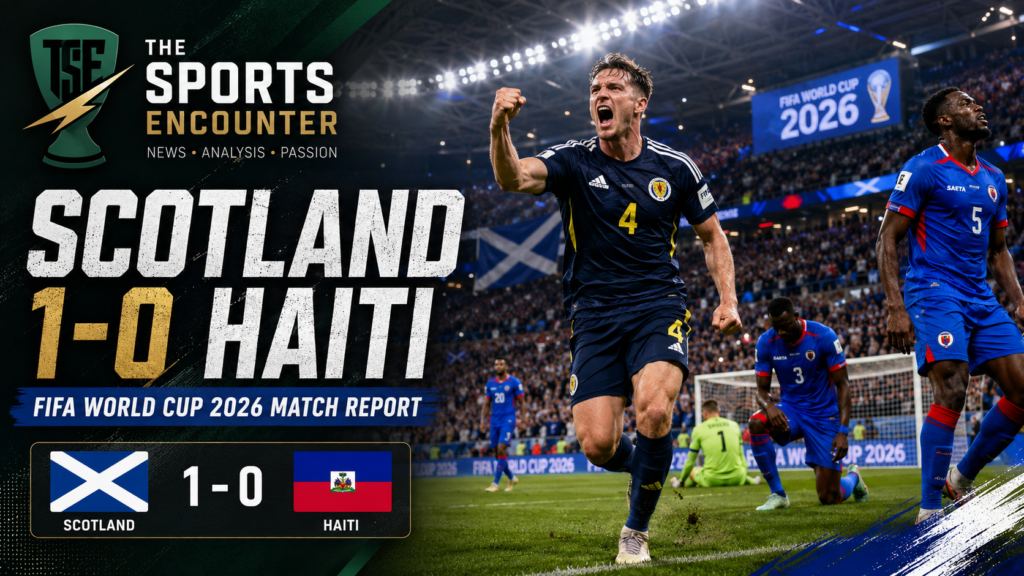
Scotland waited 36 years for this feeling.
It was not pretty. It was not calm. It was not the kind of polished World Cup performance that makes future opponents nervous.
But it was enough.
John McGinn’s first-half goal gave Scotland a priceless 1-0 win over Haiti in their FIFA World Cup 2026 Group C opener at Boston Stadium, ending the country’s long wait for a victory on football’s biggest stage.
For Steve Clarke’s side, this was more than a result. It was a release.
Scotland had not won a World Cup match since beating Sweden 2-1 in 1990. They had not even appeared at the tournament since 1998. Against Haiti, they returned with nerves, noise, pressure, and thousands of supporters who turned Boston into a sea of Scottish belief.
By full time, belief had survived.
Only just.
McGinn Finds the Breakthrough
The decisive moment arrived in the 28th minute.
Scotland had started with decent control and looked dangerous when they moved the ball quickly into wide areas. Ben Gannon-Doak gave Haiti real problems with his direct running, while Che Adams and Lawrence Shankland tried to stretch the back line.
The move that settled the match had all the ingredients Scotland needed: a long ball, a sharp attacking run, a low delivery, and a midfielder brave enough to follow the play.
Che Adams was first denied by Haiti goalkeeper Johny Placide after Gannon-Doak’s cross caused panic in the box. The rebound fell to McGinn, whose effort was not the cleanest strike of his career, but it found its way into the net.
That was all Scotland needed.
The goal sparked wild celebrations among the Tartan Army and gave Scotland their first World Cup goal since 1998. More importantly, it gave them something tangible to protect.
From that point onward, the match became a test of Scotland’s concentration, discipline, and nerves.
Haiti Refused to Fade
Haiti came into the match as the underdog, but they did not play like a side interested only in damage limitation.
They carried pace in transition, pressed Scotland into uncomfortable moments, and grew more confident after falling behind. Wilson Isidor, Frantzdy Pierrot, and Ruben Providence gave Scotland’s defense enough problems to keep the match alive until the final whistle.
Scotland goalkeeper Angus Gunn had one nervous moment soon after the goal when he spilled an effort from Carlens Arcus, but the danger was cleared before Haiti could punish the mistake.
That moment summed up Haiti’s night.
They were brave. They created pressure. They made Scotland uncomfortable.
What they lacked was the final touch.
Pierrot’s late header, which went narrowly wide from close range, was Haiti’s clearest route back into the game. It was the kind of chance that can change a group-stage story. Instead, it drifted away, and with it went Haiti’s best opportunity to earn a point.
Scotland Got the Result, But the Performance Leaves Questions
This was a huge win for Scotland, but it was also a warning.
Clarke’s team had good spells in the first half, especially before the goal, but they struggled to control the game after taking the lead. Haiti saw more of the ball, pushed Scotland deeper, and forced the match into uncomfortable territory.
Against Haiti, Scotland survived.
Against Morocco and Brazil, they may need more than survival.
Andy Robertson worked hard on the left and remained one of Scotland’s most reliable outlets. Scott McTominay almost opened the scoring earlier when he struck the post, while Gannon-Doak offered pace and courage in a performance that showed why Scotland fans are excited about his future.
Still, Scotland’s attacking rhythm faded after the goal.
McGinn also missed a chance in the second half to make it 2-0, dragging his effort wide when a second goal would have killed the match and improved Scotland’s goal difference in a difficult group.
That miss kept Haiti alive.
It also kept Scottish nerves on edge until the final whistle.
Group C Opens Up After Brazil and Morocco Draw
Scotland’s win became even more valuable because of what happened elsewhere in Group C.
Brazil and Morocco played out a 1-1 draw, leaving Scotland top of the group after the opening round of matches. That does not guarantee anything, but it changes the mood around Scotland’s campaign.
Before kickoff, this was the match Scotland had to win.
After full time, they had done the job.
Now the challenge becomes different. Scotland face Morocco next, followed by Brazil. Both matches will ask harder questions, especially if Scotland cannot keep the ball better or create more clear chances.
But in a 48-team World Cup, three points from the opening game can carry real weight.
A draw in one of the next two matches could put Scotland in a strong position to reach the knockout stage for the first time in their history.
That sentence alone shows why this result matters.
Haiti Deserved Respect
Haiti left the pitch without a point, but not without pride.
This was their first World Cup appearance since 1974, and they showed enough to suggest they will not be passive opponents in Group C. Their physicality, speed, and willingness to attack Scotland after going behind gave the match a competitive edge.
The problem was execution.
Haiti had moments. Scotland had the goal.
At World Cup level, that is usually the difference between a brave performance and a historic result.
Haiti now face Brazil in their next match, where the pressure will be even greater. They will need sharper finishing, cleaner decision-making in the final third, and better composure when chances arrive.
Still, this performance gave them something to build on.
They made Scotland work for everything.
Final Verdict
Scotland did not produce a masterpiece.
They produced a result.
In tournament football, especially in an opening match loaded with history and pressure, that can matter more than style.
John McGinn’s goal will go straight into Scotland’s modern football memory. It ended a 36-year wait for a World Cup win, put Steve Clarke’s side on top of Group C, and gave the Tartan Army the kind of night they had waited decades to enjoy.
The performance needs work.
The ball retention must improve.
The attacking threat has to last longer than short bursts.
But Scotland came back to the World Cup and won.
For one night, that was enough.