The Story That Refused to End · Episode 07 of 10
Jawad Hussain recalls hacking incidents that disrupted the original Sports Encounter. The account preserves what he remembers while separating operational consequences from technical details that the surviving evidence cannot establish.
The archive can show a homepage. It cannot show the full experience of trying to keep that homepage online. For the most difficult technical period of the original Sports Encounter, the main surviving account comes from Jawad Hussain, who remembers hacking incidents and a growing inability to protect the project adequately.
His testimony belongs in the history because he was involved in running the publication. The underlying incident records are no longer available. This account therefore cannot identify an attacker, determine how access was obtained, or give a verified chronology of each disruption.
What the Founder Remembers
Hussain associates the publication’s later difficulties with hostile activity against the website. He recalls that the team lacked the technical knowledge and control needed to investigate and reverse the damage fully. In his account, keeping the project going became increasingly difficult.
The surviving evidence does not establish a particular vulnerable plugin, compromised password, hosting fault, malicious file, or database intrusion. It would be misleading to select one of those familiar explanations and present it as the cause of TSE’s problems.
The same limit applies to intent. The founder remembers attacks, but no authenticated evidence identifying the people responsible has been recovered. The documentary can describe the disruption he recalls without attaching an accusation to an individual, company, or competing publication.
The Pressure on a Publishing Operation
The publication had developed numerous sections, reader tools, and third-party elements. Maintaining a news website involves work beyond writing the next report, including keeping access secure and recovering when systems fail. That is general operational context; it is not a technical reconstruction of the historical incidents.
Hussain’s account describes the point at which those demands exceeded what the team could reliably resolve. The record does not reveal a detailed repair budget, the number of hours spent restoring pages, or how responsibility was divided during each incident.
Those missing details limit the account, but they do not make the founder’s experience irrelevant. An independent publication’s history includes the circumstances under which its people could no longer sustain the work, even when a complete forensic report has not survived.
A Missing Image Is Not an Attack Log
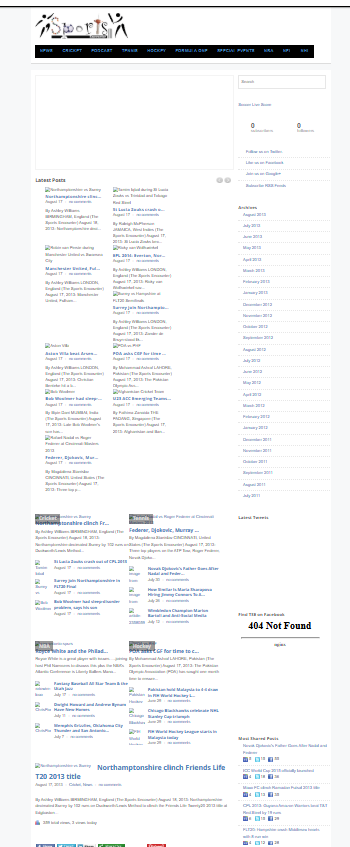
Several supplied archive replays contain blank images, failed embeds, or empty spaces. These can arise because the archive did not capture a resource or cannot replay it. They cannot be used as visual proof that hackers damaged the original live page.
The distinction is crucial when placing images beside this episode. A caption should identify the page and the period shown. It should not label an archive-replay defect as the aftermath of an intrusion unless independent evidence establishes that connection.
The August 2013 material is useful because it preserves reporting from the later period. It supplies a setting for the founder’s account and a record of the publication’s continuing work. It supplies no reliable technical diagnosis.
Several Problems That Must Remain Separate
The founder also remembers advertising and search-related consequences. A security incident, an advertising-account action, and a loss of search visibility are distinct events. They may affect the same publication, but their appearance in one remembered period does not prove a single causal chain.
This series treats the advertising account in its own episode for that reason. Without notices, analytics, or logs, it cannot determine whether a particular attack caused a particular Google decision or how much any one event contributed to the newsroom’s eventual closure.
What survives is an account of a team struggling with problems beyond its available technical capacity. The history can preserve that experience honestly without supplying an attacker or a mechanism it cannot substantiate.
The Lesson Carried Into the Revival
For the revived publication, the relevant lesson is practical. Backups must be restorable, changes reviewable, and access recoverable. These are objectives for the present operation, not claims that the old team followed a particular procedure or that the new website is immune to failure.
The founder returned to publishing in 2026 with the memory of losing control of an earlier project. That experience helps explain his determination to understand the technology supporting the newsroom as well as the journalism it produces.
Sources and Evidence
This episode distinguishes screenshot observations, public self-descriptions, founder testimony, and interpretation. Exact archive capture addresses have not been authenticated.
- F01: Founder account supplied October 16 and 17, 2026
- A12: August 2013 Upper Homepage. August 2013 label; reports dated August 17
- A13: August 2013 Middle Homepage. August 2013 label; reports dated August 17
- A14: August 2013 Lower Homepage. August 2013 label; reports dated August 17