The Story That Refused to End · Episode 02 of 10
By October 2010, Sports Encounter had a custom portal, featured coverage, sports sections, ratings, and polls. The surviving pages also preserve credits for the people maintaining its website.
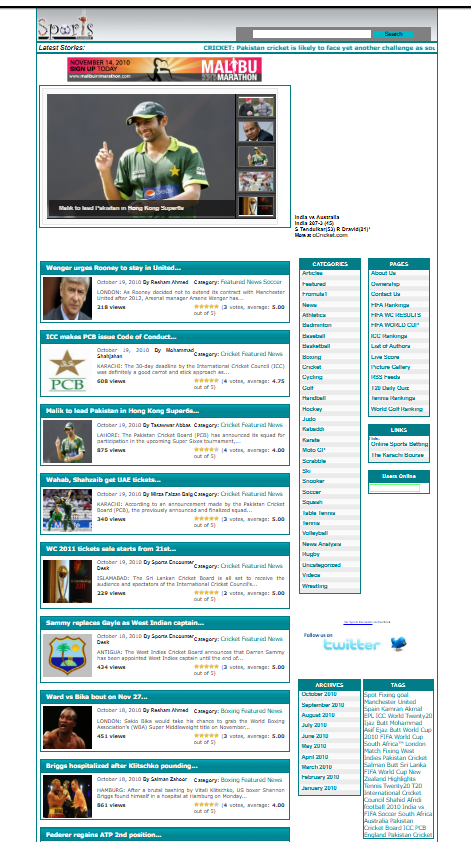
By October 2010, the page had acquired the furniture of a sports portal. A featured-story display occupied the upper section. Below it, individual reports carried images, dates, bylines, and ratings. A long category menu gave readers routes into sports that barely appeared in the earliest surviving replay.
The supplied October material records a substantial development in Sports Encounter’s presentation during its founding year. The homepage and a surviving article page show how the original newsroom was beginning to organize its reporting, invite participation, and give its expanding coverage a recognizable home.
A Homepage With Editorial Choices
The featured area gave one story greater prominence than the list beneath it. The visible selection included Pakistan cricket, English football, and boxing, while smaller sections further down the page grouped coverage by sport. Readers could scan the leading report, inspect the latest items, or move directly to a particular subject.
This arrangement involved decisions about relative importance. A portal had to do more than collect links in chronological order. Its front page could suggest which event deserved attention, which article offered a different kind of reading, and where a returning visitor should look next.
One visible item concerned Arsène Wenger and Wayne Rooney. Others addressed Pakistan cricket administration, squad matters, West Indies cricket, and professional boxing. The mixture shows the breadth of the page at that moment. It does not establish that every listed report originated from an exclusive interview or independent reporting assignment.
The Article Had a Life Beyond the Headline
A separate supplied screenshot preserves the Wenger article page. It contains a headline, author and date information, text, photographs, related navigation, sharing controls, and a comments area. The complete original article address has not been recovered, so the screenshot remains the source for its layout.
An article could now be encountered outside the homepage and still carry the publication’s identity. Readers arriving at a single report had routes to other subjects and a way to respond. The page gives a fuller picture of what the newsroom was building than a masthead alone could provide.
Its photographs also create a practical responsibility for the present archive. Preserving a screenshot as evidence of the old website does not establish ownership of every photograph within it. Any public reproduction needs its own image-use review, with original screenshots kept intact in the research record.
Asking Readers to Participate
The October homepage included article ratings and a reader poll. One visible poll asked about Pakistani cricketers and spot-fixing allegations. Its presence documents a feature the publication offered, rather than a representative survey of cricket supporters.
On-page views and voting totals also appear beside some reports. Those counters are part of the historical interface. They cannot be added together to reconstruct monthly users, treated as audited circulation, or used to verify the much later recollection of a World Cup audience peak.
The distinction does not make the features insignificant. Ratings, polls, and comments gave readers opportunities to answer back. They reveal an early interest in audience participation alongside the publication of news.
Credits at the Foot of the Page
The supplied lower-homepage image credits Jawad Hussain with website maintenance and names Faraz Ahmed in the theme’s design and development credit. These are visible historical credits, with a narrower meaning than a complete account of the founding team.
They should be preserved as printed. A design credit does not establish a person’s role in every later redesign; a maintenance credit does not reveal how much technical work was shared. The footer nevertheless records contributions that might disappear if the history were reduced to the founder’s name alone.
A Portal Still Taking Shape
Archives, category boxes, social links, and reader tools made this a more developed editorial product than the earliest replay. The changes also created more components to maintain. The screenshots show the resulting structure without revealing its development budget, working hours, or technical architecture.
The exact redesign launch date remains unknown. What the October material establishes is enough: within the project’s founding year, Sports Encounter had developed a portal presentation suited to a publication covering several sports. Its next major test would come with an event capable of bringing a much larger audience to cricket reporting.
Sources and Evidence
This episode distinguishes screenshot observations, public self-descriptions, founder testimony, and interpretation. Exact archive capture addresses have not been authenticated.
- A03: October 2010 Upper Homepage. October 2010 label; reports dated October 18 and 19
- A04: October 2010 Lower Homepage. October 2010 label
- A05: Wenger Article Page. October 2010 label