The Story That Refused to End · Episode 06 of 10
The developed Sports Encounter homepage brought together specialist coverage, reader tools, multimedia, and advertising space. Its archive records ambition and activity without supplying audited evidence of commercial success or audience size.
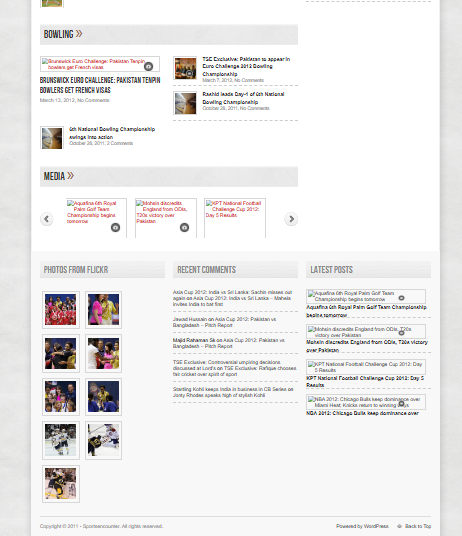
There is a point in the surviving record when Sports Encounter looks most fully assembled. The March 2012 page offers sport-specific coverage, a live cricket scoreboard area, newsletter registration, social elements, media, archives, and advertising spaces. A visitor could browse results, discover a different sport, or look for something beyond the latest headline.
This was a developed editorial product. The screenshots support that description more securely than any claim that it was the publication’s most profitable period or its largest audience month. “At the top of our game” describes the ambition visible in these pages, not an audited ranking of business performance.
Several Ways Into the Reporting
The homepage’s sections gave different sports distinct identities. The navigation also offered breaking news, analysis, events, and video. These were different routes into the publication, reflecting the possibility that readers might arrive with different expectations.
A sports fan checking a live score had a different immediate need from someone opening a feature. A newsletter registration form offered a route back to the publication. An archive created continuity between today’s report and previous coverage. The presence of those features is visible even where their historical usage is unknown.
Together, they show an effort to turn a sequence of articles into a publication readers could revisit. The archive cannot say how many people subscribed, whether every embedded service worked consistently, or what proportion of visitors used any particular feature.
Images and Sporting Identity
The March material includes photo thumbnails and media areas. The October 2011 view places an NBA Finals emblem alongside the masthead. Such details suggest attention to visual presentation and sporting occasions, although the full design decisions behind them have not been recovered.
The event mark should be described without implying an NBA endorsement or a commercial agreement. A website displaying a tournament emblem establishes use of that image in the archived presentation. It does not establish the permissions or relationships behind it.
For the present documentary, these visual details help identify successive stages of the site. They also show why the original screenshots should remain available as evidence rather than being replaced with a cleaner, newly imagined version of the past.
Reader Participation and Its Limits
Polls, comments, ratings, and social counters appear in different periods of the archive. They show how the publication invited readers to respond and how it presented signs of audience participation. They are useful details in the history of the product.
They remain a poor substitute for historical analytics. A visible follower count is neither a monthly user total nor proof of verified identities. A poll result reflects the respondents who participated under an unknown methodology. An on-page view counter cannot establish the number of distinct people reached.
The distinction is especially important when telling the story of a publication remembered for a large World Cup audience. Preserving the interactive features adds context to that memory. It does not independently verify its numerical claim.
Commercial Space and Expansion Plans
Advertising areas are visible in the archived homepages, including spaces inviting advertisers. Khawaja’s surviving project description also refers to investment and business plans. These records show that commercial development formed part of the publication’s thinking.
An advertising placeholder does not prove a paid booking. A displayed advertisement does not establish the amount earned from it. No revenue ledger, advertiser agreement, or reliable profitability record has been recovered for this series. The newsroom’s commercial aspirations can be described without inventing its finances.
That uncertainty becomes more consequential in the later account of advertising-related problems. A publication may have a strong editorial product while struggling to fund and protect the operation behind it. Here, the evidence establishes the product’s development more clearly than the strength of its business.
A Record of What Was Built
Some resources are missing in archived replay, and a social widget visibly fails in one supplied view. Those defects cannot establish that the original live page failed in the same way. They belong to the condition of the evidence unless further records show otherwise.
Once that limitation is understood, the pages remain detailed records of editorial effort. Sports Encounter had created a multi-sport destination with several forms of coverage and audience participation. Its later difficulties would affect a publication that had already acquired recognizable shape and considerable ambition.
Sources and Evidence
This episode distinguishes screenshot observations, public self-descriptions, founder testimony, and interpretation. Exact archive capture addresses have not been authenticated.
- A06: October 2011 Upper Homepage. October 14, 2011 label from supplied dossier
- A07: October 2011 Lower Homepage. October 2011 label
- A08: March 2012 Upper Homepage. March 15, 2012 label from supplied dossier
- A09: March 2012 Middle Homepage. March 15, 2012 label from supplied dossier
- A10: March 2012 Lower Homepage. March 2012 label
- P02: Junaid Khawaja LinkedIn profile and February 2013 project entry