The Story That Refused to End · Episode 05 of 10
The archived Workforce page preserves a contributor network that extended beyond the founding team. Jawad Hussain recalls that most contributors volunteered, giving the publication time, reporting, and specialist interests.
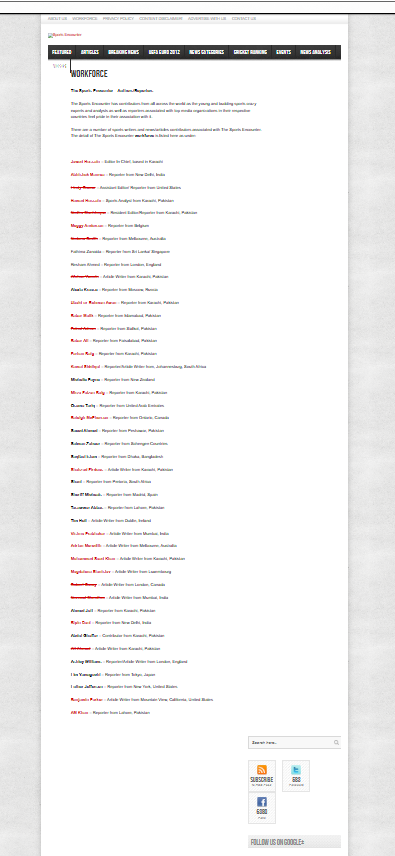
The page is headed “Workforce.” Beneath a short introduction, a long list sets out names, roles, and locations. It is one of the most important surviving documents from the original Sports Encounter because it shifts attention from the website’s appearance to the people associated with its work.
Jawad Hussain says most contributors worked voluntarily alongside the core team. The supplied roster and a surviving developer project description support the picture of a collaborative publication. They do not establish a payroll, employment contracts, or a verified total of people actively contributing at one particular time.
A Public Record of Participation
Publishing a roster made contributors visible beyond an individual byline. The page linked the publication’s identity to people described as reporters, writers, or editors in several locations. Its international scope was part of what the newsroom chose to say about itself.
The available screenshot is narrow and its text is small. Some entries can be partly read, while others cannot be transcribed with sufficient confidence. A permanent history should preserve the full original image and avoid turning uncertain readings into an authoritative credits list.
An approximate count of 44 entries appeared in the earlier research notes. This edition does not present that as a verified contributor headcount. Listed entries may also differ from active contributors, and a historical roster cannot establish how much each person wrote.
The Volunteer Basis
The founder’s description supplies an important fact about how the publication grew: much of the contribution was voluntary. That account is reinforced by Junaid Khawaja’s surviving professional profile, which includes a Sports Encounter project entry labeled February 2013 and describes volunteer writers and news personnel.
The profile is a current surviving self-description containing a dated project entry. It is useful corroboration, but it is not an employment register preserved unchanged since 2013. It should not be asked to establish compensation arrangements for every person on the roster.
What it does show is that the volunteer character of the project appears in more than the founder’s present account. The publication’s collaborative structure was also part of how a person associated with its technical development described it publicly.
Giving Credit Precisely
The October 2010 footer names Jawad Hussain in the maintenance credit and Faraz Ahmed in the design and development credit. These contributions can be recorded with the page and period attached. Khawaja’s project entry adds a separate record of association with the publication.
The distinctions matter because a retrospective can easily give one name responsibility for work carried out by several people at different times. The archive supports specific credits. It does not yet support a complete organizational chart, a list of regional bureau chiefs, or a detailed account of the recruitment process.
There are also no authenticated contributor interviews in the material available for this series. No writer is assigned a quotation, a personal motive, or an anecdote they have not supplied. Recognizing the collective work does not require inventing what individual contributors felt about it.
The Work That a Roster Cannot Show
A list cannot reconstruct the full process behind a published report. It does not tell us who edited a particular paragraph, checked a score, selected an image, or helped when a page failed to load. Those are possible subjects for future oral histories, rather than details this account can recover from a screenshot.
The visible roster still establishes something valuable. Sports Encounter presented itself through a network of contributors, with named roles and locations, rather than solely through the founder. Their inclusion in the historical record should follow the evidence as carefully as the account of the publication’s growth.
A Collaborative Spirit in the Revival
Hussain identifies Peebles, Hagan, Jaye, and Shima among people involved in the present project whose contribution recalls that earlier spirit. These are the names he supplied; this history does not invent fuller identities or imply that they also worked for the original newsroom.
The return of collaborative work gives the old Workforce page a present relevance. Preserving it is a way of acknowledging that the original publication was built through contributions larger than a single person’s output. A more complete, accurately transcribed credits register can follow when the underlying text is recoverable.
Sources and Evidence
This episode distinguishes screenshot observations, public self-descriptions, founder testimony, and interpretation. Exact archive capture addresses have not been authenticated.
- A11: Workforce Page. Capture date not independently established
- F01: Founder account supplied October 16 and 17, 2026
- P02: Junaid Khawaja LinkedIn profile and February 2013 project entry
- A04: October 2010 Lower Homepage. October 2010 label