The Story That Refused to End · Episode 04 of 10
Sports Encounter expanded beyond cricket into a broad sporting menu. Its 2011 and 2012 pages show the editorial choices, specialist sections, and international outlook behind that growing coverage.
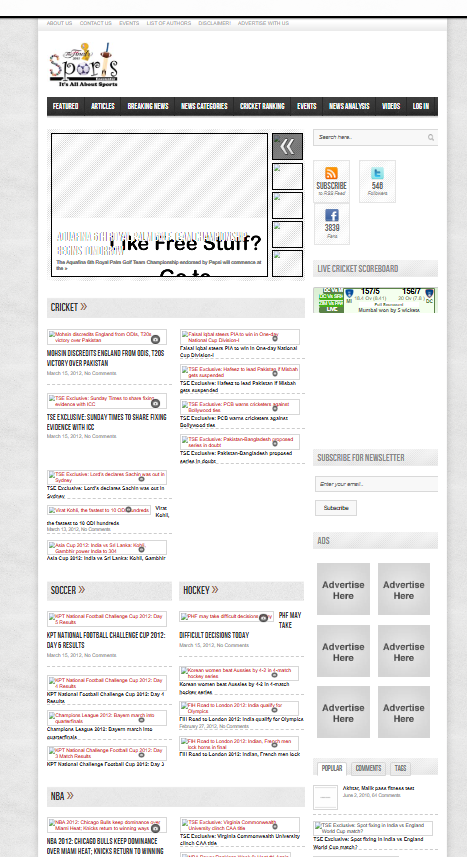
On the March 2012 homepage, cricket shared space with soccer and hockey. Below them came NBA and NFL coverage, followed by athletics, wrestling, MLB, and bowling. The breadth becomes apparent while scrolling: a reader could move from a Pakistan cricket report to basketball or a domestic sporting event without leaving the publication.
The supplied screenshots show how far Sports Encounter’s editorial presentation had expanded since its early pages. They document a multi-sport publication with an international outlook, while leaving open how consistently every section was staffed and updated.
Breadth You Can Actually See
The strongest evidence of expansion is the homepage itself. These sports were given their own labeled spaces rather than being buried together in a general news list. Several sections contained a lead item with smaller related headlines, allowing the publication to present different subjects at different levels of prominence.
The items visible in a section did not always share the same date. A category box can retain an older article while another sport receives more frequent updates. The existence of a section therefore establishes editorial provision, not a promise of daily coverage or a separately staffed department.
That qualification makes the page more informative. It shows a publication trying to accommodate sports with different rhythms and different volumes of available reporting. The homepage was an editorial arrangement of that work, with cricket remaining prominent as the range widened.
The International Alongside the Local
The March material places major international sports beside reporting on Pakistani competitions and participants. Football and hockey appear with local and regional events. Bowling receives a dedicated section. The publication’s concept of sports news extended beyond the most commercially dominant international contests.
The October 2011 lead about Pakistan’s kabaddi team provides another example. Giving that story the main visual position demonstrates a particular editorial choice at the moment shown. It cannot prove the full balance of coverage across the year, but it prevents a simplistic description of the site as exclusively a cricket publication.
Some headlines in the archive carry the publication’s “TSE Exclusive” label. That wording is evidence of how stories were presented. It does not independently verify the underlying exclusivity, the method of reporting, or whether other outlets had similar information.
Tournament Memories and the Record
Hussain identifies the 2010 FIFA World Cup and UEFA EURO 2012 among the events associated with the original publication’s development. These recollections belong in the account of its international ambitions. The supplied screenshot set does not include a complete, authenticated collection of its coverage of either tournament.
The distinction also prevents a basic chronological error. The football event in 2012 was the European championship, not a men’s FIFA World Cup. The archive should retain the correct competition names even where the original article inventory remains incomplete.
Basketball’s presence is more directly visible in the supplied pages. An NBA section appears in March 2012, and an NBA Finals emblem appears in the earlier masthead material. Neither establishes accreditation, an official partnership, or permission to use a tournament mark.
A Navigation System for Several Audiences
The publication offered more than sport labels. Its upper navigation separated articles, breaking news, rankings, events, analysis, and video. These labels suggest an attempt to organize material by the reader’s purpose as well as by the game being covered.
Someone looking for a result could enter through a sport. Someone wanting a considered argument could look for analysis. The archive does not show how often readers used those paths, but it preserves the choices made available to them.
This broader menu created editorial demands that a homepage image cannot resolve. Reporting different sports requires appropriate knowledge and reliable checks. The presence of a contributor network helps explain the ambition, although the surviving record does not map every writer to a formal assignment or editing structure.
What Going Global Meant Here
“International” is best understood in this history as an observable range of subjects and listed contributor locations. It should not be converted into an unsupported claim of overseas offices, full-time correspondents at major events, or independently measured global reach.
The visible achievement is substantial enough. Sports Encounter had built a place for several kinds of sports reporting and was presenting Pakistani stories alongside international coverage. The next part of that history belongs to the people whose names appeared behind those reports.
Sources and Evidence
This episode distinguishes screenshot observations, public self-descriptions, founder testimony, and interpretation. Exact archive capture addresses have not been authenticated.
- A06: October 2011 Upper Homepage. October 14, 2011 label from supplied dossier
- A07: October 2011 Lower Homepage. October 2011 label
- A08: March 2012 Upper Homepage. March 15, 2012 label from supplied dossier
- A09: March 2012 Middle Homepage. March 15, 2012 label from supplied dossier
- A10: March 2012 Lower Homepage. March 2012 label
- F01: Founder account supplied October 16 and 17, 2026