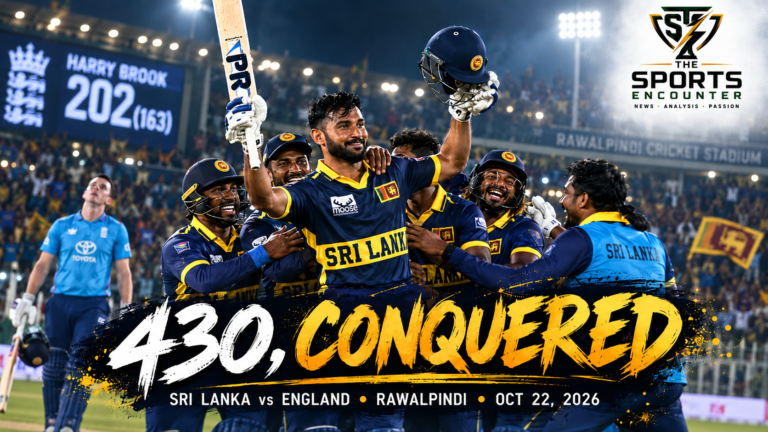
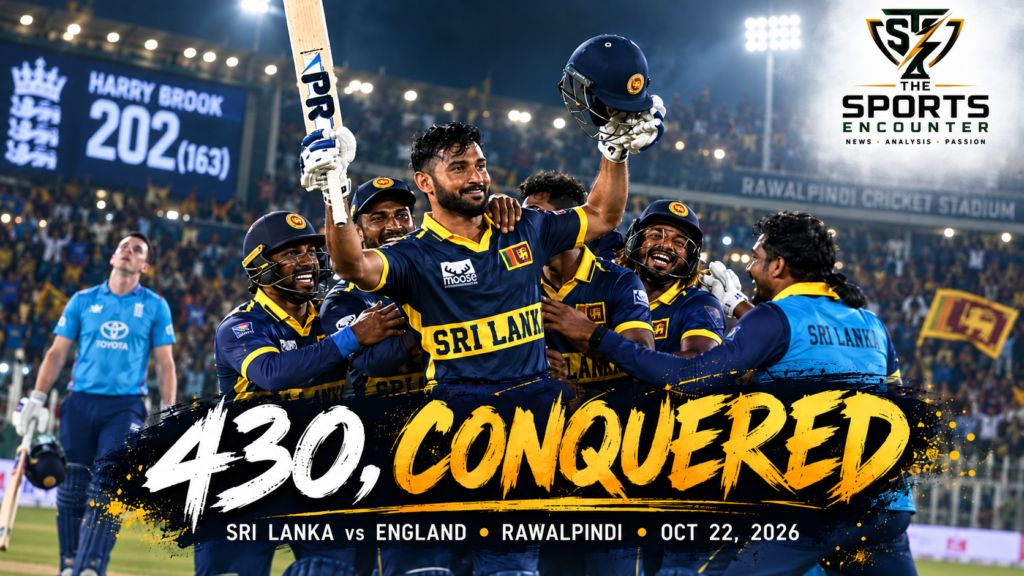
RAWALPINDI, Pakistan, October 22, 2026: Harry Brook produced the fastest double century in men’s One-Day International history, England piled up 429 for 4, and a victory appeared almost inevitable. Sri Lanka then pulled off one of cricket’s greatest chases, reaching 430 for 8 with one delivery remaining to win by two wickets in the third match of the Pakistan ODI Tri-Nation Series at Rawalpindi Cricket Stadium. Janith Liyanage settled the contest with a six off Josh Tongue after England had taken two wickets in consecutive deliveries.
Pavan Rathnayake’s magnificent 130, Avishka Fernando’s 97 and Dasun Shanaka’s explosive 97 laid the foundation before Liyanage supplied an unbeaten 61 from 27 balls. England’s bowling lacked control for long stretches, Sam Curran conceded a record 103 runs, and Brook’s captaincy came under scrutiny as the hosts of the chase maintained the required scoring rate despite losing wickets. The result left Pakistan leading the tournament with two victories, Sri Lanka back in contention and England facing a must-win encounter when the competition moves to Lahore on October 25.
The debate for readers: Was Sri Lanka’s extraordinary chase primarily the result of exceptional batting, or did England’s ineffective bowling and tactical decisions make it possible?
Reader poll specification
Story at a glance
Harry Brook’s 202 Creates History but Cannot Secure Victory
Harry Brook could hardly have imagined a more extraordinary personal innings.

The Records Harry Brook and Sri Lanka Rewrote at Rawalpindi
Brook’s 144 boundary runs came from 84 runs in fours and 60 in sixes. His 31 boundaries set an England individual ODI benchmark. The figures also illustrate why Sri Lanka’s successful chase was such an extraordinary achievement.
Avishka Fernando’s 97 Stops England From Taking Control
Sri Lanka’s chase began with immediate pressure.
Pavan Rathnayake’s 130 Gives Sri Lanka the Innings It Desperately Needed
Pavan Rathnayake produced the backbone of Sri Lanka’s chase.
Dasun Shanaka’s 97 Delivers the Acceleration England Cannot Contain
Dasun Shanaka provided the most destructive substantial innings of Sri Lanka’s chase.
What contributed most to England’s failure to defend 429?Sri Lanka’s outstanding battingEngland’s poor bowling executionBowling changes and field placementsMissed fielding opportunitiesA combination of these factors
This is the editorial poll specification, not a live voting system. A verified WordPress poll must replace it before publication.
England vs Sri Lanka, Rawalpindi ODI: Match Summary
| Match detail | Information |
|---|---|
| Tournament | Pakistan ODI Tri-Nation Series 2026 |
| Match | Third round-robin ODI |
| Date | October 22, 2026 |
| Venue | Rawalpindi Cricket Stadium |
| Toss | Sri Lanka won and fielded |
| England | 429/4 (50 overs) |
| Sri Lanka | 430/8 (49.5 overs) |
| Result | Sri Lanka won by two wickets |
| Balls remaining | One |
| England’s leading scorer | Harry Brook, 202 |
| Sri Lanka’s leading scorer | Pavan Rathnayake, 130 |
| Match-winning finish | Janith Liyanage, 61 not out |
| Leading England bowler | Josh Tongue, 3/79 |
| Leading Sri Lanka bowler | Dunith Wellalage, 2/56 |
| Player of the Match | Official designation not independently verified |
Harry Brook’s 202 Creates History but Cannot Secure Victory
Harry Brook could hardly have imagined a more extraordinary personal innings.
The England captain scored 202 from 116 deliveries, striking 21 fours and ten sixes at a strike rate of 174.14.
He reached his double century in just 114 deliveries, surpassing Shubman Gill’s previous mark of 117 balls.
Brook became the first England men’s cricketer to score an ODI double century and overtook Ben Stokes’ previous national record of 182.
Those achievements would ordinarily have dominated any match report.
Instead, they became part of one of ODI cricket’s most remarkable defeats.
Brook and Joe Root Add 159 as England Recover From 85 for 2
England’s innings began with Tom Banton and Ben Duckett providing a solid opening platform.
Banton scored 50 from 51 balls, while Duckett contributed 29 from 39.
Dunith Wellalage dismissed both batters, leaving England 85 for 2.
Brook joined Joe Root and changed the tempo of the innings.
Root played a controlled 69 from 66 balls, allowing Brook to attack without jeopardizing the partnership.
They added 159 for the third wicket.
Root’s innings deserves recognition because his accumulation supported Brook’s increasingly aggressive approach.
Sri Lanka could not contain Brook without also allowing Root to score.
When Asitha Fernando removed Root, England were already strongly positioned at 244 for 3.
Will Jacks then joined Brook for the final assault.
Brook and Will Jacks Add 185 During England’s Late Onslaught
Jacks scored an unbeaten 66 from 30 deliveries, including eight fours and three sixes.
The partnership produced 185 runs, with Brook dominating the bowling and Jacks matching his aggression.
England scored 156 runs in the final ten overs.
That represented an extraordinary acceleration after a relatively controlled beginning.
Brook completed his double century during the final over before being dismissed from the last delivery.
England finished on 429 for 4.
At that moment, the most pressing questions concerned whether Sri Lanka could avoid a humiliating defeat.
The visitors answered them through a batting performance that surpassed even Brook’s individual brilliance.
The Records Harry Brook and Sri Lanka Rewrote at Rawalpindi
| Record or landmark | Achievement |
|---|---|
| Fastest men’s ODI double century | Brook reached 200 from 114 balls |
| Previous fastest double century | Shubman Gill, 117 balls |
| First England men’s ODI double centurion | Harry Brook |
| Highest individual ODI score for England | Brook, 202 |
| Fours in Brook’s innings | 21 |
| Sixes in Brook’s innings | 10 |
| Boundary runs scored by Brook | 144 |
| Total boundaries in Brook’s innings | 31 |
| Match aggregate | 859 runs |
| Successful chase | 430/8 |
| Historical chase ranking | Second-highest successful men’s ODI chase |
| Most expensive England men’s ODI bowling figures | Sam Curran, 2/103 |
Brook’s 144 boundary runs came from 84 runs in fours and 60 in sixes. His 31 boundaries set an England individual ODI benchmark. The figures also illustrate why Sri Lanka’s successful chase was such an extraordinary achievement.
Yahoo Sports
+2
Was This the Second-Highest Scoring ODI Match?
The two teams combined for 859 runs.
The famous 2006 Australia-South Africa ODI at Johannesburg produced 872 runs, with Australia scoring 434 and South Africa chasing 438.
Rawalpindi therefore ranks among the highest-scoring completed men’s ODIs, with contemporary accounts identifying it as the second-highest match aggregate.
The 430-run pursuit also became the second-highest successful chase in men’s ODI history.
Those records tell an important story about the game’s changing scoring patterns.
A score above 400 can still represent a formidable target, but favorable surfaces and aggressive batting increasingly allow teams to sustain scoring rates that would once have seemed unrealistic.
At Rawalpindi, Sri Lanka had to score at 8.6 runs per over.
They maintained that pace across almost 50 overs.
That was the central achievement.
Avishka Fernando’s 97 Stops England From Taking Control
Sri Lanka’s chase began with immediate pressure.
Kamindu Mendis departed for 18, and captain Kusal Mendis was run out without facing a ball.
Sri Lanka were 24 for 2.
A required rate of 8.6 was already demanding. The loss of two wickets made the task considerably harder.
Avishka Fernando refused to retreat.
He scored 97 from 83 deliveries, striking 11 fours and two sixes.
His partnership with Pavan Rathnayake added 166 runs and carried Sri Lanka to 190 for 3.
Fernando’s innings was important because he continued attacking while rebuilding.
A conventional recovery built around cautious accumulation would have increased the required rate.
Instead, Fernando maintained a strike rate of 116.87.
He found boundaries regularly and reduced the burden on Rathnayake.
England eventually removed him through a return catch to Jamie Overton, but the third-wicket partnership had already transformed the chase.
Sri Lanka were still chasing an enormous target.
They now possessed a credible route toward it.
Pavan Rathnayake’s 130 Gives Sri Lanka the Innings It Desperately Needed
Pavan Rathnayake produced the backbone of Sri Lanka’s chase.
He scored 130 from 106 deliveries, including 15 fours and three sixes.
His innings combined aggressive strokeplay with the discipline required to bat deep.
That balance was essential.
Sri Lanka could not afford to lose established batters whenever the required rate increased.
Rathnayake remained at the crease long enough to construct two decisive partnerships.
The first came with Fernando.
The second came with Shanaka.
His role evolved as the innings progressed.
During the recovery from 24 for 2, Rathnayake helped establish stability.
Once Fernando departed, he maintained the scoring rate while Shanaka attacked more aggressively.
Rathnayake and Shanaka Add 133 to Change the Chase
Sri Lanka were 190 for 3 when the next major partnership developed.
Rathnayake and Shanaka added 133 runs.
By the time Rathnayake fell, Sri Lanka had reached 323 for 4.
The equation had changed dramatically.
England still needed wickets, but the visitors had already crossed 300 with sufficient deliveries remaining to complete the chase.
Rathnayake’s innings demonstrated why one substantial contribution remains so valuable in ODI cricket, even as scoring rates rise.
His 130 allowed the more aggressive batters around him to attack without repeatedly rebuilding after wickets.
Dasun Shanaka’s 97 Delivers the Acceleration England Cannot Contain
Dasun Shanaka provided the most destructive substantial innings of Sri Lanka’s chase.
The veteran all-rounder scored 97 from 50 deliveries at a strike rate of 194.
He came within three runs of a century, but the impact of his innings extended far beyond the milestone.
Shanaka recognized that Sri Lanka needed to accelerate while Rathnayake remained established.
He attacked England’s seamers, finding boundaries and forcing Brook to reconsider his fields.
England struggled to contain him.
Several deliveries intended to restrict scoring instead offered opportunities for aggressive strokes.
Why Shanaka’s Acceleration Was the Key Tactical Shift
Rathnayake and Fernando had laid the foundation.
But even after their 166-run partnership, Sri Lanka still required 240 runs.
Shanaka changed the rate at which the target disappeared.
His 97 occupied just 50 deliveries.
That meant Sri Lanka accumulated almost two runs per ball during one of the most demanding phases of the chase.
When Liam Dawson eventually dismissed Shanaka, Sri Lanka were 363 for 5.
England had removed a dangerous batter.
But the visitors had reduced a target of 430 to just 67 more runs.
Janith Liyanage still had the opportunity to finish the match.
Janith Liyanage’s Unbeaten 61 Completes the Miracle
Janith Liyanage delivered the final, decisive innings.
He scored an unbeaten 61 from just 27 balls, maintaining a strike rate of 225.93.
His contribution arrived after the major partnerships had already put Sri Lanka within reach.
But reaching 430 remained a difficult task.
England continued taking wickets.
Sahan Arachchige contributed 13 before Sam Curran removed him.
Dunith Wellalage and Eshan Malinga were subsequently dismissed in the final over.
Sri Lanka were left needing six runs from two deliveries, with only two wickets remaining.
Liyanage was on strike.
Josh Tongue Takes Two in Two Balls Before Liyanage Strikes the Winning Six
Sri Lanka entered the final over needing eight runs.
Josh Tongue started with a single.
He then bowled Wellalage.
The next delivery brought another wicket as Tongue bowled Eshan Malinga.
England were suddenly one more breakthrough away from producing an extraordinary escape.
Asitha Fernando took a single from the fourth delivery.
Liyanage faced the fifth with six runs needed.
Tongue missed his intended length.
Liyanage struck the ball straight for six.
Sri Lanka reached 430 for 8 with one ball remaining.
The match was over.
Brook’s double century had become a losing effort, and Liyanage had completed one of ODI cricket’s greatest finishes.
The Final Over: Eight Runs Needed
| Delivery | Event | Sri Lanka score |
|---|---|---|
| 49.1 | Liyanage takes one | 423/6 |
| 49.2 | Tongue bowls Wellalage | 423/7 |
| 49.3 | Tongue bowls Eshan Malinga | 423/8 |
| 49.4 | Asitha Fernando takes one | 424/8 |
| 49.5 | Liyanage strikes six | 430/8 |
The final over demonstrates how close England came to rescuing the match after conceding more than 400 runs.
Tongue produced two consecutive wickets, but the decisive delivery offered Liyanage a scoring opportunity.
He took it.
Why Did England Fail to Defend 429?
England’s defeat deserves close examination because its bowlers began with an enormous advantage.
A target of 430 required Sri Lanka to sustain an aggressive scoring rate throughout the chase.
England needed to take wickets regularly, restrict boundaries and prevent lengthy partnerships.
The opening breakthroughs gave Brook an ideal opportunity to attack.
Instead, Sri Lanka added 166 for the third wicket and 133 for the fourth.
Those two partnerships produced 299 runs.
England could not regain sustained control until the closing overs.
Sam Curran’s 103 Runs Expose England’s Death-Bowling Weakness
Sam Curran finished with 2 for 103 from nine overs, an economy rate of 11.44.
The figures were the most expensive recorded by an England bowler in men’s ODI cricket.
Curran’s performance illustrates the problem England faced throughout Sri Lanka’s innings.
The attack struggled to combine accurate lengths with effective variations.
On a flat surface, slower balls can become particularly dangerous when batters recognize them early.
Similarly, deliveries intended as yorkers can disappear for boundaries when they arrive fractionally too full.
Curran’s figures suggest England repeatedly failed to execute under pressure.
He still claimed two wickets, including Rathnayake, but the damage from his expensive overs outweighed the benefits of those breakthroughs.
Josh Tongue’s Three Wickets Provide the Strongest Bowling Resistance
Tongue claimed 3 for 79 from 8.5 overs.
He dismissed Kamindu Mendis early and returned to remove Wellalage and Malinga from consecutive deliveries in the final over.
His performance underlined the importance of wicket-taking pressure.
England were only one wicket away from victory when Liyanage struck the winning six.
Tongue should receive credit for bringing his team back into contention.
However, the final delivery also represented an execution failure.
With six required from two balls, conceding a six allowed the batter to settle the match immediately.
Did Brook’s Bowling Changes Contribute to the Defeat?
Brook’s captaincy deserves scrutiny because Sri Lanka’s major partnerships continued for long periods without decisive interruption.
The captain had six bowling options available, but none provided sustained control through the middle overs.
He needed to attack established batters without offering predictable scoring opportunities.
That is difficult when bowlers are missing their intended lengths and the opposition’s batters are in excellent form.
Nevertheless, the inability to break the Fernando-Rathnayake and Rathnayake-Shanaka partnerships raises legitimate questions about England’s tactics.
Brook also had to manage Curran’s expensive spell while retaining sufficient overs from other bowlers for the closing stages.
The evidence supports criticism of England’s collective execution.
Whether a particular bowling change or field placement caused the defeat requires a more detailed ball-by-ball tactical review.
It would be unfair to assign responsibility for every poor delivery to the captain.
But Brook cannot escape responsibility for the team’s broader performance.
England scored 429 and still lost.
That outcome demands a serious examination of the bowling strategy.
England’s Fielding Errors Added to the Pressure
England’s fielding failed to provide the support its bowling attack needed.
The match commentary identifies a missed run-out opportunity and a late misfield that allowed an additional run.
Those incidents matter because Sri Lanka ultimately completed the chase with only one delivery remaining.
A single run saved in the field might have changed the final equation.
However, that is a conditional assessment, not proof that one particular mistake decided the result.
The available records do not establish a reliable complete count of dropped catches. Accordingly, assigning four or five drops to named fielders, or calculating how many runs those chances cost, would be speculative.
The underlying point remains valid.
When defending a huge score, a team can become complacent about fielding because it assumes the target itself will create sufficient pressure.
England needed to maintain intensity throughout 50 overs.
Its fielding did not consistently reach that standard.
Dunith Wellalage’s Two Wickets Were Sri Lanka’s Overlooked Bowling Contribution
Sri Lanka’s bowling performance was expensive, conceding 429 from 50 overs.
Yet Wellalage deserves recognition for his relative control.
The left-arm spinner took 2 for 56 from ten overs.
He dismissed both England openers, Banton and Duckett, and maintained an economy rate of 5.60 while his colleagues suffered heavily.
Asitha Fernando also claimed the important wicket of Root, ending the 159-run third-wicket partnership.
The difference between Wellalage and Sri Lanka’s other bowlers illustrates how expensive the afternoon became.
Even after losing both openers, England had more than enough batting resources to accelerate.
Brook then produced his record-breaking innings.
Sri Lanka’s bowlers struggled collectively, but their batters rescued them through one of the greatest chases in the format’s history.
The Four Partnerships That Explain the Match
| Partnership | Runs | Batters | Impact |
|---|---|---|---|
| England’s third wicket | 159 | Brook and Root | Established England’s dominant position |
| England’s fourth wicket | 185 | Brook and Jacks | Produced the late surge to 429 |
| Sri Lanka’s third wicket | 166 | Fernando and Rathnayake | Recovered from 24/2 |
| Sri Lanka’s fourth wicket | 133 | Rathnayake and Shanaka | Maintained the required acceleration |
The essential tactical difference was how the teams used their partnerships.
England’s Brook-Jacks partnership generated extraordinary late acceleration.
Sri Lanka relied on major stands through the middle overs before Liyanage completed the chase.
That gave the visitors enough continuity to maintain the required rate.
Why Sri Lanka’s Chase Was More Than a Boundary-Hitting Exhibition
Sri Lanka’s batting performance involved three different phases.
Fernando and Rathnayake established control after the loss of two early wickets.
Rathnayake and Shanaka increased the scoring rate during the middle and latter stages.
Liyanage finished the target despite another cluster of dismissals.
Those partnerships mattered because chasing 430 leaves almost no room for extended periods without scoring.
A team can hit several sixes and still fall short if wickets interrupt its momentum.
Sri Lanka avoided that problem for much of the chase.
The major partnerships provided continuity, while Shanaka and Liyanage supplied the acceleration.
England’s inability to break those partnerships made the target increasingly manageable.
This explains why Brook’s extraordinary innings did not secure the result.
Sri Lanka produced a more complete collective batting performance.
Pakistan ODI Tri-Series Standings After the Rawalpindi Leg
The first three matches have transformed the qualification picture.
Pakistan defeated Sri Lanka by 37 runs on October 18.
The hosts then beat England by 87 runs on October 20.
Sri Lanka’s record chase against England on October 22 completed the first round.
| Position | Team | Played | Won | Lost | Points |
|---|---|---|---|---|---|
| 1 | Pakistan | 2 | 2 | 0 | 4 |
| 2 | Sri Lanka | 2 | 1 | 1 | 2 |
| 3 | England | 2 | 0 | 2 | 0 |
Standings based on two points per victory. Official net run rates should be checked against the tournament table.
Pakistan’s Chances of Reaching the Final
Pakistan enter the Lahore leg in the strongest position.
Two victories have given them four points.
They defeated both opponents at Rawalpindi, demonstrating their ability to defend competitive totals.
The team also benefits from home conditions and the tournament’s remaining schedule.
Pakistan face England on October 25 and Sri Lanka on October 27.
One more victory would take them to six points.
That would guarantee a place in the final under the standard two-points-per-win system, because the other two teams cannot both reach six points when they must still face each other.
Pakistan therefore control their own qualification prospects.
Their main concern should be maintaining momentum against two opponents capable of producing major individual performances.
Sri Lanka’s Chances of Reaching the Final
Sri Lanka have moved into second place with two points.
Their victory over England gives them a clear route to qualification.
They face Pakistan on October 27 and England on October 29.
Winning both matches would take them to six points and guarantee a final berth.
Winning one could also be enough, depending on England’s results and net run rate.
The visitors now have considerable confidence.
Rathnayake, Fernando, Shanaka and Liyanage demonstrated outstanding batting depth.
Their challenge is to improve their bowling after conceding 429.
Sri Lanka should not assume another chase of this magnitude will be achievable.
England’s Chances of Reaching the Final
England are in serious trouble.
They have lost both matches and remain without a point.
Their remaining fixtures are against Pakistan on October 25 and Sri Lanka on October 29.
England must win both to reach four points.
Even two victories would not guarantee qualification.
Their final position could depend on the outcome of Pakistan vs Sri Lanka and the net-run-rate tiebreaker.
If England lose to Pakistan on October 25, they will be eliminated.
They would remain on zero points with a maximum possible total of two, while Pakistan would have six and Sri Lanka already have two. Even a subsequent victory over Sri Lanka would leave England behind Pakistan and, at best, tied with Sri Lanka, subject to the competition’s tiebreak rules. Under the usual two-points-per-win and net-run-rate criteria, a loss to Pakistan would not automatically eliminate England from mathematical contention, but it would leave qualification exceptionally difficult and dependent on a large victory over Sri Lanka and favorable net run rate.
England’s immediate priority is therefore straightforward.
They must defeat Pakistan.
Lahore Leg: Remaining Fixtures
| Date | Fixture | Venue | Stakes |
|---|---|---|---|
| October 25 | Pakistan vs England | Gaddafi Stadium, Lahore | England need a victory |
| October 27 | Pakistan vs Sri Lanka | Gaddafi Stadium, Lahore | Could decide the top spot |
| October 29 | Sri Lanka vs England | Gaddafi Stadium, Lahore | Potential qualification decider |
| October 31 | Final | Gaddafi Stadium, Lahore | Top two teams contest title |
The Pakistan Cricket Board confirms all four fixtures and the double round-robin format.
PCB
What Must Change Before England Face Pakistan?
England face several important questions.
The first concerns bowling accuracy.
Curran’s 103 runs conceded highlight the danger of ineffective variations on batting-friendly surfaces.
The second involves taking wickets during the middle overs.
Sri Lanka’s two major partnerships exposed England’s inability to interrupt established batters.
The third is fielding discipline.
England cannot afford missed opportunities if they again concede pressure through expensive bowling.
Brook’s own batting form offers encouragement.
His double century was exceptional and demonstrates the firepower available to England.
But a captain cannot rely on scoring 200 personally to secure a result.
England need a more complete team performance.
Why the Rawalpindi Result Could Define Sri Lanka’s Tournament
Sri Lanka entered the match having lost to Pakistan.
A second defeat would have left them facing the Lahore leg without a victory.
Instead, they produced a record-breaking chase and moved into second place.
That result has altered the tournament’s balance.
Pakistan remain favorites to qualify because of their two wins.
Sri Lanka now possess an excellent opportunity to challenge for the second final place.
England face the greatest pressure.
The Rawalpindi result may therefore have consequences extending beyond the extraordinary 859-run match aggregate.
It could ultimately determine which teams meet in the final on October 31.
Complete Match Scorecard: England vs Sri Lanka, October 22, 2026
The following scorecard consolidates the figures established by the available completed match reports and score feeds. Where the accessible records do not provide sufficient detail, the field remains explicitly unverified.
England Innings: 429/4 in 50 Overs
| Batter | Dismissal | R | B | 4s | 6s | SR |
|---|---|---|---|---|---|---|
| Tom Banton | c Liyanage b Wellalage | 50 | 51 | 9 | 0 | 98.04 |
| Ben Duckett | lbw b Wellalage | 29 | 39 | 2 | 0 | 74.36 |
| Joe Root | c Wellalage b Asitha Fernando | 69 | 66 | 8 | 0 | 104.55 |
| Harry Brook (c) | c Arachchige b Liyanage | 202 | 116 | 21 | 10 | 174.14 |
| Will Jacks | Not out | 66 | 30 | 8 | 3 | 220.00 |
| Jordan Cox (wk) | Did not bat | |||||
| Sam Curran | Did not bat | |||||
| Jamie Overton | Did not bat | |||||
| Liam Dawson | Did not bat | |||||
| Gus Atkinson | Did not bat | |||||
| Josh Tongue | Did not bat | |||||
| Extras | 1 bye, 1 leg-bye, 9 wides, 2 no-balls | 13 | ||||
| Total | 4 wickets, 50 overs | 429 |
Fall of wickets: 1-74 (Banton, 13.2), 2-85 (Duckett, 15.6), 3-244 (Root, 37.1), 4-429 (Brook, 49.6).
Sri Lanka Bowling
| Bowler | O | M | R | W | Econ |
|---|---|---|---|---|---|
| Asitha Fernando | 10 | 1 | 68 | 1 | 6.80 |
| Dilshan Madushanka | 10 | 0 | 89 | 0 | 8.90 |
| Eshan Malinga | 10 | 0 | 91 | 0 | 9.10 |
| Dunith Wellalage | 10 | 0 | 56 | 2 | 5.60 |
| Dasun Shanaka | 6 | 0 | 74 | 0 | 12.33 |
| Kamindu Mendis | 2 | 0 | 17 | 0 | 8.50 |
| Janith Liyanage | 2 | 0 | 32 | 1 | 16.00 |
Batting runs total 416. Thirteen extras bring England to 429. The bowlers conceded 427 runs, with the remaining two recorded as byes and leg-byes.
Sri Lanka Innings: 430/8 in 49.5 Overs
| Batter | Dismissal | R | B | 4s | 6s | SR |
|---|---|---|---|---|---|---|
| Kamindu Mendis | b Josh Tongue | 18 | 16 | Pending | Pending | 112.50 |
| Avishka Fernando | c & b Jamie Overton | 97 | 83 | 11 | 2 | 116.87 |
| Kusal Mendis (c, wk) | Run out (Gus Atkinson) | 0 | 0 | 0 | 0 | N/A |
| Pavan Rathnayake | c Tom Banton b Sam Curran | 130 | 106 | 15 | 3 | 122.64 |
| Dasun Shanaka | c Tom Banton b Liam Dawson | 97 | 50 | Pending | Pending | 194.00 |
| Janith Liyanage | Not out | 61 | 27 | Pending | Pending | 225.93 |
| Sahan Arachchige | c Will Jacks b Sam Curran | 13 | Pending | Pending | Pending | Pending |
| Dunith Wellalage | b Josh Tongue | 5 | Pending | Pending | Pending | Pending |
| Eshan Malinga | b Josh Tongue | 0 | Pending | 0 | 0 | Pending |
| Asitha Fernando | Not out | 1 | 1 | 0 | 0 | 100.00 |
| Dilshan Madushanka | Did not bat | |||||
| Extras | Breakdown pending | 8 | ||||
| Total | 8 wickets, 49.5 overs | 430 |
England Bowling
| Bowler | O | M | R | W | Econ |
|---|---|---|---|---|---|
| Josh Tongue | 8.5 | 1 | 79 | 3 | 8.94 |
| Sam Curran | 9 | 0 | 103 | 2 | 11.44 |
| Jamie Overton | 10 | Pending | 77 | 1 | 7.70 |
| Liam Dawson | Pending | Pending | Pending | 1 | Pending |
| Gus Atkinson | Pending | Pending | Pending | 0 | Pending |
| Will Jacks | Pending | Pending | Pending | 0 | Pending |
Fall of wickets: 1-23 (Kamindu Mendis), 2-24 (Kusal Mendis), 3-190 (Avishka Fernando), 4-323 (Pavan Rathnayake), 5-363 (Dasun Shanaka), 6-406 (Sahan Arachchige), 7-423 (Dunith Wellalage, 49.2), 8-423 (Eshan Malinga, 49.3).
The individual batting scores add to 422. Eight extras bring the total to 430.
Result: Sri Lanka won by two wickets, with one delivery remaining.
Player of the Match: The official award recipient remains unconfirmed in the accessible completed records. It must not be assigned based solely on a subjective assessment of Rathnayake, Brook or Liyanage.
Continue the Cricket Story
 CricketWellalage Threatens Another Spin Collapse as England and Sri Lanka Look to Open Their Account in Tri-Series
 CricketArafat Minhas Announces Arrival on the International Stage as Pakistan Destroy England in Tri-Nation Series
 CricketFrom 110/6 to an Innings Victory: Bavuma’s 179 Turns Australia’s Command Into a Crushing Defeat
Frequently Asked Questions
Who Won England vs Sri Lanka at Rawalpindi on October 22, 2026?
Sri Lanka won by two wickets after chasing England’s 429 for 4. They reached 430 for 8 in 49.5 overs.
How Many Runs Did Harry Brook Score?
Brook scored 202 from 116 balls, becoming the first England men’s batter to record an ODI double century.
Was Brook’s Double Century the Fastest in ODI History?
Yes. He reached 200 from 114 balls, beating Shubman Gill’s previous record of 117 deliveries.
How Many Boundary Runs Did Brook Score?
Brook scored 144 runs in boundaries, comprising 21 fours and ten sixes.
Who Scored the Most Runs for Sri Lanka?
Pavan Rathnayake made 130 from 106 balls, supported by Avishka Fernando’s 97 and Dasun Shanaka’s 97.
Who Hit the Winning Runs?
Janith Liyanage struck a six off Josh Tongue from the fifth ball of the final over. He finished unbeaten on 61.
What Were Sam Curran’s Bowling Figures?
Curran conceded 103 runs in nine overs while taking two wickets, England’s most expensive individual ODI bowling figures at the time.
How Many Runs Were Scored in the Match?
The teams combined for 859 runs: 429 for England and 430 for Sri Lanka.
Who Is Leading the Tri-Series?
Pakistan lead with four points after victories over Sri Lanka and England. Sri Lanka have two points, while England have none.
When Does the Lahore Leg Begin?
Pakistan face England at Gaddafi Stadium on October 25, followed by Pakistan vs Sri Lanka on October 27 and Sri Lanka vs England on October 29.
Harry Brook
- Sri Lanka Chase 430 to Humiliate England at Rawalpindi as Harry Brook’s Record 202 Ends in Heartbreak
- Will Jacks Turns a Tight ODI Into a Rout as England Crush Sri Lanka by 89 Runs
- Five English Power-Hitters Who Are Bowlers’ Worst Nightmares | Proven By Latest Statistics
- Harry Brook, Sonny Baker Power England to 119-Run Rout of Sri Lanka
- Harry Brook’s Rise Has a Pakistan Thread Running Through It