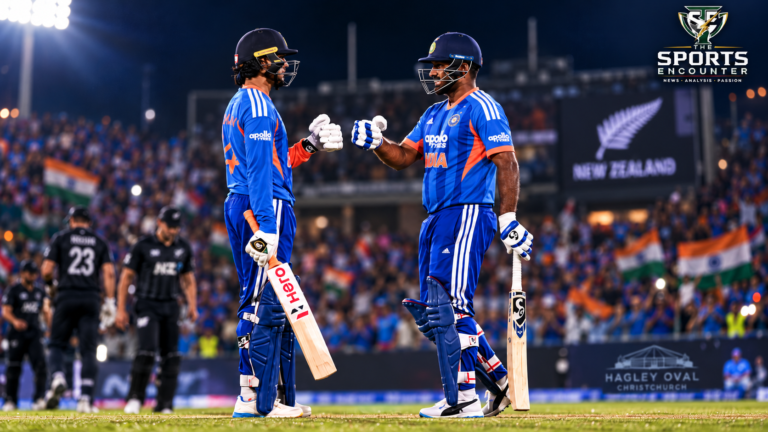
CHRISTCHURCH, New Zealand, October 22, 2026: New Zealand scored 225 for four, produced one of their strongest T20 batting performances against India on home soil, and still found a way to lose. India completed a thrilling four-wicket victory in the first T20 International at Hagley Oval, reaching 230 for six with two balls remaining after Sanju Samson, Abhishek Sharma, captain Shreyas Iyer and Naman Dhir combined to expose serious weaknesses in the hosts’ bowling, fielding and tactical decision-making.
The visitors deserved enormous credit for completing their highest successful T20I chase, but New Zealand will have plenty to answer for. Mitchell Santner’s side dropped important catches, struggled to contain the Indian openers and persisted with expensive pace options when greater tactical flexibility was needed. Matt Henry conceded 57 runs without taking a wicket, Adam Milne leaked 43 in three overs, and Dhir hammered an unbeaten 42 from 15 deliveries to finish a match that New Zealand had repeatedly threatened to reclaim.
Reader Poll: What Was the Biggest Factor Behind India’s Victory?
- Sanju Samson and Abhishek Sharma’s explosive opening partnership
- New Zealand’s dropped catches and poor fielding
- Mitchell Santner’s bowling changes and tactical decisions
- Shreyas Iyer’s recovery and Naman Dhir’s finishing
- A combination of India’s batting and New Zealand’s mistakes
Editorial production note: Insert the verified interactive WordPress poll here before publication.
Story at a glance
India vs New Zealand 1st T20I 2026: Match Summary
The two teams scored 455 runs from 39 overs and four balls, with India eventually completing a chase requiring 11.30 runs per over.
Glenn Phillips Gives New Zealand 225, but India’s Bowlers Struggle for Control
New Zealand could hardly have asked for a more aggressive batting platform.
Sanju Samson and Abhishek Sharma Turn a Huge Chase Into an Attacking Opportunity
Chasing 226 generally demands a strong powerplay. India produced something considerably better.
New Zealand Fight Back Through Bracewell and Santner
For all the criticism New Zealand’s bowling deserves, the hosts did produce an impressive middle-overs recovery.
Mitchell Santner’s Captaincy Comes Under Scrutiny as Henry and Milne Struggle
New Zealand’s captain faces legitimate questions about his handling of the bowling attack.
India vs New Zealand 1st T20I 2026: Match Summary
| Match Detail | Information |
|---|---|
| Series | India tour of New Zealand, five-match T20I series |
| Date | October 22, 2026 |
| Venue | Hagley Oval, Christchurch |
| Toss | India won and elected to field |
| New Zealand | 225/4 (20 overs) |
| India | 230/6 (19.4 overs) |
| Result | India won by four wickets |
| Balls remaining | 2 |
| Player of the Match | Sanju Samson, 67 from 33 balls |
| Series position | India lead 1-0 |
| Next match | October 24, Christchurch |
The two teams scored 455 runs from 39 overs and four balls, with India eventually completing a chase requiring 11.30 runs per over.
That number alone reveals the scale of the batting achievement. Yet the more revealing story concerns how New Zealand allowed India to sustain such an aggressive pursuit despite taking four wickets before the halfway stage of the 11th over.
Glenn Phillips Gives New Zealand 225, but India’s Bowlers Struggle for Control
New Zealand could hardly have asked for a more aggressive batting platform.
Finn Allen and Tim Seifert opened with positive intent, adding 49 runs before Seifert departed for 24 from 17 deliveries.
Allen maintained the pressure with 45 from 24 balls, striking five fours and two sixes before Axar Patel dismissed him.
At 80 for two in the eighth over, the hosts still possessed considerable batting depth.
Daryl Mitchell contributed 28, but Glenn Phillips ultimately transformed a promising innings into an imposing total.
Glenn Phillips’ Unbeaten 82 Puts New Zealand in Command
Phillips played the outstanding innings for the hosts.
His unbeaten 82 came from just 40 deliveries, including eight fours and three sixes, at a strike rate of 205.
He combined power with intelligent placement, particularly when exploiting gaps and collecting runs between the boundaries.
The middle-order batter also found valuable support from Bevon Jacobs, whose 31 from 16 deliveries included three sixes.
Together, they accelerated New Zealand’s innings after the early wickets had briefly slowed its progress.
Their partnership helped New Zealand move from 122 for three in the 13th over to 195 for four in the 18th.
Phillips remained unbeaten, ensuring India faced a demanding chase of 226.
India Concede 225 Despite Using Five Bowlers for Four Overs Each
India’s bowling figures were hardly encouraging.
Bhuvneshwar Kumar finished wicketless for 49 runs on his return to international cricket, while Axar Patel conceded 51.
Mayank Yadav proved the most economical Indian bowler, although his four overs still cost 40 runs.
New Zealand’s batters attacked consistently enough to ensure that none of India’s five bowlers conceded fewer than ten runs per over.
The difference emerged during the chase, when India could rely on batters capable of maintaining an exceptional scoring rate while New Zealand struggled to execute its defensive plans.
Sanju Samson and Abhishek Sharma Turn a Huge Chase Into an Attacking Opportunity
Chasing 226 generally demands a strong powerplay. India produced something considerably better.
Sanju Samson and Abhishek Sharma added 93 for the opening wicket in only 5.5 overs.
That partnership immediately changed the character of the contest.
Instead of allowing New Zealand to establish scoreboard pressure, the visitors attacked the new ball and forced Santner to confront a rapidly deteriorating defensive position.
India reached 94 for one after six overs, compared with New Zealand’s 65 for one.
That 29-run powerplay advantage became one of the most important numbers in the match.
Sanju Samson’s 67 From 33 Balls Sets the Foundation
Samson’s batting was exceptional.
He scored 67 from 33 deliveries, hitting eight fours and four sixes at a strike rate of 203.03.
He reached his half-century from only 23 balls, attacking the seamers whenever they offered width or missed their lengths.
His innings combined calculated aggression with an understanding of the required scoring rate.
The Indian wicketkeeper-batter refused to let the target dictate a conservative approach.
By the time Santner bowled him in the ninth over, Samson had already reduced much of the pressure associated with chasing 226.
His Player of the Match award recognized the importance of that early acceleration.
Abhishek Sharma’s 29 From 12 Balls Leaves New Zealand Searching for Answers
Abhishek provided the perfect complement to Samson.
His 29 from 12 deliveries featured two fours and three sixes, producing a strike rate of 241.67.
He attacked immediately, preventing the New Zealand seamers from settling into their preferred lines and lengths.
Although Michael Bracewell dismissed him during the sixth over, the damage was substantial.
India had reached 93 before losing its first wicket.
The partnership illustrated why India’s attacking approach remains dangerous even when an imposing target appears to favor the bowling side.
There is a useful comparison with India’s previous T20I series against West Indies.
As The Sports Encounter reported after India’s 2-2 series draw, the Indian batting lineup repeatedly demonstrated its ability to score at extraordinary rates, although wickets during the middle overs remained a concern.
Christchurch provided further evidence of both characteristics.
New Zealand Fight Back Through Bracewell and Santner
For all the criticism New Zealand’s bowling deserves, the hosts did produce an impressive middle-overs recovery.
Michael Bracewell removed Abhishek Sharma before dismissing Tilak Varma for six.
Santner then bowled Samson for 67 and subsequently dismissed Ishan Kishan for one.
India slipped from 93 without loss to 122 for four in the 11th over.
At that stage, New Zealand had an opportunity to seize control.
The required rate remained demanding, India had lost its explosive opening combination, and two relatively new batters had to rebuild against a bowling attack that had finally discovered some rhythm.
Bracewell finished with two for 37, while Santner returned two for 39.
Their figures were far more respectable than those of the specialist pace bowlers.
The obvious question concerns why New Zealand could not convert that middle-overs pressure into a winning position.
Mitchell Santner’s Captaincy Comes Under Scrutiny as Henry and Milne Struggle
New Zealand’s captain faces legitimate questions about his handling of the bowling attack.
The criticism should not obscure India’s batting quality or the assistance that conditions offered the chasing side.
However, the scorecard strongly suggests New Zealand failed to obtain adequate value from its bowling resources.
Matt Henry’s 57-Run Spell Becomes a Major Liability
Henry was one of the principal reasons New Zealand struggled to defend 225.
The experienced fast bowler conceded 57 runs from 3.4 overs without taking a wicket.
His economy rate of 15.55 was the worst among New Zealand’s six bowlers.
In a match where India needed 11.30 runs per over at the start of its chase, Henry allowed the visitors to score at a rate significantly above that requirement.
That was particularly damaging because New Zealand needed its experienced seamers to apply pressure after the initial assault.
Instead, Henry repeatedly failed to contain the Indian batters.
The decision to entrust him with the final over deserves particular scrutiny.
India required eight runs from the last six deliveries.
Henry began with a full toss that Dhir struck for four.
Two singles followed before Dhir ended the match by dispatching a short delivery over fine leg for six.
The winning blow came from a top edge, which underlines the fine margins involved, but it also exposed Henry’s failure to control his length at the decisive moment.
Santner had reasons to trust an experienced bowler in the final over. Nevertheless, Henry’s earlier figures offered little reassurance that he was the best option under pressure.
Adam Milne’s 43 Runs in Three Overs Compound New Zealand’s Problems
Milne also endured a difficult evening.
His three overs cost 43 runs at an economy rate of 14.33.
Although he dismissed Iyer for 42, his overall spell offered insufficient control.
His inability to consistently restrict boundaries placed additional pressure on New Zealand’s other bowlers.
The 19th over illustrated the problem.
With India needing 19 from 12 balls, Milne conceded 11 runs, including a boundary to Dhir from a missed yorker.
That left eight runs for Henry to defend.
For a bowler selected primarily to provide high pace and wicket-taking ability, Milne’s economy rate represented a disappointing return.
Why Did Nathan Smith Bowl Only Two Overs?
One of the most debatable aspects of Santner’s captaincy was the limited use of Nathan Smith.
Smith bowled two overs for 20 runs.
Although an economy rate of ten is hardly exceptional, it was considerably better than Henry’s 15.55 and Milne’s 14.33.
Smith also provided a different pace option in an attack struggling to contain aggressive batting.
The captain might have benefited from introducing him earlier or retaining greater flexibility for the closing overs.
Of course, Smith’s two-over sample cannot establish that he would have succeeded at the death.
He might also have conceded heavily against Dhir.
However, New Zealand’s failure to experiment more decisively with its bowling resources remains a fair subject for tactical criticism.
New Zealand’s Dropped Catches Make a Difficult Chase Easier
Bowling strategy was only one part of New Zealand’s problems.
Their fielding also fell below the standards normally associated with the Black Caps.
Missed opportunities allowed India to continue attacking when New Zealand desperately needed wickets.
The most consequential errors involved Shreyas Iyer and Axar Patel during the middle phase of the chase.
Finn Allen dropped Iyer at long-on in the 15th over after Lockie Ferguson induced a mistimed pull.
Iyer survived and continued contributing to India’s recovery.
Axar also benefited from a missed catching opportunity.
In an ordinary run chase, those mistakes would be costly.
Against a side pursuing 226, they became particularly damaging because New Zealand needed to take wickets while simultaneously controlling the scoring rate.
Why the Dropped Catches Were So Important
The significance of a dropped catch depends on the match situation.
When India fell to 122 for four, New Zealand had created an opening to expose the lower middle order.
Another wicket at that point could have increased the pressure on the remaining batters.
Instead, Iyer and Axar were able to rebuild.
The pair helped India recover to 167 before Axar departed.
Their partnership restored enough stability for Dhir to launch his late assault.
New Zealand therefore paid a double price for its mistakes.
The missed catches gave Indian batters additional deliveries and denied the bowling side opportunities to increase scoreboard pressure.
Fielding is especially important when defending a large target because taking wickets remains one of the most effective ways to interrupt an attacking chase.
New Zealand created some of those opportunities but failed to capitalize on them consistently.
Shreyas Iyer’s 42 Provides the Composure India Needed
Samson and Abhishek supplied the fireworks, but Iyer’s contribution deserves equal respect.
The Indian captain walked into a demanding situation and scored 42 from 28 deliveries.
His innings included one four and two sixes.
Those figures appear modest compared with Samson’s explosive performance, yet they tell only part of the story.
India needed someone to stabilize the innings after New Zealand’s spin-driven comeback.
Iyer fulfilled that responsibility.
He rotated the strike, preserved enough batting resources and allowed India’s lower middle order to attack without facing an impossible equation.
His partnership with Axar proved particularly important.
India had previously experienced problems maintaining momentum through the middle overs against West Indies.
During the fourth T20I in Hyderabad, a series of wickets undermined another aggressive chase.
Iyer’s innings in Christchurch offered a better model for recovering from that type of disruption.
The captain eventually fell to Milne with India on 210, but he had already helped bring the target within reach.
His leadership also merits credit for backing India’s aggressive batting philosophy despite the difficult target.
Naman Dhir’s 42 From 15 Balls Delivers a Spectacular Finish
Naman Dhir transformed a tense finish into one of the memorable moments of India’s victory.
The right-handed batter scored an unbeaten 42 from just 15 deliveries, including five fours and two sixes.
His strike rate of 280 was the highest among India’s batters.
What made the innings particularly impressive was the situation in which he played it.
India still had substantial work to do after losing Axar at 167 for five.
Dhir did not spend valuable deliveries settling in.
He attacked New Zealand’s bowlers immediately, ensuring the required scoring rate remained manageable.
His clean hitting and willingness to challenge the field placements prevented Santner from establishing sustained pressure.
Dhir’s Final-Over Six Seals India’s Four-Wicket Victory
With eight needed from the final over, Henry offered India an early opportunity.
Dhir struck the first delivery for four.
He then collected a single before Nitish Kumar Reddy added another.
India needed two runs from three balls when Henry delivered short.
Dhir attempted the pull, collected a thick top edge and watched the ball sail over the fine-leg boundary for six.
It was an emphatic ending, even if the final contact was fortunate.
Dhir finished unbeaten on 42, while Reddy remained two not out.
The result also underlined India’s developing lower-middle-order batting depth.
Dhir had already demonstrated his ability to score quickly during the preceding West Indies series.
His Christchurch performance strengthened the argument that India can sustain aggressive run chases even after losing several established batters.
The Scorecard Reveals Why New Zealand Lost Despite Scoring 225
New Zealand’s problem becomes clearer when comparing the bowling attacks.
India conceded runs freely but kept finding wickets at intervals.
New Zealand also took wickets, particularly through its spinners, but its most expensive bowling spells came from players expected to deliver greater control.
New Zealand vs India 1st T20I: Decisive Batting Contributions
| Batter | Team | Runs | Balls | Strike Rate |
|---|---|---|---|---|
| Glenn Phillips | New Zealand | 82* | 40 | 205.00 |
| Finn Allen | New Zealand | 45 | 24 | 187.50 |
| Bevon Jacobs | New Zealand | 31 | 16 | 193.75 |
| Sanju Samson | India | 67 | 33 | 203.03 |
| Shreyas Iyer | India | 42 | 28 | 150.00 |
| Naman Dhir | India | 42* | 15 | 280.00 |
| Abhishek Sharma | India | 29 | 12 | 241.67 |
India’s successful chase rested on contributions from different phases of the innings.
Samson and Abhishek attacked the powerplay, Iyer managed the recovery, and Dhir completed the pursuit.
The hosts relied more heavily on Phillips’ sustained brilliance, supported by Allen and Jacobs.
That difference in how the runs were distributed helps explain India’s resilience after losing wickets.
The Key Turning Points in India’s Record Chase
| Match Phase | Score or Event | Why It Mattered |
|---|---|---|
| NZ innings | Phillips scores 82* | Gives the hosts a formidable 225/4 |
| India powerplay | 94/1 after six overs | India gain a 29-run advantage over NZ’s powerplay |
| India’s collapse | 122/4 in 10.3 overs | Bracewell and Santner bring NZ back |
| Middle overs | Iyer and Axar rebuild | India recover from the collapse |
| Fielding errors | Missed chances involving Iyer and Axar | NZ fail to sustain wicket pressure |
| 18.1 overs | Iyer dismissed at 210/6 | India still need 16 runs |
| Final over | Dhir hits Henry for four and six | India win with two balls remaining |
The most striking statistical insight is that New Zealand’s collapse was tactical rather than numerical.
They posted an imposing total and took six wickets.
However, India maintained enough batting depth to exploit the hosts’ weakest overs.
Complete Match Scorecard
New Zealand Innings: 225/4 in 20 Overs
| Batter | Dismissal | Runs | Balls | 4s | 6s | SR |
|---|---|---|---|---|---|---|
| Tim Seifert | c Samson b Mayank Yadav | 24 | 17 | 3 | 1 | 141.18 |
| Finn Allen | c Tilak Varma b Axar Patel | 45 | 24 | 5 | 2 | 187.50 |
| Daryl Mitchell | c Bhuvneshwar b Arshdeep | 28 | 19 | 2 | 1 | 147.37 |
| Glenn Phillips | Not out | 82 | 40 | 8 | 3 | 205.00 |
| Bevon Jacobs | Run out (Arshdeep Singh) | 31 | 16 | 0 | 3 | 193.75 |
| Michael Bracewell | Not out | 7 | 6 | 0 | 0 | 116.67 |
| Extras | 6 wides, 2 no-balls | 8 | ||||
| Total | 4 wickets, 20 overs | 225 |
Did not bat: Mitchell Santner, Nathan Smith, Matt Henry, Adam Milne, Lockie Ferguson.
Fall of wickets: 49/1 (Seifert, 5.0), 80/2 (Allen, 7.4), 122/3 (Mitchell, 12.1), 195/4 (Jacobs, 17.3).
India Bowling
| Bowler | Overs | Maidens | Runs | Wickets | Economy |
|---|---|---|---|---|---|
| Bhuvneshwar Kumar | 4 | 0 | 49 | 0 | 12.25 |
| Arshdeep Singh | 4 | 0 | 45 | 1 | 11.25 |
| Mayank Yadav | 4 | 0 | 40 | 1 | 10.00 |
| Axar Patel | 4 | 0 | 51 | 1 | 12.75 |
| Nitish Kumar Reddy | 4 | 0 | 40 | 0 | 10.00 |
India Innings: 230/6 in 19.4 Overs
| Batter | Dismissal | Runs | Balls | 4s | 6s | SR |
|---|---|---|---|---|---|---|
| Sanju Samson | b Santner | 67 | 33 | 8 | 4 | 203.03 |
| Abhishek Sharma | c Milne b Bracewell | 29 | 12 | 2 | 3 | 241.67 |
| Tilak Varma | c Ferguson b Bracewell | 6 | 11 | 0 | 0 | 54.55 |
| Shreyas Iyer | c Santner b Milne | 42 | 28 | 1 | 2 | 150.00 |
| Ishan Kishan | c Allen b Santner | 1 | 3 | 0 | 0 | 33.33 |
| Axar Patel | c sub (Conway) b Ferguson | 24 | 14 | 3 | 1 | 171.43 |
| Naman Dhir | Not out | 42 | 15 | 5 | 2 | 280.00 |
| Nitish Kumar Reddy | Not out | 2 | 3 | 0 | 0 | 66.67 |
| Extras | 16 wides, 1 no-ball | 17 | ||||
| Total | 6 wickets, 19.4 overs | 230 |
Did not bat: Bhuvneshwar Kumar, Arshdeep Singh, Mayank Yadav.
Fall of wickets: 93/1 (Abhishek, 5.5), 115/2 (Samson, 9.0), 117/3 (Tilak, 9.3), 122/4 (Kishan, 10.3), 167/5 (Axar, 14.3), 210/6 (Iyer, 18.1).
New Zealand Bowling
| Bowler | Overs | Maidens | Runs | Wickets | Economy |
|---|---|---|---|---|---|
| Matt Henry | 3.4 | 0 | 57 | 0 | 15.55 |
| Adam Milne | 3 | 0 | 43 | 1 | 14.33 |
| Lockie Ferguson | 3 | 0 | 34 | 1 | 11.33 |
| Michael Bracewell | 4 | 0 | 37 | 2 | 9.25 |
| Mitchell Santner | 4 | 0 | 39 | 2 | 9.75 |
| Nathan Smith | 2 | 0 | 20 | 0 | 10.00 |
Player of the Match: Sanju Samson (67 from 33 balls).
What New Zealand Must Change Before the Second T20I
New Zealand will have little time to recover from this defeat.
The second T20I is scheduled for October 24 at the same venue.
Santner and the New Zealand management must examine three interconnected issues.
First, their fielding needs immediate improvement. Dropped catches against powerful batting teams can rapidly turn competitive matches into losing efforts.
Second, their pace bowlers must execute better lengths and reduce the number of scoring opportunities available from missed yorkers and short deliveries.
Third, the captain must evaluate bowling combinations more flexibly, particularly when an experienced bowler is struggling and other options remain available.
The contrast between the performances of Bracewell, Santner and the specialist quicks was too pronounced to ignore.
India also have lessons to consider.
Their bowling conceded 225, continuing the pattern of expensive spells seen during the previous West Indies series.
However, their batting depth and confidence in high-pressure chases offer considerable encouragement.
With five T20Is preceding the ODI and Test legs of the New Zealand tour, both sides have opportunities to correct weaknesses before the more demanding stages of the trip.
The Sports Encounter’s analysis of India’s New Zealand Test squad also examines the different selection and workload questions awaiting the tourists later in November.
Who Deserves the Most Credit for India’s Victory?
Samson deserved his Player of the Match award.
His 67 gave India the attacking foundation necessary to pursue such a substantial target.
Abhishek provided early momentum, while Iyer and Axar repaired the damage caused by New Zealand’s middle-overs comeback.
Dhir then produced the innings that turned an achievable chase into a completed victory.
All four contributions mattered.
New Zealand’s shortcomings must also be assessed fairly.
The hosts batted impressively, and their spinners created a genuine opening for victory.
They were undone by a combination of outstanding opposition batting, costly fielding mistakes and expensive seam bowling.
Those failures do not diminish India’s achievement, but they help explain how a team capable of scoring 225 could still lose.
The Final Verdict: India’s Batters Were Ruthless, New Zealand’s Errors Were Costly
India leave Christchurch with a 1-0 series lead and renewed confidence in their batting resources.
New Zealand leave with a more uncomfortable realization.
A total of 225 should provide a strong platform for victory, but only when the fielding supports the bowlers and the captain finds effective responses to attacking batters.
Santner’s team did neither consistently enough.
For India, the victory belonged to Samson’s fearless opening assault, Iyer’s measured recovery and Dhir’s remarkable finish.
For New Zealand, the match will be remembered for the opportunities they failed to take.
They scored 225, took six wickets and still watched India cross the finish line.
That should make the second T20I an intriguing examination of how quickly the hosts can respond.
Continue the Cricket Story
 CricketAliss Al Islam’s ODI Dream Faces Familiar Threat as Third Suspect Bowling-Action Report Revives Seven-Year Ordeal
 CricketPSL Eyes Six-a-Side Tournament to Reach Smaller Cities, but Can Another Cricket League Make Money?
 CricketSri Lanka Chase 430 to Humiliate England at Rawalpindi as Harry Brook’s Record 202 Ends in Heartbreak
Frequently Asked Questions
Who Won the First T20I Between New Zealand and India in 2026?
India won by four wickets at Hagley Oval, Christchurch, on October 22, 2026, reaching 230/6 in 19.4 overs after New Zealand posted 225/4.
Who Was the Player of the Match?
Sanju Samson received the Player of the Match award after scoring 67 from 33 deliveries.
How Many Runs Did Naman Dhir Score?
Naman Dhir scored an unbeaten 42 from 15 deliveries, including five fours and two sixes.
Who Scored the Most Runs for New Zealand?
Glenn Phillips top-scored with an unbeaten 82 from 40 balls.
How Many Runs Did Matt Henry Concede?
Matt Henry conceded 57 runs from 3.4 overs without taking a wicket.
Why Did New Zealand Lose Despite Scoring 225?
India’s aggressive opening partnership, a successful middle-order recovery and Naman Dhir’s finishing combined with New Zealand’s missed catching opportunities, expensive pace bowling and debatable bowling decisions.
Who Was New Zealand’s Most Successful Bowler?
Michael Bracewell and Mitchell Santner took two wickets each. Bracewell returned 2/37 and Santner 2/39.
When Is the Second New Zealand vs India T20I?
The second match is scheduled for October 24, 2026, at Hagley Oval, Christchurch.
What Is the Series Score After the First T20I?
India lead the five-match T20I series 1-0.