
SINGAPORE, Singapore, September 21, 2026: Singapore’s first day as a WTA 500 host delivered the kind of draw disruption that can change a tournament before its biggest names have even taken the court.
Aliaksandra Sasnovich eliminated Daria Kasatkina and finished the match by winning eight consecutive games. Qualifiers Nao Hibino and Joanna Garland turned the work of qualifying weekend into main-draw victories. Leylah Fernandez handled her opening assignment in straight sets, while Maja Chwalinska gave further evidence that her run to the Roland Garros final was not an isolated month of inspired tennis.
Talia Gibson also advanced in straight sets, and the doubles draw began with two matches in which established pairings proved more effective than combinations featuring better-known singles names.
Eight completed matches shaped September 21: six in singles and two in doubles.
Story at a glance

Sasnovich Turns a Competitive Match Into the Day’s Most Ruthless Finish
Daria Kasatkina looked as though she had entered a difficult but manageable first-round contest when the opening set reached 5-5.
Nao Hibino Survives the Day’s Most Complicated Singles Match
Nao Hibino had already played two matches simply to enter the main draw.
Talia Gibson Makes Her Return Game the Difference Against Fiona Ferro
Talia Gibson’s 6-3, 6-3 victory over Fiona Ferro looks routine on the scoreboard.
Maja Chwalinska’s Roland Garros Breakthrough Is Starting to Travel
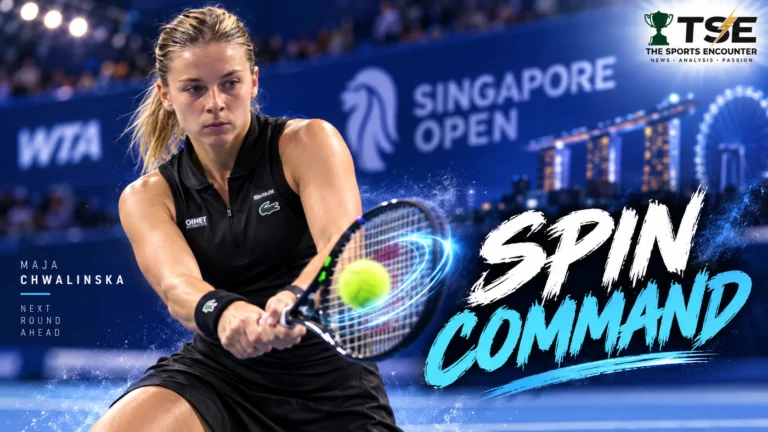
Maja Chwalinska produced the most controlled performance of the afternoon.
Leylah Fernandez Opens With the Authority Expected From a No. 6 Seed
Leylah Fernandez did what seeded players are supposed to do against qualifiers.
The larger context matters. The Singapore Tennis Open has been upgraded to WTA 500 status for 2026 after returning to the calendar as a WTA 250 event last year. The tournament runs through September 27, carries a total financial commitment of $1,206,446 and forms an important early part of the Asian Swing before the tour moves toward Beijing, Wuhan and the closing stages of the WTA Finals race.
For continuing results and analysis across the women’s tour, follow The Sports Encounter’s Tennis Hub.
Singapore Open September 21 Results at a Glance
| Event | Winner | Opponent | Score |
|---|---|---|---|
| Singles R32 | Aliaksandra Sasnovich | Daria Kasatkina | 7-5, 6-0 |
| Singles R32 | Nao Hibino | Kristina Mladenovic | 7-5, 3-6, 6-4 |
| Singles R32 | Talia Gibson | Fiona Ferro | 6-3, 6-3 |
| Singles R32 | Maja Chwalinska | Rebecca Sramkova | 6-4, 6-2 |
| Singles R32 | Leylah Fernandez | Kyoka Okamura | 6-2, 6-3 |
| Singles R32 | Joanna Garland | Storm Hunter | 6-3, 5-7, 6-1 |
| Doubles R16 | Miyu Kato / Ellen Perez | Maria Sakkari / Donna Vekic | 7-5, 6-1 |
| Doubles R16 | Tang Qianhui / Xu Yifan | Fiona Ferro / Linda Fruhvirtova | 6-4, 6-2 |
Sasnovich Turns a Competitive Match Into the Day’s Most Ruthless Finish
Daria Kasatkina looked as though she had entered a difficult but manageable first-round contest when the opening set reached 5-5.
She never won another game.
Sasnovich took the next two games to secure the first set 7-5 and then swept the second 6-0, closing the match with eight consecutive games.
That sequence transformed what had initially looked like a tactical contest into the clearest singles upset of Singapore’s opening day.
The service numbers explain part of the collapse.
Kasatkina committed seven double faults. Sasnovich did not commit one.
The Belarusian won 73 percent of points behind her first serve and converted six of 10 break opportunities. Kasatkina managed only two breaks from five chances and won just three of nine service games.
The first set therefore mattered enormously.
Kasatkina could still use variation, height and changing direction to disrupt Sasnovich through much of it. Once Sasnovich broke through at the end of the set, the resistance disappeared quickly.
Kasatkina’s exit continues an uneven hard-court stretch. TSE previously examined another match she had been positioned to win before losing in three sets in our analysis of the biggest disappointments from the Cincinnati Open.
The Singapore defeat feels different because there was no long final-set struggle.
The match simply ran away from her.
Nao Hibino Survives the Day’s Most Complicated Singles Match
Nao Hibino had already played two matches simply to enter the main draw.
She needed almost everything that qualifying experience gave her to survive Kristina Mladenovic.
The Japanese qualifier won 7-5, 3-6, 6-4 after a match filled with return pressure, breaks of serve and repeated changes in momentum.
The two women were separated by only two total points, with Hibino winning 96 and Mladenovic 94.
That is a remarkable margin across three sets.
Break-point efficiency became the difference. Hibino converted seven of 10 opportunities. Mladenovic generated more chances but converted six of 14.
The Frenchwoman’s greater height and reach gave her options on serve, but the match rarely became a serving contest. Both players spent long periods under pressure in their own games.
Hibino had also required three sets to beat Aoi Ito in the final round of qualifying.
That means she has now survived two consecutive deciding sets before some of the tournament’s seeded stars have played a point.
This is one of the hidden advantages and risks created by qualifying.
The workload is greater.
The match rhythm can also become invaluable.
Talia Gibson Makes Her Return Game the Difference Against Fiona Ferro
Talia Gibson’s 6-3, 6-3 victory over Fiona Ferro looks routine on the scoreboard.
The rallies were less comfortable.
There were 18 combined break-point opportunities across the match, which meant neither player enjoyed prolonged security on serve.
Gibson handled those moments considerably better.
The Australian converted seven of 11 break opportunities, an aggressive return performance that repeatedly prevented Ferro from establishing service rhythm.
Ferro won only 40 percent of her first-serve points.
That number is particularly damaging because first serve normally provides the server with the best opportunity to begin a rally on favorable terms.
Gibson instead won 60 percent of Ferro’s first-serve points and 67 percent against her second serve.
The match therefore became less about producing spectacular winners and more about who could begin points from stronger positions.
Gibson did that more consistently.
Her season has already pushed her into the world’s Top 70 range, and Singapore offers another opportunity to convert gradual ranking improvement into a deeper WTA 500 run.
Maja Chwalinska’s Roland Garros Breakthrough Is Starting to Travel
Maja Chwalinska produced the most controlled performance of the afternoon.
The No. 5 seed defeated Rebecca Sramkova 6-4, 6-2 in 79 minutes, winning 64 of the 106 points played.
She converted four of six break points and saved four of the five she faced.
Those numbers were important.
The point everyone remembered was stranger.
Chwalinska struck a heavily spun return that landed on Sramkova’s side, kicked backward and crossed back over the net before the Slovak could make a legal play.
The WTA quickly highlighted the shot, but the broader performance mattered more than the novelty. Its own opening-day analysis highlighted both Chwalinska and Fernandez as players who found their touch quickly in Singapore.
TSE has already broken down the match in detail in our full Chwalinska-Sramkova analysis.
The result carries additional weight because Chwalinska’s season changed dramatically at Roland Garros.
She entered Paris ranked outside the Top 100, came through qualifying and reached the final before Mirra Andreeva stopped her.
Our French Open final analysis documented how unusual that run was.
The challenge after a breakthrough like that is repetition.
Players begin studying patterns more closely. Expectations change. Every early loss becomes framed against the tournament that created the ranking jump.
Chwalinska experienced some of that pressure in the months that followed. Alycia Parks recovered from a set down to beat her in Monterrey, a result TSE covered during the Monterrey Open’s upset-heavy week.
Singapore therefore represents more than another second-round appearance.
It is evidence that the tennis which carried her through Paris can function on a quicker indoor hard court as well.
Leylah Fernandez Opens With the Authority Expected From a No. 6 Seed
Leylah Fernandez did what seeded players are supposed to do against qualifiers.
She removed uncertainty early.
The Canadian defeated Kyoka Okamura 6-2, 6-3, taking control of the return games and refusing to let the Japanese qualifier convert long exchanges into scoreboard pressure.
Fernandez created 22 break-point opportunities and converted five.
The conversion rate itself was not exceptional.
The volume was.
Generating that many chances across two sets tells you how frequently Okamura was being forced to play important points on serve.
Fernandez also struck four aces and won 91 total points to Okamura’s 74.
The match lasted far longer than the scoreline might suggest because several service games became extended battles.
Fernandez has experienced both sides of volatile hard-court tennis this season.
She produced one of her better summer wins against Renata Zarazua during the National Bank Open, then later fell to Naomi Osaka as Toronto moved toward its quarterfinals.
She also lost after taking the opening set during Cincinnati, a result included in TSE’s Cincinnati review.
Singapore started differently.
There was no recovery required.
Joanna Garland Turns Qualifying Into Her First Tour-Level Win of 2026
Joanna Garland’s 6-3, 5-7, 6-1 victory over Storm Hunter may become the result with the greatest personal significance from the opening day.
Garland had already defeated Ellen Perez and Viktoria Morvayova to negotiate qualifying.
She then needed three sets against Hunter after missing an opportunity to finish the match in two.
The second-set loss could easily have changed the emotional direction of the contest.
Instead, Garland dominated the deciding set 6-1.
The WTA confirmed that it was Garland’s first tour-level victory of 2026 and her first since her semifinal run in Chennai during 2025.
That context changes the meaning of the score.
For Fernandez, advancement was expected.
For Garland, it was validation.
Three consecutive wins in Singapore now give her a tournament rhythm few remaining players possess.
Kato and Perez Expose the Difference Between Singles Reputation and Doubles Structure
Maria Sakkari and Donna Vekic are far more recognizable to casual tennis fans than Miyu Kato and Ellen Perez.
Doubles rewards a different set of relationships.
Kato and Perez, the No. 3 seeds, won 7-5, 6-1.
The opening set remained competitive until the experienced doubles pairing found the late break. The second became far more decisive.
Kato and Perez won 78 percent of points behind their first serve and converted five of 10 break opportunities.
Sakkari and Vekic managed only one break.
They also won fewer than half of the points played behind their first serve.
The result demonstrates why placing two accomplished singles players together does not automatically create an elite doubles team.
Positioning at net, return formations, communication and familiarity with the geometry of doubles all matter.
Kato and Perez looked more comfortable in those patterns as the match progressed.
Tang Qianhui and Xu Yifan Complete a Strong Chinese Doubles Start
Tang Qianhui and Xu Yifan completed the day’s doubles program by beating Fiona Ferro and Linda Fruhvirtova 6-4, 6-2.
Ferro therefore left opening day with defeats in both singles and doubles.
The Chinese pair kept the first set under enough control to avoid a tiebreak and then separated more decisively in the second.
Xu brings extensive doubles experience, while Tang’s development has given the pairing a useful blend of established positional awareness and younger court coverage.
That becomes increasingly important at WTA 500 level, where the doubles draw contains specialist teams rather than serving simply as an additional opportunity for singles players.
The Qualifiers Were the Real Opening-Day Story
Three qualifiers played singles matches on September 21.
All three won.
| Qualifier | Opponent | Result |
|---|---|---|
| Nao Hibino | Kristina Mladenovic | Won 7-5, 3-6, 6-4 |
| Leylah Fernandez’s opponent Kyoka Okamura | Leylah Fernandez | Lost 2-6, 3-6 |
| Joanna Garland | Storm Hunter | Won 6-3, 5-7, 6-1 |
That makes Hibino and Garland the qualifiers who advanced, while Okamura’s run ended against a seeded opponent.
The larger point remains.
Qualifying has already influenced the main draw.
Hibino and Garland entered Monday having adapted to Singapore’s court speed and competitive rhythm. Both then survived three-set main-draw matches.
This is one reason first-round byes can become strategically complicated for top seeds.
Rest has value.
So does having already solved real match problems on the same court.
The Top Four Seeds Have Not Played Yet
Mirra Andreeva, Amanda Anisimova, Alexandra Eala and Elise Mertens received first-round byes as the tournament’s top four seeds.
Their Singapore campaigns therefore begin against opponents who have already experienced the conditions.
Andreeva arrives as the reigning Roland Garros champion, a transformation TSE followed closely after her maiden Grand Slam victory in Paris.
Eala brings one of Southeast Asia’s strongest fan followings and enters Singapore with the additional attention that has followed her breakthrough season.
Anisimova carries the No. 2 seeding and one of the tournament’s most dangerous first-strike games.
Mertens enters as No. 4 and recently rebuilt some momentum during Monterrey.
The first day therefore cleared the lower branches of the draw without yet revealing how the highest seeds will respond.
Singapore’s Upgrade Changes the Stakes
The tournament returned to the WTA calendar in 2025.
One year later it is already a WTA 500 event.
That progression matters in a part of the calendar where ranking opportunities become increasingly valuable.
The champion can collect 500 ranking points while players are positioning themselves for the final stretch of the Asian Swing and year-end events.
Singapore also sits ahead of a much deeper Wuhan field. TSE recently reported that all 10 of the world’s leading women are entered at the Wuhan Open.
That creates a useful incentive for Singapore’s field.
Players outside the very top tier have a WTA 500 opportunity before the tour’s elite reconvenes at one of the strongest WTA 1000 events of the season.
For somebody such as Chwalinska, Fernandez, Gibson or Garland, a deep week here can substantially change the final months of 2026.
What September 21 Told Us About the Draw
Opening rounds rarely determine champions.
They do reveal where instability may develop.
Kasatkina’s departure has already opened one section.
Sasnovich now carries match confidence into a part of the draw containing top seed Andreeva.
Chwalinska looked more secure than she did through portions of the North American hard-court swing.
Fernandez avoided the slow start that has complicated several tournaments this year.
Hibino and Garland have become dangerous because qualifying has given both momentum and repeated exposure to the conditions.
Gibson’s return performance showed why her ranking has moved upward.
The biggest stars have yet to respond.
That is what makes September 22 particularly interesting.
Donna Vekic, Wang Xinyu, Maria Sakkari, Linda Fruhvirtova, Barbora Krejcikova and the remaining first-round players now enter a draw that has already lost one established name.
Singapore wanted a bigger place on the WTA calendar.
Its first WTA 500 day supplied enough movement to justify the upgrade.
Continue the Tennis Story


Frequently Asked Questions
How many matches were played at the Singapore Open on September 21?
Eight matches were completed: six women’s singles first-round matches and two women’s doubles first-round matches.
Who was the biggest upset winner?
Aliaksandra Sasnovich produced the most notable upset by defeating Daria Kasatkina 7-5, 6-0.
Did Leylah Fernandez win?
Yes. Sixth seed Leylah Fernandez defeated qualifier Kyoka Okamura 6-2, 6-3.
What was Maja Chwalinska’s result?
Chwalinska defeated Rebecca Sramkova 6-4, 6-2 in 79 minutes.
Who won the longest and closest match?
Nao Hibino defeated Kristina Mladenovic 7-5, 3-6, 6-4 in a match where the players finished separated by only two total points.
Did Joanna Garland advance?
Yes. Garland defeated Storm Hunter 6-3, 5-7, 6-1 to earn her first tour-level victory of 2026.
Who won the doubles matches?
Third seeds Miyu Kato and Ellen Perez defeated Maria Sakkari and Donna Vekic 7-5, 6-1. Tang Qianhui and Xu Yifan beat Fiona Ferro and Linda Fruhvirtova 6-4, 6-2.
Is the Singapore Open a WTA 500 event?
Yes. The tournament was upgraded to WTA 500 status for 2026 after returning to the WTA Tour as a WTA 250 event in 2025.
Who are the top four seeds?
Mirra Andreeva is the top seed, followed by Amanda Anisimova, Alexandra Eala and Elise Mertens. All four received first-round byes.
Where can fans follow more Singapore Open coverage?
Follow The Sports Encounter’s Tennis Hub for Singapore results, player analysis and coverage of the wider WTA Asian Swing.