MANCHESTER, England, September 21, 2026: Five Premier League matches have taken Manchester United from genuine preseason optimism to an uncomfortable question Michael Carrick probably did not expect to face before the first international break: how has a team that looked transformed under him only months ago become so difficult to recognize?
United are 12th with five points from 15. They have won once, drawn twice and lost twice. Eight goals have been scored and eight conceded. Manchester City are already 10 points ahead.
The raw results are concerning enough. The circumstances behind them are harder to dismiss.
United lost 2-0 to promoted Hull City, recovered by beating promoted Ipswich Town 5-2, surrendered a 96th-minute equalizer at Everton, lost 1-0 to Manchester City and required a heavily deflected Matheus Cunha strike in the 89th minute to rescue a 1-1 draw against a Fulham side that entered the weekend without a league victory.
Story at a glance
Manchester United’s First Five Premier League Matches
United entered the campaign with very different expectations. Carrick had taken charge in January, collected 39 Premier League points during the remainder of the season and guided the club into third place.
1. United Are Bottom of the League Where High-Intensity Running Matters Most
The physical numbers provide the clearest starting point because they remove some of the subjectivity surrounding body language.
2. United’s Press Is Too Passive and Too Easy to Escape
The running data connects directly to United’s work without possession.
3. Carrick’s Team Is Caught Between Transition Football and Possession Football
This may be the most important tactical issue of all.
4. The Midfield Rebuild Looks Stronger on Paper Than It Has on the Pitch
United invested heavily in solving central midfield.
Five points equal United’s lowest Premier League total after five matches, matching 2014-15.
The latest physical data has made the discussion more uncomfortable. United rank last in the Premier League across several high-intensity running categories, including high-intensity distance, total sprints and time spent sprinting. At Fulham, their opponents covered approximately 6.6 kilometers more.
Running alone does not explain football. Manchester City have been outrun by United and still possess a perfect league record. The problem emerges when those physical numbers are combined with what the matches themselves reveal.
The press is not operating consistently. Midfield distances expand too easily. Possession can become sterile. Defensive moments arrive without enough protection. Attacking urgency frequently appears only after United fall behind.
The pattern deserves more than another discussion about effort.
It requires a diagnosis.
Follow the wider developing picture through The Sports Encounter’s Premier League coverage, where United’s early struggles are unfolding alongside a title race already being shaped by Manchester City, Arsenal and Brighton.
Manchester United’s First Five Premier League Matches
| Match | Result | What It Revealed |
|---|---|---|
| Hull City vs Manchester United | 2-0 | Set-piece weakness, poor chance creation and a lack of control against promoted opposition |
| Manchester United vs Ipswich Town | 5-2 | Bruno Fernandes brilliance and United’s attacking ceiling, but another concession to promoted opposition |
| Everton vs Manchester United | 2-2 | United allowed a winning position to disappear in the 96th minute |
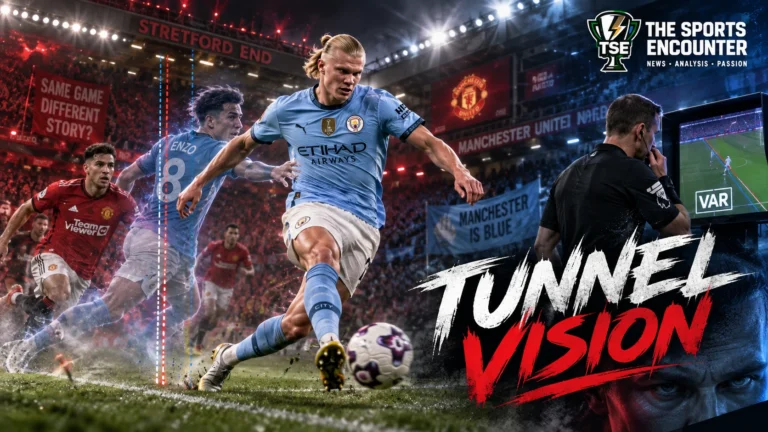
| Manchester United vs Manchester City | 0-1 | A controversial goal decided the derby, but United again struggled to impose sustained pressure |
| Fulham vs Manchester United | 1-1 | Large shot volume, weak intensity and another late rescue rather than convincing control |
United entered the campaign with very different expectations. Carrick had taken charge in January, collected 39 Premier League points during the remainder of the season and guided the club into third place.
The Sports Encounter’s preseason analysis of Carrick’s Manchester United rebuild identified improved balance, stronger transitions and midfield control as the foundations upon which a title challenge might be constructed.
Those foundations have become unstable remarkably quickly.
1. United Are Bottom of the League Where High-Intensity Running Matters Most
The physical numbers provide the clearest starting point because they remove some of the subjectivity surrounding body language.
United rank 20th in the Premier League for several demanding running measures:
- distance covered at high intensity;
- time spent at high intensity;
- total number of sprints;
- time spent sprinting.
At Craven Cottage, Fulham covered roughly 6.6 kilometers more than United.
Distance by itself can mislead. A possession-heavy side may force an opponent to run considerably more. Manchester City provide the obvious counterexample because United have covered more ground than City despite sitting 10 points behind them.
High-intensity work tells a more relevant story.
Sprinting is often connected to transitions, defensive recoveries, overlapping runs, counterpressing and closing down opponents before they can progress.
When a team sits at the bottom across several of those categories simultaneously, the tactical consequences become visible.
Opponents receive extra time.
United’s defenders face attacks that should have been disrupted earlier.
Forward players begin their own attacks farther from goal because possession is recovered too deep.
Carrick does not simply need his players to run farther. He needs more of United’s running to occur at the moments when the game is being decided.
2. United’s Press Is Too Passive and Too Easy to Escape
The running data connects directly to United’s work without possession.
A successful press requires more than one forward chasing a center back. The first movement must trigger the next one. Midfielders move forward. Fullbacks adjust behind them. Center backs compress the field.
When one part hesitates, opponents play through the pressure.
That has happened too often.
United also rank near the bottom for the percentage of time spent walking while out of possession, another indicator supporting the visual impression that the side can become passive when the opponent establishes control.
Fulham exploited exactly that problem during the opening phase of the second half.
United stopped disrupting possession aggressively enough. Fulham began playing through midfield with greater comfort, pushed Carrick’s side backward and eventually created the sequence that ended with Lisandro Martinez putting the ball into his own net.
A press does not need to operate for 90 minutes.
It does need to operate collectively.
3. Carrick’s Team Is Caught Between Transition Football and Possession Football
This may be the most important tactical issue of all.
Carrick’s rescue job last season worked partly because he gave United clarity.
The team became dangerous after turnovers. Bruno Fernandes could release runners early. Matheus Cunha, Bryan Mbeumo and other attackers could operate with space ahead of them. Midfield positioning became more disciplined.
A full season created another challenge.
United now need to dominate opponents who deliberately refuse to give them transition opportunities.
The Sports Encounter raised that question in its full Premier League 2026-27 preview: could United control compact opponents instead of depending on turnovers and open space?
The answer remains incomplete.
United sometimes circulate possession like a control team while attacking like a transition side.
Those approaches can coexist, but the spacing has to support both.
Against deeper opponents, United’s possession occasionally pushes too many players ahead of the ball without creating enough movement between defensive lines.
Lose possession from there and the midfield has too much ground to cover.
The physical and tactical problems therefore reinforce each other.
4. The Midfield Rebuild Looks Stronger on Paper Than It Has on the Pitch
United invested heavily in solving central midfield.
Youri Tielemans brought passing range and Premier League experience. Andrey Santos added mobility. Carlos Baleba arrived from Brighton with elite-level ball-winning and second-ball numbers.
The Sports Encounter described Baleba’s signing as potentially the missing physical component of Carrick’s midfield in our analysis of the completed transfer.
Five league matches later, the department has not yet become the strength recruitment suggested.
Baleba only reached the bench against Fulham after a disrupted opening to his United career. Manuel Ugarte has been working through rehabilitation. Tielemans has had to adapt immediately. Kobbie Mainoo continues to carry significant responsibility.
The club’s official profile of Carlos Baleba highlights precisely why United wanted him: his tackles, interceptions, progressive carrying and second-ball ability.
Those attributes are particularly relevant now because United are losing too many of the moments Baleba was recruited to influence.
The midfield rebuild may eventually work.
It has not synchronized quickly enough to prevent the current problems.
5. United Still Do Not Have a Settled Center-Forward Structure
Benjamin Šeško looked as though he might provide clarity when he headed United ahead at Everton.
His subsequent injury disrupted that possibility.
Šeško missed Fulham after picking up a problem during the Carabao Cup defeat against Brighton. The official Manchester United injury update confirmed his absence from Carrick’s attacking options.
Cunha consequently operated centrally at Craven Cottage, although his natural strengths are different.
He likes receiving the ball facing goal, carrying possession, combining around the box and attacking from slightly deeper positions.
Šeško offers a more traditional penalty-area focal point.
Joshua Zirkzee provides another profile.
Marcus Rashford has returned after extended loan spells and is rebuilding relationships within a team that changed considerably while he was away.
TSE examined those complications when Rashford returned to Carrick’s squad.
Options are useful.
United currently have several different attacking profiles without an obvious combination that has settled across multiple league games.
6. Five of United’s Eight League Goals Came in One Match
The headline attacking total is eight goals in five matches.
That looks respectable until the Ipswich result is removed.
United scored five times against the promoted side.
The other four league matches produced three goals combined.
That means 62.5 percent of United’s league goals came during one afternoon at Old Trafford.
Bruno Fernandes scored a hat-trick against Ipswich. Bryan Mbeumo added another before Chuba Akpom’s late consolation completed the 5-2 scoreline.
Fernandes’ performance showed United’s attacking ceiling.
It also distorted the early scoring picture.
Hull kept them scoreless.
City kept them scoreless.
Everton allowed two.
Fulham were within a minute of a clean sheet before Cunha’s deflected effort.
Championship-caliber attacking consistency requires goals to arrive across different game states, opponents and tactical environments.
United have not reached that level.
7. Shot Volume Is Hiding a Chance-Quality Problem
The Fulham match is particularly revealing.
United produced 29 attempts.
A number that large normally creates the impression of domination.
The scoreboard told another story.
They needed an 89th-minute deflection to score once.
During a frantic first half, United generated plenty of attempts but too few clean finishes. Fernandes struck the woodwork, other efforts were blocked or poorly directed, and Fulham goalkeeper Bernd Leno dealt with much of the remaining work.
The Sports Encounter’s Matchweek 5 analysis identified the central frustration: United generated enough activity to threaten without producing enough decisive execution.
The distinction between a shot and a good chance matters.
Repeated efforts from distance can raise shot totals without meaningfully increasing the probability of scoring.
Better attacking teams enter the penalty area with numerical advantages, create cutbacks and force goalkeepers into close-range interventions.
United too often reach the shooting stage before the move has created sufficient separation.
8. Set-Piece Defending Hurt United Immediately
The first warning arrived within 17 minutes of the season.
Hull’s opening goal developed from a corner before Semi Ajayi reacted quickest inside the area.
Nobel Mendy doubled the lead from Regan Slater’s free kick.
Two goals.
Two dead-ball situations.
A promoted team returning to the Premier League after nine years had identified one of the simplest routes into United’s penalty area.
The Sports Encounter’s opening-weekend analysis treated the defeat as the result least consistent with United’s preseason title ambitions.
That observation has aged badly for Carrick because Hull no longer look like an isolated accident.
Set-piece defending requires concentration, physical commitment, clear assignments and second-ball reactions.
Those are closely connected to the wider intensity problem.
9. Five League Matches Have Produced Zero Clean Sheets
United’s defensive record reads eight goals conceded from five matches.
The more revealing number is zero clean sheets.
Hull scored twice.
Ipswich scored twice.
Everton scored twice.
Manchester City scored once.
Fulham scored once.
Some goals arrived through unusual circumstances.
City’s derby winner should have been disallowed after the offside review failed to account properly for Enzo Fernández’s interference. The Sports Encounter examined that acknowledged mistake in our Manchester derby VAR analysis.
Fulham’s goal ultimately went down as a Martinez own goal following a messy sequence around Senne Lammens’ initial save.
Those details matter.
They cannot explain away five consecutive league matches without a shutout.
Defensive stability is rarely about the back four alone. United’s problems begin farther forward whenever the press is broken and midfield protection disappears.
10. United Are Managing Winning Positions Poorly
Everton should have been three points.
Mbeumo gave United the lead shortly after halftime.
Tyrique George equalized in the 83rd minute.
Šeško restored United’s advantage five minutes later.
The match had reached the 96th minute when Ainsley Maitland-Niles made it 2-2.
TSE described it at the time as another United win disappearing late.
The problem became more serious 10 days later in the League Cup.
United led Brighton 2-0 after only 10 minutes.
They lost 3-2.
The full Brighton comeback analysis showed how United lost control once the emotional direction of the match changed.
Leading and controlling are different skills.
United have demonstrated the first.
They have struggled badly with the second.
11. The Team Often Finds Its Urgency Only After Trouble Arrives
Matheus Cunha provided perhaps the most useful diagnosis from inside the dressing room after Fulham.
He acknowledged that United have repeatedly improved after conceding.
The observation fits the season.
Ipswich scored first at Old Trafford before United woke up and eventually scored five.
Everton equalized before United found the move that produced Šeško’s late header.
Fulham went ahead and United eventually raised the pressure enough for Cunha to rescue a point.
This reactive rhythm is expensive.
Strong teams do not need adversity to activate their highest intensity.
They create the emotional temperature themselves.
United currently spend too many stretches waiting for the match to tell them how urgently they should play.
12. Injuries Have Prevented Carrick From Building Continuity
The problems cannot be reduced to injuries, but availability has complicated Carrick’s attempt to establish a stable team.
Šeško missed Fulham.
Luke Shaw returned only after missing several matches.
Matthijs de Ligt was unavailable at Craven Cottage.
Manuel Ugarte has been rehabilitating.
Baleba only reached the Fulham bench after his own interrupted start.
Rashford also picked up an issue late in the draw.
Constant changes affect more than team selection.
Pressing relationships require repetition.
Defenders learn one another’s triggers.
Midfielders begin anticipating where teammates will move before receiving possession.
Attackers develop automatic combinations.
United’s squad has depth on paper.
Carrick has not had enough opportunity to establish which combination deserves to become the default.
13. Carrick’s Full-Season Job Is Much Harder Than His Rescue Job
Last season’s transformation deserves credit.
Carrick took over midway through a campaign and changed United quickly enough to finish third.
That context matters when comparing 2025-26 with today.
A midseason rescue often provides unusual advantages.
The tactical message can stay relatively simple.
Opponents have limited evidence.
Every improvement creates emotional momentum.
The schedule also gave Carrick more preparation time than he now receives while balancing Champions League football.
United returned to Europe’s premier competition by beating Sabah 4-0 in their opening league-phase fixture. TSE’s Champions League report showed the squad’s considerable attacking and midfield depth that night.
Three days later came Manchester City.
Three days after that came Brighton in the League Cup.
Four days later came Fulham.
The rhythm changes everything.
Carrick now has to rotate, develop players, prepare multiple tactical plans, manage injuries and maintain physical intensity while competing across several fronts.
The successful caretaker period proved he could repair a team.
This season is testing whether he can operate one across an entire elite calendar.
14. United Have Already Wasted the Friendly Part of Their Opening Schedule
This may become the most expensive issue later in the season.
The official Premier League fixture list gave United an opening sequence that looked manageable when it was published.
Three of the first five opponents were Hull, Ipswich and Fulham.
Hull and Ipswich had just been promoted.
Fulham entered Matchweek 5 without a victory.
United collected four points from those three games.
Everton represented another plausible opportunity for three points, and United were leading with only minutes remaining.
Manchester City was the one fixture in the opening five where dropping points could reasonably have been accepted before kickoff.
The result is five points from 15.
City have 15.
United are already chasing a 10-point deficit after 13 percent of the league season.
The schedule now becomes less forgiving.
Tottenham visit Old Trafford on October 10. United then travel to Leeds, host Bournemouth and finish October at Chelsea.
There is also a Champions League trip to Atlético Madrid between domestic fixtures.
The opening five matches were supposed to give Carrick’s team room to build.
Instead, they have created pressure.
Why Bruno Fernandes Remains Both the Solution and a Warning
No United player illustrates the wider problem better than Bruno Fernandes.
He entered this season after producing 21 Premier League assists in 2025-26, a league record and a central reason Carrick’s recovery worked.
Against Ipswich, Fernandes scored three times.
His influence remains enormous.
That creates two simultaneous realities for United.
They possess one of the Premier League’s most productive creative players.
The collective structure still leans too heavily on him changing difficult games.
Opponents understand that.
When Fernandes receives possession facing forward, United look dangerous.
When teams deny him those spaces, the alternative routes become less reliable.
Tielemans was recruited partly to distribute creative responsibility. Baleba and Santos were added to improve the platform underneath Fernandes.
The objective is sensible.
United have not yet turned those pieces into a functioning midfield ecosystem.
Matheus Cunha Has Become United’s Most Valuable Emergency Solution
Cunha’s goal at Fulham carried more significance than the point itself.
He was playing centrally because Šeško was unavailable.
The match had become increasingly uncomfortable.
United needed somebody willing to receive possession, turn and attack defenders rather than wait for a perfect pattern.
Cunha provided it.
The equalizer required a substantial deflection, but the decision to shoot came from the individual initiative United had lacked during several earlier phases.
That usefulness can become dangerous if Carrick begins depending on Cunha to repair structural problems every week.
A team hoping to return to the title race needs a functioning mechanism around its best individuals.
Individual rescue acts should complement the structure.
They cannot replace it.
The Manchester City Defeat Needs Context, but It Cannot Become an Excuse
United have legitimate grounds to feel aggrieved by the derby.
Haaland’s winning goal survived VAR despite Fernández interfering from an offside position, and refereeing officials subsequently acknowledged that the review had failed.
Removing that error from the season would improve United’s emotional picture.
It would not explain Hull.
It would not explain the late collapse at Everton.
It would not explain Brighton overturning a two-goal League Cup deficit.
It would not explain United ranking last across multiple high-intensity running measures.
It would not explain why winless Fulham looked physically stronger during important periods at Craven Cottage.
Good analysis has to separate a genuine officiating injustice from a convenient explanation for a wider pattern.
What Carrick Has to Fix During the International Break
The three-week gap before Tottenham gives United something they badly need: training time.
The priorities should be clear.
1. Rebuild the Press
Carrick needs a smaller number of pressing triggers that every player recognizes immediately. Synchronization matters more than chasing for the sake of appearances.
2. Integrate Baleba
If he is physically ready, Baleba’s ball-winning, carrying and range could address several weaknesses simultaneously. United bought him precisely for matches where the midfield has to defend larger spaces.
3. Decide the Attacking Hierarchy
Šeško, Cunha, Rashford, Mbeumo, Zirkzee and Fernandes cannot all occupy their preferred spaces at once. Carrick needs a primary attacking structure and alternatives rather than constant experimentation.
4. Improve Rest Defense
When United attack, enough protection must remain behind the ball to stop opponents countering through empty midfield areas.
5. Train Game-State Control
Everton and Brighton provide enough evidence. When United lead, the objective cannot simply become retreating or continuing at exactly the same tempo. Players need clearer instructions for slowing matches, retaining possession and recognizing when risks are unnecessary.
6. Raise the Physical Standard
The league-low high-intensity numbers cannot become normal.
Football tactics depend on physical execution.
If United intend to press, counterpress and recover defensively, the running data eventually has to resemble those ambitions.
Is Michael Carrick Already Under Serious Pressure?
The table inevitably creates pressure.
Five points from five matches at Manchester United attracts scrutiny regardless of what happened the previous season.
Carrick has also earned context.
He inherited a struggling side in January and guided it into third place. United’s summer recruitment was shaped around his football. Several important players have endured disrupted starts.
Five Premier League games are far too few to establish whether a manager’s project has permanently failed.
They are enough to demand correction.
The next phase matters because United’s current problems are measurable rather than abstract.
The sprint numbers can improve.
The press can become tighter.
Baleba can enter the midfield.
Šeško can return.
Defensive spacing can be trained.
Game management can become more deliberate.
Those are solvable football problems.
If the same weaknesses remain after another five or six matches, the conversation will change significantly.
United’s Real Problem Is That Too Many Weaknesses Are Interacting at Once
The simplest explanations are appealing.
Blame the manager.
Blame fitness.
Blame injuries.
Blame finishing.
Blame referees.
Manchester United’s opening month does not fit neatly inside any one of those explanations.
The high-intensity numbers matter because the press is already disjointed.
The midfield looks exposed because players are not recovering possession early enough.
The defense looks vulnerable because opponents are arriving with space.
The attack becomes impatient because matches remain uncomfortable for too long.
Game management deteriorates because United rarely establish enough control to dictate what happens next.
That is why the same team can score five against Ipswich, beat Sabah 4-0 in Europe, lose after leading Brighton 2-0 and then appear strangely passive against Fulham within a few weeks.
The talent has not disappeared.
The connections between the talent have.
Carrick’s work during the international break therefore goes beyond asking his players for more effort.
Manchester United need their football to become connected again.
Continue the Premier League Story

Frequently Asked Questions
Where are Manchester United in the Premier League table?
Manchester United are 12th after five matches with five points from one victory, two draws and two defeats.
How many points are Manchester United behind Manchester City?
United are 10 points behind Manchester City, who entered the international break with a perfect 15 points from five matches.
What are Manchester United’s first five Premier League results?
United lost 2-0 at Hull, beat Ipswich 5-2, drew 2-2 at Everton, lost 1-0 at home to Manchester City and drew 1-1 at Fulham.
Why are Manchester United’s running statistics concerning?
United rank 20th in several high-intensity categories, including high-intensity distance, sprint volume and time spent sprinting. Those numbers support concerns about their pressing and defensive recovery.
Have Manchester United kept a Premier League clean sheet this season?
No. United have conceded in all five of their opening Premier League matches.
How many Premier League goals have Manchester United scored?
United have scored eight goals. Five came in the 5-2 victory over Ipswich, meaning their other four league matches produced only three goals combined.
Who has been Manchester United’s standout attacking player?
Bruno Fernandes produced the biggest individual league performance with a hat-trick against Ipswich, while Bryan Mbeumo, Benjamin Šeško and Matheus Cunha have supplied important goals in other matches.
When is Manchester United’s next Premier League match?
United return after the international break against Tottenham Hotspur at Old Trafford on October 10, 2026.
Can Manchester United still recover their season?
Thirty-three league matches remain, leaving substantial time for the table to change. The more immediate issue is whether Carrick can improve United’s intensity, midfield structure, attacking chemistry and defensive control before the early deficit becomes significantly larger.
Manchester United
- Manchester United’s Five-Game Alarm: 14 Reasons Carrick’s Revival Has Stalled
- Premier League: Man City Take Control as Isak Delivers and Manchester United Stumble Again
- Smilla Holmberg Saves Arsenal at 95 Minutes as Manchester United’s Defensive Reset Falls Seconds Short
- Brighton Erase 2-0 Deficit to Knock Manchester United Out of League Cup 2026
- Manchester Derby VAR Error Exposes the Human Problem Technology Cannot Fix