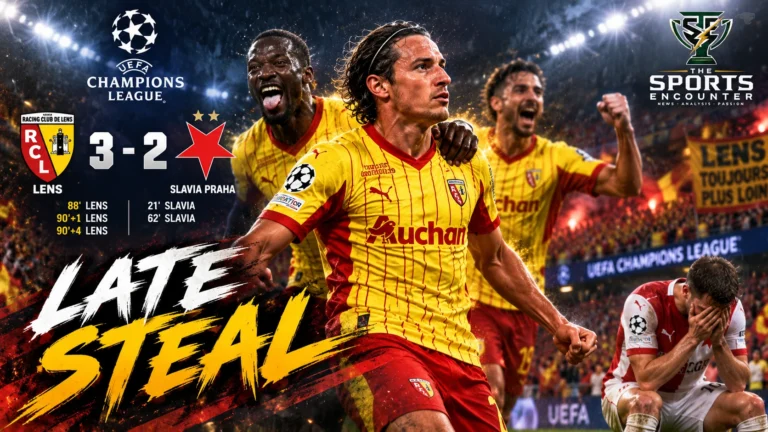
PRAGUE, Czechia, September 10, 2026: Slavia Praha spent almost the entire second half with 10 men, scored twice anyway and were two minutes from completing one of Matchday 1’s most improbable escapes. Lens then turned survival into heartbreak with two stoppage-time goals.
RC Lens beat Slavia 3-2 at Eden Arena after Abdallah Sima scored against his former club in the 73rd minute, Florian Thauvin struck in the 90+1st and Ruben Aguilar delivered the winner in the 90+3rd.
Danijel Šturm had twice put Slavia in front, first in the 51st minute and again in the 88th, despite Mikuláš Konečný being sent off in the 49th minute.
The sequence made this one of the most dramatic finishes of the opening UEFA Champions League round. Slavia survived more than 40 minutes with a numerical disadvantage, found an equalizer after Lens appeared to have taken control, and then lost the match in the space of roughly two stoppage-time minutes.
Story at a glance

Konečný’s Red Card Should Have Changed the Game Immediately
The decisive tactical moment appeared to arrive in the 49th minute when Konečný was sent off.
Slavia’s Direct Style Still Hurt Lens With 10 Men
Slavia coach Jindřich Trpišovský had made clear before kickoff that his team would not abandon its identity for the Champions League.
Sima’s Return to Prague Produced the Goal Lens Needed
Lens finally broke through in the 73rd minute through Abdallah Sima.
Twenty-One Lens Shots Eventually Became Too Much Pressure
Lens attempted 21 shots.
Šturm’s 88th-Minute Goal Looked Like the Perfect Ending
Slavia’s second goal was remarkable precisely because of what had happened before it.
The underlying statistics explain why Lens kept pushing. The French side finished with 21 shots to Slavia’s 11, seven efforts on target to five, 58 percent possession, 408 passes and nine corners. Slavia’s resistance was extraordinary, but Lens eventually created too much pressure for 10 men to absorb.
Follow all of the opening-round developments through The Sports Encounter’s UEFA Champions League 2026-27 coverage.
Konečný’s Red Card Should Have Changed the Game Immediately
The decisive tactical moment appeared to arrive in the 49th minute when Konečný was sent off.
For Slavia, losing a player so early in the second half should have meant abandoning much of the attacking ambition they had carried into the match.
Lens suddenly had space, a numerical advantage and more than 40 minutes to exploit it.
Instead, Slavia scored two minutes later.
Šturm struck in the 51st minute to give the hosts a 1-0 lead, producing exactly the opposite response Lens would have expected after the dismissal.
The goal transformed the emotional balance inside Eden Arena. Slavia were no longer merely trying to survive with 10 men. They had something tangible to defend.
Slavia’s Direct Style Still Hurt Lens With 10 Men
Slavia coach Jindřich Trpišovský had made clear before kickoff that his team would not abandon its identity for the Champions League.
The Czech champions are built around intensity, direct running and aggressive vertical attacks rather than prolonged possession.
That style remained useful after the red card because it did not require Slavia to dominate the ball.
They finished with only 42 percent possession and completed 261 passes at 72 percent accuracy, but still generated 11 shots and put five on target.
Those numbers are impressive for a team that played virtually the entire second half a man down.
Slavia’s official pre-match coverage emphasized the same aggressive identity and the expectation of an intense physical contest against a Lens team built to play quickly through attacking transitions. Slavia’s pre-match comments provide useful context for why the hosts continued attacking even after the dismissal.
Sima’s Return to Prague Produced the Goal Lens Needed
Lens finally broke through in the 73rd minute through Abdallah Sima.
The scorer carried particular significance.
Sima was returning to a stadium where he had previously played an important part in his career with Slavia.
Both clubs had highlighted the reunion before kickoff, and the official Lens pre-match press conference specifically addressed his return to Prague.
His equalizer also rewarded Lens for the sustained territorial pressure that followed Konečný’s dismissal.
The visitors kept the ball more effectively, completed 147 more passes than Slavia and gradually forced the home defense deeper.
Twenty-One Lens Shots Eventually Became Too Much Pressure
Lens attempted 21 shots.
Slavia managed 11.
The 10-shot difference became increasingly important as the second half progressed because the hosts were defending with one fewer player.
Every Lens possession forced Slavia to cover additional space.
Every defensive recovery required another sprint.
The nine Lens corners added further physical stress.
Slavia repeatedly survived those sequences, but the workload accumulated.
This was not unlike some of the other tactical contrasts seen across Matchday 1. Arsenal generated 25 shots before finally breaking Napoli, while Liverpool doubled Atlético Madrid’s shot count in a 2-1 comeback win.
Pressure does not guarantee a goal immediately.
It increases the number of moments a defense must survive.
Šturm’s 88th-Minute Goal Looked Like the Perfect Ending
Slavia’s second goal was remarkable precisely because of what had happened before it.
Lens had equalized.
The visitors still had the extra player.
They had greater possession and twice as many shots.
Slavia should have been thinking primarily about protecting a draw.
Šturm scored again in the 88th minute.
For a brief period, Eden Arena had every reason to believe it was about to witness one of the great opening-night Champions League victories.
A 10-man team had taken the lead twice against the Ligue 1 runners-up.
Only stoppage time remained.
Thauvin Changed Everything in the 90+1st Minute
Florian Thauvin had been identified by Slavia before the game as one of Lens’ principal attacking threats.
The 2018 World Cup winner carries experience that matters in precisely these situations.
Lens were trailing late, the stadium was roaring and the emotional momentum belonged almost entirely to Slavia.
Thauvin scored in the 90+1st minute.
The equalizer did more than make it 2-2.
It immediately removed the emotional reward Slavia believed they had earned through nearly an entire half of short-handed resistance.
Lens still had time.
Two minutes later, they used it.
Aguilar Turned One Point Into Three
Ruben Aguilar scored in the 90+3rd minute to complete the comeback.
The timing makes the defeat particularly cruel for Slavia.
They went from leading 2-1 in the 90th minute to losing 3-2 before the final whistle.
For Lens, those two minutes may eventually carry enormous value in the league phase.
A draw away from home would have represented a respectable opening result.
A victory provides three points and immediately places Lens among the stronger Matchday 1 starters.
The Scoreline Hides How Close Slavia Came
A 3-2 Lens victory can easily be interpreted as the logical result of the visitors’ numerical and statistical advantages.
The match itself was far less straightforward.
Slavia led twice.
They put five shots on target despite playing with 10 men.
They scored their second goal with only two minutes of regulation time remaining.
The difference between a famous victory and a devastating defeat was measured in stoppage time.
Lens Deserved Their Pressure but Nearly Wasted It
From the Lens perspective, the comeback deserves credit.
There is also a warning inside it.
The visitors had 58 percent possession, 408 passes at 85 percent accuracy, 21 shots and nine corners.
They were also playing against 10 men from the 49th minute.
Yet they were still behind after 88 minutes.
That suggests a finishing and defensive-control problem even within a successful result.
Lens eventually converted three of seven shots on target, but they allowed a short-handed opponent to score twice.
The late goals saved the night from becoming a major missed opportunity.
Slavia’s Five Shots on Target Show This Was More Than Passive Resistance
Many teams reduced to 10 men retreat completely.
Slavia did not.
The hosts produced five shots on target, only two fewer than Lens.
That statistic explains why the game stayed dangerous even as Lens accumulated more possession and attempts.
Slavia’s attacks were less frequent but remained capable of changing the score.
Šturm proved that twice.
Lens Finally Reverse Their Slavia History
The clubs had met only twice previously, during the 1995-96 UEFA Cup.
Slavia progressed 1-0 on aggregate after a goalless first leg in Prague and a 1-0 victory in France.
UEFA’s official Slavia-Lens Matchday 1 guide confirms those were their only previous competitive meetings.
More than three decades later, Lens finally have a victory in the fixture.
The manner of it could hardly have been more dramatic.
Lens Had Arrived With Serious Expectations
This was not an ordinary away side taking advantage of a red card.
Lens qualified for the Champions League after finishing second in Ligue 1 last season.
The French club returned to the competition carrying a squad led by experienced figures such as Thauvin and a coach, Dino Toppmöller, determined to transfer strong domestic performance into Europe.
The official Lens preview described Slavia as an intense, direct opponent and highlighted the atmosphere awaiting them at Eden Arena.
Those warnings proved accurate.
Lens had to fight until the 93rd minute to escape with the points.
Matchday 1 Keeps Producing Different Types of Wins
The opening Champions League round has offered very little tactical repetition.
PSG overwhelmed Slovan Bratislava 6-1 through attacking superiority.
Sporting CP beat Galatasaray 3-1 despite having substantially less possession.
Como turned their first European match into a 4-1 demolition of RB Leipzig through extraordinary finishing efficiency.
Manchester United beat Sabah 4-0 while allowing only one shot on target.
Lens supplied another model.
Persistence.
They kept creating chances until the game finally broke.
The Next Match Makes These Three Points Even More Valuable
Lens next face Sporting CP at home on October 13 before travelling to Club Brugge.
Their remaining league-phase schedule also includes Como, RB Leipzig, Bodø/Glimt, Manchester City and Liverpool.
UEFA’s official league-phase fixture list confirms that the difficulty rises considerably later in the campaign. :contentReference[oaicite:0]{index=0}
That makes three away points in Prague extremely useful.
Continue the UEFA Champions League 2026-27 Story
 UEFA Champions League 2026-27Champions League: Madrid’s Perfect Start, Arsenal’s Munich Escape and LASK’s Sporting Upset Redraw the European Race
 UEFA Champions League 2026-27PSG Rattles City, Madrid Escapes Rome, Villa Hits Six as Champions League Serves Up 46 Goals
 UEFA Champions League 2026-27Brugge Break Inter, Viking Deny Bayern as Barcelona and Arsenal Strike in 32-Goal Champions League Night
Dropping them after playing against 10 men for most of the second half would have created immediate pressure.
Slavia Now Face a Very Different Kind of Pressure
Slavia’s next Champions League assignment is away to Sabah.
After that comes another away game at Fenerbahçe before Arsenal visit Prague.
The later schedule includes Villarreal, Bayern Munich, Porto and Aston Villa.
There are opportunities in that sequence.
There are also significantly harder fixtures.
That is why losing a home game in which Slavia led after 88 minutes could prove expensive.
Slavia’s Discipline Changed the Entire Contest
The red card cannot be separated from the result.
Konečný’s dismissal forced Slavia to play more than 40 minutes with 10 men.
The hosts responded admirably, but the physical consequences became increasingly severe as Lens continued to circulate the ball and force defensive movements.
Playing short-handed against a side completing 85 percent of its passes eventually creates gaps.
Those gaps were still manageable for most of the second half.
They became fatal in stoppage time.
TSE Analysis: Slavia Lost the Final Three Minutes, Not the Whole Match
The simplest analysis would say Lens deserved to win because they had 21 shots, 58 percent possession and a one-player advantage.
That misses what made the match extraordinary.
Slavia adapted remarkably well to the red card.
They scored immediately after it.
They remained dangerous enough to put five attempts on target.
Even after Sima equalized, they found another goal through Šturm in the 88th minute.
The tactical plan had therefore worked for almost the entire period of numerical disadvantage.
The collapse came at the very end.
Thauvin’s 90+1st-minute goal changed the emotional state of the match, and Slavia had almost no time to reset before Aguilar scored again.
That is the lesson the Czech champions will have to absorb.
They demonstrated that 10 men could compete with Lens.
They failed to survive the few minutes when fatigue, emotion and defensive concentration all collided.
Final Verdict
Lens leave Prague with three points that looked almost impossible in the 89th minute.
Slavia leave with nothing from a performance that, for much of the second half, looked destined to become one of the defining stories of Matchday 1.
Konečný was sent off in the 49th minute.
Šturm scored in the 51st.
Sima equalized in the 73rd.
Šturm scored again in the 88th.
Then Thauvin and Aguilar turned the match completely around in stoppage time.
Lens’ 21 shots and seven efforts on target explain why the pressure never disappeared. Slavia’s two goals with 10 men explain why the victory was anything but routine.
For Lens, it is an outstanding European start.
For Slavia, it is the kind of defeat that can linger because the result was so close to becoming something entirely different.
For more Matchday 1 reports, tactical breakdowns and league-phase coverage, follow The Sports Encounter’s Soccer section.